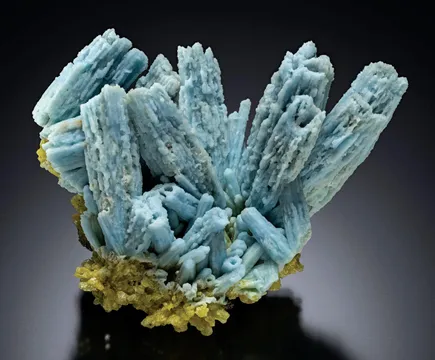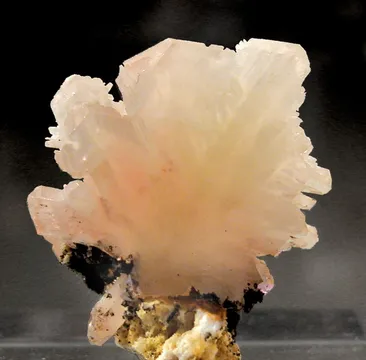
Wuzhou, China: Wutong Mine yields iconic rhodochrosite crystals, petal-like rosettes in pink-red hues, making this locality a milestone for collectors.
Key facts
For mineral collectors, “Wuzhou” usually means one locality above all others: the Wutong Mine near Liubao in Cangwu County, Wuzhou Prefecture, Guangxi. This small underground polymetallic mine, historically worked for lead, zinc and silver, became one of the great modern rhodochrosite localities when deep pink to red manganese-carbonate crystals began reaching the Chinese market in the early 2000s. The deposit is not a simple manganese mine. It is a Late Cretaceous magmatic-hydrothermal system in folded Cambrian sedimentary rocks, where quartz, hübnerite, sulfides, fluorite, calcite, baryte and rhodochrosite were introduced along steep, bedding-parallel fracture zones and smaller ladder-vein structures.
Wutong’s fame rests on a very distinctive look. The best rhodochrosites are not merely pink crystals on matrix; they are sculptural, petal-like rosettes, flattened rhombs, discoidal clusters and lustrous red plates set against quartz needles, bright pyrite, purple to pale green fluorite, black sphalerite and occasional white calcite. The great pocket specimens from 2009 and 2010, including the celebrated “Emperor of China” and “Empress of China,” placed Wutong in the same collecting conversation as Sweet Home, N’Chwaning and Uchucchacua, though with a habit and personality entirely its own: broader, flatter, more floral, and often more architectural than gemmy.
Regional View
Country View
The locality is also important because it changed the expectations for Asian rhodochrosite. Before Wutong, fine crystallized rhodochrosite from China was not a major category in the international specimen trade. After Wutong, collectors had to learn a new visual vocabulary: stacked lenticular blades, large flattened crystals, pink-red discoids, rhodochrosite-fluorite-quartz combinations, and carbonate pockets in which late calcite and clay sometimes had to be carefully removed before the specimen’s true form emerged.

Photo: Wikimedia Commons

Photo: Wikimedia Commons
Search for specimens: View all specimens from Wuzhou, China
The specimen-producing locality is the Wutong Mine, also rendered Wudong Mine, near Liubao in Cangwu County. It lies in the low, tree-covered hills of eastern Guangxi, roughly southeast of Guilin and inland from the Pearl River drainage. In the specimen trade, older labels may simply read “Wuzhou, Guangxi, China,” but the collectible rhodochrosite-calcite association is most specifically tied to Wutong.
The mine is a polymetallic hydrothermal vein deposit. Its country rocks are Cambrian clastic and siliceous sediments: dark gray to black shale and siltstone, sandstone, and a brittle chert horizon that helped localize fracturing. The beds strike northwest and dip steeply northeast. The mineralized zone follows bedding-parallel faults and fractures, with locally open pockets where competent chert fractured against less competent shale and siltstone. This is why Wutong specimens so often have the open-space aesthetics of a classic pocket deposit rather than the massive texture of a simple ore vein.
The ore system is best understood as a tungsten-bearing Pb-Zn-Ag deposit with important manganese-carbonate mineralization. Earlier descriptions emphasized a ladder-vein style, with quartz-hübnerite mineralization followed by base-metal sulfides, rhodochrosite and fluorite, then later fluorite, apatite, calcite and baryte. More recent geochronology and ore-petrology work places Wutong in a Late Cretaceous magmatic-hydrothermal system genetically related to a concealed porphyritic monzogranite. That interpretation neatly explains the otherwise unusual blend of tungsten, base metals, fluorine-rich gangue and collectible manganese carbonate.
The deposit was discovered in 1958 and for most of its life was treated as a modest lead-zinc-silver operation. Reserve estimates cited in published locality accounts list 4,676 tons of lead, 3,555 tons of zinc and 6.65 tons of silver. Specimens were not the original business of the mine. The first striking rhodochrosites appeared in Chinese mineral markets around 2000, but from 2000 to early 2006 many pieces were sold under uncertain or incorrect locality names, including Babu or Nandan, before Wutong became widely recognized as the source.
Collector’s Edge Minerals became directly involved after visiting the mine in 2006 and forming a collaborative arrangement with the mine owners in 2007. Their contribution was not merely commercial: they brought specimen-recovery methods, cutting tools, preparation expertise, and a geologic strategy derived from earlier work at the Sweet Home Mine in Colorado. A new decline was extended to reach deeper parts of the mineralized veins. That deeper exploration was expensive and initially discouraging, but late 2009 and April 2010 produced the pockets that made Wutong famous.
The most important finds were pocket discoveries rather than continuous production. November 2009 produced memorable large rhodochrosite-fluorite specimens later nicknamed “The Lips” and “The Blade.” April 2010 produced the “Emperor of China” and “Empress of China,” monumental rhodochrosites whose scale and form are still the benchmark for the locality. After that, production was inconsistent. Collector’s Edge reported that the mine was placed on care and maintenance in summer 2011 and that the lower levels had flooded, with no specimen mining then planned. Since then, Wutong material has continued to circulate from earlier finds, private holdings, dealer inventories, and occasional later market appearances; labels on recent specimens should therefore be read carefully rather than assumed to indicate steady public access.
There is no public collecting access to the Wutong Mine. It is an underground, privately controlled mine locality, not a field-collecting site. Serious collectors encounter Wuzhou material almost entirely through dealers, auctions, established collections and museum displays. Provenance matters: early pieces may carry obsolete locality names, and some later material is labeled broadly as Wuzhou or Guangxi without the precision that a high-value specimen deserves.
Wuzhou rhodochrosite is prized for flattened, lenticular to discoidal crystals, stepped rhombs and petal-like rosettes that can range from thumbnail plates to major cabinet specimens; Mindat records rhombohedrons to about 6 cm, discoid crystals to about 16 cm and flattened twinned crystals to about 8 cm, while the great April 2010 pocket produced much larger composite display pieces with individual crystals far beyond ordinary cabinet scale. The color is typically rose pink to deep pink-red, only rarely approaching the glassy, transparent cherry-red quality of the finest Sweet Home or N’Chwaning crystals, but Wutong compensates with dramatic form and associations: quartz sprays, pyrite, black sphalerite, purple to pale green fluorite, baryte, calcite and kutnohorite. The best pieces have saturated color, clean exposed crystal faces, sharp or attractively rounded lenticular outlines, balanced placement on matrix, and lively contrast with fluorite, quartz or pyrite; ordinary pieces tend to be duller, more massive, edge-worn, heavily coated, or visually confused by broken plates and late carbonate overgrowth.
Calcite from Wuzhou is chiefly a late-stage gangue mineral at Wutong rather than the star species, but it is important to the appearance, preparation and interpretation of many specimens. White massive calcite occurs as vein fill, and scattered calcite rhombs are documented on rhodochrosite specimens, commonly as small white to colorless rhombohedra or broken rhomb sections perched on or near pink rhodochrosite. In the paragenesis, late calcite belongs with fluorite, apatite and baryte that filled remaining open spaces and locally coated earlier minerals, which means calcite can either add desirable contrast or obscure the rhodochrosite beneath it. The better Wuzhou calcite-bearing specimens use calcite as an accent—sharp, clean rhombs that frame the rhodochrosite without hiding it—whereas mediocre examples are dominated by massive white carbonate, clay-limonite coatings, or visually distracting crusts that make the specimen look unfinished.
Other documented Wutong minerals round out the deposit’s identity as a complex polymetallic hydrothermal system. Quartz is abundant as clear to milky prisms and later tabular crystals; fluorite occurs as cubes, truncated cubes, cuboctahedra and octahedral forms in colors from sea-green and pale green to bluish purple and violet; pyrite is common as bright cubes and pyritohedra; sphalerite forms lustrous black twinned crystals; and the ore suite includes galena, chalcopyrite, acanthite and native silver. Rarer collector minerals include hübnerite, baryte, fluorapatite, kutnohorite, sellaite, dolomite and bertrandite. The locality is not best known as a type locality, but its rarity list is meaningful: sellaite is confirmed from the mine by Raman spectroscopy in a later collection record, and bertrandite from Wutong has been significant enough in the trade to have been misattributed to Yaogangxian.
The main authenticity issue for Wuzhou is not usually synthetic rhodochrosite in matrix specimens, but locality accuracy and material substitution in the broader gem market. Wutong rhodochrosite was historically sold under other Chinese locality names before the source became public, especially Babu and Nandan. Conversely, specimens from the Wutong suite can sometimes be given overly broad labels such as “Wuzhou” or “Guangxi,” which are acceptable as shorthand but inadequate for top pieces. Serious labels should say Wutong Mine, Liubao, Cangwu County, Wuzhou Prefecture, Guangxi, China.
There is also a documented Wuzhou-market imitation issue. GIA described pressed gibbsite and calcite material sold as rhodochrosite, obtained from the gem market in Wuzhou. That study concerns cut or lapidary-style material rather than classic Wutong matrix specimens, but it is still a useful warning: banded pink-and-white “rhodochrosite” goods from Wuzhou-area markets should not be assumed natural without gemological testing. For collectible crystals, look for real carbonate cleavage and crystal continuity, natural association with Wutong gangue, and believable matrix relationships; avoid oddly uniform pink-and-white manufactured textures.
Condition is a major value factor. Rhodochrosite is soft, brittle and has perfect cleavage, and Wutong crystals are often thin, flattened or blade-like, so edge wear is common. Even good pieces may have small chips along the rims of plates. Judge whether damage interrupts the specimen’s silhouette or merely reflects normal pocket extraction. Large, important Wutong pieces may have required professional preparation because calcite, clay and limonite coatings hid the crystals; preparation is not inherently a negative, but undisclosed repairs and restorations are. The “Empress of China” is publicly documented as having required repairs and restorations after cleaning, while the “Emperor of China” was reported as needing no repairs or restoration after preparation.
Avoid acid cleaning. Calcite is part of the natural paragenesis and may be an aesthetic component, while rhodochrosite itself is a carbonate and can be damaged by acids, especially along cleavages and etched surfaces. Handle specimens by the matrix, keep them away from ultrasonic cleaners, and avoid tight perky-box pressure against raised plates. Pieces with attached fluorite and quartz are usually more mechanically complex than they appear, because the attachment points may be narrow and the rhodochrosite plates may be more fragile than the harder associated minerals.
Market availability is uneven. Small to miniature Wutong rhodochrosites remain obtainable, especially flattened pink crystals with quartz, pyrite, fluorite or sphalerite. Fine, saturated, undamaged, well-balanced examples are much scarcer. Large cabinet pieces, strong fluorite associations, rich red color, unusually sharp rhombohedra, and specimens from the 2009–2010 pockets command a premium. Truly iconic Wutong specimens are effectively museum-class objects rather than routine market material.
In the beginning, the great Wutong rhodochrosites were almost anonymous. From about 2000 to early 2006, rich red and deep pink specimens appeared in the mineral markets of Guilin and Changsha, but their true source was murky. Some were said to be from Babu, others from Nandan. The secrecy was understandable: a new crystallized rhodochrosite locality is not an everyday discovery, and the first pieces were good enough to make experienced dealers ask uncomfortable questions. One published account describes a Chinese mineral dealer showing “tantalizing rhodochrosite” in a Guilin motel room—an image that captures the moment perfectly: a world-class locality hiding in plain sight, passing hand to hand before anyone outside the circle could pin it down.
By 2006, Collector’s Edge Minerals had been invited to see the source. Bryan Lees and his team already carried the experience of Colorado’s Sweet Home Mine, where geological modeling, careful pocket work and professional preparation had transformed rhodochrosite collecting. When Lees visited the new Wutong owners in Changsha, he found something telling on the table: a worn copy of the famous Mineralogical Record issue on the Sweet Home Mine. The Chinese owners had not merely heard of Sweet Home; they were studying it. They wanted the same thing Wutong now seemed capable of producing: large, beautiful, carefully recovered rhodochrosite specimens rather than broken ore curiosities.
The mine itself was not an easy stage for a treasure hunt. It was a small underground operation with a declined shaft, ore carts, a ball mill and flotation equipment for base-metal concentrates. The road in passed terraced farms and water buffalo before climbing into low forested hills. Once underground, the search became a practical geometry problem: find where steep sedimentary beds, brittle chert and mineralized fractures created enough open space for crystals. Collector’s Edge supplied specimen-mining equipment and experienced miners. A diamond chain saw was used in 2008 to extract a rhodochrosite pocket, a striking contrast to the older ore-mining rhythm of blasting, mucking and milling.
The turning point took time and money. A major decline extension was driven to intersect the mineralized veins at depth, with the idea that miners could then raise along the rhodochrosite structures. The work dragged on for months through country rock and consumed operating funds. When the deeper workings were finally reached in late 2009, the first results were discouraging. The predicted veins were there, but not with the quality or size hoped for. Then, late in 2009 and again in early 2010, the mine began to give up the pockets that changed its history.
The April 2010 pocket is the Wutong legend. From it came the two great named specimens: the “Emperor of China” and the “Empress of China.” The Emperor measured roughly 60 cm tall by 40 cm across and weighed 63.5 kg after preparation, with a single crystal about 22 cm across and a huge 360-degree rhodochrosite rosette described as larger than a basketball. When it arrived at the Collector’s Edge laboratory in Golden, Colorado, it reportedly weighed more than 65 kg. Three technicians worked for about six weeks to remove calcite, clay and limonite coatings. The astonishing part, for such a large carbonate specimen, is that the Emperor was reported to need no repairs or restoration.
The Empress was smaller but, to many eyes, even more beautiful. It formed a fully blossomed flower-like cluster, about 33 cm tall and 39 cm across, with lustrous medium-red crystals to about 19 cm. Robert Lorda prepared it over nearly three months, spending about 50 hours removing coating. Unlike the Emperor, the Empress required eight repairs and several restorations—an honest detail that matters, because it reminds collectors that iconic specimens are still physical objects wrestled out of narrow underground openings, not magically perfect sculptures.
When the pair reached the public, they caused exactly the reaction one would expect. They were unveiled at the 2011 Tucson Gem and Mineral Show and became among the most talked-about and photographed specimens there. Later that year the Empress went on display at the Colorado School of Mines Geology Museum, where a July 28 reception marked its arrival. The museum article valued it at $1.6 million, noted its April 2010 discovery, and posed the question every viewer was already thinking: “Is it a flower or a mineral?” That question is still the best shorthand for Wutong’s finest work.