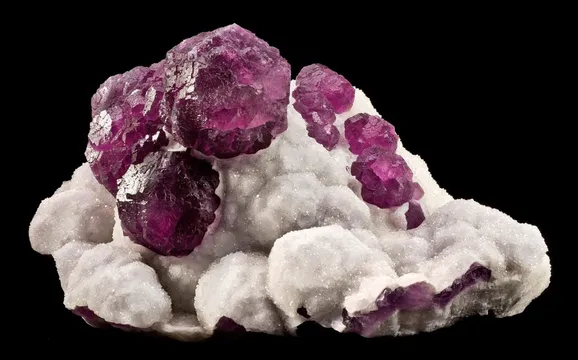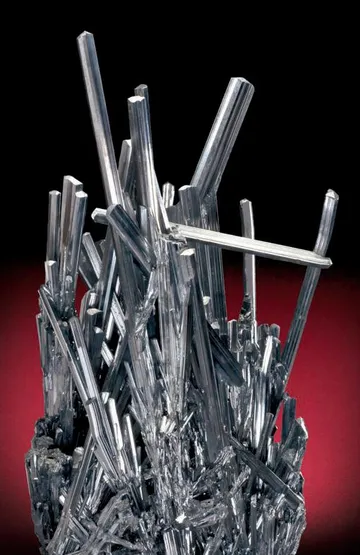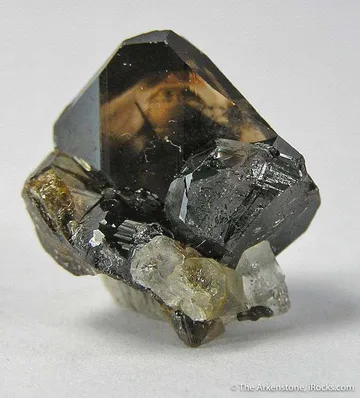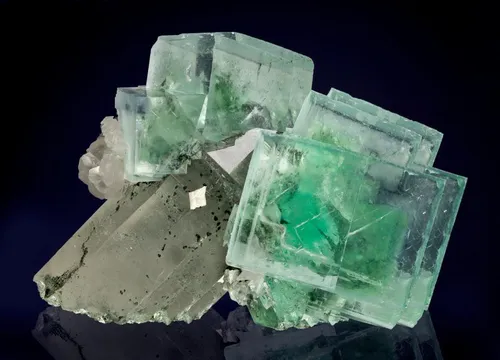
Wushan, China — famed spessartine locality with orange garnets and smoky quartz; pocket-rich specimens that elevated Chinese spessartine in collecting circles.
Key facts
Wushan, known to collectors through the entrenched label “Wushan Spessartine Mine,” is one of the great Chinese specimen localities of the modern era. The name points to the Tongbei–Wushan area of Yunxiao County, Zhangzhou, Fujian Province, where miarolitic cavities in a Late Cretaceous granitic system produced a remarkably photogenic pocket assemblage: orange to reddish-orange spessartine, smoky quartz, pale K-feldspar, muscovite, and a small cast of beryllium-, fluorine-, and silica-rich accessory minerals. It is not an ore mine in the classic metal-mining sense; its importance is almost entirely specimen mineralogical, born from open cavities in granite where crystals had room to form sharp, lustrous, three-dimensional combinations.
The locality’s signature is instantly recognizable. Fine pieces show saturated orange garnets scattered over smoky quartz prisms or sprinkled across creamy feldspar, often with silvery muscovite books and occasional pyrite, helvine, fluorite, topaz, beryl, or opal-AN. The garnets are usually small, but that is part of the Wushan aesthetic: dozens or hundreds of bright, sharp crystals can glitter over a sculptural quartz-and-feldspar matrix with a contrast few spessartine localities can match. The best specimens have the drama of dark glass and embers—smoky quartz rising from pale feldspar, its flanks dusted or crusted with mandarin garnet.
Historically, Wushan/Tongbei matters because it brought Chinese spessartine into the center of the international specimen market. The first garnet-smoky quartz-feldspar pieces appeared around the late 1990s under incorrect Guangdong attributions, especially Lechang. By the end of 2001, Fujian—particularly Tongbei near Yunxiao—had emerged as the true source of the classic material. Since then, “Wushan” has become the collector’s shorthand for a broader system of small workings, quarry exposures, and pocket zones rather than a single neatly defined mine portal.
Regional View
Country View
The finest Wushan specimens are judged less by a single giant garnet than by balance: vivid color, glassy luster, undamaged smoky quartz, strong relief, and clean placement of the garnets on quartz or feldspar. Large display pieces exist, but even thumbnails and miniatures can be compelling when the spessartine is sharp, transparent, and well distributed. Good cabinet pieces with intact quartz terminations and high-density garnet coverage now read as old Chinese classics, especially when accompanied by early-2000s provenance or older dealer labels.

Photo: Wikimedia Commons
Search for specimens: View all specimens from Wushan, China
The accepted mineral-locality name in collector use is Wushan Spessartine Mine, Tongbei, Yunxiao County, Zhangzhou, Fujian, China, with the main Mindat locality placed near 23.90611° N, 117.19806° E. In practical collecting language, however, “Wushan” needs interpretation. Wushan means Wu Mountain, Tongbei is the nearby village, and the “mine” name became a useful trade and database label for a cluster of granitic pocket localities rather than one formal mine with a single shaft, one operator, and a conventional ore plan. Serious labels often read “Wushan Spessartine Mine, Tongbei,” but “Tongbei–Wushan area, Yunxiao County, Fujian” is the more cautious geological phrasing.
Geologically, the specimens come from miarolitic cavities and pegmatitic zones in granite. Regional syntheses place the Wushan granite within a Late Cretaceous aluminous A-type granite belt along southeastern coastal China, part of a northeast-trending granitic province associated with major tectonic lineaments of Fujian and neighboring provinces. Published summaries give an age range for the Wushan granite of roughly 92–86 Ma, with related pegmatitic host-rock crystallization temperatures reported around 505–532°C. The pockets are the key: late-stage volatile-rich fluids and residual melts created open spaces lined with quartz, K-feldspar, muscovite, and accessory minerals, then decorated by spessartine and rarer late minerals.
The deposit is therefore better thought of as a specimen-producing miarolitic granite system than as an ore body. The “ore” of interest to collectors was the pocket lining itself: smoky quartz crystals, blocky feldspar, spessartine crusts, and accessory species. Spessartine occurs as euhedral crystals, commonly trapezohedra modified by dodecahedral faces, often in crusts or scattered aggregates on feldspar and quartz. The quartz is usually smoky, ranging from pale gray-brown to deep brown-black; the feldspar has historically been called orthoclase on many labels, though modern database treatment and specimen descriptions commonly use microcline for the classic association.
Mining history is closely tied to granite extraction and small-scale specimen recovery. Public locality notes and the classic specimen literature do not document a single long-running industrial “Wushan Spessartine Mine” operator in the way one might expect for a metal mine. Instead, specimens were recovered from small workings, quarry faces, and pocket-bearing granite exposures. Tongbei became an early center for systematic recovery and trade in these garnet specimens, while similar material was later reported from Yunling in Zhangpu County, roughly 30 km northeast of Tongbei. The resulting market label can blur multiple closely related pocket zones; for many specimens, exact assignment to one individual working is not possible.
The commercial story begins around 1998, when Chinese spessartine with smoky quartz and feldspar began appearing internationally. Early labels commonly pointed to Lechang in Guangdong Province, an attribution now treated with caution for the classic spessartine-smoky quartz-feldspar material. By late 2001, Fujian—and specifically the Tongbei/Yunxiao area—was being given as the correct source. Berthold Ottens’ 2005 Mineralogical Record article fixed the locality in the modern collector literature, and Wushan/Tongbei quickly became one of the reference names for Chinese minerals of the early 21st century.
Production appears to have been concentrated from the late 1990s through the 2000s and into the early-to-mid 2010s. A published Fujian mineral-diversity account reports that Tongbei production had ceased by 2016. Dealer and auction descriptions through the 2020s repeatedly describe fine examples as older stock, early-2000s material, or pieces from the “lost days” of the locality’s production. That does not make Wushan specimens rare in an absolute sense—the original production was substantial—but it does mean the best, undamaged, aesthetic combinations are increasingly dependent on old collections and dealer inventories.
Collecting access today should be regarded as closed or restricted, not as a field-collecting opportunity. Locality notes describe Wushan as protected, with collecting from exposed granite prohibited. Other notes distinguish legitimate granite building-material work from specimen extraction and describe specimen mining outside that context as illegal. For collectors, the practical advice is simple: acquire Wushan material through established dealers, auctions, and collection dispersals; do not assume that visiting the area to dig pockets is permissible.
Notable finds include cabinet plates of spessartine on feldspar, smoky quartz clusters partly coated with garnets, and sculptural quartz-feldspar combinations carrying dense orange garnet coverage. Exhibition and auction records document large display pieces, including significant Wushan spessartine-smoky quartz specimens in the 18 cm to 40+ cm range. The most desirable pockets produced sharp smoky quartz with intact terminations, vivid garnets sitting directly on quartz faces, and strong three-dimensional architecture rather than flat crusts alone. Rarer pocket associations with fluorite, helvine, topaz, opal-AN, beryl, pyrite, hematite, and milarite are especially interesting when locality and association are convincing.
Wushan spessartine is the locality’s defining mineral: small, sharp, orange to reddish-orange garnets, commonly trapezohedral and often modified by dodecahedral faces, scattered or crusted over smoky quartz and pale feldspar. Individual crystals are commonly in the 1–5 mm range, and published locality summaries note that the brightest, most transparent crystals are generally the smaller ones; larger crystals, while prized, are more likely to be darker, cloudier, or less lustrous. Dealer and auction records document exceptional crystals around 7–9 mm, which are large for the locality, but Wushan’s best pieces usually win by density, sparkle, color saturation, and association rather than sheer crystal size. Classic associations are smoky quartz, microcline or older-labelled orthoclase, muscovite, pyrite, helvine, opal-AN, and rarer fluorite or topaz. The strongest specimens show clean, vivid orange garnets standing out against dark smoky quartz or cream feldspar, with undamaged crystal faces, bright luster, and enough sculptural relief to avoid looking like a flat garnet crust.
Quartz from Wushan is important chiefly as smoky quartz, the dark architectural partner that makes the garnets so visually memorable. Crystals range from small smoky points to substantial prismatic crystals on cabinet specimens, commonly brown, gray-brown, or nearly black, and may be partly coated by spessartine around their bases, sides, or faces. Good Wushan quartz is lustrous, transparent to translucent, and sharply terminated; the most desirable pieces have garnets positioned on the quartz itself rather than only on the feldspar matrix. Auction descriptions record smoky quartz crystals from a few centimeters to 12 cm or more on larger cabinet specimens, though undamaged terminations are not automatic because the pocket rock is tough and extraction was difficult. Ordinary pieces have dull, bruised, or broken quartz with scattered garnet; fine ones combine intact smoky crystals, strong contrast, lively garnet coverage, and a three-dimensional composition that reads clearly from more than one viewing angle.
Other documented minerals from Wushan include microcline, orthoclase, albite, muscovite, fluorite, helvine, opal-AN, pyrite, beryl, hematite, topaz, milarite, calcite, clinochlore, molybdenite, manganite, goethite, schorl, and siderophyllite. Wushan is not known to collectors as a type-locality field in the way some Chinese rare-mineral pegmatites are; its rarities are accessory species within an otherwise famous garnet-quartz system. Helvine is one of the most collectible of these, occurring as uncommon yellow crystals in the same pocket environment. Milarite is far rarer and has been recorded as tiny crystals up to about 0.5 mm, associated in photo data with smoky quartz, muscovite, spessartine, pyrite, fluorite, and hematite. Fluorite and topaz can occur on or with spessartine-bearing pieces, but they are much less typical than the standard spessartine-smoky quartz-feldspar association and deserve careful locality scrutiny.
The primary authenticity issue with Wushan is locality labeling rather than widespread artificial manufacture. “Wushan Spessartine Mine” is a convenient and widely accepted collector name, but it can imply a precision that many specimens do not actually have. Older labels may read Lechang, Guangdong; Tongbei; Yunxiao; Wushan; Fujian; or simply China. A classic orange spessartine-smoky quartz-feldspar specimen with an old Lechang label should be understood in the context of the early misattribution history: many such pieces are now regarded as Fujian/Tongbei-Wushan material rather than true Lechang.
The feldspar name is another common label issue. Older tags and captions frequently say orthoclase, while modern locality data and many current specimen descriptions favor microcline for the classic pale feldspar matrix. Do not discard a specimen or label merely because it says orthoclase; that wording is part of the locality’s market history. A modern label can preserve the old wording in quotes while adding “microcline” where appropriate.
Treatments are not usually the central concern. The garnet color is natural, and the association with smoky quartz is a primary pocket-growth feature, not a decorative afterthought. However, preparation and repair deserve close inspection. Many specimens came from hard granite blocks, so sawn backs, trimmed edges, stabilized matrix, repaired quartz crystals, and reattached pieces can occur. On larger cabinet pieces, check the smoky quartz terminations carefully, inspect garnet-coated contact points for glue, and look for unnatural repetition or mismatched luster where pieces may have been assembled or repaired.
Condition matters greatly because Wushan specimens are often visually busy. Missing quartz tips, rubbed garnet faces, bruised crystal edges, iron staining, and broken feldspar corners can disappear in a seller’s overall photo but become obvious in hand. Fine garnets should look glassy and crisp, not matte and granular. The most valuable examples have sharp, undamaged smoky quartz, vivid garnet coverage, and a coherent matrix; a dense orange coating on a battered quartz crystal is less desirable than a more open but clean and balanced composition.
Fluorescence can add interest but should be described carefully. Spessartine itself is not the fluorescence attraction here; published gemological work on faceted Tongbei spessartine found it inert under both long-wave and short-wave ultraviolet light. Some Wushan/Tongbei specimens carry opal-AN or feldspar-related responses, and collector reports and auction descriptions note green opal-AN fluorescence or orange-pink feldspar fluorescence on certain pieces. UV response is therefore a useful accessory clue, not proof of spessartine identity or locality.
Market availability remains healthy at the representative level but selective at the top end. Small-cabinet and cabinet specimens continue to appear through dealers and auctions, often described as older stock. Recent public auction records show modest representative examples selling in the few-hundred-dollar range, stronger cabinet pieces in the high hundreds to low thousands, and exceptional large, aesthetic, damage-free examples reaching several thousand dollars or more. The locality is common enough that buyers can be patient, but truly fine pieces with bright garnets, transparent smoky quartz, no repairs, and old provenance are no longer casual commodities.
The Wushan story begins with a wrong address. Around 1998, striking Chinese specimens of orange spessartine on smoky quartz and feldspar began reaching the market with Guangdong labels, especially Lechang. The look was too distinctive to remain just another garnet occurrence: vivid orange crystals, smoky quartz, pale feldspar, and the kind of contrast that made even small pieces leap out of a dealer flat. By late 2001, the labels shifted. Fujian became the accepted source, Yunxiao the nearest large locality name, and Tongbei the village that serious collectors would learn to recognize.
Then came the mine that was not exactly a mine. “Wushan Spessartine Mine” sounds reassuringly precise, but the locality literature and later collector discussion make it clear that the name is partly a trade construction. Wushan is Wu Mountain; Tongbei is the village; the specimens came from pocket-bearing granite in a broader area of small workings and quarry exposures. The label endured because it was useful. It told collectors what visual family a specimen belonged to, even if it did not always tell them the exact pocket, quarry face, or hillside.
The third act is the change from active recovery to a protected and largely closed source. Tongbei became an important collecting and trading center because the granite exposed miarolitic cavities, and those cavities supplied the world with the orange-on-smoky combinations collectors now treat as classic. But locality notes now describe collecting from exposed Wushan granite as prohibited, and specimen extraction outside legitimate granite work as illegal. That tension—world-famous specimens from a locality many collectors will never legally collect—adds a quiet finality to the best old pieces.
The specimens themselves tell the last part of the story. One pocket style produced feldspar plates sugared with garnets; another gave smoky quartz crystals rising like dark chimneys through orange crusts; another left garnets perched on quartz faces with enough transparency to glow from within. A large cabinet specimen can look almost over-decorated, as if the granite pocket had decided to wrap every available surface in orange sparks. That distinctive excess is why Wushan remains memorable: not because spessartine and smoky quartz are rare minerals, but because here they met in exactly the right geometry, color, and contrast.