Jiangxi, China locality guide: diverse ore systems yield fluorite, stibnite, scheelite, and cassiterite; prized for architectural crystals and rare specimen st…
Key facts
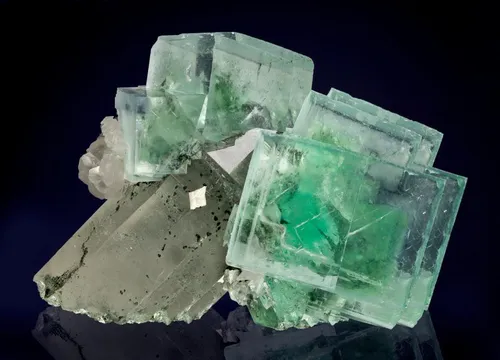
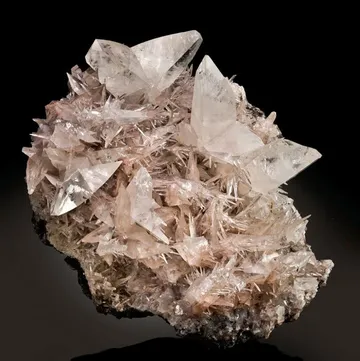
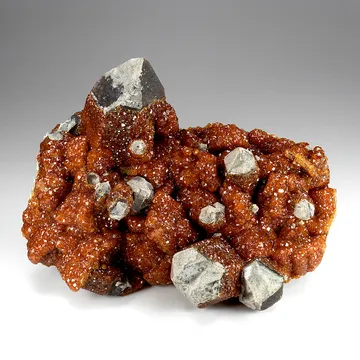
Jiangxi is not a single “mine locality” in the collector’s sense, but a province-wide mineral province whose best specimens come from several very different ore systems in the South China Block: fluorite veins at Xiefang and De’an, antimony veins at Wuning/Wuling, tungsten–tin quartz veins and skarns in southern Jiangxi, rare-metal granites at Yichun, copper–gold–molybdenum porphyry systems at Dexing, and hematite-rich quartz assemblages around Dongxiang and Xinyu. For collectors, that breadth is the point. A Jiangxi label can mean mint-green fluorite cuboctahedrons on snow-white quartz, honey-yellow baryte standing on purple fluorite, mirror-bright stibnite blades from a short-lived specimen boom, red hematite-included quartz with pyrite and carbonate accents, or scheelite and cassiterite from one of the great tungsten provinces of the world.
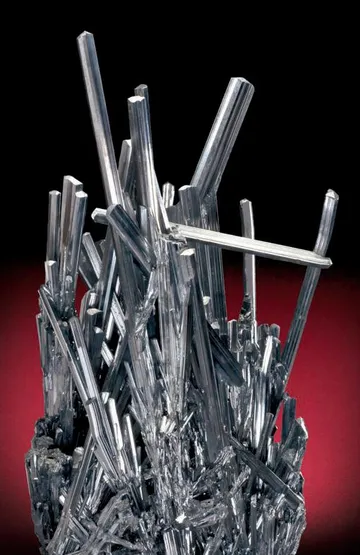
The province sits across an exceptionally fertile metallogenic corridor. Northern Jiangxi belongs to the Jiangnan Orogen and includes the Dexing and Zhuxi districts; southern Jiangxi lies in the eastern Nanling metallogenic belt, a classic granitic tungsten–tin province where quartz veins, greisen alteration, skarns, fluorite, mica, cassiterite, wolframite, scheelite, bismuth minerals, and rare-metal oxides are recurring themes. These are not merely academic ore deposits: several of them have produced recognizable, tradeable specimen styles. The best Jiangxi fluorites are judged by architecture as much as color—isolated octahedra or cuboctahedra set on contrasting quartz, clean purple zoning on green cores, sharp faces, and minimal scuffing. The best Wuning stibnites are judged by an entirely different standard: undamaged terminations, freestanding blades, metallic luster, sculptural balance, and the rare survival of a mineral that was usually mined as ore rather than saved as a specimen.
Regional View
Country View
Jiangxi’s historical importance also reaches beyond showy cabinet specimens. Gaoling, the old “Kauling” clay locality near Jingdezhen, is the mineralogical and linguistic root of kaolin and kaolinite, tied to the porcelain culture that made Jingdezhen famous. In modern systematic mineralogy, Jiangxi has yielded type-locality material for gananite from the Laikeng tungsten mine and tantalaeschynite-(Ce) from the Huangshan Nb-Ta deposit, while the Yichun rare-metal granite remains a reference point for Li-Ta-Nb-Cs mineralization in highly evolved granitic systems.


Photo: Wikimedia Commons

Photo: Wikimedia Commons
Search for specimens: View all specimens from Jiangxi, China
Jiangxi occupies a key part of southeastern China’s Mesozoic metallogenic architecture. In broad geological terms, its specimen-producing mines are divided between northern Jiangxi systems of the Jiangnan Orogen and southern Jiangxi systems of the Nanling metallogenic belt. The southern districts are especially rich in granite-related tungsten, tin, bismuth, molybdenum, fluorite, rare-metal, and uranium mineralization, while northern Jiangxi includes major copper, gold, molybdenum, and tungsten resources. The province’s collecting identity is therefore not a single paragenesis but a network of hydrothermal and magmatic-hydrothermal systems.
The Xiefang Mine at Ruijin, Ganzhou, is one of the province’s most recognizable specimen localities. It is described as a volcanic-hydrothermal fluorite deposit with a vein system about 10 km long. Its specimen suite is compact but highly distinctive: fluorite, quartz, baryte, pyrite, calcite, dolomite, opal, muscovite or sericite, chalcopyrite, galena, and minor carbonate species. The classic collector look is purple to green fluorite with quartz, but the mine’s most market-visible modern style is tabular golden to honey baryte perched on purple, green, or blue-green fluorite. Xiefang specimens are often aesthetic rather than simply large: stepped quartz plates, fluorite octahedra or cuboctahedra, and baryte blades provide strong color contrast without the visual heaviness of massive ore.
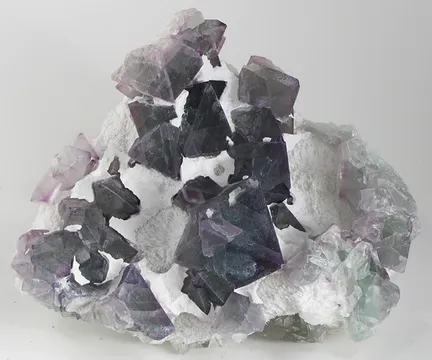
De’an, in Wushan, De’an County, Jiujiang, represents a separate and sometimes confusing fluorite story. The locality is best known to collectors for purple cubo-octahedral to octahedral fluorite exposed from white quartz matrix, with translucent green tones and darker purple zoning along edges or cores. Many pieces from the early 2000s were prepared by dissolving enclosing quartz, giving them the open, freestanding look that made De’an fluorite immediately recognizable. The locality history is complicated: “Wushan Mine” has been used loosely, and published locality notes caution that some octahedral blue-green material once assigned to De’an more likely came from the Ganzhou area, while other octahedral pieces attributed to De’an may belong to a mine near Shangrao. For serious collectors, a De’an label should therefore be evaluated with more skepticism than a generic Chinese fluorite label might suggest.
Wuning, also known in the specimen trade as Wuling or Qingjiang, is the Jiangxi locality that elevated the province into the top tier of world stibnite collecting. The antimony deposit was discovered by Chinese government prospectors in 1962, and mining by the local government began in 1982. The mine’s specimen fame began in the late 1990s, and two spectacular pockets encountered in the closing months of 2000 brought Wuning stibnite to international attention. Associated species documented from the locality include baryte, calcite, stibiconite, and valentinite. The ore setting is a low-temperature hydrothermal antimony system in which heated fluids deposited stibnite along favorable openings; the exceptional specimens came from cavities large enough to let delicate blades grow without being crushed or mined away.
Quartz specimens from Jiangxi are less tied to a single mine name, but several sources matter to collectors. At Xiefang and De’an, quartz is the essential stage on which fluorite is displayed: sugary, drusy, platey, or etched white quartz makes the green and purple fluorite stand out. At Dongxiang and Huxu in Fuzhou, quartz appears in a different role, as translucent crystals colored by hematite inclusions or coatings and associated with pyrite, dolomite, calcite, chalcopyrite, sphalerite, galena, and tennantite-tetrahedrite group minerals. Jiulong Mine material from Xinyu is also known for quartz with hematite. These red quartz assemblages are often attractive small-cabinet pieces, but they have also been subject to locality confusion with other Chinese districts producing superficially similar hematite-stained quartz.
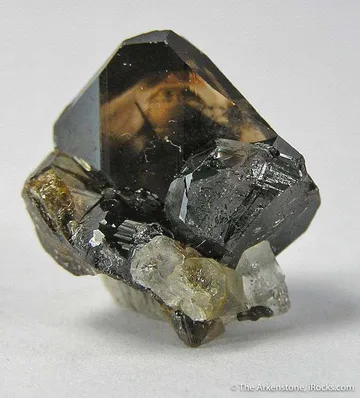
Jiangxi’s tungsten and tin localities form the province’s deeper historical and geological backbone. The Xihuashan ore field and Piaotang Mine in Dayu County belong to the southern Jiangxi tungsten district, where quartz veins, greisen, granite contacts, wolframite, cassiterite, scheelite, molybdenite, bismuth minerals, fluorite, and sulfides recur. Piaotang is a tungsten–tin quartz-vein system in the contact zone of the Xihuashan biotite-granite intrusion, and fine collector scheelite specimens are known, including brown pseudo-octahedral crystals. Xihuashan itself is a world-class tungsten name, while Baoshan, in the same broader southern Jiangxi metallogenic environment, is a skarn-type scheelite deposit with garnet, clinopyroxene, vesuvianite, epidote, chlorite, fluorite, and scheelite.
Yichun, in western Jiangxi, is important for a different reason: rare-metal granite. The Yichun Ta-Nb-Li deposit is hosted by highly fractionated topaz-lepidolite granite of the Yashan batholith, with vertical lithological zoning from two-mica granite through muscovite granite and albite granite to lepidolite-albite granite. It is better known to economic geologists than cabinet collectors, but mineralogically it anchors Jiangxi’s reputation for lithium, tantalum, niobium, cesium, rubidium, topaz, lepidolite, pollucite, microlite-group minerals, columbite-tantalite, cassiterite, albite, K-feldspar, and fluorite.
In northeastern Jiangxi, Dexing is one of China’s great porphyry copper names. The Dexing porphyry Cu-Mo-Au system consists of the Tongchang, Fujiawu, and Zhushahong mines and belongs to a linked district that also includes Yinshan Ag-Pb-Zn and Jinshan gold mineralization. It is primarily an industrial mining district, not a prolific fine-mineral source in the same sense as Xiefang or Wuning, but it explains why Jiangxi labels also occur on copper, chalcopyrite, pyrite, molybdenite, quartz, and related ore minerals. Chengmenshan, another Jiangxi copper locality, is better represented in specimen circles by native copper, chalcopyrite, calcite, quartz, and hematite-associated material.
Modern collecting access should be considered restricted unless permission is explicitly arranged. Many Jiangxi localities are active or former industrial operations, some are underground workings, some are open pits or processing areas, and some, like Gaoling, are cultural or historical mine sites rather than casual collecting grounds. Specimens on the market typically entered collections through miners, dealers, mine-run material, or older collections rather than recreational field collecting. For buyers, the more important question is often not whether Jiangxi specimens are available—they are—but whether the exact mine attribution is reliable.
Jiangxi fluorite is best known from Xiefang and De’an, two localities that produced very different collector aesthetics: Xiefang gives green, purple, blue-green, and multi-generation fluorite as octahedra, cuboctahedra, cubes, mounded druses, and quartz-hosted combinations, often with golden baryte, pyrite, calcite, dolomite, or opal; De’an is famous for purple to green octahedral or cubo-octahedral crystals exposed from white quartz, with darker purple edge zoning and many specimens showing the etched, open look created when quartz was removed during preparation. Fine Xiefang pieces separate themselves by saturated color, clean contrast against quartz, distinct crystal generations, and attractive baryte or quartz architecture; fine De’an pieces need undamaged faces, strong zoning, convincing provenance, and balanced distribution of fluorite across the quartz plate rather than a few isolated, bruised crystals.
Quartz from Jiangxi matters most as a specimen partner rather than as anonymous rock crystal: at Xiefang and De’an it forms the white, sparkling, sugary, or platey matrix that makes green and purple fluorite visually legible, while at Dongxiang, Huxu, and Jiulong it appears as hematite-included or hematite-coated red to brick-red crystals associated with pyrite, dolomite, calcite, chalcopyrite, sphalerite, galena, and tennantite-tetrahedrite group minerals. Strong Jiangxi quartz specimens have sharp terminations, translucency under the hematite color, lively surface sparkle, and an association that fixes the locality style; ordinary pieces are dull red druses or quartz plates whose locality cannot be separated confidently from similar Chinese hematite-quartz material.
Jiangxi stibnite is essentially the Wuning/Wuling story: bright steel-gray to blue-gray metallic blades and prismatic crystals from a low-temperature antimony deposit at Qingjiang, with baryte, calcite, stibiconite, and valentinite in the documented assemblage. The finest specimens came from the late-1990s to early-2000s pocket discoveries, especially the 2000 finds that produced freestanding, striated, swordlike crystals and clusters good enough to compete with the best historic stibnite localities. Quality is ruthlessly condition-dependent here: the difference between a world-class Wuning specimen and a merely interesting one is complete terminations, minimal edge bruising, strong luster, three-dimensional arrangement, and the rare preservation of fragile crystals that normally would have been shattered during antimony mining.
Other important Jiangxi minerals broaden the province far beyond its three most visible marketplace species. Kaolinite has its type-locality and neotype importance at the original Gaoling, or Kauling, mine near Jingdezhen, with quartz and muscovite in weathered granite and pegmatite. Gananite, BiF3, was described from the Laikeng tungsten mine in the Helong W-Cu deposit of Ganzhou as microscopic brown to black and greenish-black aggregates associated with native bismuth, bismuthinite, chalcopyrite, pyrite, quartz, and wolframite-group minerals. Tantalaeschynite-(Ce), Ce(TiTa)O6, was approved from the Huangshan Nb-Ta deposit in the Lingshan complex, occurring in a narrow border aplite zone of an NYF-type pegmatite with fluorite and microlite-group minerals. Collector-significant non-type species include baryte from Xiefang, scheelite from Xihuashan and Piaotang, cassiterite and wolframite from southern Jiangxi tungsten veins, lepidolite and pollucite from Yichun, native copper and chalcopyrite from Chengmenshan and Dongxiang-related districts, and a long list of rare uranium, bismuth, tantalum, niobium, and rare-earth minerals that make Jiangxi more important mineralogically than its specimen-market footprint alone suggests.
Jiangxi specimens demand careful locality discipline. The biggest authenticity issue is not widespread artificial manufacture of Jiangxi minerals, but misattribution among Chinese fluorite localities. De’an/Wushan fluorite is especially problematic: published locality notes record that some blue-green octahedral fluorite etched from quartz and once assigned to De’an probably came from the Ganzhou area, and that some octahedral fluorites labeled De’an may instead come from a mine near Shangrao. Xiefang fluorite can also be confused visually with other Chinese fluorite districts, and some older Jiangxi fluorite combinations have been compared with Yaogangxian-style material from Hunan. Buy pieces with old labels, collection history, dealer notes, or photographic matches to well-documented finds whenever the exact mine matters.
Preparation is part of the De’an conversation. Many De’an fluorites owe their dramatic open display to chemical removal of enclosing quartz, typically described in the trade as hydrofluoric-acid etching. This is not automatically a defect—many classic specimens were prepared that way—but it does affect how one evaluates the piece. Look for frosted or undercut quartz, unnatural-looking exposure, weak attachment points, and bruised fluorite faces revealed during preparation. Specimens with sharp, undamaged fluorite sitting naturally on an attractive quartz plate usually command stronger interest than pieces that look excavated out of their matrix.
Fluorite from Jiangxi has the normal vulnerabilities of the species: perfect cleavage, moderate softness, and susceptibility to edge chips. Large Xiefang plates with baryte add another risk: tabular baryte can detach or abrade, especially where it stands high on fluorite. Purple fluorite should be kept out of prolonged direct sunlight as a conservative display practice, and high-contrast De’an and Xiefang pieces should be dusted with air or a very soft brush rather than washed aggressively. Some De’an fluorites fluoresce blue under longwave UV, but response varies by generation and should not be used alone as a locality test.
Wuning stibnite is a specialist’s mineral. It is fragile, soft, easily scratched, and commonly broken at terminations or along thin blades. Even excellent pieces may show small bruises because the crystals are blade-like and brittle. Yellowish alteration, dull gray patches, or oxidized areas may represent stibiconite or valentinite development and should be weighed as either natural paragenetic character or condition loss depending on the specimen. Handle Wuning stibnite with gloves or wash hands afterward, keep it away from children and food areas, and avoid ultrasonic cleaning, soaking, or any abrasive cleaning. The market rewards untouched luster and intact tips far more than sheer size.
Hematite-included quartz from Dongxiang, Huxu, Jiulong, and related Jiangxi labels is attractive but can be locality-fluid in the trade. Similar red quartz with sulfides and carbonates has been sold from other Chinese districts, and historical collector discussions record confusion among Jiangxi, Hubei, and Jiangsu attributions. Evaluate the whole association: red translucent quartz, pyrite sparkle, dolomite or calcite accents, sphalerite or chalcopyrite, and the style of matrix. For inexpensive pieces, a province-level Jiangxi label may be adequate; for high-end cabinet specimens, insist on the mine or county attribution and provenance.
Availability varies strongly by species. Xiefang fluorite and baryte-fluorite combinations remain obtainable, including recent-market pieces, but the best large plates and balanced golden-baryte examples are competitive. De’an fluorite is more classic than current, with many desirable pieces coming from early-2000s finds and older collections. Wuning stibnite appears regularly but in uneven quality; fine, undamaged, lustrous, three-dimensional clusters are genuinely scarce, and large museum-grade pieces are effectively institutional or major-private-collection material. Jiangxi quartz with hematite remains accessible in small-cabinet to cabinet sizes, while top-quality scheelite, cassiterite, and rare-metal specimens from the tungsten and Yichun systems are much less common in general mineral commerce.
The Wuning stibnite story is the one Jiangxi tale every serious collector should know. The deposit itself had an industrial life before it had a specimen identity: government prospectors found the antimony deposit in 1962, and local-government mining began in 1982. For the first years, countless crystals must have vanished into ore carts, crushers, and furnaces. Stibnite was being mined for antimony, not for glass cases.
Then the mine began producing the kind of cavities that make collectors hold their breath. Its specimen reputation began in 1997, and in the closing months of 2000 two spectacular pockets were encountered. From those pockets came metallic blades that did not look like routine ore at all: long, striated, swordlike crystals, some slightly curved or bent, many bright enough to act like polished steel. The miracle was not simply that the crystals grew. It was that any survived. Stibnite breaks easily, and industrial antimony mining is not gentle work.
One specimen from this district became a public landmark. The American Museum of Natural History announced a Wuning/Wuling stibnite for display in 2007: hundreds of swordlike metallic blue-gray crystals rising from a rocky base, donated by Marc Weill. The museum described it at the time as a 1,000-pound specimen and later exhibition information lists it at 838 pounds, or 380 kg, still one of the largest stibnites on public display. George Harlow, then curator in the Department of Earth and Planetary Sciences, summed up what every collector thinks when looking at a Wuning giant: “That it survived the mining process at all is a miracle.” In the later Mignone Halls of Gems and Minerals, the specimen’s scale became part of its scientific explanation—the crystals reached such lengths because they grew in a large underground cavity.
The Xiefang fluorite story is quieter but no less distinctive. One well-documented specimen from the mine, photographed by Rob Lavinsky, shows three generations of fluorite in a single small-cabinet piece: deep green frosted octahedra to 3 cm, then a drusy purple generation, then colorless crystals to about 0.5 cm perched epitactically on the corners. That kind of growth record is what makes Xiefang material more than a pretty color specimen. Good pieces read like a sequence: green cores, purple overgrowths, clear late crystals, quartz platforms, and sometimes yellow baryte stepping across the fluorite like small panes of glass.
De’an adds a more uncomfortable but useful collecting lesson. Some of the famous purple and green fluorites were not simply chipped from open pockets; many were liberated from quartz. That gave the specimens their airy, sculptural appearance, but it also made preparation part of the object’s history. The finest De’an plates retain an honest relationship between fluorite and quartz. The less convincing ones can look too excavated, too forced, or too vague in provenance. Jiangxi rewards the collector who asks not just “Is it beautiful?” but “Which mine, which style, which generation, and how did it reach this form?”