A collector's guide to De'an Co., China: its geology, mining history and notable minerals, illustrated with the 134 specimens documented from this locality on EarthWonders.
Key facts
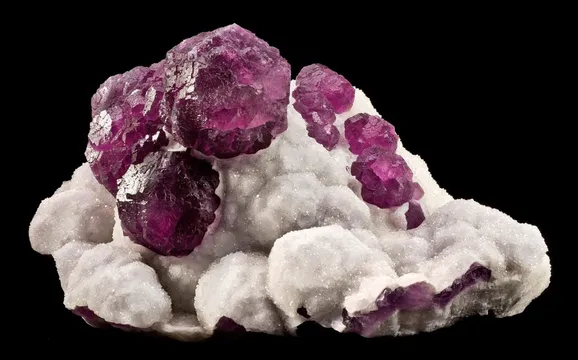
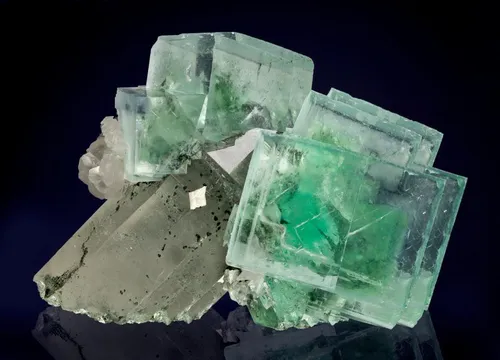
De'an County, in northern Jiangxi near Jiujiang, occupies one of those Chinese mineral districts where the specimen story and the ore-geology story are both unusually strong. To most collectors the name means the De'an fluorite mine at Wushan: cabinet plates of purple to green fluorite, commonly cubo-octahedral to octahedral, perched in stark contrast on white quartz. To economic geologists, the county also includes the Pengshan Sn-Pb-Zn polymetallic ore field, a granite-related system with skarn, greisen, quartz-vein, fluorite-silica, sulfide and carbonate stages developed around Early Cretaceous granites. The best specimens are instantly recognizable: translucent fluorite with green interiors and violet rims or tips, darker “grape” cubo-octahedra on etched quartz plates, and occasional two-generation pieces where earlier green fluorite, white quartz druse, and later purple crystals all remain visible in one hand specimen.
Regional View
Country View
The De'an fluorites entered the international market in the early 2000s and very quickly became one of the signature Chinese fluorite styles of that period. Their appeal is not simply color, though the green-to-purple zoning can be superb; it is the sculptural contrast of soft-looking purple fluorite forms emerging from a snow-white quartz matrix. Many specimens were prepared by removing quartz that had partly or completely enclosed the fluorite, so a top piece can look almost carved out of its matrix while still preserving the natural relationships between the minerals.

Photo: Wikimedia Commons

Photo: Wikimedia Commons
Search for specimens: View all specimens from De'an Co., China
De'an County is an administrative locality that contains several mineral districts, but the collector locality attached to most De'an labels is the De'an fluorite mine at Wushan, north of De'an city in Jiujiang Prefecture, Jiangxi Province. Collector literature and locality databases record “De'an Mine,” “Wushan,” and “Wushan Fluorite Mine” labels, but the better locality usage is De'an fluorite mine, Wushan, De'an Co.; published notes indicate that a separate “Wushan mine” name caused confusion and that the workings were near Wushan rather than a distinct mine of that exact name.
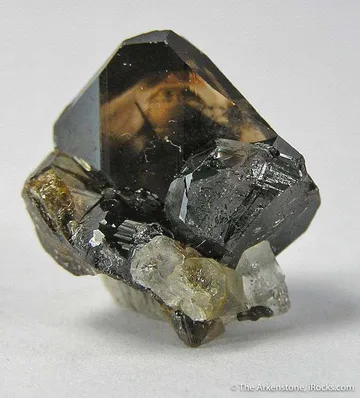
Geologically, De'an sits within the broader metallogenic framework of northern Jiangxi and the Middle-Lower Yangtze region. The county’s Pengshan Sn-Pb-Zn ore field is tied to granitic magmatism and polymetallic hydrothermal activity. Published work describes Pengshan mineralization as zoned around the Pengshan pluton, with inner As-Sn assemblages, middle Sn-Pb and Pb-Zn-Ag assemblages, and outer fluorite-rich mineralization. The recognized stages include greisenization, skarnization, fluorite-stanniferous silicification, quartz-cassiterite-sulfide activity, and late carbonatization. That is important context for collectors because it explains why the county’s specimen suite is not merely fluorite and quartz: the same county-scale mineralizing environment also produced cassiterite, sphalerite, galena, arsenopyrite, pyrite, stannite, topaz, tourmaline, garnet, vesuvianite, wollastonite, scheelite and other skarn or greisen minerals at Pengshan sublocalities.
The De'an fluorite mine itself is a much narrower specimen story. It is known from abundant fluorite-quartz specimens rather than from a broad display suite. The classic pieces came from early-2000s production and show fluorite in or on quartz, commonly with the quartz partly removed during preparation. Some specimens preserve a base or underside of earlier green massive to crystalline fluorite, then a layer of white quartz, then a later generation of purple or purple-rimmed fluorite. Others show isolated “grape juice” cubo-octahedra, strongly purple and rounded by composite crystal growth, set into pockets or islands on white quartz.
Mining history is better documented for the county’s tin-polymetallic mines than for the specimen fluorite workings. At Jianfengpo, north of De'an city in the Pengshan field, the mine was in production by 2007 under Fangyuan Mining Investment Co., Ltd. Published mining-engineering work describes a thin, gently dipping, complex polymetallic orebody with cassiterite as the principal tin mineral and sphalerite, pyrite, arsenopyrite, pyrrhotite, chalcopyrite and other sulfides. The same study records gangue and alteration minerals including quartz, feldspar, fluorite, calcite, ankerite, muscovite-sericite and diopside, with mining methods adapted to thin ore zones commonly under 1.8 m.
For field access today, De'an should be treated as a mining district, not a casual collecting site. The famous fluorite mine is widely described in the trade as no longer producing specimen material, and the active or historically active polymetallic deposits are industrial operations or controlled mineral properties. Modern specimens on the market are therefore overwhelmingly old stock, collection releases, dealer inventory from earlier finds, or pieces that have moved through auction houses and established mineral dealers.
The notable pockets that made De'an famous were those where fluorite grew with quartz in visually clean, separable generations. The best preserved groups display well-spaced fluorite crystals rather than dense, damaged carpets; strong green-to-violet zoning; good translucency; and a high-contrast white quartz matrix. Less desirable pieces tend to be overly etched, oil-darkened, chipped along octahedral edges, or reduced to incomplete crystals on a chalky-looking quartz base.
Fluorite from De'an is prized for translucent green interiors with violet edges, purple tips, or deep “grape” cubo-octahedral crystals on white quartz. The most familiar habit is sharp to slightly curved octahedral crystals, commonly 1–3 cm on edge, but larger cabinet pieces are documented with crystals exceeding 4 cm and exceptional single crystals reported around 7–8 cm. The strongest specimens show discrete fluorite groups rising from etched quartz, with color concentrated along edges, bevels, phantoms, or outer zones; ordinary examples lack either the contrast, the zoning, or the undamaged geometry. Associations are overwhelmingly quartz and, less commonly, underlying massive green fluorite or small pyrite; the finest De'an pieces are judged by the balance of color, isolation, translucency, preparation, and how naturally the fluorite sits in its quartz matrix.
Quartz at De'an is usually the matrix mineral rather than the headline species, but it is essential to the locality’s look. It appears as white to milky quartz plates, fine druse, sparkling microcrystalline coatings, and locally needle-like to prismatic crystals that contrast strongly with purple or green fluorite. In many classic specimens the quartz originally coated or partly engulfed the fluorite and was later etched back, leaving a white pedestal or halo around individual crystals; in rarer, especially instructive pieces, much of the quartz was left intact, allowing collectors to read the growth sequence from earlier fluorite through quartz druse to later fluorite. The best quartz-bearing specimens are not simply “fluorite on matrix” but balanced compositions where the quartz is bright, clean, and three-dimensional without hiding the fluorite.
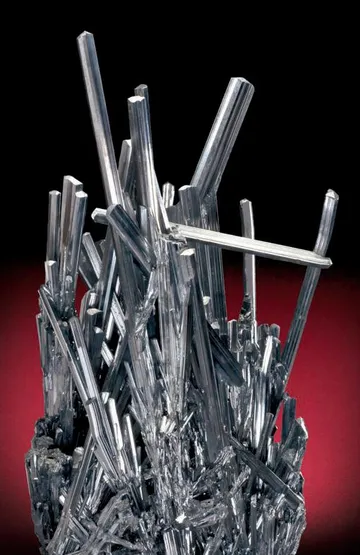
Beyond the collector fluorite-quartz suite, De'an County has a much broader documented mineralogy in the Pengshan and related deposits. Jianfengpo and Zengjialong add cassiterite, malayaite, stannite, sphalerite including iron-rich marmatite, galena, chalcopyrite, pyrite, pyrrhotite, arsenopyrite, scheelite, topaz, tourmaline, fluorite, calcite, siderite, ankerite, diopside, actinolite, tremolite, epidote, vesuvianite, wollastonite, and garnet-group minerals such as andradite and grossular. Zengjialong also records realgar, orpiment, cinnabar, native lead, wulfenite and xenotime-(Y), while the Baoshan Sb-Au deposit contributes stibnite and arsenopyrite to the county list. These minerals are far less commonly encountered as aesthetic specimens than the Wushan fluorites, but they make De'an a legitimate ore-field locality rather than a one-mineral curiosity.
The first thing to understand about De'an fluorite is that preparation is part of the locality’s collecting history. Many specimens were recovered with fluorite partly enclosed by stubborn quartz, and the quartz was removed or reduced with acid to expose the fluorite. Good preparation leaves islands and druse of quartz that frame the crystals; over-preparation can make the matrix look chalky, unnatural, or eaten away. Hydrofluoric-acid preparation is also why old De'an pieces can show odd borders around crystals where the surrounding quartz has been dissolved back.
Oiling is another practical issue. Some dealer records explicitly note that De'an fluorites are often oiled, presumably to deepen color and improve apparent translucency or surface wetness. Oiled specimens may look unusually glossy in recesses, may attract dust, and can darken paper labels or packing material. A clean, unoiled example with good natural luster is preferable, though many high-end De'an pieces have some history of cleaning or surface enhancement simply because of how the material came out.
The main authenticity concern is not synthetic fluorite but locality confusion. Published collector notes distinguish the purple cubo-octahedral De'an material from blue-green octahedral fluorites that were at times attributed to De'an but may actually come from the Ganzhou area or from mines near Shangrao. Older labels may also read Yiwu, Zhejiang, for material later assigned to the De'an workings near Wushan. For a serious collector, “De'an Co.” alone is useful but incomplete; the best label should say De'an fluorite mine, Wushan, De'an Co., Jiujiang, Jiangxi, China, and should preserve any older dealer or collection history that explains how the attribution was made.
Condition matters greatly. Fluorite cleaves easily, and De'an octahedra commonly show tiny bruises or nicks on tips and edges. Purple rims can make damage less obvious in photographs, so examine edge continuity, points, and the contact between fluorite and quartz. White quartz matrices can be friable or granular after acid work, and small quartz grains may shed from the underside. On large plates, look for repaired breaks, fresh-looking saw cuts, or stabilized areas hidden beneath the matrix.
Fluorescence is a pleasant bonus rather than the core value. De'an fluorite has been documented with minor long- and short-wave UV response, and some auction descriptions record blue-purple long-wave fluorescence. Because response varies by generation and piece, it should be tested specimen by specimen. Avoid prolonged bright sunlight and high heat, not because De'an fluorite is uniquely unstable, but because fluorite color and any oil or restoration materials are best preserved under normal cabinet conditions.
Market availability remains good but uneven. The mine is not regarded as a current source of new production, yet De'an pieces continue to surface from early-2000s stocks, older collections, and auctions. Small damaged examples and heavily etched pieces are still accessible, while large, balanced plates with clean purple-green zoning and minimal edge wear are increasingly treated as modern Chinese classics. Recent public sales show a broad spread: modest cabinet pieces can sell in the low hundreds, while large, fine, collection-quality plates have reached several thousand dollars.
The most memorable De'an story is not a romantic pocket discovery but the preparation that followed. The fluorite was often locked in a white quartz coating so tenacious that mechanical trimming could only do so much. On earlier purple dodecahedral to cubo-octahedral material, the preparation could leave a visible border only a few millimeters wide around the crystal, like a window cut through quartz to reveal the fluorite beneath. To expose larger plates without destroying the fluorite, preparators resorted to hydrofluoric acid, a dangerous choice made more hazardous by the size of some specimens and the amount of quartz that had to be removed.
One dealer account gives the episode an unsettling human detail. A family member who had handled mine-run De'an material during the later years of production remembered the cleaning work and said of one preparator that “his mouth was black.” The writer did not diagnose the cause, but the image is hard to forget: beautiful purple-and-green fluorite plates on one side of the story, and on the other, the fumes and chemical risk required to reveal them. It is a reminder that a gleaming De'an plate, especially one with fluorite standing cleanly out of etched white quartz, is often both a natural mineral specimen and a record of hazardous hand preparation.
The locality itself also had a detective story. In the first years of Chinese fluorite exports, labels moved faster than reliable mine information. Some purple cubo-octahedral pieces were reportedly circulated as Yiwu, Zhejiang, before being tied back to De'an workings near Wushan. Meanwhile, some blue-green octahedral specimens etched from white quartz were challenged by specialists and reassigned, at least provisionally, away from De'an toward Ganzhou or toward fluorite mines in the Shangrao area. What looks like a simple white-quartz-and-fluorite style on a show table can therefore carry a complicated label history, and the best old tags are worth keeping even when they preserve an error. They document the route by which Chinese mineral information was corrected specimen by specimen.