Wuning Mine, China - a modern stibnite locality famed for blade-like sprays with blue-gray luster from pocket finds; paragenesis with calcite and baryte.
Key facts
Wuning Mine—better known in much of the specimen literature as the Wuling antimony mine or Qingjiang mine—is one of the defining modern stibnite localities. It is an underground antimony deposit at Qingjiang in Wuning County, Jiujiang, northwestern Jiangxi Province, where antimony-rich hydrothermal fluids entered fractured limestone and produced thick stibnite vein material with occasional open pockets. Those pockets are what changed the mine from an industrial antimony source into a world-class collecting locality: they yielded sprays, sheaves, and single “swords” of stibnite with metallic blue-gray to gunmetal luster, strong longitudinal striations, wedge-like terminations, and the slight curvature or bend that gives the best pieces their unmistakable sculptural tension.
The finest Wuning stibnites have an almost improbable look. Broad blades rise from dense metallic bases as if cast in polished steel; some are thick, robust cabinet groups, while others are long, slender, doubly terminated floaters. The classic assemblage is stibnite with calcite and baryte, with oxidized antimony minerals such as stibiconite and valentinite documented from the deposit and fluorite known from later collection records. Calcite is not the star here, but when present as clear, colorless, white, or amber crystals perched on or pierced by stibnite blades, it gives Wuning specimens a livelier paragenetic story than the more common loose stibnite singles.
Regional View
Country View
Wuning’s place in collecting history rests on a short but spectacular run of pocket discoveries beginning in the late 1990s and continuing through the early 2000s. At the height of the finds, specimens from the mine were compared with the historic Japanese stibnites of Ichinokawa and Saijo, but with a scale and abundance that belonged unmistakably to the modern Chinese mineral boom. The enormous public-display pieces at the American Museum of Natural History and Harvard Museum of Natural History made the mine visible far beyond specialist circles, while thousands of cabinet and smaller pieces entered collections through the international show circuit.

Photo: Wikimedia Commons

Photo: Wikimedia Commons
Search for specimens: View all specimens from Wuning Mine, China
The Wuning Mine is an antimony deposit in the South China antimony metallogenic province, situated in the Jiulingshan Mountains near Qingjiang and overlooking the Xiushui River. Published specimen accounts place the mine and its support buildings on Tuobeishan Hill at roughly 2,000 feet elevation. The deposit is described as a hydrothermal antimony system formed about 130 million years ago, during a period of volcanic and tectonic activity that fractured the limestone country rock. Acidic, antimony-bearing fluids moved through faults, shear zones, and favorable limestone horizons; interaction with carbonate rock helped neutralize those fluids and precipitate stibnite as veins and massive linings. Where open cavities remained in the vein system, crystals had room to grow into the large blades and sprays for which the locality is famous.
The productive ore bodies were mined underground. Accounts of the operation describe three shafts reaching the lower portions of the ore bodies, with much of the ore extracted and processed by labor-intensive methods. Ore grades were reported at roughly 15–20 percent antimony, with crude crushing and hand cobbing producing concentrate around 50 percent antimony. The concentrate was then trucked to smelters in nearby Hunan Province. The operation was not created as a specimen mine; for its first years it was worked as an antimony source, and many fine crystals were almost certainly destroyed before their collecting value was recognized.
The deposit was discovered by Chinese government prospectors in 1962, and the Wuling municipal government opened the mine in 1982. In 1995 it was sold to Star Antimony Limited Company as part of China’s broader shift toward controlled industrial privatization. The specimen era began in earnest in 1997, when miners broke into the first great pocket: a cavity reported as about 9 x 18 x 60 feet, lined with stibnite crystals up to 3 feet long. That discovery drew the attention of mineral dealers and collectors in Changsha, roughly 80 miles to the southwest, and preserved the first major wave of Wuning cabinet specimens. Two smaller pockets followed in 2000, and additional notable recoveries were reported in the 2003–2004 period and again around 2006.
Most collector specimens from Wuning are not true matrix pieces in the traditional sense. The pocket walls were lined with massive stibnite, a soft metallic substrate that does not behave like hard quartz or limestone matrix during extraction. As a result, large matrix plates were difficult to remove intact, and the market is dominated by loose single crystals, sprays, jackstraw clusters, and trimmed groups resting on a base of massive stibnite. The best surviving pieces are three-dimensional, naturally balanced clusters with multiple undamaged terminations, strong mirrorlike luster, and visible striations. Pieces with calcite or baryte are less common and desirable when the association is undamaged and visually integrated rather than merely attached at the base.
Collecting access today should be regarded as restricted industrial-mine access, not a casual field-collecting locality. Modern specimens in circulation overwhelmingly come from older pocket recoveries and dealer stock rather than from active collecting by visiting collectors. Any attempt to visit or collect would require permission from land and mineral-rights holders, current safety confirmation, and local guidance; the underground workings, soft massive stibnite, oxidized antimony minerals, and historical mine infrastructure all argue for caution rather than casual entry.
Stibnite from Wuning Mine is prized for long, metallic, orthorhombic blades in gunmetal gray, steel gray, bluish gray, and locally iridescent tones, typically showing strong lengthwise striations, chisel to wedge-like terminations, and a tendency for crystals to bend or subtly curve. The best pieces came from open hydrothermal pockets lined with massive stibnite, with major finds beginning in 1997 and continuing through pockets in 2000, 2003–2004, and 2006; individual crystals in the great early pocket were reported up to 3 feet long, although collector pieces more commonly range from small singles to cabinet groups with blades in the 5–30 cm range. Associations include calcite and baryte, with stibiconite alteration on some oxidized surfaces. What separates elite Wuning stibnite from ordinary examples is not just size: it is the combination of complete undamaged terminations, brilliant mirror-metallic faces, thick robust blades rather than flimsy splinters, sculptural three-dimensional spray form, and minimal bruising along exposed edges.
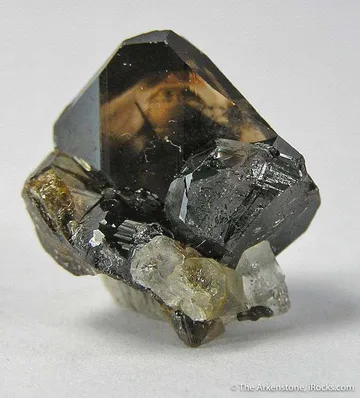
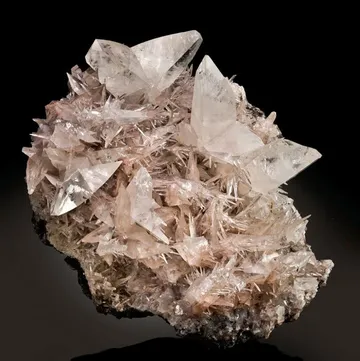
Calcite at Wuning is a subordinate gangue and association mineral rather than the primary attraction, but it gives some specimens their most memorable contrast: colorless, white, pale honey, or amber calcite crystals sitting on metallic stibnite, in a few cases with stibnite blades partly enclosed by or poking into the calcite. Documented examples include small cabinet pieces with amber, striated calcite crystals on stibnite-rich matrix and smaller colorless calcites attached near stibnite terminations. Good Wuning calcite specimens are those where the calcite is sharp, transparent to translucent, and compositionally placed so that it enhances the stibnite rather than hiding it; ordinary pieces tend to show massive white carbonate, broken calcite, or calcite that is visually secondary to a damaged stibnite cluster.
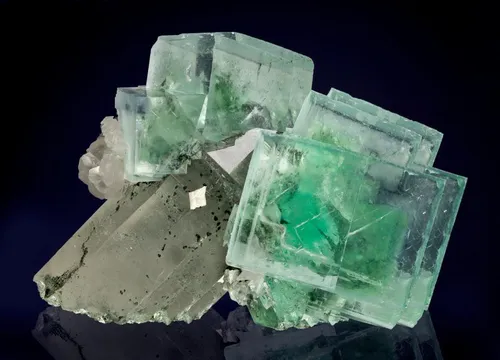
Other documented minerals from Wuning Mine include baryte, fluorite, stibiconite, and valentinite. Baryte is especially important to collectors because tabular pale-yellow to light-colored baryte plates can occur with stibnite, making matrix-associated pieces scarcer and more textural than loose stibnite sprays. Stibiconite and valentinite are antimony-oxide alteration minerals from the oxidized parts of the deposit, and stibiconite may appear as yellowish alteration on or after stibnite. Fluorite is a much rarer recorded association at the locality. No accepted type-locality mineral is documented for Wuning Mine in the principal locality records, but the mine is nonetheless a benchmark locality for the species stibnite because of crystal scale, preservation, and the museum-caliber pocket finds.
Wuning stibnite is common enough that small and mid-sized examples remain available, but truly top pieces are not common at all. The market separates quickly between loose singles or partial sprays with edge bruising, and major cabinet pieces with intact terminations, strong three-dimensional form, thick blades, and high luster. Modern auction records show the spread clearly: modest cabinet examples can still trade in the low hundreds, while exceptional large sprays and historic-pocket pieces can reach five figures, and a major Wuning stibnite sold through Sotheby’s was recorded on EarthWonders with a 2025 acquisition price of $63,500. Heritage also sold a large Wuning stibnite specimen in May 2026 for $40,000.
Condition is the central issue. Stibnite has perfect cleavage, Mohs hardness around 2, and a splintery, blade-like habit; even excellent specimens may show small nicks, contacted tips, cleaved side faces, or bent and repaired-looking growth forms that are actually natural. Inspect terminations and the exposed high points of each blade, not just the overall silhouette. Bright luster can hide small rubs in photographs, so raking light and side views matter. Large pieces should be handled from the base only, ideally displayed on a custom mount that prevents vibration and tip contact. Loose singles are often legitimate Wuning pieces, but three-dimensional clusters on massive stibnite bases are more desirable when stable and unrepaired.
Mislabelling is usually less about species and more about locality wording. Wuning, Wuling, and Qingjiang all appear on labels for the same mine, and older labels may use Jiujiang Prefecture or variant county spellings. More problematic are vague “China stibnite” labels applied to pieces from other Chinese antimony mines, especially if the habit is not typical Wuning. Genuine Wuning material commonly has bright metallic, striated, sword-like crystals; associations with calcite or baryte can strengthen the attribution when accompanied by a reliable label or provenance. The best protection is provenance: older dealer labels, collection history, publication photos, or recognizable specimens from known 2000–2006 dispersals.
No standard treatment is needed or desirable. Do not oil stibnite, do not use aggressive chemical cleaning, and avoid ultrasonic cleaning entirely. Dust removal should be minimal and gentle, using air or a very soft brush with care around splintered edges. Antimony minerals should be handled sensibly: wash hands after handling, avoid inhaling dust from broken material, keep fragments away from children and pets, and never grind or saw specimens without proper mineral-preparation controls. Stibnite is generally stable in a display case, but oxidized yellowish areas should not be mistaken automatically for dirt; on Wuning material they may represent stibiconite alteration.
The story collectors retell begins underground in 1997. For 15 years Wuning had been an antimony mine first and a specimen locality only by accident, and countless crystals probably went into the ore stream. Then miners opened a cavity of astonishing scale—about 9 feet by 18 feet by 60 feet—its walls lined with stibnite crystals reportedly up to 3 feet long. In a hard-rock quartz pocket those dimensions would already be memorable; in soft, cleavable, metallic stibnite, it was something else altogether. The pocket was not simply a void with crystals inside, but a chamber lined with massive stibnite from which the bright blades grew. That made recovery maddeningly difficult: the “matrix” itself was soft ore, prone to breaking as collectors tried to free the crystal groups.
The first pocket reached Changsha collectors and dealers, and that intervention is why the locality exists in modern collections at all. The mine was producing antimony concentrate, not curating minerals, and stibnite’s economic path is usually crushing, roasting, and smelting. Once the value of intact crystals was understood, supervisors called collectors again when two smaller pockets appeared in 2000. By the 2002 and 2003 shows at Tucson, Denver, and Munich, the verdict had spread: Wuning had entered the short list of world stibnite classics. Collectors who had grown up revering Japanese Ichinokawa material suddenly had to make room for a Chinese locality whose crystals could be larger, brighter, and more available, even if the Japanese pieces retained their old-world patina and mystique.
The most public Wuning story belongs to the American Museum of Natural History. In 2007, a 1,000-pound stibnite from the mine went on display in New York, its hundreds of sword-like blue-gray metallic crystals rising from a rocky base. It had survived the industrial fate of most antimony ore because miners recognized it before it was destroyed. George Harlow, curator in the Department of Earth and Planetary Sciences, called that survival “a miracle” and “one of nature’s treasures.” The specimen was donated by Marc Weill and installed in the renovated 77th Street Grand Gallery, turning what had been a specialist locality into a public mineral icon photographed by museum visitors who may never have heard the word “stibnite” before.
Harvard’s “Swords of China” added a second museum-scale chapter. The specimen, discovered in 2003 at Wuning, weighs nearly 400 pounds; when it entered the Harvard Museum of Natural History, six strong men carried it into place. Its display on the third-floor landing gave the locality another civic stage, and the name is unusually apt: Wuning stibnite does not merely form crystals—it forms blades, lances, and metallic sheaves that look less like mineral growth than armory work.
There is also a quieter market story behind the famous pockets. Dealer accounts describe a large lot—around 5,000 pieces—purchased from the mine owners through a partnership that included Andrew Pagliero, Markus Walter, and Daniel Trinchillo of Fine Minerals International. The material reportedly required weeks of negotiation, two months of careful packing before it could leave China, and then the slow work of sorting, cleaning, and grading. Out of thousands of pieces, roughly 100 emerged as the elite examples by the standards serious collectors care about: completeness, luster, dimensionality, and presence. That ratio explains Wuning’s paradox today. The locality is famous and not rare in a broad sense, yet the great pieces feel scarce because the truly exceptional fraction was small from the beginning.