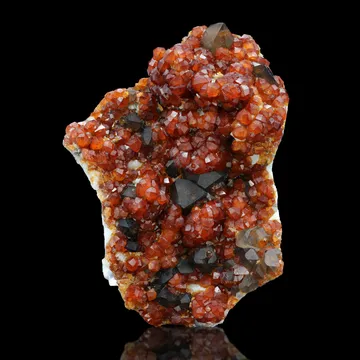
A collector's guide to Wushan Spessartine Mine, China: its geology, mining history and notable minerals, illustrated with the 558 specimens documented from this locality on EarthWonders.
Key facts
Wushan Spessartine Mine is one of the defining Chinese mineral localities of the modern collecting era: the place name collectors associate with mandarin-orange spessartine sparkling over smoky quartz and pale feldspar. The “mine” is best understood not as a single orderly underground operation, but as a trade and database name for the Tongbei–Wushan spessartine field near Tongbei village, Yunxiao County, Zhangzhou, Fujian. The specimens come from miarolitic cavities and pegmatitic zones in Late Cretaceous aluminous A-type granite on China’s southeastern coastal granitic belt, where open pockets allowed sharply formed garnets, quartz, feldspar, mica, helvine, fluorite, opal-AN, and accessory minerals to grow into free crystal groups.
The locality’s importance is historical as well as aesthetic. In the late 1990s and early 2000s, these Chinese spessartines entered the international market in quantity and quickly became recognizable across show tables: small, brilliant, orange to reddish-orange garnets on cream-white microcline, commonly accompanied by glassy smoky quartz prisms. Early labels were confused, and some material was first attributed to Lechang in Guangdong before Fujian and the Tongbei–Yunxiao area became accepted as the true source. That labeling history still matters to collectors today.
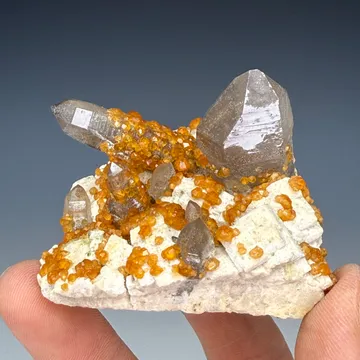
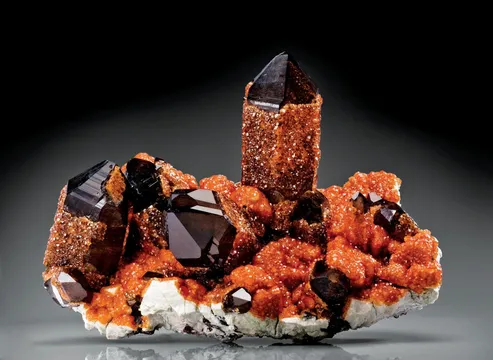
The best Wushan specimens are not judged simply by crystal size. Most of the spessartines are small, commonly millimetric, so quality lives in luster, color saturation, sharpness, even distribution, and composition. A fine piece may show hundreds of bright garnets peppering smoky quartz and feldspar like sparks on pale granite; another may carry a single dark, transparent smoky quartz rising from a crust of orange garnet; rarer examples add purple or nearly colorless fluorite, yellow-brown helvine, pearly muscovite books, or bright green-fluorescent opal-AN.
Regional View
Country View
Geologically, the appeal is easy to see in the specimens themselves. The pale feldspar is the architectural framework of the pocket; smoky quartz gives height and drama; spessartine supplies intense color and sparkle; muscovite and helvine add complexity; fluorite, when present, turns a familiar orange-and-brown combination into a much rarer multicolor granitic-pocket association. The Wushan material also has scientific interest, because Tongbei spessartine has been studied gemologically and crystallographically, including OH,F-rich material showing tetragonal symmetry rather than the ordinary cubic garnet ideal.

Photo: Wikimedia Commons

Photo: Wikimedia Commons
Search for specimens: View all specimens from Wushan Spessartine Mine, China
The accepted locality is Wushan Spessartine Mine, Tongbei, Yunxiao County, Zhangzhou, Fujian Province, China, with published coordinates around 23° 54′ 21″ N, 117° 11′ 53″ E. The Chinese locality name is given as 乌山锰铝榴石矿, with Wushan meaning Wu Mountain. For specimen labels, “Wushan Spessartine Mine,” “Tongbei,” “Yunxiao,” and “Fujian” have all been used, but the most precise modern label keeps the full hierarchy and treats Wushan as a collecting-area name rather than proof of a single mine opening.
The deposit type is a miarolitic granitic-pocket occurrence. The host belongs to the Cretaceous granitic belt exposed along southeastern coastal China, extending through Guangdong, Fujian, and Zhejiang. In the Wushan area, late-stage volatile-rich portions of aluminous A-type granite developed cavities lined by quartz, K-feldspar, muscovite, spessartine, and accessory minerals. Published work on the Baishishan, Jingangshan, and Wushan plutons places these granites in the Late Cretaceous, roughly 92–86 Ma, and relates them to regional extension associated with Paleo-Pacific plate rollback beneath southeastern China.
There are no ore bodies in the ordinary mining sense. The valuable “ore” was the pocket system itself: cavities in granite and pegmatitic zones that yielded collectible crystals. Mineralization is best described as late-magmatic to hydrothermal pocket crystallization in granite, with quartz and feldspar forming the framework, spessartine crystallizing as small orange trapezohedral to dodecahedrally modified garnets, and late accessory species including helvine, fluorite, opal-AN, pyrite, beryl, topaz, and others appearing locally. The pale feldspar on classic specimens was long called orthoclase in the trade, but the current consensus for the spessartine-bearing feldspar is microcline, with albite also documented on some pieces.
The locality history is tangled because the market moved faster than the documentation. Chinese spessartine with smoky quartz and feldspar began appearing internationally around 1998, and early labels commonly gave Lechang, Guangdong. By late 2001, dealers and authors were correcting that attribution to Fujian, especially the Tongbei area near Yunxiao. Berthold Ottens’ 2005 article in The Mineralogical Record became the core English-language locality account, and Guanghua Liu’s Fine Minerals of China treated the broader Fujian spessartine localities, including Tongbei, Shuijingping, and Yunling/Shiliu.
Older locality accounts distinguish two or three main collecting areas: Tongbei near Yunxiao, Shuijingping in Yunxiao County, and Yunling in the Zhangpu County/Shiliu area farther northeast. The distinctions matter because mineral associations vary. Tongbei is noted for helvine and topaz with the spessartine assemblage, whereas fluorite-bearing specimens have often been tied to Yunling or related granitic pockets rather than the most restricted Tongbei occurrence. Later locality notes caution that “Yunling village” as used in older descriptions may not be exact, and that many market specimens came from the Wushan pluton around Tongbei village, while other similar pockets between Yunxiao and Suian belong to related granitic bodies such as the Jingangshan pluton.
Mining was largely tied to granite quarrying and small specimen workings rather than a formal, well-documented mining company. Granite extraction exposed the miarolitic cavities, and local digging for specimens followed the pockets. Tongbei is especially important because it was among the first places in the district where people pursued specimen mining systematically. Published locality notes also state that Wushan is now a protected national park area and that collecting from exposed granite is prohibited. Modern collectors should regard the locality as closed for practical field collecting and should acquire specimens through established dealers, old collections, auction records, and material already in circulation.
The most famous finds produced plates and sculptural groups of orange spessartine on microcline with smoky quartz. Some pockets yielded dense, even carpets of millimetric garnets; others produced more open pieces with isolated larger crystals rising from a field of smaller ones. Smoky quartz crystals are reported to reach large cabinet scale, with locality data recording crystals up to 30 cm. Rarer pockets or related pocket zones yielded fluorite-spessartine combinations, helvine on feldspar or smoky quartz, opal-AN crusts that glow green under short-wave ultraviolet light, and unusual pyrite-bearing pieces. A Mineralogical Record supplement illustrated major Wushan specimens as large as a 46 cm spessartine with smoky quartz and a 30 cm pyrite on spessartine, showing that the district was capable of far more than thumbnail and miniature production.
Wushan spessartine is the locality’s signature mineral: orange to reddish-orange, lustrous, commonly gemmy, and typically formed as small trapezohedral crystals with dodecahedral modifications. Published descriptions emphasize that most crystals are only a few millimeters across, often mainly up to about 5 mm, though specimen records show individual garnets to roughly 6–8 mm and occasional larger crystals; a Wikimedia-documented specimen has spessartines to 0.7 cm on a 7.3 cm feldspar plate. The classic associations are smoky quartz, quartz, microcline, muscovite, albite, opal-AN, helvine, pyrite, and less commonly fluorite. Good pieces have sharp, glassy, saturated garnets with little abrasion or pitting, arranged so the orange crystals either evenly carpet pale microcline or climb dramatically around smoky quartz; ordinary pieces are duller, more brownish, crowded into indistinct crusts, or mounted on chalky decomposed feldspar without strong contrast.
Quartz from Wushan is fundamental to the pocket architecture, ranging from clear to smoky crystals and commonly serving as the host or stage for spessartine. In the locality’s photo and specimen records, quartz is overwhelmingly associated with spessartine, feldspar-group minerals, microcline, muscovite, fluorite, beryl, helvine, opal-AN, albite, clinochlore, pyrite, and rare garnet-group entries. The most attractive non-smoky quartz pieces show clear to lightly colored, sharply terminated crystals rising cleanly from pale feldspar and orange garnet, where the quartz has transparency and defined faces rather than being a broken milky cavity lining. Collectors prize quartz here when it is compositionally integrated with the garnets—either as clean points emerging from orange spessartine crusts or as clear windows into the paragenesis of the miarolitic pocket.
Smoky quartz is the dramatic dark counterweight to Wushan spessartine, and the best specimens owe much of their visual power to the contrast between brown to blackish transparent quartz, cream microcline or albite, and brilliant orange garnets. Locality data record smoky quartz crystals up to 30 cm, while market and museum-scale pieces show everything from centimeter-scale miniature crystals to large cabinet groups; specimen descriptions include smoky quartz to 2–5 cm in common display pieces and much larger crystals on major examples. The finest smoky quartz from Wushan is glassy, transparent to translucent, sharply terminated, and only partly overgrown by spessartine so that both minerals can be read clearly. Pieces where garnets cluster around the bases and flanks of the quartz while leaving clean terminations are especially desirable; weaker pieces have bruised tips, opaque or etched quartz, or spessartine scattered too thinly to create the classic fire-and-smoke contrast.
Feldspar is the pale structural matrix of most Wushan specimens, commonly appearing as cream-white to pale pinkish blocky crystals, plates, or granular pocket walls beneath spessartine and smoky quartz. Older labels often used “orthoclase,” but modern locality notes emphasize that the feldspar associated with the spessartine is microcline, with albite also documented in the assemblage. Collector-grade feldspar matters here because it provides contrast and geometry: clean blocky feldspar makes orange garnets brighter, supports smoky quartz well, and gives the specimen a natural granitic-pocket context. Ordinary feldspar matrix can be chalky, decomposed, iron-stained, sawed awkwardly, or so densely encrusted that its form disappears; the better pieces retain recognizable feldspar faces or a tidy pale base that frames the garnet and quartz.
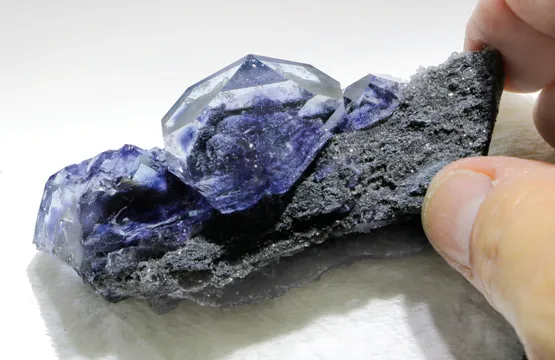
Fluorite is a prized secondary species in the Wushan/Tongbei trade suite and is much scarcer than the standard spessartine-smoky quartz-microcline combination. Documented pieces show fluorite as octahedral crystals, commonly colorless to pale green, green, bluish, or purple, associated with spessartine, smoky quartz, microcline, muscovite, hematite, opal-AN, and pyrite. A notable cabinet specimen record describes deep purple octahedral fluorites to 2.1 cm with red spessartine to 6 mm and smoky quartz to 2.7 cm on cream microcline, while another documented miniature features an almost colorless twinned octahedron about 1 cm wide on spessartine-bearing microcline. Good Wushan fluorite specimens have distinct, undamaged octahedra clearly visible in the composition; lesser examples may be tiny, hidden, colorless masses or questionable fluorite labels on ordinary garnet-feldspar pieces.
Generic “garnet” labels from Wushan almost always refer to the locality’s spessartine, and careful modern descriptions should identify the garnet as spessartine when the specimen fits the Tongbei orange garnet assemblage. The garnets are typically small, sharp, orange to reddish orange, and rich in manganese, sitting on microcline, albite, smoky quartz, or quartz with muscovite, fluorite, helvine, opal-AN, and pyrite as possible companions. The best garnet-labeled pieces are worth relabeling more precisely if the identification is secure: they show glassy, transparent to translucent crystals with crisp forms and no dull etched surfaces. Generic labels become problematic when they obscure locality precision or when brownish, poorly formed garnets from other Chinese or worldwide localities are sold into the Wushan style without the right feldspar-quartz-pocket association.
Muscovite from Wushan is an accent mineral that can elevate a spessartine specimen from colorful to complex. It appears as pearly, silvery, grey, pale greenish, or slightly chlorite-edged books and stacked plates on microcline and feldspar, commonly with orange spessartine and smoky quartz. The best muscovite is not a dull micaceous smear but a set of distinct, sharp books, sometimes hexagonal in outline, positioned where their pearly surfaces contrast with garnet and quartz. Auction records and specimen descriptions note muscovite-forward pieces with well-formed books on microcline, as well as fluorite-spessartine-muscovite combinations; in collector terms, muscovite is strongest when it is visibly part of the pocket architecture rather than merely a minor coating between garnets.
Microcline is the main feldspar collectors should expect on classic Wushan spessartine pieces, even when older labels say orthoclase. It forms white, cream, pale tan, or pale pinkish blocky crystals and plates, frequently carrying dense orange spessartine coatings, smoky quartz, muscovite, fluorite, helvine, opal-AN, pyrite, and albite. The locality’s microcline is not usually collected as a standalone feldspar specimen; its importance lies in the way it supports the garnet-quartz association. Fine examples have crisp feldspar faces or attractive sculptural massing, with spessartine distributed in a lively but not muddy pattern. Poorer pieces show decomposed, chalky, sawed, or heavily stained microcline that weakens the contrast and can make otherwise good garnets appear dull.
Albite is a documented feldspar associate at Wushan and appears on some specimens as white matrix or contrasting feldspar beneath spessartine and smoky quartz. Wikimedia and dealer records show spessartine-quartz-albite combinations, including pieces with a sharp smoky quartz crystal rising from spessartine-coated white albite and smaller miniatures with orange garnets on smoky quartz and albite. Albite specimens are most appealing when the white matrix is clean and provides a bright base for reddish-orange garnet and dark quartz. Because microcline dominates many classic Wushan labels, albite should be treated thoughtfully: valuable pieces are those with a believable documented association, not simply any pale feldspar called albite without support.
Orthoclase is a historically important name on Wushan labels, but it is also the locality’s most important feldspar-label caution. Early descriptions and many older dealer tags called the pale K-feldspar orthoclase, and Mindat occurrence data still preserve orthoclase in older association records; however, current locality notes explicitly state that the feldspar associated with the spessartine is microcline, not orthoclase as originally reported. For collectors, this means an old “orthoclase” label on a genuine Wushan spessartine should not automatically be rejected, but a modern catalog entry should normally read microcline unless orthoclase has been analytically confirmed. The best so-called orthoclase specimens are therefore best appreciated as historical Wushan feldspar labels attached to classic spessartine-smoky quartz-microcline combinations.
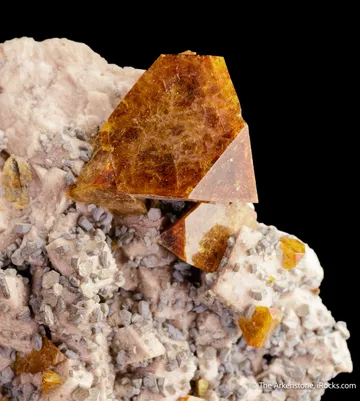
The mineral commonly called helvite in older specimen descriptions is officially helvine, a manganese beryllium silicate, and Wushan/Tongbei is one of the most collectible Chinese sources for it. It occurs as yellow, golden-yellow, brown-red, reddish brown, or yellow-green crystals, commonly pseudo-octahedral to modified tetrahedral in habit, perched on feldspar, smoky quartz, microcline, muscovite, or spessartine-bearing matrix. Documented specimens include a 1.4 cm zoned golden-yellow crystal with a 2.0 cm smoky quartz, a brown-red intergrown pair about 1.5 cm across on feldspar with smoky quartz, and Mindat minID records for helvine-muscovite-smoky quartz-microcline combinations. Fine Wushan helvine is sharply faced, lustrous, distinct from the matrix, and large enough to read at cabinet scale; ordinary examples are small, embedded, poorly exposed, or visually lost among stronger spessartine and quartz.
Other documented valid minerals from Wushan include opal and opal-AN, pyrite, beryl, hematite, milarite, topaz, manganite, calcite, clinochlore, molybdenite, and schorl. Opal-AN is the most distinctive accessory for the ultraviolet collector: it is recorded as thin whitish crusts on feldspar and spessartine and can fluoresce bright green under short-wave UV. Pyrite is locally present as cubic crystals and appears in notable spessartine-bearing pieces, including large illustrated examples. Milarite is a rarity documented in association with smoky quartz, spessartine, microcline, fluorite, and pyrite; topaz is reported from the Tongbei side of the field; beryl is a recognized but uncommon granitic-pocket associate. No type-locality mineral species were verified for Wushan itself, so the locality’s significance rests on specimen quality, association, and modern scientific study rather than type-mineral status.
The first authenticity issue is locality precision. “Wushan Spessartine Mine” is entrenched and usable, but it should not be read literally as a single formal mine. Berthold Ottens and later locality notes have criticized the name as a dealer-created or misleading label for specimens from several small workings, quarry faces, and related granitic pockets around Tongbei and Wushan. A careful label should preserve the trade name while making the geography clear: Wushan Spessartine Mine, Tongbei, Yunxiao County, Zhangzhou, Fujian, China.
The second major issue is old locality mislabeling. Early market material was sometimes sold as Lechang, Guangdong, before Fujian was established as the source. Specimens with old Guangdong labels but the unmistakable Wushan association—orange spessartine, smoky quartz, and pale feldspar—deserve scrutiny and may represent historical misattribution rather than fraud. Conversely, not every Chinese orange garnet on quartz should be forced into Wushan; serious pieces should have coherent provenance, the right matrix, and preferably an older dealer or collection trail.
The third issue is feldspar identity. Orthoclase labels are common on old Wushan material, but current locality notes state that the feldspar associated with the spessartine is microcline. Do not discard an old label simply because it says orthoclase; treat it as part of the locality’s documentation history. For modern cataloging, “spessartine on smoky quartz and microcline” is usually more accurate than “spessartine on orthoclase.”
There is no well-documented Wushan-specific fake industry comparable to the glued or dyed problems known from some other mineral localities, but the style is easy to imitate superficially. Watch for unnatural-looking glued garnets on quartz, mismatched broken bases, resin or adhesive shine in recesses, and suspiciously perfect crystals placed where pocket growth would be unlikely. Fluorite and helvine combinations deserve extra caution because they are scarcer and more valuable; a verified older label, reputable dealer record, or photographic provenance adds real confidence.
Condition is central. The garnets are small and hard, but their high points can be abraded, turning sparkle into a sugary dullness. Smoky quartz tips and edges are frequently exposed and may show small chips. Microcline or albite matrix can be crumbly, kaolinized, or sawed for display; a sawed base is not inherently bad, but poor trimming can weaken aesthetics and stability. Muscovite books cleave and bruise easily, and helvine crystals can be damaged on sharp edges. For fluorite, check octahedral tips and edges carefully under magnification.
Fluorescence is worth testing. The spessartine studied gemologically was inert to both long- and short-wave UV, but opal-AN from the locality is documented as bright green under short-wave ultraviolet and can occur as thin whitish crusts on feldspar or garnet. UV response can therefore help reveal an accessory phase that is nearly invisible in daylight, but it should not be used as proof of garnet identity.
Market availability is uneven. Ordinary small spessartine-on-feldspar pieces still appear regularly, especially from older dealer stock and collector turnover. Balanced smoky quartz-spessartine combinations with sharp, undamaged quartz and bright garnets are less common and command stronger prices. Fluorite-bearing, helvine-bearing, muscovite-forward, pyrite-rich, and large cabinet examples are genuinely scarcer. Since the locality area is now treated as protected and collecting is described as prohibited, the best pieces on the market increasingly come from early 2000s production, old collections, and auction dispersals rather than fresh pocket runs.
The Wushan story begins with a mistake that has become part of the locality’s identity. Around 1998, the first Chinese garnet specimens with smoky quartz and feldspar appeared on the international market under Guangdong labels, especially Lechang. The pieces were too distinctive to stay anonymous for long: orange garnets glittering on smoky quartz and pale feldspar, unlike most earlier Chinese material. By late 2001, dealers began giving Fujian as the true source, and Yunxiao near Tongbei emerged as the geographic anchor. Today, the erroneous Lechang attribution is itself a clue to early circulation; an old label can document the confusion of the first years rather than discredit the specimen.
The name “Wushan Spessartine Mine” also tells a dealer’s story. The label sounds tidy, almost bureaucratic, but the locality was never so simple. Wushan means Wu Mountain, and the “mine” was a convenient commercial name for material from granite quarrying, small workings, and miarolitic pockets around Tongbei. Later locality notes preserved the sharpest criticism: there was “no such thing” as a single Wushan spessartine mine in the way collectors might imagine. Yet the name stuck because the specimens needed a label, and because Wushan became the word collectors remembered when they saw the orange garnets.
One of the most evocative details comes from Tongbei village itself: houses built of granite containing miarolitic pegmatite veins. Few locality facts better capture the intimacy between the village and the rock. The same granite that supplied building stone also held the cavities that made Tongbei famous to collectors. In the early years, granite work exposed pockets, and specimen mining followed. The result was a strange crossover economy in which building material and world-class miniature mineral specimens came from the same granitic landscape.
The field was not one simple hill. Older accounts separated Tongbei near Yunxiao from Yunling farther northeast and from Shuijingping, with different accessory minerals attached to different sites. Tongbei became associated with helvine and topaz, while fluorite-bearing examples were tied to Yunling or related pockets. Later locality notes complicated that picture again, questioning the exact “Yunling village” description and pointing to similar miarolitic mineralization in related granitic plutons between Yunxiao and Suian. For collectors, the practical outcome is humility: the best label may be precise enough to be useful, but not so overconfident that it pretends every pocket can be reconstructed from a show tag.
The production arc was brief enough to give the material a modern-classic aura. The strongest market wave belongs to the late 1990s and early 2000s, followed by much reduced availability. One published Fujian mineral-diversity account records that the Tongbei mine ceased production in 2016, and later locality notes state that Wushan is now within a protected national park area where collecting from the exposed granite is prohibited. The result is familiar to advanced collectors: a locality that still feels modern because the material is recent, yet whose best pieces already behave like closed-locality classics.
Ottens, Berthold (2005), “Tongbei Spessartine Localities, Fujian Province, China,” The Mineralogical Record, 36(1), 35–43 — The core locality article for the Tongbei spessartine occurrences, early market history, locality confusion, and associated minerals.
The Mineralogical Record, Vol. 36, No. 1, China I issue — Issue table of contents documenting Ottens’ Tongbei article alongside other foundational papers on Chinese mineral localities.
Ottens, Berthold (2005), “Tongbei: Spessartine localities, Fujian province, China,” ResearchGate record — Bibliographic record and abstract noting red-orange spessartine coatings on feldspar and smoky quartz from granite outcrops in Fujian.
Liu, Guanghua (2006), Fine Minerals of China, AAA Minerals AG — Reference record for Liu’s book, which documents Tongbei-area minerals including feldspar, fluorite, granite, helvine, microcline, orthoclase, pyrite, quartz, and spessartine.
Štubňa, Ján; Hanus, Radek; Fridrichová, Jana; Bačík, Peter (2022), “Spessartine from Tongbei, China,” The Journal of Gemmology, 38(1), 18–19 — Gemological study of faceted Tongbei spessartine, including RI, SG, inclusions, Raman data, and UV-Vis-NIR absorptions.
Antao, S. M.; Cruickshank, L. A. (2018), “Crystal structure refinements of tetragonal (OH,F)-rich spessartine and henritermierite garnets,” Acta Crystallographica Section B, 74, 104–114 — Crystallographic work including OH,F-rich Tongbei/Wushan spessartine with tetragonal symmetry.
“On the symmetry and atomic ordering in (OH,F)-rich spessartine: towards a new hydrogarnet end-member” — Research abstract on OH,F-rich spessartine from Wushan Spessartine Mine, Yunxiao County, Fujian, with tetragonal symmetry and FTIR data.
Zhao et al. (2015), “Geochronological, geochemical and Nd–Hf isotopic constraints on the petrogenesis of Late Cretaceous A-type granites from the southeastern coast of Fujian Province, South China,” Journal of Asian Earth Sciences — Regional petrogenesis paper on the Baishishan, Jingangshan, and Wushan granitic plutons, placing them in the Late Cretaceous and interpreting their aluminous A-type affinities.
“Some Aspects of the Mineral Diversity and Geoparks of Fujian Province, China” — Useful overview of Fujian mineral diversity, summarizing Wushan pluton geology, spessartine habits, associated minerals, and production status.
Mineralogical Record supplement, Crystalline Treasures: China — Illustrated reference including large Wushan specimens such as spessartine with smoky quartz and pyrite on spessartine.
Spessartine-Quartz-Albite-23861, Wikimedia Commons — Public specimen record illustrating a smoky quartz crystal rising from spessartine-coated albite from Wushan.
Fluorite with Spessartine on Microcline, EarthWonders specimen record — Market and provenance record for a miniature Wushan fluorite-spessartine-microcline specimen, noted as a twinned octahedral fluorite and tied to Arvid Pasto’s Collector’s Guide to Fluorite.
KCC7482 SPESSARTINE, Wushan Spessartine Mine, China — Crystal Classics — Vimeo specimen video showing a Wushan spessartine specimen from the Crystal Classics inventory.
Fluorite with Spessartine on Microcline — EarthWonders specimen video — Specimen page with video media for a rare Wushan fluorite-spessartine-microcline miniature.
Smoky Quartz on Feldspar with Spessartine Garnets — Heritage 1971 — Dealer media page linking to a YouTube video of a Wushan smoky quartz, feldspar, and spessartine specimen.
Mindat: Wushan Spessartine Mine, Tongbei, Yunxiao Co., Zhangzhou, Fujian, China — Primary locality hub for coordinates, mineral list, locality notes, references, and photo galleries.
Mindat: Spessartine from Wushan Spessartine Mine — Species occurrence page with habit, color, associated minerals, and photo-statistics context.
Mindat: Smoky Quartz from Wushan Spessartine Mine — Useful occurrence record documenting smoky quartz size and associated species.
Mindat: Microcline from Tongbei / Wushan Spessartine Mine — Key reference for the corrected feldspar identity and common associations.
Mindat: Opal-AN from Wushan Spessartine Mine — Documents the thin whitish opal-AN crusts and bright green short-wave UV response.
Wikimedia Commons: Wushan Spessartine Mine category — Large public image set of Wushan spessartine, quartz, fluorite, helvine, feldspar, muscovite, and related combinations.
Wikimedia Commons: Spessartine-118558 — High-resolution Rob Lavinsky photograph of orange spessartine on pale feldspar, with specimen size and descriptive notes.
Wikimedia Commons: Spessartine-Quartz-113438 — High-resolution Rob Lavinsky photograph of spessartine with smoky quartz and muscovite on feldspar.
EarthWonders specimen: Spessartine with Fluorite on Muscovite and Microcline — Example of a rarer fluorite-bearing Wushan combination with market provenance.
EarthWonders specimen: Spessartine on Smoky Quartz on Feldspar — Large-cabinet example showing the classic spessartine-smoky quartz-microcline association and common condition notes.
EarthWonders specimen: Fluorite from Wushan Spessartine Mine — Collector note on a 7 cm fluorite-spessartine-quartz example from Tongbei/Wushan material.
Mineral Auctions: Helvine on Quartz with Feldspar — Archived auction record for a brown-red helvine pair with smoky quartz and feldspar from older Wushan finds.
Mineral Auctions: Helvite and Smoky Quartz — Archived 2010 auction record documenting a zoned golden-yellow helvine crystal with smoky quartz.
Mindat minID RWX-4L2: Helvine, Muscovite, Smoky Quartz, Microcline — Specimen record for a helvine-bearing Wushan combination with dimensions and mineral list.
Mindat minID AU3-PF4: Fluorite, Spessartine, Smoky Quartz, Microcline — Specimen record describing large-for-locality purple octahedral fluorites with spessartine and smoky quartz.