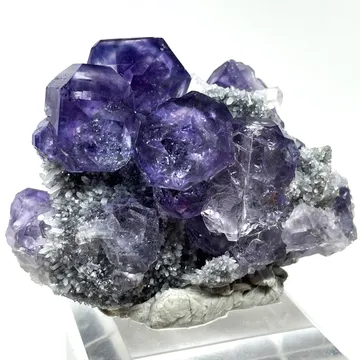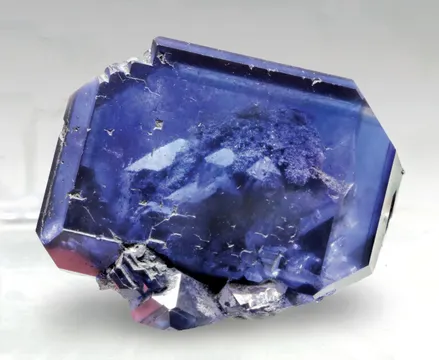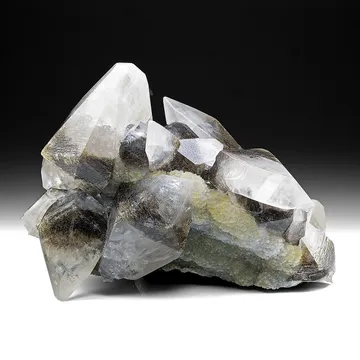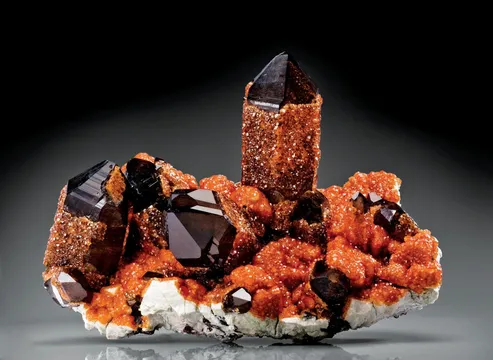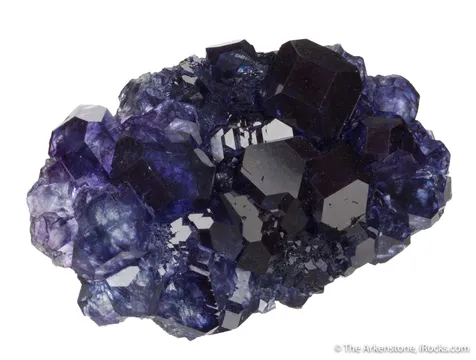
Yongchun fluorite from Xiayang Mine, Fujian — blue-violet, gemmy cuboctahedral crystals on quartz; prized for color, locality, and collector appeal.
Key facts
Yongchun County, in the interior hill country of Quanzhou, Fujian, entered the modern collector’s vocabulary through one conspicuous mineral: intensely colored fluorite on quartz from the Xiayang area. The locality is not an old classic in the European sense; its importance is the importance of a recent Chinese find that arrived rapidly, impressed dealers and collectors with saturated blue-violet color, and then became entangled in the familiar problem of Chinese fluorite labels that shift between nearby towns, counties, mines, exporters, and marketing names. The finest Yongchun-attributed specimens show transparent to gemmy fluorite crystals, commonly cuboctahedral, dodecahedral, or cube-dodecahedron combinations, set on bright white quartz druse. In the best pieces, the crystals are not merely purple: they carry a blue core or “tanzanite” cast in cool light and flash violet when backlit, with stepped faces, frosted modifications, phantoms, and internal zoning that give the crystals a cut-stone depth.
Regional View
Country View
The broader geological setting is southeastern China’s fluorite-rich, Mesozoic magmatic and tectonic province, where fluorine-bearing hydrothermal systems exploited faults, fractures, and carbonate or volcanic host rocks. At the specimen scale, the Yongchun material is open-space growth: fluorite and quartz lining cavities, not massive industrial fluorspar. The county’s verified mineral list is short, but the collecting identity is strong because the fluorite is visually unmistakable when good: deep violet-blue crystals, glassy windows, pale to white quartz matrices, and a tendency toward highly modified faces that can make even modest miniatures look architecturally complex.
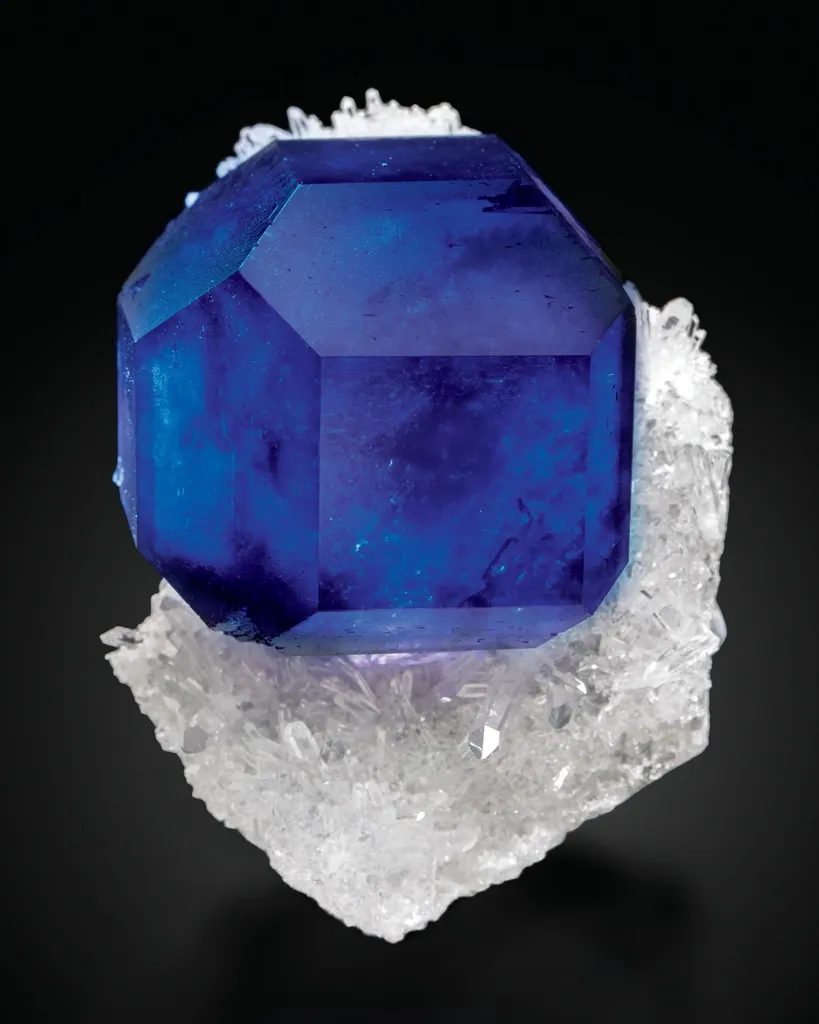
Photo: EarthWonders
Search for specimens: View all specimens from Yongchun Co., China
Collector labels normally place the fluorite at Xia Yang Mine, Xia Yang city or Xiayang Town, Yongchun County, Quanzhou, Fujian. Mindat records Xia Yang Mine as an active mine with lime/cement as the exploited commodity and lists calcite, fluorite, and quartz there. That is an important detail: this is not presented in the literature as a large, species-rich polymetallic ore mine in the style of Huanggang or Yaogangxian, but as a limestone/cement-related underground operation from which attractive fluorite-quartz-calcite pockets reached the specimen trade.
The mineralization is best understood as low-temperature hydrothermal fluorite and quartz in open spaces, with carbonate-hosted or carbonate-adjacent cavities playing a major role. Good specimens show fluorite perched on quartz rather than embedded in massive ore. The quartz forms sparkling druse, small clear to white prismatic crystals, or dense crystalline crusts over matrix; fluorite grew later or contemporaneously in cavities as modified cubes, cuboctahedra, dodecahedral-looking crystals, and intergrown aggregates. Calcite is documented as an accessory and in some Xia Yang material becomes more than a background mineral, appearing as prismatic or scalenohedral crystals on the same quartz-fluorite plates.
The mining and specimen history is modern. Fine pieces became visible internationally in the late 2010s, with dealers presenting Yongchun or Xiayang fluorites as novelties at major shows and online updates. A 2017 pocket is repeatedly cited in the trade for introducing the deep blue-violet “tanzanite fluorite” look, and by 2018–2019 the material was abundant enough at Tucson and in dealer inventories that collectors began to recognize it as a distinct Chinese fluorite style. Later auction records and dealer offerings show that production, resale, or old-stock circulation continued through the early and mid-2020s, including cabinet-size plates and larger individual crystals.
The locality data should be handled with unusual care. A 2024 locality note recorded by Mindat states that a Chinese geologist considered Xia Yang Mine not to be the true source of the famous “tanzanite” fluorites, and instead pointed to the Haixia Limestone Mine in Meihu Town, Dehua County, a nearby but administratively different locality. The two areas are close enough that this kind of trade-label migration is plausible, and specimens have circulated under several spellings and place names: Xia Yang, Xiayang, Yongchun, Quanzhou, Kengzikou, Keng Zi Kou, and occasionally broader Fujian labels. For the collector, the practical conclusion is not that every Yongchun label is wrong, but that high-end specimens deserve a provenance trail: dealer invoice, old label, publication record, and photographs from the original sale whenever possible.
Today, collecting access should be treated as closed unless arranged through the operator or local mineral-rights holder. The relevant workings are active or former industrial mine sites, and regional government material from Yongchun also documents mine restoration and abandoned-mine governance in the Xiayang area. These are not public dig sites. Most collectors will encounter Yongchun material through dealers, auctions, and collection resales rather than field collecting.
Fluorite is the defining collector mineral of Yongchun-attributed material, especially from the Xiayang/Xia Yang labels that entered the market from about 2017 onward. The classic specimens are blue-violet to deep purple, commonly transparent near the surface or when backlit, and occur as modified cubes, cuboctahedra, dodecahedral-looking crystals, and stepped intergrowths on white quartz druse; individual crystals in documented sales range from small thumbnail-scale crystals to several centimeters, with cabinet specimens carrying crystals around 5 cm reported in auction descriptions. The best pieces combine saturated “tanzanite” color, transparency, sharp modifications, and clean quartz contrast; ordinary examples are more opaque, bruised along cleavage edges, overgrown by sugary microcrystals, or lack the glowing internal blue-violet zoning that made the find famous.
Quartz from Yongchun is chiefly important as the matrix and textural foil for fluorite rather than as large standalone crystals. On the best Xiayang pieces it forms brilliant white to colorless druses of small prismatic crystals or dense sparkling crusts that wrap the matrix and lift the fluorite visually, sometimes with little quartz points growing around or against the fluorite faces. Quality is judged by freshness and contrast: clean, snowy quartz that is intact and bright makes the blue-violet fluorite appear richer, while stained, abraded, or dull quartz reduces the specimen’s display value even when the fluorite itself is colorful.
Other minerals verified from Yongchun County are few. Calcite is documented from the Xia Yang Mine and can occur with fluorite and quartz, including clear, prismatic, or more complex crystals that add a secondary focal point; some calcite on Xiayang-attributed specimens has been described as fluorescent. Kaolinite is recorded from the Daqiutou Mine in Yongchun County, a separate kaolin deposit tied to weathered granite porphyry and volcanic clastic rocks rather than to the fluorite pockets. No type-locality mineral is documented for Yongchun County in the sources consulted.
The principal collector issue is not synthetic material, but locality discipline. The best-known blue-violet “tanzanite fluorite” style has been sold as Xia Yang Mine, Xiayang Town, Yongchun County, Quanzhou, and sometimes simply Fujian, China; Kengzikou or Keng Zi Kou has also appeared on dealer labels. Mindat’s 2024 note suggesting the famous fluorites may actually come from Haixia Limestone Mine, Meihu Town, Dehua County, makes old labels worth preserving rather than “correcting” casually. When buying significant pieces, ask whether the specimen has a pre-2024 label, a dealer invoice, a show tag, auction lot history, or a publication reference.
Condition matters greatly. Fluorite has perfect octahedral cleavage, and Yongchun crystals often project from quartz plates, so edge bruising, cleaved corners, and contact marks along exposed crystal ridges are common. The highly modified faces can disguise damage; inspect with side light for unnatural flat cleaves that cut across growth texture. Conversely, do not mistake all frosted or stepped surfaces for damage: stepped macromosaic faces, etched-looking modifications, and frosted dodecahedral faces are part of the locality’s character.
Color should be evaluated under more than one light source. Many specimens appear blue in cool daylight or LED light and more violet to purple under warmer light, while backlighting can reveal internal phantoms and zoning. Some material fluoresces blue under UV, and associated calcite may respond strongly, but fluorescence is not consistent enough to authenticate a specimen by itself. Avoid prolonged direct sunlight for display; fluorite color can be stable in many specimens, but vivid purple and blue fluorites in general are best treated conservatively.
Market availability is better than for many one-pocket Chinese fluorites, but the top pieces are no longer casual purchases. Miniatures and small cabinets with decent color remain available through dealers and online platforms, while transparent, undamaged, sharply modified crystals on clean quartz command a premium. Large cabinet plates exist, including auctioned examples over 20 cm, but they are usually judged by composition and crystal condition rather than size alone.
The Yongchun story begins, in the collector market, with the thrill and confusion that accompany many modern Chinese discoveries. Around 2017, dealers began showing fluorites from Fujian with a color that seemed too gemmy for the usual purple-fluorite vocabulary. Mardani Fine Minerals described an April 2017 pocket from Keng Zi Kou Mine, Xiayang Town, as a never-before-seen style: fluorite with a blue tone in cool light and royal purple in warm light. That color shift gave the material its seductive trade name, “tanzanite fluorite,” a nickname that is mineralogically inexact but visually understandable the moment a good crystal is backlit.
The next act played out in show reports. Tom Moore, writing for The Mineralogical Record’s online “What’s New” reports, noted a November 2017 Arkenstone update with fourteen miniature to small-cabinet specimens of dark blue-purple fluorite attributed to Yong Chun County. He compared them to earlier blue-purple Chinese fluorites from Hunan, then did something collectors rarely do in print: he admitted that the resemblance raised the specter of “Chinese locality confusion or obfuscation,” studied his own earlier specimen closely, and concluded the color was subtly different. That sentence captures the Yongchun problem perfectly. The specimens were beautiful enough to buy; the labels were close enough to question.
By the 2018 Tucson Show, the material had become plentiful enough that Moore could refer back to it as a recognizable wave in the market. His later report on Tc-Mineral-China described transparent blue-purple fluorites from Xiayang, Yongchun County, with dodecahedral and cubo-dodecahedral crystals perched on white quartz. The human thread is memorable too: the dealer Mr. Chen, known for Chinese minerals, had moved from one productive source to another as localities “finished,” and the Xiayang fluorites appeared in that same modern rhythm of discovery, extraction, export, and sudden disappearance from the show tables.
Auction records added scale. Heritage sold a 9.3 cm fluorite on quartz from Xia Yang Mine in October 2022 for $3,250, describing the color as a shocking deep blue. In October 2024, a much larger 24.8 cm cabinet specimen from the Ben Zuraitis Collection crossed the block: a broad plate of interwoven fluorite octahedrons and dazzling quartz druse, with a 5.1 cm crystal and blue fluorescence under UV. That piece was called an odd find because it leaned blue-green rather than the more familiar violet, a reminder that Yongchun-attributed material is not a single look but a family of pocket styles.
Then came the locality twist. Mindat’s 2024 note that the famous “tanzanite” fluorites may not be from Xia Yang Mine at all, but from Haixia Limestone Mine in neighboring Dehua County, is the kind of update that serious collectors should welcome even when it complicates old labels. It does not erase the market history of Yongchun; it makes that history more interesting. The specimens remain the same glowing blue-violet fluorites on quartz, but the label has become part of the specimen’s story.