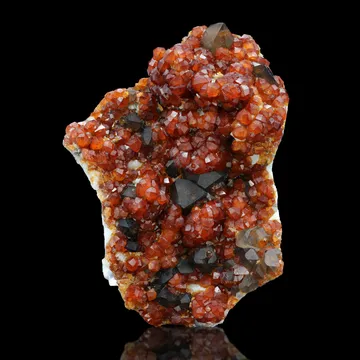
Tongbei, China locality: orange spessartine garnets in granite pockets with smoky quartz, iconic minerals prized by collectors for color and rarity.
Key facts
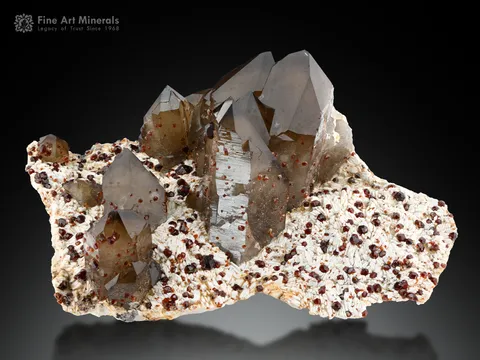
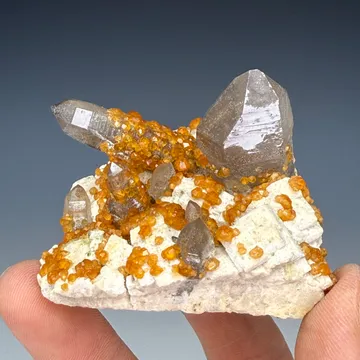
Tongbei is one of the great modern Chinese specimen localities: a miarolitic-granite occurrence in southeastern Fujian where orange spessartine crystallized in open pockets with smoky quartz, pale feldspar, muscovite, helvine, opal-AN, pyrite, and rarer fluorite and topaz. The collector’s image of Tongbei is instantly recognizable—bright, glassy, orange to red-orange garnets scattered like sparks over cream-white feldspar or climbing the lower faces of smoky quartz points. The best pieces are small sculptures rather than simple crusts: smoky quartz rising from feldspar, garnets concentrated around crystal bases and prism faces, occasional muscovite books or yellow helvine tucked into the pocket assemblage.
Geologically, Tongbei belongs to the Wushan granitic system near Yunxiao in Zhangzhou, Fujian Province. The specimens are not from a conventional metal mine with veins and ore stopes; they are pocket minerals from gas cavities and pegmatitic zones in granite, exposed by quarrying and specimen work. The host granites are part of the Late Cretaceous A-type granite belt of coastal southeastern China, and the Wushan pluton has been dated in the broad range of about 92–86 million years, with published work also citing an age near 91 million years. In the collector market, “Tongbei,” “Wushan,” “Wushan Spessartine Mine,” and “Yunxiao” have often been used with overlapping meanings, and a good label should be read as referring to the Tongbei–Wushan pocket field rather than a single sharply bounded underground mine.
Regional View
Country View
Tongbei’s historical importance is out of proportion to the small size of many of its garnets. When Chinese spessartine-on-smoky-quartz specimens first reached the international market in the late 1990s, they helped define the new wave of Chinese cabinet minerals: fresh, aesthetic, affordable enough to circulate widely, yet distinctive enough to become classics almost immediately. By the early 2000s the Tongbei look was firmly established, and fine pieces were being described, photographed, and traded as a new standard for matrix spessartine specimens.

Photo: Wikimedia Commons
Search for specimens: View all specimens from Tongbei, China
The Tongbei occurrence lies in Yunxiao County, Zhangzhou, Fujian Province, near the Wushan hill area southwest of Tongbei village. Mindat treats Tongbei as the broader deposit locality and lists the Wushan Spessartine Mine as a subordinate collecting locality; specimen labels may also give Tongbei alone, Wushan alone, or simply Yunxiao, Fujian. The important geological point is that the classic material comes from miarolitic cavities in granite: open spaces in the cooling pluton where quartz, feldspar, mica, garnet, and accessories grew freely into voids.
The deposit type is a miarolitic granite and pegmatitic-cavity occurrence within a Late Cretaceous aluminous A-type granite. Published summaries of Fujian mineralogy describe the Wushan pluton as part of a northeast–southwest belt of aluminous A-type granites associated with the Changle–Nan’ao fault system. The Wushan granite is metaluminous and aluminum-rich enough to favor aluminous pocket minerals, and the pegmatitic host rocks have been reported to have crystallized at roughly 505–532°C. The pocket assemblage is dominated by K-feldspar, quartz, spessartine, muscovite, and late accessory minerals; the manganese-rich chemistry that produced orange spessartine is the defining collector feature.
There is no ore body here in the normal mining sense. The “ore” for collectors was a network of miarolitic pockets and small pegmatitic zones within granite outcrops and quarry faces. Quartz and feldspar form the main pocket framework. Spessartine commonly came later, as individual trapezohedral to dodecahedral crystals, dense crusts, and drusy sprays on feldspar and smoky quartz. Helvine/helvite-group crystals, opal-AN crusts, pyrite, fluorite, topaz, beryl, microcline, orthoclase, albite, schorl, hematite, manganite, molybdenite, rhodochrosite, and milarite have all been documented from the Tongbei/Wushan locality system, though most are minor compared with the spessartine–quartz–feldspar association.
The mining history is inseparable from local granite extraction. Many specimens were exposed in the course of quarrying or working granite outcrops rather than through a formal underground specimen mine. Locality literature and collector commentary also emphasize that “Wushan Spessartine Mine” is partly a collector-market name: Wushan means Wu Mountain, and the label became a convenient way to separate the material from vague early “China” or incorrect Guangdong labels. Published locality notes record that the first Chinese garnet specimens associated with smoky quartz and feldspar appeared on the market in 1998 with Lechang, Guangdong Province, given as the locality. By the end of 2001, dealers and authors were identifying Fujian—specifically Tongbei near Yunxiao—as the true source of the classic material.
Production appears to have been strongest from the late 1990s through the early and middle 2000s. One Fujian mineral-diversity summary states that the Tongbei mine had ceased production by 2016, and contemporary market descriptions generally treat fresh Tongbei production as limited or absent. Present collecting access should not be assumed: database warnings and dealer notes describe the Wushan area as protected or closed to specimen extraction, and serious collectors should consider Tongbei a buy-from-established-sources locality rather than a practical field-collecting destination.
The notable finds are the pieces that made the locality famous: orange garnet crusts on pale feldspar, smoky quartz points emerging through garnet-covered matrix, quartz prisms partly coated by small garnets, and plates where the garnets are sufficiently sharp and gemmy to sparkle under a single cabinet light. Larger cabinet pieces are known, including impressive spessartine-with-smoky-quartz and pyrite-on-spessartine examples illustrated in Chinese mineral publications and exhibition catalogs, but most market specimens are miniatures, small cabinets, or hand-sized plates. The rarest and most closely scrutinized combinations are those with helvine, fluorite, topaz, or opal-AN, especially where the accessory mineral is well crystallized and clearly belongs to the same pocket growth.
Spessartine is the signature Tongbei mineral, occurring as bright orange, tangerine, cinnamon-orange, reddish-orange, and locally deeper wine-red crystals on feldspar and smoky quartz. The classic crystals are small—commonly millimetric and often around 1–5 mm—but they are sharply formed, lustrous, transparent to translucent, and typically show trapezohedral forms modified by dodecahedra; striated crystal faces are a familiar Tongbei trait. Exceptional pieces are judged less by a single giant garnet than by composition: dense but not muddy coverage, clean glassy crystals, saturated color, minimal bruising on exposed high points, and a lively relationship to the matrix, especially where spessartine climbs smoky quartz faces or frames a dark quartz termination without completely obscuring it. Gem study of Tongbei rough has confirmed very spessartine-rich chemistry, with analyzed material around Sps94Alm5Grs1 and unusual OH,F-rich structural features, which helps explain why the locality’s small crystals have attracted both mineral collectors and gemologists.
Quartz at Tongbei is important because it gives the garnet specimens their architecture: short to medium prismatic crystals, often smoky but also present as lighter quartz, rise from feldspar-rich matrix and provide dark transparent faces for the orange garnets to contrast against. The most desirable quartz-bearing pieces have undamaged terminations, balanced crystal clusters, good translucency, and garnets placed along prism faces, bases, or intergrown contact zones rather than simply smeared across broken matrix. Quartz crystals may be partly coated, peppered, or wrapped by spessartine, and the finest examples preserve enough clean quartz to show the original pocket form while still carrying the unmistakable Tongbei garnet sparkle.
“Garnet” labels from Tongbei almost always mean spessartine, but the broader garnet heading is useful because many specimens entered older collections simply as “orange garnet on smoky quartz” before the locality and chemistry became familiar. Tongbei garnets are not massive skarn garnets or coarse metamorphic crystals; they are pocket-grown, sharply bounded isometric crystals on feldspar and quartz, commonly in drusy fields or sparkling scattered groups. Good garnet specimens from Tongbei show individual crystal definition, glassy luster, and color consistency, while ordinary pieces may have duller brownish crystals, damaged druse, weak contrast, or so much coverage that the specimen loses the visual rhythm that makes the locality special.
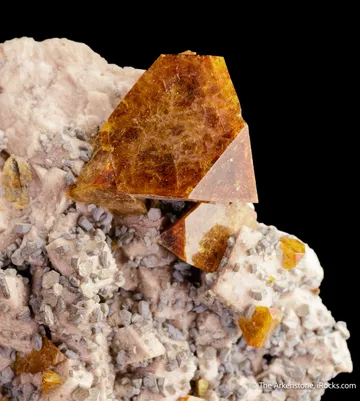
Helvite-group material from Tongbei, commonly recorded in modern databases as helvine, is one of the locality’s prize accessories. It occurs as yellow to honey-yellow, brownish-yellow, or coated pseudo-octahedral to tetrahedral crystals associated with spessartine, smoky quartz, muscovite, microcline, and locally fluorite; published Fujian mineral notes mention a 10 mm photographed crystal and report analytical work indicating a genthelvite-rich composition for some material. Collectors should value sharp, isolated crystals that sit visibly on feldspar or quartz rather than being lost in garnet druse, and should be alert to pseudomorphs: some early “helvine” specimens from Tongbei were later confirmed as manganese oxides after helvine, which are collectible in their own right but not the same thing as fresh yellow helvine/helvite crystals.
Feldspar is the main stage on which Tongbei’s famous garnets perform. Older descriptions commonly used orthoclase, while many current locality records and dealer labels identify the pale matrix as microcline or feldspar group; in hand specimens it is usually cream, white, pale beige, or faintly pinkish and may form blocky cleavages, etched-looking surfaces, or low-relief crystalline plates. Strong feldspar pieces are not merely matrix fragments: they provide clean pale contrast, undamaged crystal edges where present, and enough sculptural relief for spessartine to sit in sparkling groups rather than as a flat orange crust. Microcline with spessartine, smoky quartz, muscovite, helvine, or rare fluorite is especially desirable when the matrix is compact and aesthetically trimmed.
Smoky quartz is the classic Tongbei partner to spessartine, typically appearing as gray-brown to dark smoky prismatic crystals on pale feldspar, with garnets scattered across the surface or concentrated around the bases and prism faces. The strongest specimens have transparent to translucent smoky quartz with clean terminations and enough open face area to show the contrast between dark quartz and glowing orange garnet. Damage matters here: smoky quartz terminations and edges are exposed, and many otherwise attractive pieces have contacted sides, chips, or repaired-looking breaks. Premium examples balance deep smoky color, intact quartz geometry, and garnet placement; unusual pieces with garnets included in or seemingly partly enclosed by smoky quartz are much scarcer than simple garnet-on-matrix specimens.
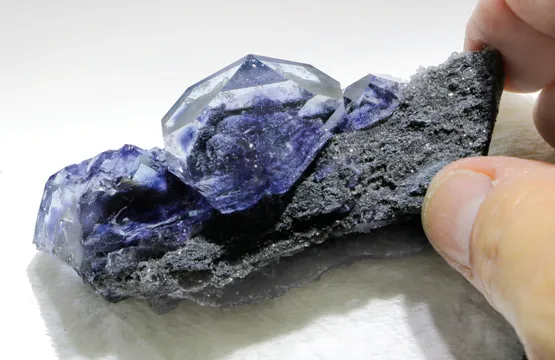
Other documented minerals from Tongbei and the Wushan collecting area include albite, beryl, calcite, clinochlore, fluorite, hematite, manganite, microcline, milarite, molybdenite, muscovite, opal including opal-AN, orthoclase, pyrite, rhodochrosite, and schorl. No accepted type-locality mineral is established for Tongbei in the major locality records, but the area is notable for rarities within the spessartine pocket assemblage: helvine/helvite-group crystals, opal-AN crusts that can fluoresce bright green under short-wave ultraviolet light, occasional fluorite, topaz, beryl, milarite, and large pyrite-bearing combinations. Fluorite is especially worth checking carefully because it is more characteristic of some related Fujian miarolitic localities than of the core Tongbei material, and well-documented Tongbei fluorite-spessartine combinations command extra attention.
The chief authenticity issue with Tongbei is not a widespread documented industry of artificial spessartine specimens; it is locality discipline. Early material was sold with Guangdong labels, especially Lechang, before the Tongbei/Yunxiao source was clarified. A classic orange spessartine–smoky quartz–feldspar specimen with an old Lechang label should be interpreted cautiously and may well belong to the Tongbei/Wushan production. Conversely, a modern label reading “Wushan Spessartine Mine” should be understood as the standard collector convention for the Tongbei–Wushan pocket field, not proof that the specimen came from a single named shaft or formal mine level.
Repairs, trimming, and condition are more realistic concerns than color treatment. The garnet color is natural, and the smoky quartz association is a primary pocket-growth relationship, but specimens were recovered from hard granite and many have sawn backs, trimmed edges, contacted sides, or repaired quartz. Use magnification to inspect glue at quartz contacts, crushed garnet druse along ridges, unnatural gaps beneath larger crystals, and matrix breaks that have been disguised by dirt. A sawn or trimmed back is not a defect if disclosed and if the display face is excellent; a reset smoky quartz point or added accessory mineral is a far more serious issue.
Condition standards should be strict. Tongbei spessartines are small and glassy, so bruising can be easy to miss in dealer photographs but obvious under side light. Rubbed garnet high points, broken smoky quartz tips, and chipped feldspar edges reduce value quickly. In better pieces the garnets should look sharp under 10x magnification, not sugary and crushed. Smoky quartz should retain at least one clean termination unless the specimen is primarily a spessartine plate. Helvine/helvite-group pieces need particular scrutiny: some Tongbei specimens are manganese oxide pseudomorphs after helvine, and those should be labeled as such rather than sold as fresh helvine crystals.
Fluorescence is a niche but useful collector feature. Spessartine itself is generally not the point of UV display, and gemological testing of faceted Tongbei spessartine found stones inert to both long- and short-wave ultraviolet radiation. Opal-AN or hyalite-like crusts associated with Tongbei/Wushan material, however, have been reported with bright green short-wave fluorescence, so a UV lamp can reveal a secondary feature that is nearly invisible in daylight.
Tongbei remains available on the market, but the buying environment has changed. Ordinary miniatures and small cabinets are still seen from older stock, estate collections, dealer inventories, and online auctions. Fine, undamaged, strongly colored, aesthetic pieces with clean smoky quartz are less replaceable than they once were, and specimens with verified helvine, fluorite, topaz, opal-AN fluorescence, unusually large garnets, or old provenance have become progressively more selective purchases. The best advice is to buy the specimen, not merely the locality: insist on sharp crystals, honest locality wording, disclosed repairs, and a composition that shows why Tongbei became famous in the first place.
Tongbei entered the Western market wearing the wrong name. In 1998, the first Chinese garnet specimens with smoky quartz and feldspar began appearing under Lechang, Guangdong Province labels. They were convincing enough to circulate, but wrong enough to create one of those small label mysteries that serious collectors still talk about. By late 2001 the story had changed: dealers began giving Fujian Province as the source, with Yunxiao as the nearest large locality, and the now-familiar Tongbei/Wushan attribution took hold. That shift matters today because it explains why an old Lechang label on a textbook orange spessartine-on-smoky-quartz specimen may be historically interesting rather than simply false.
The name “Wushan Spessartine Mine” also has a more complicated life than most cabinet labels suggest. Wushan means Wu Mountain, and locality notes preserve the view that the name was effectively coined in the trade to give more precision to specimens that otherwise would have been sold only as Tongbei, Yunxiao, Fujian, or China. The rocks themselves were not obliging enough to fit a neat dealer label: several granite outcrops and collecting sites in the wider Tongbei and Yunling region produced related miarolitic minerals. For most collectors, the practical truth is that the famous orange garnet and smoky quartz material belongs to the Wushan pluton around Tongbei village, even when no one can reconstruct the exact pocket decades later.
One of the most vivid locality details is architectural: published Fujian mineral notes record that houses in Tongbei were built of granite containing miarolitic pegmatite veins. It is hard to imagine a better metaphor for the locality. The same granitic body that supplied building stone to the village also held the little cavities that put Tongbei into mineral cabinets around the world. The collectible mineralization was not a broad ore zone glittering in a mine face, but scattered pockets in a hard, practical stone—granite for walls, granite for quarries, granite for the occasional open cavity lined with quartz, feldspar, and orange garnet.
The helvine story adds a cautionary collector’s twist. At the end of 2001, helvine crystals from Tongbei began to appear, some with dark surface coatings. Later, at least some specimens initially described as helvine were confirmed as pseudomorphs of manganese oxides after helvine. That does not make them uninteresting; it makes them more demanding. A yellow pseudo-octahedral helvine perched with spessartine is a prize accessory, while a blackened or replaced crystal may be a different kind of prize entirely—but only if the label says what it is.