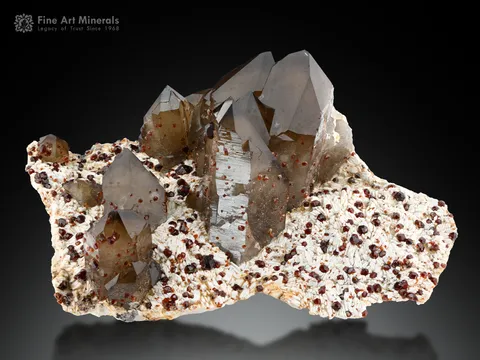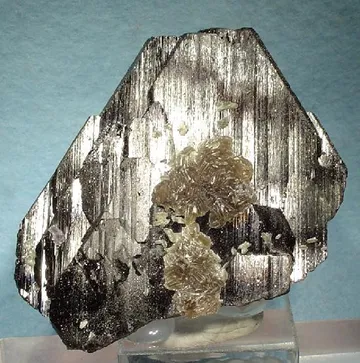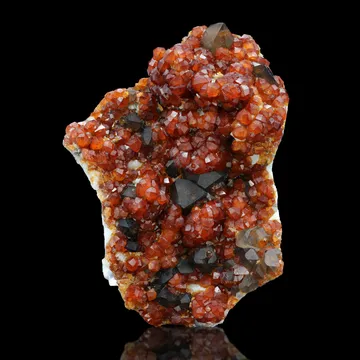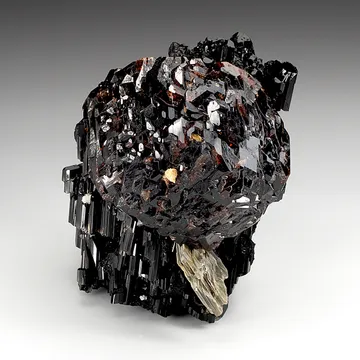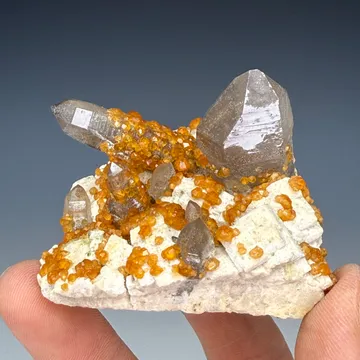
Muscovite from the Wushan Spessartine Mine is not the headline mineral of the locality; that role belongs to the vivid orange spessartine. Yet the mica is one of the accents that gives the best Tongbei-area pieces their mineralogical poise. It appears as pearly, thin, hexagonal books and stacked plates on pale microcline, commonly in the same miarolitic-cavity assemblage as smoky quartz and spessartine. On strong specimens the mica acts almost like a cool-toned architectural counterpoint: dove-grey, silvery, pale greenish, or chlorite-edged books set against glassy orange garnets and dark smoky quartz.
Key facts
Muscovite from the Wushan Spessartine Mine is not the headline mineral of the locality; that role belongs to the vivid orange spessartine. Yet the mica is one of the accents that gives the best Tongbei-area pieces their mineralogical poise. It appears as pearly, thin, hexagonal books and stacked plates on pale microcline, commonly in the same miarolitic-cavity assemblage as smoky quartz and spessartine. On strong specimens the mica acts almost like a cool-toned architectural counterpoint: dove-grey, silvery, pale greenish, or chlorite-edged books set against glassy orange garnets and dark smoky quartz.
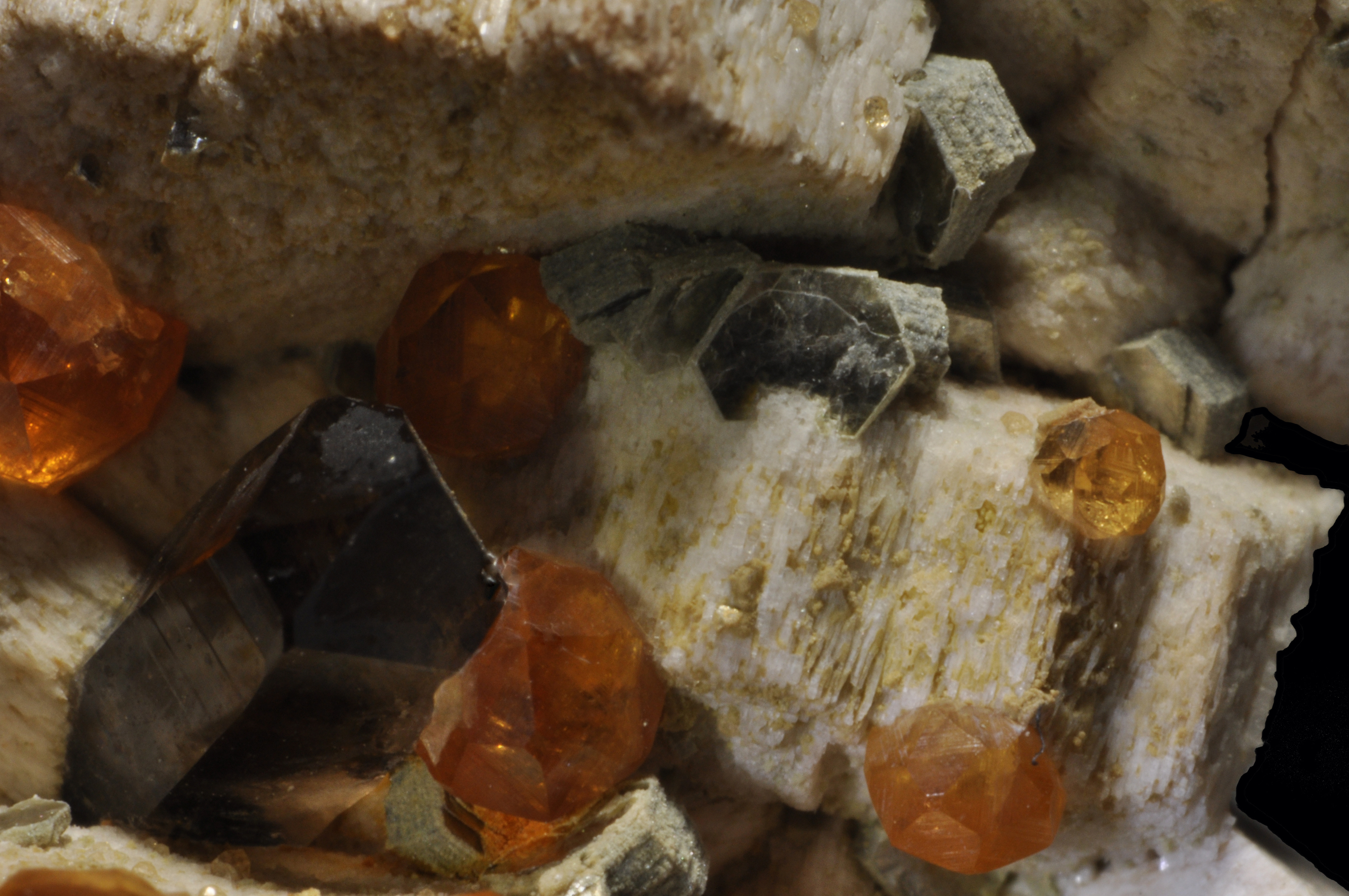
Photo: Wikimedia Commons
The locality belongs to the celebrated Tongbei–Wushan spessartine field of southeastern Fujian, a granitic, miarolitic-cavity environment in which specimen minerals were exposed mainly through quarrying and small workings in granite. The best-known specimens are plates or clusters of microcline and smoky quartz dusted or crusted with orange spessartine; muscovite is valued where it is well separated, sharply book-like, and visually integrated rather than merely a dull micaceous coating.

Photo: Wikimedia Commons
For collectors, Wushan muscovite is most compelling as part of a complex pegmatitic association. A freestanding muscovite-only specimen from this locality would rarely compete with classic micas from Pakistan, Brazil, or Minas Gerais pegmatites; the value here lies in context. A good Wushan piece shows the mica as a natural member of the orange-spessartine, smoky-quartz, microcline paragenesis that made the district internationally recognizable in the early 2000s.
Search for specimens: View all muscovite specimens from Wushan Spessartine Mine, China
The Wushan Spessartine Mine is listed at Tongbei, Yunxiao County, Zhangzhou, Fujian Province, China, at approximately 23.90611° N, 117.19806° E. The locality name is now entrenched in the mineral trade, but it is best understood as a commercial and collecting label for the Tongbei–Wushan area rather than a single sharply bounded underground mine. The “Wushan” name refers to Wu Mountain near Tongbei, while many specimens came from small workings, quarry faces, and miarolitic pockets in the surrounding granitic terrain.
Geologically, the specimens come from miarolitic cavities in granite and pegmatitic zones within a southeastern coastal Cretaceous granitic belt extending through Guangdong, Fujian, and Zhejiang. The Wushan granite is part of an aluminous A-type granite setting; published summaries place its age in the Late Cretaceous, roughly around 92–86 Ma, with crystallization temperatures for related pegmatitic host rocks reported in the range of about 505–532°C. These cavities produced a classic granitic assemblage: microcline, smoky quartz, spessartine, muscovite, fluorite, helvine, opal-AN, pyrite, beryl, topaz, and accessory species.
The production history is tangled because the earliest trade labels were not stable. Chinese spessartine specimens with smoky quartz and feldspar appeared on the market in 1998 under a Guangdong locality; by the end of 2001 dealers were giving Fujian and Yunxiao as the correct area. Tongbei became the collecting and trading center, and the orange spessartine-on-matrix specimens quickly became among the most recognizable Chinese mineral specimens of the modern era.
Access is not a casual field-collecting matter. Published locality notes describe systematic specimen recovery around Tongbei as tied to granite quarrying, with specimen extraction outside legitimate granite-building-material work described as illegal. Wushan is also described in locality notes as a protected national park, with collecting from exposed granite prohibited. For collectors, the practical implication is simple: present-day specimens should be evaluated as market specimens from earlier or dealer-held production, not as material to be field-collected by visitors.
Important production appears to have been concentrated from the late 1990s through the early-to-mid 2010s, with later market comments repeatedly noting reduced availability. A Fujian mineral-diversity paper records that the Tongbei mine had ceased production by 2016, based on personal communication from Shen Hong Tau of Wuhan University of Technology. Fine pieces still circulate, but much of the attractive material now offered is older stock, collection recycling, or dealer inventory from earlier finds.
Wushan muscovite is typically seen as compact mica books rather than broad, isolated museum-scale sheets. The books may be thin, hexagonal, stacked, pearly, and slightly translucent on edges. Colors reported and observed on photographed specimens include silvery grey, dove-grey, pale greenish-grey, and pearly off-white; some books have green chloritic sides or coatings, giving them a subdued green rim or skin.
The best muscovite is sharply defined and spatially separated on the matrix. Dealer-described high-quality examples include plates with three well-formed hexagonal muscovite books on microcline, and combination pieces where pearly muscovite books are scattered across feldspar with isolated cinnamon-orange spessartine and small smoky quartz accents. On other pieces muscovite is minor: small greenish groups, tiny books scattered across feldspar, or micaceous patches partly hidden among garnets and quartz.
Matrix is fundamental. The usual support is pale microcline, historically often called orthoclase in older descriptions. Current locality notes correct much of that older labeling: the feldspar associated with the spessartine is microcline rather than orthoclase. Smoky quartz occurs as small crystals through large prisms; published locality data notes smoky quartz crystals up to 30 cm from the area, though muscovite-bearing display pieces are more commonly cabinet to small-cabinet scale.
Associated minerals are the reason collectors pay attention. The signature association is muscovite with orange spessartine, smoky quartz, and microcline. Fluorite, when present, is a prized addition, especially in transparent octahedral crystals from pale green to blue or colorless tones. Helvine is another important association, occurring as yellow pseudo-octahedral to modified tetrahedral crystals; pieces with helvine and muscovite are less common than ordinary spessartine-microcline combinations. Opal-AN may occur as thin whitish crusts on feldspar or spessartine and can fluoresce bright green under short-wave UV.
Size ranges vary by role. Spessartine crystals on these specimens are usually small; high-luster transparent crystals are commonly under 5 mm, though some individual garnets reach larger sizes. Muscovite books on attractive specimens are usually accent-scale to several centimeters across, with exceptional combination pieces valued when the mica books are large, sharp, and clean enough to compete visually with the garnets. A 15.5 x 5.5 x 3.4 cm large-cabinet auction specimen was described with three sharp, hexagonal pearly muscovite books on microcline, illustrating the sort of muscovite presence collectors regard as unusually strong for the locality.
Quality factors for Wushan muscovite are very specific. The mica should be complete at the edges, not crushed into dull flakes; it should have pearly luster rather than a chalky or chloritized matte surface; and it should sit visibly in the composition rather than disappear under spessartine crust. A fine Wushan muscovite specimen usually succeeds as a combination: orange spessartine for color, smoky quartz for vertical structure, microcline for pale contrast, and muscovite for silvery geometry.
The main authenticity issue is locality precision. “Wushan Spessartine Mine” is a familiar and acceptable trade label, but it should not be read too literally as proof of a single mine. The name has been criticized by Berthold Ottens and later locality compilers as a dealer-coined or misleading label for material from several Tongbei-area workings and related granitic sites. Labels such as Tongbei, Wushan, Yunxiao County, Fujian, or Wushan Spessartine Mine may all appear on older pieces; the most careful modern labels keep the full Tongbei–Yunxiao–Zhangzhou–Fujian hierarchy.
The second common label problem is feldspar identity. Older descriptions frequently used orthoclase, but current locality notes state that the feldspar associated with the spessartine is microcline. Collectors should not automatically reject an older “orthoclase” label, because that wording is historically common; rather, it should be understood as part of the locality’s evolving documentation.
No widely documented muscovite-specific fake industry is associated with Wushan in the way that some classic localities have known glued composites or dyed minerals. The pieces most worth scrutinizing are complex, high-value combinations: spessartine on smoky quartz, fluorite-spessartine combinations, helvine-bearing pieces, and unusual isolated-crystal plates. Check for glue at crystal contacts, unnatural gaps under garnets, inconsistent dirt or polish around attachment points, and broken-and-reset quartz crystals. The natural Wushan style is busy and pocket-grown, with spessartine crusts or scattered crystals following microcline and quartz surfaces; a too-perfect crystal perched on a flat sawed area deserves magnification.
Treatments and preparation are more subtle. Sawed backs and bases are common and openly disclosed in many dealer records, usually to improve display. That is not fakery, but it affects value: a cleanly trimmed base is normal for Chinese cabinet specimens, while aggressive sawing that removes pocket context or leaves an awkward slab can reduce desirability. Locality notes also mention suspicion that some helvine pieces lacking dark surface coatings may have been treated with hydrochloric acid in Tongbei; this concern is tied to helvine rather than muscovite, but it matters on helvine-muscovite combinations.
Condition issues are predictable. Muscovite books cleave easily, so look for bruised edges, missing plates, compressed or bent stacks, and dull chloritic coatings that obscure luster. Smoky quartz terminations are often the most exposed part of the specimen and may show small chips. Spessartine crystals are small but can be abraded on high points; the best crystals remain glassy, transparent to translucent, and not pitted. Microcline matrix may show kaolinization in near-surface pockets, giving a chalky or friable look.
Market availability is moderate for ordinary spessartine-microcline pieces but much tighter for muscovite-forward combinations. Small accent muscovite is not rare on Wushan specimens; sharp, prominent mica books arranged with isolated orange spessartine and smoky quartz are far less common. The best muscovite-bearing examples tend to be older cabinet pieces from the early 2000s to early 2010s and are most often encountered through dealer back stock, auction archives, collection releases, and higher-end mixed-species Chinese specimen selections.
The name on the label is part of the story. The mineral trade knows “Wushan Spessartine Mine,” but the ground itself is messier than that clean phrase suggests. Wushan means Wu Mountain, near Tongbei; the specimens came not from a single romantic tunnel mouth but from a spread of small workings, quarry exposures, and miarolitic pockets in granitic rock. Berthold Ottens, who documented the district for The Mineralogical Record, later objected to the tidy mine name, and Mindat’s locality notes preserve the caution: the famous label is a useful convention, not a cadastral truth.
The market debut was equally confused. In 1998, Chinese garnet specimens with smoky quartz and feldspar appeared under a Guangdong label, with Lechang given as the locality. Only near the end of 2001 did dealers begin correcting the story toward Fujian, Yunxiao, and Tongbei. That is one reason older labels can be inconsistent yet still belong to the same collecting era. For a serious collector, an early label is worth reading as a historical artifact: it may tell as much about the international mineral trade of the early 2000s as about the pocket itself.
The best pieces changed how collectors pictured Chinese minerals. The classic form was instantly memorable: orange spessartine crystals, often gemmy and bright, scattered or crusted over pale feldspar with dark smoky quartz rising through the plate. Muscovite entered the scene quietly, as pearly books and grey-green stacks that gave the compositions a more complex pegmatitic character. On a strong specimen, the mica is not decoration; it is evidence of the cavity’s layered crystallization history, a soft-sheened mineral among glassy garnet and quartz.
Tongbei itself is also part of the geology. One published summary notes that houses in Tongbei were built of granite containing miarolitic pegmatite veins. That is a striking image: a village at the center of a specimen boom, literally built from the same kind of rock that produced orange garnets, smoky quartz, microcline, muscovite, helvine, and opal-AN. The specimen economy developed around stone that was already part of everyday architecture.
By the mid-2010s, the flow had changed. Auction records from 2012 were already reporting that the locality was “officially closed,” and later literature records Tongbei production as ceased by 2016. Fine pieces did not vanish from the market, but they began to feel increasingly like older-find material. Today, when a muscovite-bearing Wushan specimen appears with sharp books, clean orange spessartine, and an old dealer history, it carries the period flavor of the great Chinese specimen influx that reshaped cabinets in the first decade of the twenty-first century.