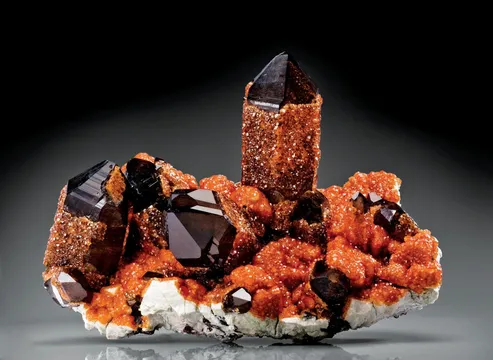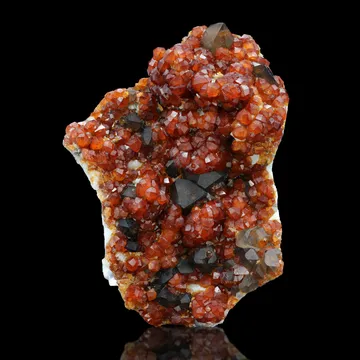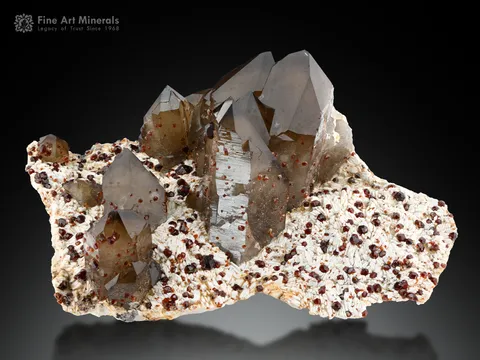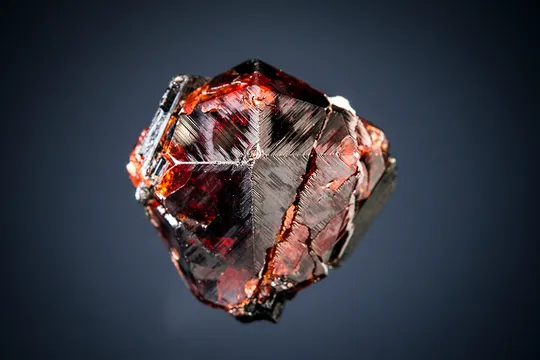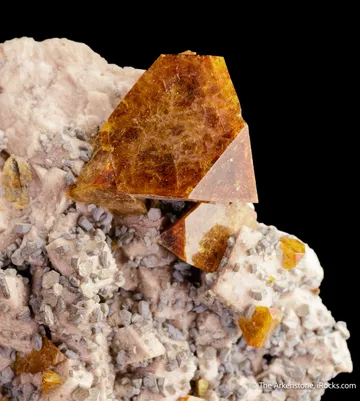
Tongbei spessartine, China — orange to red-orange garnet crystals with smoky quartz and microcline; gemmy luster, elegant pockets, collector appeal.
Key facts
Tongbei spessartine is one of the defining Chinese mineral classics of the modern collecting era: orange to red-orange garnet crystals scattered, crusted, or wrapped around smoky quartz and pale feldspar in a way that seems almost designed for the cabinet. The finest pieces have sharp, glassy trapezohedral garnets that flash like cut stones, but they retain the architecture of a pegmatite pocket specimen—smoky quartz points rising through orange garnet druses, mica books tucked between feldspar faces, and occasional accessory species that reward close inspection.

Photo: Wikimedia Commons
The Tongbei material comes from granitic miarolitic cavities in southeastern China’s coastal Cretaceous granitic belt. These cavities gave crystals open space to grow freely, producing the locality’s characteristic luster, clean faces, and three-dimensional combinations. Although many older specimen labels and early descriptions refer to orthoclase, the feldspar in the classic Tongbei association is now generally treated as microcline in locality records; older “orthoclase” labels should be read with that history in mind.
Visually, the attraction is the contrast. The spessartine is usually orange, reddish orange, amber-orange, or deeper wine-red; the smoky quartz ranges from pale gray-brown to nearly black; the feldspar is cream to white; and muscovite adds silvery books. The garnets themselves are commonly small, but on strong specimens they are gemmy, sharply edged, brilliantly lustrous, and densely distributed. That combination—small crystals but exceptional sparkle and balance—is what made Tongbei specimens so quickly recognizable.

Photo: Wikimedia Commons
Historically, Tongbei also matters because it entered the Western specimen market with a degree of confusion that has become part of the locality’s lore. Chinese garnet specimens with smoky quartz and feldspar appeared on the market in 1998 with Guangdong Province locality attributions, and only later were Fujian Province and the Yunxiao area recognized as the true source for the classic material. By the early 2000s, the orange garnet-on-smoky-quartz look had become unmistakable, and Tongbei was firmly established among serious collectors.
Collectors look first for undamaged, sharp, transparent to translucent spessartine crystals with bright orange to red-orange color and high luster. The best display pieces are not merely “covered” with garnet; they have rhythm—garnets arranged around quartz bases, isolated larger crystals interrupting a field of smaller ones, or a sculptural smoky quartz point partly veiled by orange crystals while its termination remains clean. Larger isolated garnets, balanced smoky quartz associations, and unusual accessory minerals such as helvine, fluorite, opal-AN, pyrite, topaz, beryl, or milarite add further interest.

Photo: Wikimedia Commons
Search for specimens: View all spessartine specimens from Tongbei, China
The classic Tongbei locality is in the Yunxiao County area of Zhangzhou, Fujian Province, southeastern China. Specimen labels commonly read “Wushan Spessartine Mine, Tongbei, Yunxiao Co., Zhangzhou, Fujian, China,” but the name should be handled carefully. “Wushan” means Wu Mountain, and the “Wushan Spessartine Mine” label became a convenient trade name for specimens from the Tongbei-Wushan area rather than a single conventional mine in the way collectors might imagine a mine. Locality notes also record that spessartine-quartz specimens on the market overwhelmingly came from the Wushan pluton around Tongbei village.
Geologically, these are granitic-pocket specimens. The host belongs to a long Cretaceous granitic belt along coastal southeastern China, extending through Guangdong, Fujian, and Zhejiang. In that belt, miarolitic cavities in granite produced pocket minerals; Tongbei was important because it was among the earliest places in the region where specimen mining for these cavities became systematic. The spessartine grew with smoky quartz and feldspar in open cavities, producing freely formed crystals rather than massive garnet or ordinary accessory grains.
Mining and collecting history are inseparable from quarrying. Many miarolitic-cavity minerals in the region were exposed through granite extraction. Local accounts distinguish legal granite building-material work from specimen extraction, and collecting from exposed granite at Wushan is now described as prohibited because the mountain area is protected. In practical collecting terms, Tongbei is not a field-collecting destination for foreign visitors or casual collectors; specimens are acquired through established dealers, old collections, auction records, and Chinese-market material already in circulation.
The market history begins around 1998, when Chinese spessartine with smoky quartz and feldspar first appeared with erroneous Guangdong attributions, especially Lechang. By late 2001, Tongbei near Yunxiao, Fujian Province, was being recognized as the source of the classic material. The late 1990s and early 2000s are therefore the prime production era for the best-known specimens. Later production appears much reduced, and many current dealer offerings describe their examples as older material from the first strong period.
Notable finds include broad plates of orange spessartine on feldspar, sculptural smoky quartz points coated around the base or sides with garnet, and rarer multi-species combinations. Helvine is an especially collectible accessory from Tongbei, commonly yellow and pseudo-octahedral, sometimes resting on feldspar or smoky quartz. Fluorite is much less characteristic for Tongbei than for some related Fujian localities, which makes verified Tongbei fluorite-spessartine combinations unusual and worth careful scrutiny. Thin whitish opal-AN crusts on feldspar and garnet are also recorded and can fluoresce bright green under short-wave ultraviolet light.
Tongbei spessartine most often appears as small but sharply formed garnets on a feldspar-rich matrix, with smoky quartz as the signature companion. The crystals are commonly trapezohedral, though dealer descriptions may also refer to rhombic dodecahedral-looking forms depending on crystal development and face expression. Good crystals show clean, bright faces, strong vitreous luster, and a gemmy interior glow when backlit.
Color ranges from bright mandarin-orange through reddish orange to deeper red-orange and wine-red. Many specimens have enough iron component to deepen the tone, but Tongbei is valued precisely because it can keep strong orange saturation without becoming dull brown or opaque. Gemological work on faceted Tongbei stones documented refractive indices around 1.805–1.810, hydrostatic specific gravity of 4.04–4.13, and inert behavior under both long-wave and short-wave ultraviolet radiation. Microscopic features in studied cut stones included fluid inclusions, rhombic growth structures, and anomalous lamellar birefringence under crossed polarizers.
The garnets are usually small: 2–6 mm crystals are very typical on specimen plates, while 8–12 mm crystals are more desirable and less common. Exceptional pieces may show crystals to about 1.3 cm, but Tongbei should not be judged by the standards of localities that produce large isolated single garnets. Its strength is repetition, sparkle, and association. A cabinet specimen with hundreds of crisp, glowing, evenly distributed garnets can be more important than a piece with one larger but less attractive crystal.
Associated minerals are a major part of Tongbei’s identity. The core assemblage is spessartine, smoky quartz, and feldspar, now generally understood as microcline in the classic association even though “orthoclase” appears in older references and labels. Muscovite books are common accents. Recorded accessory species include albite, beryl, calcite, clinochlore, fluorite, helvine, hematite, manganite, milarite, molybdenite, opal and opal-AN, pyrite, quartz, schorl, and topaz. Among these, helvine, opal-AN, pyrite, fluorite, topaz, beryl, and milarite are the species most likely to make a Tongbei piece mineralogically more interesting than a standard garnet-quartz-feldspar specimen.
Quality depends on five factors: color, luster, transparency, balance, and condition. The most desirable garnets are orange to red-orange, glassy, and at least translucent, with sharp faces and minimal edge wear. Matrix aesthetics matter greatly: smoky quartz points should be clean and well-positioned, feldspar should not dominate as a dead white mass, and garnets should be arranged in a way that draws the eye. A clean quartz termination rising from an orange garnet field is especially attractive, as are specimens where garnets wrap naturally around quartz sides while leaving part of the crystal exposed.
Gemologically, Tongbei spessartine has additional significance. A 2018 crystal-structure study of an OH,F-rich spessartine from Tongbei found a composition near Sps94 Alm5 Grs1 and showed tetragonal symmetry rather than ordinary cubic garnet symmetry because of elevated OH and F contents and vacancies in the tetrahedral site. For collectors, this does not change the cabinet appearance, but it makes Tongbei material more than just pretty: it is also a well-studied example of unusual spessartine crystal chemistry.
The most important authenticity issue with Tongbei spessartine is locality attribution, not garnet treatment. Early material was sold under incorrect Guangdong Province or Lechang labels before the Fujian source became recognized. Modern labels reading “Lechang” for this orange spessartine-smoky quartz style should be treated cautiously, especially when the specimen is visually indistinguishable from Tongbei material. “Wushan Spessartine Mine” is also best understood as a trade-locality convention for the Tongbei-Wushan area rather than proof of a single, precisely defined mine.
No widely documented spessartine-specific treatment problem is attached to Tongbei garnets in the way heating, dyeing, or coating might be for other minerals or gems. However, associated helvine from Tongbei has a documented caution: early helvine crystals reportedly had dark surface coatings, while later examples lacking those coatings were suspected of having been cleaned with hydrochloric acid. That concern applies to associated helvine surfaces rather than to orange spessartine itself, but it matters on high-value multi-species pieces.
Condition requires close examination. Many Tongbei specimens were prepared from tough granite pockets, and saw cuts on the base are common. A sawed base is not automatically a defect if it improves display and is honestly disclosed, but specimens with no visible saw cuts may bring a premium. Smoky quartz points often show small chips, broken rear crystals, contacted sides, or repaired-looking terminations; because the garnets are small and glassy, magnification is useful for checking crushed edges, rubbed high points, and glue around broken quartz. On plates, incomplete garnets at the perimeter are common and usually acceptable, while obvious damage in the main display field is much less acceptable.
Rarity is tiered. Small plates and thumbnails with orange garnets on feldspar or smoky quartz are still obtainable. Good miniatures and small cabinets with strong composition, clean smoky quartz, and gemmy garnets are much scarcer. Large, balanced cabinet specimens from the early production period are genuinely sought after, especially if they show abundant undamaged spessartine, sculptural smoky quartz, and minimal preparation scars. Specimens with accessory helvine, fluorite, bright green-fluorescent opal-AN, or documented old collection provenance deserve extra attention.
As of 2026, Tongbei spessartine remains present in the market but is no longer a fresh, abundant production locality in the way it was during its early surge. Current availability is strongest through dealer back stock, old collections, online auctions, and collector-to-collector sales. Prices vary widely: modest thumbnails and small plates can still be affordable, while high-end small cabinets and older, pristine, well-composed specimens routinely move into the high hundreds or low thousands of dollars. The best buying strategy is to choose aesthetics first, then verify locality history, condition, and whether the piece is merely a garnet-covered plate or a truly balanced garnet-smoky quartz combination.
The first Tongbei story begins with a wrong address. In 1998, orange Chinese garnets with smoky quartz and feldspar began appearing on the market under a Guangdong Province attribution, commonly tied to Lechang. The specimens were too distinctive to remain anonymous for long: bright orange garnets, smoky quartz, pale feldspar, and a look unlike the older American, African, or Pakistani spessartine classics. By late 2001, the labels began to shift. Fujian Province emerged as the real source, with Yunxiao as the nearest larger city and Tongbei as the locality name that would stay with collectors.
The second story is the name “Wushan Spessartine Mine” itself. It sounds precise, like a shaft or quarry with a single entrance and a single ownership history, but the name is more complicated. Wushan means Wu Mountain, and the “mine” label appears to have been a trade construction that gave dealers and collectors a more specific-sounding locality for specimens that actually came from small workings and quarries in the Tongbei-Wushan area. For collectors, that matters because the label is both useful and imperfect: useful because it points to the recognized classic material, imperfect because it should not be read as a GPS-level mine name.
The third story is the shift from quarry to protected landscape. The broader southeastern Chinese granitic belt contains many miarolitic cavities, and many pocket minerals were exposed by granite mining. Tongbei village became the first place in the region where specimen work became systematic, but locality notes distinguish specimen digging from granite building-material mining and describe collecting from exposed granite at Wushan as prohibited now that the area is protected. The result is a locality that remains common in collections but is not casually collectible at the source.
The fourth story belongs to the specimens themselves. Some pieces carry the unmistakable architecture of the early finds: smoky quartz crystals standing like dark glass chimneys from cream feldspar, their bases wrapped in orange garnets; fields of 2–6 mm crystals glittering across a plate; and occasional large garnets interrupting the surface like brighter embers. One especially memorable style shows a smoky quartz crystal with garnets clinging to its sides while the termination remains relatively clean, as if the garnet-forming stage rose around the quartz but never quite covered the last window into the crystal.