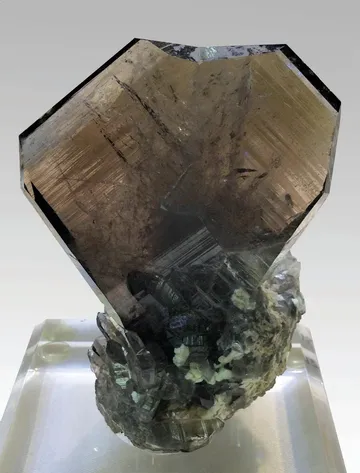
White Mountain Wilderness, USA — Sierra Blanca Smoky Bear quartz: glassy prismatic crystals with phantom zoning, high-altitude provenance, a prized collector l…
Key facts
White Mountain Wilderness is the high, roadless mineral country of Sierra Blanca in Lincoln County, south-central New Mexico: not a mine in the usual sense, but a rugged volcanic-and-intrusive mountain block whose name has become inseparable from some of the finest smoky quartz ever collected in the American Southwest. The collector locality most often represented in cabinets is the Smokey Bear Quartz Claims, also called the Sierra Blanca quartz locality, high in the White Mountain Wilderness at about 10,650 feet. Its best specimens are unmistakable: glassy, sharply terminated, simple-prismatic smoky quartz crystals, commonly with internal phantoms and smoky-to-colorless zoning, sometimes standing as bristling matrix plates rather than merely loose singles.
Geologically the setting is part of the Sierra Blanca Igneous Complex, a late Eocene to Oligocene volcanic pile intruded by alkaline stocks and dikes. The Three Rivers stock, a complex body ranging from syenite to quartz syenite and alkali granite, underlies much of the southern part of the wilderness and is central to both the economic-geologic story and the specimen story. Hydrothermal alteration and mineralization are widespread enough that the area drew prospectors for gold, silver, copper, lead, zinc, molybdenum, fluorite, and quartz crystals, yet the specimen legacy has outlasted the ore story: the great cabinet pieces are remembered not for metal content but for their combination of alpine-style clarity, New Mexico color, and high-altitude American provenance.
Regional View
Country View
For collectors, the essential distinction is between the Sierra Blanca / Smokey Bear style and the nearby but different Mina Tiro Estrella style that has often been confused with it in labels and online galleries. Sierra Blanca quartz is typically simple-prismatic, medium to dark smoky, sometimes much larger, and famous for phantom zoning; Mina Tiro Estrella material is generally smaller, more commonly twinned or Tessin-habit, paler to medium smoky, and associated with feldspar, bladed allanite, and titanite. That distinction matters because a correctly labeled White Mountain Wilderness smoky quartz is not just another New Mexico quartz: it is a closed classic from a locality with a real literature, a finite supply, and a look that advanced collectors learn to recognize.
Search for specimens: View all specimens from White Mountain Wilderness, USA
White Mountain Wilderness lies in the Sierra Blanca Mountains of Lincoln County, New Mexico, north-northwest of Ruidoso, in the Smokey Bear Ranger District of Lincoln National Forest. The wilderness occupies a steep, deeply dissected mountain mass with high relief, broad forested canyons on the east, much rougher western slopes, and elevations that climb from the lower Three Rivers side toward the crest below Sierra Blanca Peak. The highest peak itself is on the Mescalero Apache Indian Reservation, so the collector locality should not be casually broadened across reservation land; old labels that say simply “Sierra Blanca” need to be read carefully.
The deposit belongs to an alkaline igneous system rather than a pegmatite field in the New England or Colorado sense. The White Mountains are built of Tertiary volcanic rocks intruded by several stocks, including the Rialto, Bonito Lake, and Three Rivers stocks. The Three Rivers stock is the most important for this locality: it is a composite syenitic to alkali-granitic intrusion with quartz-bearing alkaline phases, local aplite and rhyolite dikes, alteration minerals such as sericite, epidote, chlorite, and iron oxides, and hydrothermal mineralization along fractures, breccia zones, and vein systems. The USGS and U.S. Bureau of Mines wilderness study described the mineralization as occurring in breccia pipes, disseminations in intrusive rock, and fissure veins.
The ore story is broad but mostly low-grade. Fissure veins in volcanic rocks were prospected for copper, lead, zinc, silver, and gold; molybdenum-copper potential was recognized in breccia-pipe and disseminated settings; and anomalous beryllium, niobium, rare-earth elements, molybdenum, fluorine, and riebeckite were noted as characteristic of the alkaline rocks near the Three Rivers stock. The USGS study emphasized that the narrow, lenticular veins had been heavily prospected, and that since 1880 more than 4,000 mining claims had been located in the study area, most of them on fissure-vein deposits in volcanic rocks. Assays from old workings show why prospectors kept coming back but also why no great mine resulted: individual chip and dump samples returned local gold and silver values, zinc, molybdenum, or copper stains, but the mineralization was not demonstrated as a large profitable ore body.
Named workings and claim groups in and around the wilderness include the Surprise Contact claim area, Park Gold Tunnel or Black Cap, Homestake-related workings, and numerous Nogal and Schelerville district claims. At the Surprise Contact area, USGS sampling noted amethystine quartz and minor copper staining on a dump sample, iron-stained quartz and calcite veins, malachite-coated fractures in porphyritic andesite, and a lamprophyre dike with minor gold and silver. At the Park Gold Tunnel / Black Cap area in upper Water Canyon, an adit was reported to be about 122 meters long, though caving and water restricted examination during the survey. These are mining-geology localities, not the source of the famous display smoky quartz plates, but they show the same larger pattern: fractured alkaline and volcanic rocks, local hydrothermal fluids, and persistent but uneven mineralization.
The specimen locality collectors mean when they say White Mountain Wilderness smoky quartz is the Smokey Bear Quartz Claims / Sierra Blanca quartz locality. The published locality description places the deposit in the southeast quarter of Section 29 and southwest quarter of Section 28, T10S, R11E, New Mexico Principal Meridian, at about 10,650 feet. Specimens from this locality are not ore specimens in the narrow sense. They are quartz-pocket specimens from an alpine-like, high-elevation fracture system in the alkaline intrusive complex. The pockets produced lustrous to brilliant smoky quartz, often with phantom growth zones, water-clear terminations, and distinctive smoky “blush” color. Matrix plates are especially prized because many pieces on the market are singles or detached groups, and because good plates show the locality’s characteristic forest of slim prisms rising from a thin matrix.
Collecting access today is the critical point: the collection and removal of quartz crystals from the White Mountain Wilderness area of Lincoln National Forest is strictly prohibited under a Forest Service closure order. General Lincoln National Forest rockhounding rules allow insignificant amounts of common rock collecting for personal, noncommercial use where no closure, claim, permit, lease, or surface disturbance issue exists, but quartz crystals from this particular wilderness are explicitly closed. Any modern field plan should begin with the Smokey Bear Ranger District and current Forest Service orders, not with old magazine articles, old dealer labels, or hearsay from earlier collecting days.
Quartz from White Mountain Wilderness is best understood through the Sierra Blanca / Smokey Bear material: sharply formed SiO2 prisms, generally simple rather than elaborately twinned, ranging from thumbnail singles to cabinet plates and exceptional crystals reported to about 40 cm. The most desirable pieces combine brilliant glassy luster, transparency, clean terminations, and internal phantom zoning; ordinary examples may still show the right smoky color but lack the sharpness, clarity, or damage-free presentation that makes the locality famous. White to colloform fluorite is an occasional accessory on Sierra Blanca pieces, while the broader wilderness also contains quartz in narrow hydrothermal veins, calcite-quartz veinlets, and locally amethystine quartz from prospect dumps, tying the showy pocket quartz to a much larger hydrothermal system.
The smoky quartz is the great collector mineral of White Mountain Wilderness, and good specimens have a very specific look: elongated prismatic crystals, smoky brown to smoky gray, commonly darker toward the base and paler or nearly colorless at the termination, with crisp internal phantoms that can appear as chevrons, veils, or sharply bounded growth ghosts. Sierra Blanca crystals are typically simple-prismatic and may form plates of slender points to several centimeters with larger crystals rising above them; fine examples are judged on alpine-level clarity and luster, intact terminations, lack of edge bruising, and the presence of strong phantom architecture. The finest matrix plates and large single crystals are scarce on the market because the collecting source is closed and most available specimens are older pieces from the active collecting period.
Chlorite at White Mountain Wilderness is not a showpiece species in the way smoky quartz is; it is chiefly part of the alteration story in the Sierra Blanca igneous rocks and associated volcanic wall rocks. Geological mapping in the Nogal Peak quadrangle describes altered volcanic rocks adjacent to intrusive bodies as commonly containing chlorite with sericite or chlorite with epidote, and some intrusive units show chlorite as a secondary alteration mineral with silica and iron oxides. As a collector-associated species here, chlorite is most plausibly encountered as greenish alteration, coatings, or inclusions on quartz-bearing material rather than as freestanding display crystals; the better specimens are those where the chloritic material adds contrast or documents the altered host without obscuring the sharp smoky quartz.
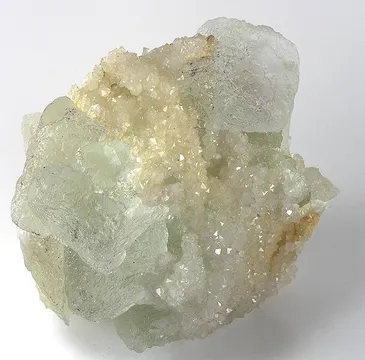
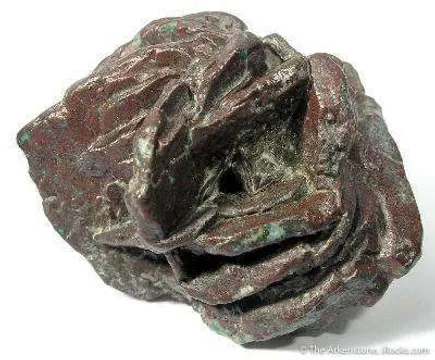
Other documented minerals from the White Mountain Wilderness and its Smokey Bear / Sierra Blanca collector locality include fluorite, allanite-(Ce), apatite, ferrimolybdite, molybdenite, pyrite, chalcopyrite, bornite, galena, sphalerite, native copper, native gold, malachite, goethite, hematite, siderite, baryte, calcite, and members of the tennantite and tetrahedrite subgroups. Fluorite is the accessory species collectors most want to see with Sierra Blanca quartz: usually white and colloform, but very rarely reported as mint- to emerald-green octahedrons. Allanite-(Ce) and apatite are important rarities in the Smokey Bear literature, while xenotime is notable from the wider wilderness geochemical story because rare-earth-element anomalies near the head of Indian Creek were attributed in part to its presence.
White Mountain Wilderness smoky quartz is a locality where provenance matters. Serious buyers should expect the label to say White Mountain Wilderness, Sierra Blanca, Smokey Bear Quartz Claims, or Smokey Bear / Smokey Bear Quartz Claims, Lincoln County, New Mexico. The spelling “Smokey” with an e is the classic locality spelling; “Smoky Bear” appears often enough to be understandable, but it is not the preferred locality form.
The most common authenticity problem is not fake quartz but mislabeling. Sierra Blanca / Smokey Bear material has been confused with Mina Tiro Estrella material from the Capitan area, and the difference is not trivial. Sierra Blanca pieces are generally simple-prismatic, medium to dark smoky, and can be much larger; Mina Tiro Estrella pieces are typically smaller, more often twinned or Tessin-habit, usually paler to medium smoky, and more commonly associated with feldspar, black bladed allanite, and titanite. A Japan-law twin labeled as Sierra Blanca should invite scrutiny, because Japan-law twins are characteristic of Mina Tiro Estrella rather than the Sierra Blanca Smokey Bear occurrence.
Condition is the next major issue. Many White Mountain Wilderness specimens are slender, glassy quartz crystals on thin matrix, and the edges of plates often carry small chips from extraction, trimming, transport, or old cleaning. Check terminations under magnification, especially on the tallest exposed crystals; look for bruising along prism edges; and examine the base of larger crystals for repaired breaks. Detached singles can be excellent and fully legitimate, but matrix plates command a premium when they are clean, aesthetic, and undamaged.
Preparation history should also be considered. Some Sierra Blanca quartz was reportedly coated with a thin quartz druse that had to be carefully removed to reveal the luster and clarity of the underlying crystals. Any specimen described as etched, cleaned, or acid-prepared should be evaluated for unnatural surface dulling, softened edges, residue in crevices, or loss of delicate accessory minerals. Hydrofluoric acid preparation, where it was used historically, is not something collectors should attempt casually; old prepared specimens are judged by the final surface quality and by whether the crystal faces retain sharp, natural luster.
The locality is effectively a closed classic for quartz crystals. Modern collecting of quartz crystals from White Mountain Wilderness is prohibited by Forest Service closure order, so the market is supplied by older collections, dealer inventories, and occasional deaccessions. Good thumbnails and small cabinet pieces appear from time to time, but fine matrix plates, large clean crystals, and specimens with fluorite or strong phantoms are much less common. The best examples are increasingly valued as American classics rather than merely regional smoky quartz.
The most enduring White Mountain Wilderness story is the way this locality sits on the boundary between old rockhound freedom and modern public-land protection. The mountains were already a wilderness, the slopes were steep, and the pockets were high, yet collectors still knew that the Sierra Blanca crystals could be extraordinary. Old pieces came out as glassy smoky prisms with phantoms sharp enough to rival European alpine quartz, but the same locality eventually became the example cited in New Mexico access discussions: a place where the question was not whether the quartz was good, but whether collectors had any right to remove it.
In 1990, a New Mexico Mineral Symposium paper on collecting law recorded a remarkably specific moment in the legal gray zone. The author noted that a Federal Magistrate in Alamogordo had recently ruled that minor excavations into vugs of exposed country rock and surrounding soil in the Sierra Blanca Wilderness Area, done noncommercially to collect smoky quartz, were not a violation of Forest Service regulations concerning removal or damage of natural features. The same account immediately showed how unsettled the ground still was: a Smokey Bear Ranger District employee reportedly said collectors could only pick up specimens exposed on the surface and that any excavation at all was prohibited. That tension—one judge’s narrow ruling, one ranger district’s stricter field interpretation, and collectors trying to read the gap between them—became part of the locality’s folklore.
Another story is told through mislabeled specimens. Collectors who know Lincoln County smoky quartz have repeatedly pointed out that some online and dealer-attributed “Mina Tiro Estrella” specimens actually match Sierra Blanca / Smokey Bear material instead. One Mindat discussion singled out the problem bluntly: several smoky quartz specimens posted under Mina Tiro Estrella were said to be from the Smokey Bear Prospect in the nearby Sacramento Mountains. That may sound like collector nitpicking, but it is exactly the sort of correction that protects value and history. A Mina Tiro Estrella smoky Japan-law twin and a Sierra Blanca smoky phantom crystal are both New Mexico classics; they are not interchangeable.
The locality also produced a small but memorable preparation lore. One collector described Sierra Blanca plates with four- to six-inch crystals showing clarity, luster, and smoky veils, then added the practical complication: the crystals could be coated by a thin quartz druse and had to be etched carefully to reveal their brilliance. It is an image any specimen collector can picture—the superb crystal already there, hidden under a later skin of silica, the difference between a mediocre-looking plate and a classic depending on patient, dangerous preparation and a steady hand.
Hanson, Timothy A., and Bob Thompson (1991), “The Smokey Bear Quartz Claims, Lincoln County, New Mexico,” The Mineralogical Record, vol. 22, no. 5, pp. 359–366. The key collector publication for the Smokey Bear / Sierra Blanca quartz locality, covering its history, mineralogy, and geology. Mineralogical Record issue listing
Segerstrom, Kenneth K.; Stotelmeyer, Ronald B.; Williams, Frank E.; and Cordell, Lindrith (1979), Mineral resources of the White Mountain Wilderness and adjacent areas, Lincoln County, New Mexico, with a section on aeromagnetic interpretation, U.S. Geological Survey Bulletin 1453, 135 p. The foundational federal mineral-resource study of the wilderness, with geology, geochemistry, mining data, claims, and resource assessment. USGS publication page
Segerstrom, Kenneth; Hladky, Frank R.; and Briggs, J.P. (1983), Mineral resource potential of the southeast addition to the White Mountain Wilderness, Lincoln County, New Mexico, U.S. Geological Survey Open-File Report 83-594, 9 p. A focused assessment of the southeast addition, concluding that despite favorable regional geology, the addition had low mineral-resource potential based on sampled veins and altered rocks. USGS report PDF
Giles, D.L., and Thompson, T.B. (1972), “Petrology and mineralization of a molybdenum-bearing alkalic stock, Sierra Blanca, New Mexico,” Geological Society of America Bulletin, vol. 83, pp. 2129–2148. A key petrologic and mineralization study for the alkaline intrusive system behind the White Mountain Wilderness resource story.
Thompson, T.B. (1972), “Sierra Blanca Igneous Complex, New Mexico,” Geological Society of America Bulletin, vol. 83, pp. 2341–2356. A major regional reference for the igneous complex that hosts the White Mountain Wilderness mineralization.
Thompson, T.B. (1973), Mineral deposits of Nogal and Bonito mining districts, New Mexico, New Mexico Bureau of Mines and Mineral Resources Circular 123, 29 p. Important background on the nearby district-scale precious- and base-metal deposits associated with the Sierra Blanca igneous rocks.
Goff, Fraser; Kelley, Shari; Lawrence, J.R.; Cikoski, C.T.; and coauthors (2011), geologic mapping of the Nogal Peak quadrangle, New Mexico Bureau of Geology and Mineral Resources. Useful for the modern interpretation of the Nogal Peak quadrangle, Three Rivers stock, Sierra Blanca volcanics, alteration, and mineralized trends in the White Mountain Wilderness core. Accessible copy
Northrop, Stuart A., and LaBruzza, Florence A. (1996), Minerals of New Mexico, 3rd ed., University of New Mexico Press. A statewide mineralogical reference that supports locality and species context for New Mexico specimens, including Lincoln County quartz localities.
Mindat: White Mountain Wilderness, New Mexico, USA — Regional locality page with the documented mineral list and sublocalities for the wilderness.
Mindat: Smokey Bear Quartz Claims, Lincoln County, New Mexico — The most important online locality page for the Sierra Blanca / Smokey Bear quartz occurrence, including the key locality distinction from Mina Tiro Estrella.
Mindat gallery: Smokey Bear Quartz Claims — Useful visual reference for the range of smoky quartz habits, phantoms, matrix plates, fluorite associations, and dealer-attributed specimens.
USGS Bulletin 1453: Mineral resources of the White Mountain Wilderness and adjacent areas — Essential technical source for the wilderness geology, geochemistry, mineralization styles, claims, and resource assessment.
Lincoln National Forest Land Management Plan, minerals section — Current Forest Service planning document noting that collection and removal of quartz crystals from White Mountain Wilderness is strictly prohibited.
Lincoln National Forest recreational prospecting brochure — Practical Forest Service guidance for rockhounding, prospecting, ownership, claims, and district contact expectations on Lincoln National Forest lands.
New Mexico Mineral Symposium abstract: Collecting on public lands — Valuable historical discussion of New Mexico mineral-collecting law, including the Sierra Blanca smoky quartz access controversy.
Mineralogical Record Vol. 22 No. 5 issue listing — Source for the classic 1991 Hanson and Thompson article, “The Smokey Bear Quartz Claims, Lincoln County, New Mexico.”
EarthWonders specimen example: Smoky Quartz from White Mountain Wilderness — Modern market example illustrating the large-cabinet Sierra Blanca style: a large smoky quartz crystal on a dense bed of smaller gemmy prisms.
Heritage Auctions archive: Smokey Quartz, Sierra Blanca, White Mountain Wilderness — Auction description documenting an older matrix plate and the collector-market view of the locality as a closed classic.