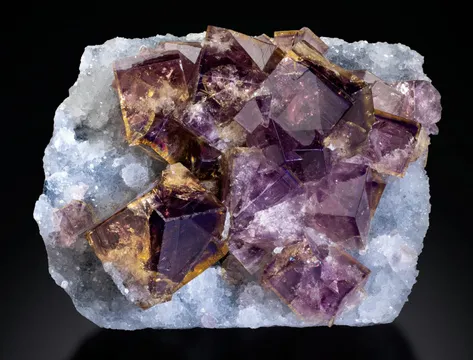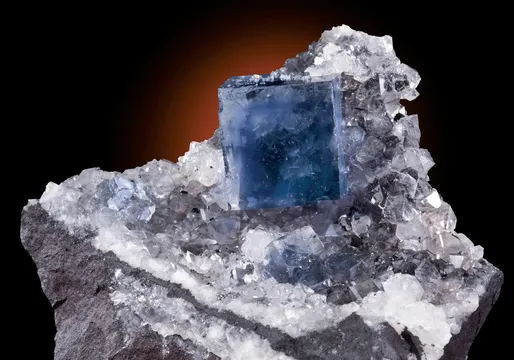
Wet Grooves Mine, UK — a Wensleydale lead-fluorite-baryte locality in North Yorkshire, prized for well-crystallised baryte and clear to pale yellow fluorite.
Key facts
Wet Grooves Mine is one of the classic Wensleydale names for collectors of northern English vein minerals: a lead mine in the Carperby-cum-Thoresby area of North Yorkshire, set into the broken limestone-and-grit country below Ivy Scar and around the conspicuous landslipped block known as The Knott. Its importance is not based on great industrial output alone, but on the unusually handsome suite of gangue minerals that came from a compact and geologically complicated part of the Askrigg Block. Here the Pennine lead-fluorite-baryte-carbonate assemblage is concentrated in fissure veins, strings, flats, and replacement bodies in Carboniferous limestones, especially around the Underset Limestone and related horizons. For the collector, the name “Wet Grooves” immediately suggests well-crystallised baryte/barite, clear to yellow fluorite, nail-head and aggregated calcite, and attractive secondary zinc-copper minerals such as aurichalcite and smithsonite.
Regional View
Country View
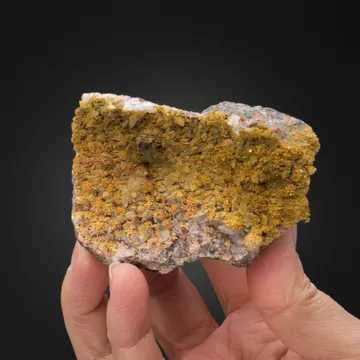
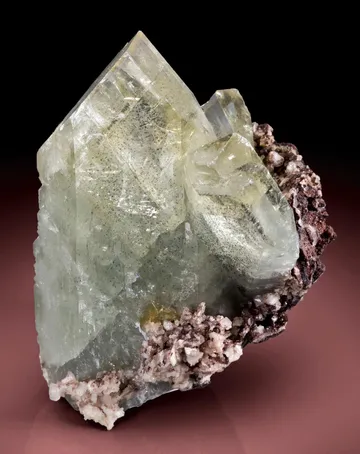
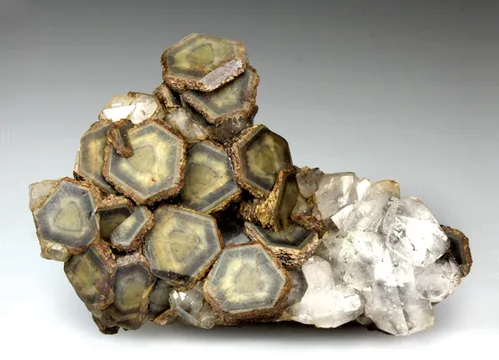
The mine sits in the Wensleydale “inlier” of the fluorite zone: an area where fluorite-bearing mineralisation appears in the valley rather than only in the better-known larger fluorite centres of the Pennine orefield. The best Wet Grooves specimens are recognisably Pennine, but they do not look quite like Weardale or the more prolific Yorkshire Greenhow-Grassington material. Barite may be pale blue, buttermilk, cream, tan, golden-caramel, or water-clear, often in thick chisel-shaped crystals or lustrous bladed groups. Fluorite tends toward clear, pale yellow, or amber cubes, sometimes etched or included, and commonly accompanied by calcite, baryte, chalcopyrite, hydrozincite, or smithsonite. Calcite is generally not the main trophy mineral here, but it supplies the crisp white to colourless carbonate architecture against which the more collectible baryte and fluorite are shown.

Photo: Gordon Hatton, Geograph Britain and Ireland
What makes the locality especially engaging is the way the specimens mirror the mining ground. The Knott is not merely a picturesque lump of limestone; it is part of the reason the mine has such a mixed habit of veins, strings, and replacement openings. Wet Grooves worked a fractured, slumped, basin-like structure where limestone was locally honeycombed by old workings, and where mineralising brines found many routes through open fissures and bedding planes. That structural confusion created headaches for miners, but it also produced the irregular cavities in which collector-quality baryte, fluorite, and calcite could grow.
Search for specimens: View all specimens from Wet Grooves Mine, UK
Wet Grooves Mine, also seen as Wet Groves Mine, lies near Carperby and Woodhall in Wensleydale, North Yorkshire, within the Yorkshire Dales National Park. The mining ground is centred around Ivy Scar, Haw Bank, The Knott, Eller Beck, and related levels and hushes. In formal locality usage it belongs to Carperby-cum-Thoresby, Richmondshire, North Yorkshire, England, UK. The main grid reference given in the British Geological Survey memoir for worked-over dump residue is SD987 902, placing it in the broken ground below the scar and close to the historic dressing and reworking areas.
Geologically, Wet Grooves belongs to the southern part of the Northern Pennine Orefield, on the Askrigg Block. The broader ore field is a Carboniferous-hosted Mississippi Valley-type family of deposits in practical collector terms: lead-zinc-copper sulphides and gangue minerals introduced by basinal brines into faults, fissures, and favourable limestone beds. The local country rock belongs to the Yoredale cyclothem sequence of limestones, shales, sandstones, and grits. Around Wet Grooves the British Geological Survey describes a closed faulted basin roughly 0.75 mile, or 1.2 km, across, with an amplitude of about 250 ft, or 76 m. Ivy Scar is formed of Underset Limestone dipping about 15 degrees west, and the area is unusual for the thickness of limestone in the Underset cyclothem: more than 50 ft of the approximately 90 ft cyclothem thickness is limestone. That unusually broad limestone outcrop gave mineralising fluids both fracture space and replaceable carbonate rock.
The mine is not a single clean vein in the textbook sense. The named structures include Woodhall Vein, Disher Force Vein, Oxclose Vein, Wet Grooves Knot Vein and Strings, Wet Grooves Cross Vein, Wet Grooves Vein, Thackthwaite Vein, and the Blue Scar/Brownfield system farther north. The principal Wet Grooves veins trend in several directions: the Knot Vein and strings are broadly north-south, the Cross Vein trends northwest, and the Wet Grooves Vein runs east-west, turning east-northeast. This is why old descriptions repeatedly stress confused ground, clumpy ore, replacement flats, strings, and irregular stopes rather than one simple lode. The Knott itself is regarded as a landslipped mass of Underset Limestone from Ivy Scar, now resting against Preston Grit and associated beds; it was strongly mineralised by fracture filling and replacement and became riddled with workings.
The ore was galena, with sphalerite present in small but persistent quantity and local chalcopyrite. The gangue suite is the collector’s attraction: fluorite, baryte/barite, calcite, witherite in parts of the wider system, dolomitic carbonate, and oxidation products including smithsonite, hemimorphite, hydrozincite, aurichalcite, limonite, and locally rarer secondary species. In the BGS zonal interpretation, Wet Grooves is one of the Wensleydale localities where the fluorite zone reaches the valley; as the veins are followed higher on the valley side, the mineralisation passes toward baryte gangue. This helps explain why specimens can show both attractive fluorite and strong baryte development. It also explains why Wet Grooves is so different from mines farther north on the same structural line, where fluorite may disappear and brown carbonate or calcite becomes more conspicuous.
The mine was an old lead producer long before the Victorian period. Local field evidence includes early smelting places, or bails, and one bail site near the mine has been reported with radiocarbon evidence from charcoal and slag in the range AD 1010–1080. Antiquarian tradition also links the area with John Leland’s mid-sixteenth-century account of Lord Scrope seeking lead ore at “a place in a great Rok,” a description often connected with The Knott or Ivy Scar. Surface open-cuts, hushes, shafts, and later drainage levels record a long sequence of working methods: early grooving and shallow extraction, water-assisted hushing, shaft work, and level driving.
By the eighteenth and nineteenth centuries Wet Grooves was a recognisable mining enterprise. Records cited in local history place miners working from shafts in the valley base in 1668, profit in 1732, and fluctuating eighteenth-century returns. Plews Shaft, sunk before 1804, was about 180 ft deep to the East or Haw Bank Level and was described as an engine shaft, the “engine” being a horse whim rather than a steam engine. During the 1820s the mine reportedly produced about 120 tons of lead per year, but it was then abandoned between 1829 and 1835. A new lease was taken in 1843 by the Wet Grooves Mining Company under William Craig as agent; Plews Shaft and the low level at Haw Bank were reopened, and between 1848 and 1855 the mine produced about 500 tons of lead. In 1855 there were 16 miners, later increased by four more men.
Victorian records preserve the practical difficulties of the mine. In February 1859 the dip of the vein was said to be carrying ore below the existing level, with a proposed lower level 15 fathoms beneath it, while carbon dioxide gas was already causing trouble underground. In April 1859 the mine was “badly hampered” by accumulations of carbon dioxide linked to depressed weather conditions, even though it had been doing well. In September 1859 the new level was being driven for ventilation and had cut lead ore, including lumps weighing up to one hundredweight; the same report notes that the ground was much confused. That phrase is a remarkably apt description for both the mining geology and the specimen-producing character of Wet Grooves.
The main period of underground lead mining ended in the later nineteenth century. BGS records state that the Wet Grooves and adjacent mines produced ore from the Simonstone and Middle Limestones, but that most ore came from the Underset level, and that all underground activity had ceased by 1879. The Bolton Park Company, successor to Storey and Company, had tested the mine down to the Preston Grit but found little encouragement and ceased operations in 1871. Nearby How Bank Mine, first listed in 1862, was merged with Wet Grooves in 1869, and the surrounding Wensleydale mines were broadly in decline by the late nineteenth century.
Wet Grooves had a second life as a fluorspar and barytes waste-reworking site. The extensive dumps south of The Knott and around the old dressing area were reworked after the Second World War. BGS included an estimated 5,000 tonnes for Wet Grooves and Keld Heads combined in its discussion of post-war fluorspar recovery. Local history gives a more vivid account of G.D.T. Minerals beginning in 1959, using mechanical jigs and flotation cells, working seasonally because freezing weather stopped the water-dependent plant, and producing roughly 15 tons per week during the first ten years. William Taylor, one of the partners, is said to have continued working at the site into the early 1970s. That reworking removed much of the old dump material and accounts for the relative scarcity of easy surface finds today.
Modern collecting must be approached conservatively. A public footpath crosses the mining landscape, and the ruins, hushes, adits, collapsed portals, shafts, and old dressing areas are visible in the field, but mineral rights and land access are not the same as footpath access. The site is in a national park, the underground workings are unstable, and old lead-zinc mine waste can contain heavy-metal residues. Serious collecting should be limited to legal, permission-based activity, with no entry into adits, shafts, or collapses unless under properly authorised mine-exploration conditions. Much of the accessible dump ground has already been reworked industrially and heavily picked over by collectors, so the best Wet Grooves pieces on the market are generally old collection specimens, specimens recovered during dump reworking or controlled collecting, or more recent pieces with reliable field provenance from named parts of the mine such as The Knott, Eller Beck Hush, Haw Bank, or the Wet Grooves/Knott Level area.
Wet Grooves barite is among the most desirable Yorkshire Pennine barytes when it has size, lustre, and undamaged chisel terminations: specimens range from compact bladed miniatures to cabinet pieces with individual crystals reported at roughly 4–7 cm, and the best examples show thick, sharp, lustrous blades or rhombic/chisel-shaped crystals in cream, buttermilk-yellow, pale blue-grey, tan, golden-caramel, or exceptionally clear material; it occurs with fluorite, calcite, galena, sphalerite, chalcopyrite, and secondary zinc minerals, and the most prized pieces are open, three-dimensional groups rather than flat plates of small white blades, especially where the crystals are translucent, display internal phantoms, or sit cleanly on a thin matrix from classic Wet Grooves material.
Wet Grooves fluorite is typically clear, pale yellow, amber, or lightly coloured rather than the saturated purple-green show material of some other northern English districts, but it is important because it marks a Wensleydale exposure of the fluorite zone and because specimens can show sharp, untwinned cubes, etched yellow crystals, and fluorite intimately associated with calcite, baryte, chalcopyrite, hydrozincite, smithsonite, and limonite; classic references record pale yellow crystals up to about 1 inch, while collector and dealer descriptions extend the field range to clear-to-pale-yellow cubes up to around 60 mm, with good specimens judged by transparency, sharp cubic form, pleasing contrast with white calcite or bladed baryte, and freedom from the bruising and cleaving common in recovered dump pieces.
Under the British spelling, Wet Grooves baryte is the same BaSO4 species as barite, but the locality is especially well represented in older British collections and in descriptive labels that stress “chisel barytes” from The Knott, Eller Beck Hush, and associated dump material; verified specimen records describe thin matrices covered with freestanding off-white to pale blue-grey crystals averaging about 14 mm with larger crystals to about 41 mm, large sprays below The Knott, and loose matrix-free flower-like groups of lustrous tan blades to more than 5 cm, while the highest-grade pieces stand out by having complete tips, glassy to mirror-like lustre, open spacing, and a colour or translucency beyond the more ordinary chalky white dump baryte.
Calcite from Wet Grooves is a supporting but locally attractive member of the assemblage, occurring as simple nail-head crystals and as more complex aggregated habits in the fluorite-baryte-galena-sphalerite-calcite vein and replacement system; it is commonly found with pale yellow fluorite and baryte, and it also provides the substrate for fine sprays of aurichalcite in some collector pieces, with the best calcite-bearing specimens valued less for isolated calcite perfection than for sharp, undamaged white to colourless crystals that give structure and contrast to fluorite cubes, creamy baryte blades, or blue-green secondary mineral sprays.
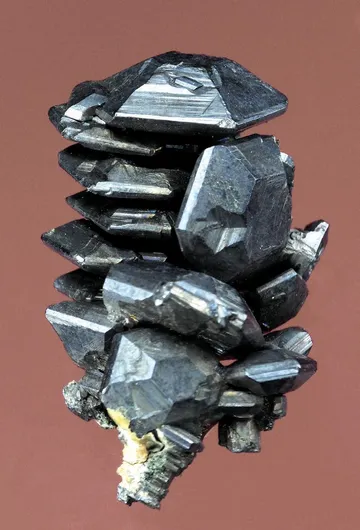
Other documented Wet Grooves minerals give the locality much of its specialist appeal. Galena was the lead ore, with sphalerite widespread enough that smithsonite and hydrozincite occur as secondary zinc species; chalcopyrite is a common accessory in some fluorite specimens. Aurichalcite is one of the locality’s most attractive micromineral and small-specimen species, reported as blue-green laths, sprays, and radiating spherulites on calcite. Hemimorphite is recorded from Wet Grooves and appears in the Russell Collection context for the wider orefield as chains of crystals and mammillary growths associated with siderite, sphalerite, witherite, baryte, galena, and later calcite. Smithsonite is relatively common but usually grey to pale orange and not especially showy. Greenockite, linarite, witherite, hydrozincite, limonite/goethite, pyrite or marcasite, and possibly small amounts of barytocalcite and gypsum have also been recorded in the broader collector literature for the site, though none has the specimen fame of the baryte-fluorite-calcite suite.
The chief authenticity issue with Wet Grooves is not widespread deliberate fakery, but provenance. Labels vary between “Wet Grooves,” “Wet Groves,” “Wetgrooves,” “Askrigg,” “Carperby,” “Wensleydale,” and “North Yorkshire,” and older British labels may use “barytes,” “barites,” “cawk,” or “spar” loosely. Specimens from nearby Haw Bank Level, The Knott, Ivy Scar, Thackthwaite Beck Hush, Disher Force Level, Brownfield Mine, and Woodhall may be geographically close and geologically related, but they are not always identical collecting points. A high-value Wet Grooves barite or fluorite should therefore be judged on the quality of its old label chain, not merely on a plausible Yorkshire appearance.
For barite/baryte, watch for repaired or trimmed blades, missing chisel tips, cleaved edges, and contacted undersides. Many specimens were recovered from old dumps or from reworked ground, so even otherwise fine pieces may have edge bruising, iron staining, or a sawn or cleaned base. The heavy density of baryte also means that matrix plates can crack or shed small crystals if handled carelessly. Deep golden or translucent Wet Grooves barite is scarcer than the more common off-white to tan material and deserves closer provenance scrutiny, but the colour range is real for the locality.
Fluorite is commonly pale and can be etched, included, partly cleaved, or bruised. Bright, undamaged, glassy cubes with strong contrast against calcite or baryte are much less common than loose amber or yellow fragments and damaged cubes from dump material. Wet Grooves fluorite should not be expected to resemble highly saturated Weardale classics; excessive colour intensity without a strong label history should raise questions about locality assignment rather than treatment alone. No locality-specific routine heat treatment, irradiation, or artificial colouring practice is well documented for Wet Grooves specimens, but generic fluorite colour alteration is always something to consider when provenance is weak.
Calcite is vulnerable to acid cleaning, bruising, and surface dulling. Because baryte, fluorite, calcite, and iron oxides commonly occur together here, over-cleaned specimens may show unnatural brightness, etched carbonate, or chalky residues in crevices. Aurichalcite and other secondary zinc-copper minerals are delicate and should not be washed aggressively, treated with acids, or stored where vibration can abrade sprays. Greenockite and other cadmium-bearing or lead-associated material should be handled with normal mineral hygiene: avoid dust, wash hands after handling, and keep small friable pieces away from children.
Market availability is intermittent. Small to medium Wet Grooves baryte and fluorite specimens appear from British collections and specialist dealers, but top cabinet barites with large, complete, lustrous crystals and old provenance are genuinely difficult to replace. The best examples increasingly trade as classic English mineral specimens rather than as casual locality pieces. Fluorite is available more often than premium barite, but fine, aesthetic Wet Grooves fluorite with calcite and baryte is much less common than the specimen count alone suggests.
Wet Grooves has one of those Pennine mining landscapes where the field story is almost as memorable as the specimens. Near The Knott, local historian Ian Spensley describes an early smelting site where Dr Richard Smith and Beryl Smith found pieces of slag and charcoal. Radiocarbon dating placed that material between AD 1010 and 1080, roughly the age of the Norman Conquest. It was not a grand smelt mill with flues and chimneys, but a bail: a simple open-air smelting place where timber or faggots were heaped with galena ore and the fire, oxygen, and carbon did the chemical work. In a few scraps of slag and charcoal, the site preserves the deep age of lead working in Wensleydale.
The Knott itself gives the mine its theatrical centre. It is a detached lump of Underset Limestone at the base of Ivy Scar, pitted with short workings and standing against the Preston Grit like a fallen block from the scar above. Antiquarian writers have connected this “great rock” with John Leland’s mid-sixteenth-century note that he had accompanied Lord Scrope to a place where “my lord seeketh for lead ore.” Whether Leland meant The Knott or Ivy Scar, the description captures exactly what the modern visitor sees: not a neat mine yard, but a rugged limestone mass, broken and opened, where the ore seems to have been chased into the rock wherever it occurred.
The nineteenth-century mine was no easier. Reports from 1859 describe a vein dipping so that the ore was passing below the working level, a proposed lower level 15 fathoms down, and carbon dioxide gas causing trouble underground. In April that year the mine was badly hampered for six weeks by carbon dioxide accumulations attributed to depressed weather, a reminder that the old lead miners were fighting invisible hazards as much as rock and water. By September, a new level was being driven to ventilate the mine. It had already found lead ore, including lumps weighing up to one hundredweight, but the report added the telling phrase: “The ground is much confused.”
Later explorers found the confusion still there. The Wet Grooves/Knott Level, begun in 1859, is now partly collapsed at the portal; its keystone survives not in the hillside but in the Dales Countryside Museum at Hawes. In the 1970s and 1980s, Spensley and companions could still get into parts of the workings and tried to dig through a fall in the continuation of the level, but there was nowhere to put the waste. They reached a route down toward the East or Haw Bank Level, about 200 ft below, only to find the low level flooded to the roof. A modern mine explorer described another Wet Grooves descent more playfully: a small shaft corkscrewing downward “like Alice down the rabbit hole,” with a lump of amber fluorite encountered on the way back up.
The last industrial chapter belongs not to galena but to fluorspar. In 1959 G.D.T. Minerals began processing the old waste. The plant needed water for mechanical jigs and flotation cells, and in the first decade it reportedly recovered about 15 tons of fluorspar a week from spring until winter. Frost could stop the work, but Tom Kearton recalled once working through a blizzard. William Taylor, one of the three partners, continued at the site into the early 1970s, leaving behind the sort of small, practical remains that look unremarkable unless one knows the story: a block wall, a stripped dump, and the memory of an old lead mine briefly reborn as a fluorspar operation.
K. C. Dunham and A. A. Wilson, Geology of the Northern Pennine Orefield: Volume 2, Stainmore to Craven, Economic Memoir of the British Geological Survey, HMSO, 1985. The essential geological source for Wet Grooves, including the Carperby structure, named veins, BGS grid references, tailings analyses, mineral zoning, production discussion, and the fluorite-zone interpretation.
https://webapps.bgs.ac.uk/memoirs/docs/B01792.html
J. R. Forster-Smith, “Extracts from Old Editions of the Mining Journal,” Memoirs, Northern Cavern & Mine Research Society, 1965, pp. 10–21. Includes the 1859 Wet Grooves Mining Journal extracts on gas, ventilation, lower-level proposals, and lead ore lumps weighing up to one hundredweight.
https://nmrs.org.uk/assets/pdf/M65/M65-10-21-extracts.pdf
Northern Mine Research Society Memoirs, 1973, pp. 151–160. Useful for nineteenth-century administrative and ownership notes in the Wensleydale group, including How Bank being merged with Wet Grooves in 1869.
https://www.nmrs.org.uk/assets/pdf/M73/M73-151-160-mines.pdf
Mindat occurrence record: “Fluorite from Wet Grooves Mine (Wet Groves Mine), Carperby-cum-Thoresby, Richmondshire, North Yorkshire, England, UK.” Useful for species confirmation, locality hierarchy, photo-linked associations, and the Harry Day/British Micromount Society database reference.
https://www.mindat.org/locentry-16048.html
Mindat occurrence record: “Hemimorphite from Wet Grooves Mine (Wet Groves Mine), Carperby-cum-Thoresby, Richmondshire, North Yorkshire, England, UK.” Confirms Wet Grooves as a hemimorphite locality with British Micromount Society database provenance.
https://zh.mindat.org/locentry-16458.html
Journal of the Russell Society, Volume 23. Includes discussion of scarce Yorkshire Pennine linarite records, noting minute visually identified linarite at Wet Grooves Mine near Carperby.
https://russellsoc.org/wp-content/uploads/2022/01/JRS-23-Website.pdf
Russell Society 3D Images PDF, aurichalcite entry. Illustrates aurichalcite from Wet Grooves Lead Mine as blue-green transparent laths forming loose radiating spherulites on calcite, from a David McCallum underground find.
https://russellsoc.org/wp-content/uploads/2025/05/3D-Images-pages-001-102.pdf
“Wet Groves Lead Mine in Wensleydale Video,” Ian Spensley, Yorkshire Dales History — A narrated field presentation with a full transcript covering the geology, early smelting, The Knott, levels, Victorian history, and fluorspar reworking.
https://yorkshiredaleshistory.wordpress.com/2021/09/13/wet-groves-lead-mine-in-wensleydale-video/
“Wet Grooves Mine, Wensleydale” media and locality photographs, Steetley Minerals — A collector-oriented page with images of the mine and Wet Grooves specimens, including barite and aurichalcite.
https://steetleyminerals.com/content/13-yorkshire
British Geological Survey — Geology of the Northern Pennine Orefield, Volume 2: Stainmore to Craven — The key technical geological reference for Wet Grooves and the surrounding Wensleydale mineralisation.
Mindat — Fluorite from Wet Grooves Mine — Species occurrence page with locality hierarchy, formula, associations, and photo-linked Wet Grooves fluorite records.
Mindat — Hemimorphite from Wet Grooves Mine — Confirms hemimorphite for the locality and links the occurrence to British Micromount Society data.
Steetley Minerals — Yorkshire — Collector-focused overview of Yorkshire localities, with a concise Wet Grooves section and specimen photographs.
Yorkshire Dales History — Wet Groves Lead Mine in Wensleydale Video — Rich local-history account of Wet Grooves, The Knott, early smelting, mining phases, and fluorspar reworking.
Northern Mine Research Society — Extracts from Old Editions of the Mining Journal — Primary nineteenth-century mining-news extracts, including the 1859 Wet Grooves reports.
Geograph — The Knott — A useful field photograph of The Knott and Ivy Scar landscape central to the Wet Grooves mining ground.
Geograph — Tunnel entrances — Shows adit entrances under Ivy Scar and the sparse vegetation of the old lead-mining ground.
28DaysLater — Wensleydale Lead Mines: Wet Grooves, Yorkshire, 2022 — Modern exploration report with photographs of the levels, collapsed portals, ore bins, corkscrew shaft, and remaining traces of mineralisation.
Mineral Auctions — Barite, Wet Grooves Mine, ex Cureton Collection — Market record for a large, old-provenance golden-caramel Wet Grooves barite, useful for understanding collector-grade examples.
Mineral Auctions — Baryte, Wet Grooves Mine, ex Kurt Hefendehl — Recent auction record illustrating the market for sharp tan Wet Grooves baryte groups.
EarthWonders — Baryte, Wet Grooves Mine — Example of a large cabinet Wet Grooves baryte specimen with locality notes, dimensions, fluorescence note, and market context.