A collector's guide to West Pasture Mine, UK: its geology, mining history and notable minerals, illustrated with the 48 specimens documented from this locality on EarthWonders.
Key facts
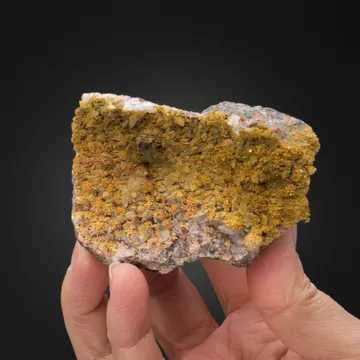
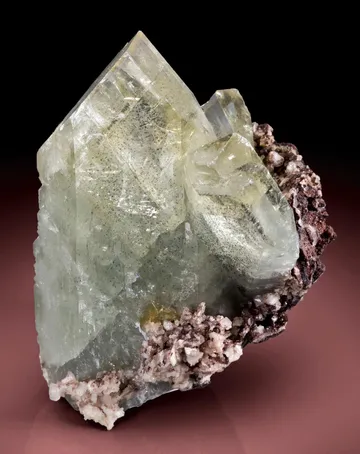
West Pasture Mine is one of the quieter but highly distinctive fluorite localities of the Stanhope district in Weardale, County Durham. It sits on the eastern side of Stanhopeburn, north of Stanhope, in the central fluorite–galena zone of the Northern Pennine Orefield, where mineralized faults and veins cut the Carboniferous limestones, sandstones, and shales of the Alston Block. For collectors, the mine’s importance rests on a very particular combination: apple-green to grey-green fluorite, commonly untwinned, from flats and related mineralized ground in the Great Limestone, often set against ironstone, galena, siderite, limonite, or quartz. The best pieces do not have the deep, theatrical purple of Blackdene or Frazer’s Hush, nor the modern commercial polish of Rogerley; they have a more reserved, unmistakably West Pasture character—subtle green cubes, sometimes pale yellowish or colourless, with a limestone-and-ironstone matrix that speaks directly of the flats from which they came.
Regional View
Country View
The mine accesses the West Pasture Vein, described in the geological literature as an eastern branch or continuation of the Red Vein system. The broader Stanhopeburn area was a working lead and later fluorspar landscape, with levels, quarries, smelt-mill remains, flues, and lime-working scars all lying close together in a compact stretch of valley-side ground. The locality therefore appeals not only as a mineral source but as a miniature cross-section of Weardale’s collecting history: lead ore first, ironstone flats, fluorspar, and finally specimen recovery from an old, deteriorating working known mainly to serious British collectors.

Photo: Wikimedia Commons
Search for specimens: View all specimens from West Pasture Mine, UK
West Pasture Mine lies near Stanhope, in Weardale, County Durham, on the east side of Stanhopeburn. The locality is usually labelled “West Pasture Mine,” though “West Pastures Mine” is common on specimen labels and in older dealer usage. For catalogue purposes, the singular form is the more defensible map and literature form, while the plural spelling is sufficiently entrenched in the collector trade that old labels should not be dismissed merely for using it.
Geologically, West Pasture belongs to the Northern Pennine Orefield, a classic Mississippi Valley-type fluorite–lead–zinc–barium province developed in Carboniferous sedimentary rocks above the concealed Weardale Granite and related basement structures. In the central fluorite zone around Weardale, hydrothermal brines moved through faults and fractures, depositing fluorite, galena, quartz, iron carbonates, calcite, and related minerals. Where the fluids reacted with limestone wall rock, they produced near-horizontal replacement bodies known to miners as flats. At West Pasture, the collector specimens are especially associated with flats in the Great Limestone, the same broad stratigraphic setting that made other Weardale mines famous for fine fluorite.
The West Pasture Vein is closely related to the Red Vein system. The mine appears to have been worked mainly for ironstone from flats connected with this structure, rather than as one of the great specimen-producing lead mines. The North Pennines Stanhope Burn geotrail notes that the West Pasture Vein was mined for galena from 1866 to 1879 and later for fluorspar in the 1970s. Nearby Stanhopeburn Mine, part of the same densely mineralized district, was a larger mining complex, with lead extraction from the Red Vein ending in the nineteenth century and fluorspar working continuing into the late twentieth century. The distinction matters: many specimens and historical notes from the immediate area can blur West Pasture, West Pastures, Stanhopeburn, Red Vein, and associated levels unless labels are precise.
The ore and specimen assemblage is compact but telling. Fluorite is the collector mineral: apple-green to grey-green when fresh, with purple, yellow, and colourless examples also known. Galena appears as the lead ore and as steel-grey to metallic crystals or crusts in association pieces. Siderite and related iron carbonate alteration are important to the visual identity of many specimens, commonly as brown bladed, crusty, or iron-stained matrix material. Quartz occurs as crusts and small sharp crystals, sometimes mantling fluorite or forming bright milky drusy plates on which small fluorite cubes sit.
Documented specimen sizes range from small cabinet plates with fluorite cubes around 8 mm to 15 mm, through classic apple-green pieces with crystals around 2 cm, to much larger purple fluorite crystals reportedly reaching about 70 mm on edge from fallen blocks inside the mine. A 1970s Richard Barstow list recorded West Pastures apple-green fluorite cubes to 3/4 inch on siderite/sphalerite veinstuff, while later records and market examples show cabinet pieces with translucent green cubes on iron-stained limestone, quartz, siderite, and galena. Recent trade references also include material labelled from the “Allison Pocket” in the Flat Drift or “Flatt Drift,” evidence that small named-find provenances circulate among collectors even though the published technical record for individual pockets is thin.
Access today is not a casual collecting proposition. The site is on private land, the old mine is in poor condition, and independent mine entry is unsafe. Published access notes describe collapsing timbers, unstable surface structures, and a gated or deteriorating entrance. The responsible collector treats West Pasture as a closed or permission-only historical locality: specimens should come from old collections, reputable dealers, documented organized visits, or clearly lawful collecting, not from trespass or underground exploration.
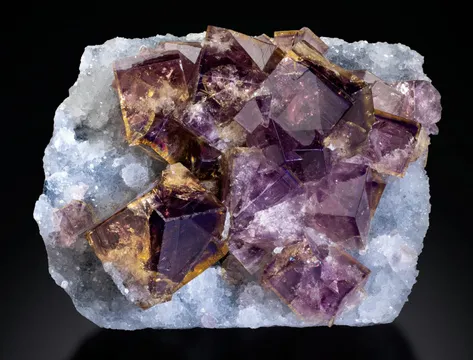
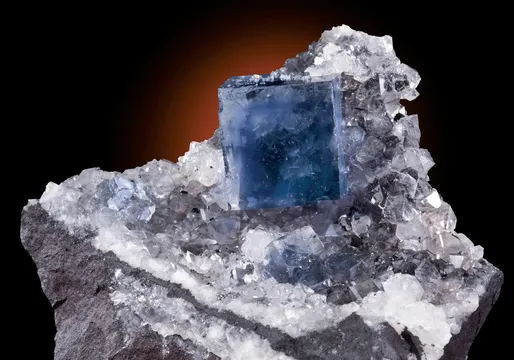
West Pasture fluorite is prized for a restrained apple-green to grey-green colour that can shift toward pale yellow-green, colourless, or purple, with the best specimens showing sharp, translucent to transparent cubes on ironstone, limestone, siderite, galena, or quartz-rich crusts. Unlike many Weardale fluorites, the crystals are commonly untwinned, a point repeatedly used by collectors when separating West Pasture material from superficially similar County Durham pieces. Ordinary examples are dull, bruised, or sun-faded; good ones retain a fresh citrus or apple-green body colour, bright cubic faces, clear zoning or internal glow, and attractive contrast with brown siderite blades, steel-grey galena, or sparkling quartz. Most classic green crystals are in the small-cabinet scale, commonly around 8 mm to 20 mm, but larger purple cubes to around 70 mm have been documented from fallen blocks within the mine.
Quartz from West Pasture is usually a supporting mineral rather than the principal prize, but it is central to the look of many of the best association specimens. It occurs as glassy to milky crusts, small sharp crystals, and drusy plates, sometimes with fluorite cubes perched across a sparkling quartz surface and sometimes as a later coating over fluorite or iron-carbonate matrix. Documented examples include plates of milky quartz crystals only a few millimetres tall carrying pale apple-green fluorite cubes, as well as larger West Pasture quartz specimens represented in collection-dispersal catalogues. The strongest quartz pieces are those in which the quartz is bright, sharp, and compositionally useful—framing the fluorite rather than burying it, or adding sparkle to otherwise sombre ironstone and siderite matrix.
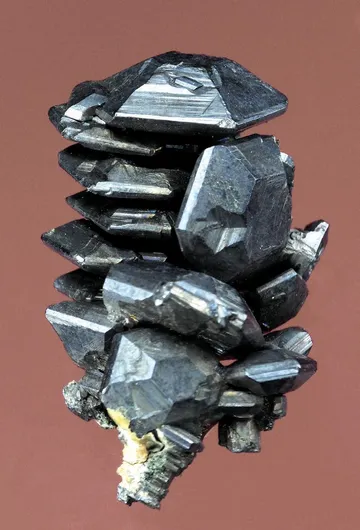
Galena is the historical ore mineral of the West Pasture Vein and remains an important association on collectible specimens, though it is much less often the display focus than fluorite. On West Pasture pieces it is typically seen as steel-grey to metallic crystals, crusts, or matrix patches with fluorite, siderite, quartz, limonite, and ironstone; older dealer records also describe bright modified galena crystals to about 8 mm associated with milky pyramidal quartz and pyrite crusts. The best galena-bearing specimens are not necessarily the largest galenas, but balanced fluorite-galena-siderite-quartz combinations in which the metallic grey sulphide gives contrast to pale green fluorite and brown iron carbonate. Loose or poorly labelled galena-rich material from Weardale can be hard to assign, so old labels and convincing matrix are especially important here.
Siderite at West Pasture is primarily the character matrix and association mineral of the flats, occurring as brown bladed, crusty, or iron-stained aggregates with fluorite, quartz, and galena. It is one of the best locality clues when assessing West Pasture material, especially where pale apple-green cubes sit on a compact iron-carbonate base rather than on the cleaner limestone or quartz matrices more typical of some other Weardale mines. Fine siderite-associated specimens show brown siderite as a textural foil rather than a muddy coating: crisp fluorite cubes rising from bladed siderite, small galena crystals embedded in the same ground, or quartz adding sparkle across the iron-rich surface. Siderite-only West Pasture pieces are far scarcer in the collector trade than fluorite combinations, but siderite is fundamental to the locality’s visual signature.
Other documented minerals from West Pasture Mine include aragonite, calcite, chalcopyrite, gypsum including selenite, malachite, and rosasite. These are not what built the locality’s reputation, but they matter to suite collectors because they show the small-scale secondary and accessory mineralogy developed in an otherwise fluorite–galena–iron-carbonate system. Rosasite is the most notable rarity on the list, recorded from British Micromount Society database material; malachite and chalcopyrite point to minor copper mineralization, while gypsum/selenite and carbonate species reflect late-stage alteration and open-space growth. West Pasture is not recognized as a type locality for a mineral species, but it is a good example of how a modest Weardale mine can reward close, label-conscious collecting beyond the headline fluorite.
The principal authenticity issue with West Pasture specimens is locality drift, not outright fakery. No well-established fake or treatment problem is attached to West Pasture fluorite in the standard collector literature, but pale green Weardale fluorites from several mines can overlap in colour and habit. West Pasture, West Pastures, Stanhopeburn, Blackdene, Heights, Eastgate, Rogerley, Diana Maria, Frazer’s Hush, and other County Durham names are all seen in the market, and an old specimen without a label can be difficult to assign securely. Strong West Pasture attribution rests on the whole specimen: pale apple-green to grey-green untwinned cubes, ironstone or limestone from Great Limestone flats, brown siderite or limonitic crusts, galena, and quartz, supported by an old label or a trustworthy collection chain.
The second major concern is colour stability. West Pasture’s green fluorite is notably prone to fading in direct daylight; fine pieces should be kept away from sunny shelves and ideally stored in a drawer or low-light cabinet. Fresh green colour is a value point, but it should be treated as vulnerable rather than permanent. Purple West Pasture fluorite appears more stable by comparison, but any strongly coloured Weardale fluorite is best handled conservatively.
Condition is a real market separator. West Pasture fluorite commonly occurs as small cubes on hard, iron-rich matrix, and many recovered pieces show bruised edges, dull surfaces, cleaved crystals, or iron staining. Minor bruising is common enough that a completely clean cabinet piece deserves attention. The most desirable specimens combine sharp untwinned cubes, preserved green colour, good luster, attractive matrix contrast, and no obvious daylight bleaching. Quartz-coated examples should be examined to ensure the quartz adds brightness rather than obscuring the fluorite.
Under longwave ultraviolet light, West Pasture fluorite can show bluish-white to purple fluorescence, and modern auction records describe strong purple fluorescence on some specimens. Fluorescence is useful supporting evidence for Weardale attribution, but it is not diagnostic by itself. Many northern Pennine fluorites fluoresce, and fluorescence should never override label quality, matrix, habit, and association.
In the current market, West Pasture is available but not abundant. It appears through British dealers, older collection dispersals, auction lots, and occasional small modern or recently cleaned specimens. Small apple-green examples remain obtainable; large, fresh, lustrous, well-composed cabinet specimens with old labels or named-pocket provenance are much less common. Because the mine is not an active specimen operation and safe access is limited, provenance adds real value.
At a Russell Society Northwest Branch “Show and Tell” meeting in January 2016, John Davidson brought out a West Pastures specimen that captured the experience of collecting this locality better than a polished auction description ever could. His account followed a Weardale side trip to what the report called “a very muddy locality,” where a piece was not so much spotted as felt in wet, gooey mud, then taken home for washing and an Iron Out soak before the green fluorite revealed itself. The West Pastures piece came out among “heavy bags” carried from the mine: apple-green fluorite that, once cleaned and shown under ultraviolet light, displayed a “wonderful ‘glow’ in UV.” That small meeting-room moment—mud, weight, cleaning, and then the sudden fluorescence—is exactly the kind of afterlife old Weardale mines still have for collectors.
Another modern West Pasture story is the slow detective work of a mislabelled specimen. A collector found a fluorite in an Ontario mineral shop labelled as Kentucky, but the colour, fluorescence, siderite-rich matrix, and North of England look raised doubts. Experienced collectors on Mindat compared the habit and associations, asked for photographs of the matrix, and noted that West Pasture specimens commonly carry siderite, galena, and the pale green fluorite look. After the back of the specimen showed a nearly solid siderite-like vein material, the consensus shifted toward West Pasture. The discussion also preserved a useful label lesson: “West Pasture” is the Ordnance Survey and Dunham spelling, while “West Pastures” seems to have spread in the dealer trade after appearing on specimens for sale.