A collector's guide to Valais, Switzerland: its geology, mining history and notable minerals, illustrated with the 49 specimens documented from this locality on EarthWonders.
Key facts
Valais is not a single mine in the ordinary sense; it is one of the great mineral provinces of the Alps. For collectors, the canton matters because it brings together three different traditions of Alpine mineral collecting in one long Rhône-centered mountain corridor: classic alpine-cleft quartz, epidote and feldspar from high metamorphic rocks; tunnel and pass specimens from the Simplon and Furka regions; and, in the Binn Valley, the extraordinary Lengenbach sulfosalt locality, where minute metallic species in white dolomite have made mineralogical history for nearly two centuries.
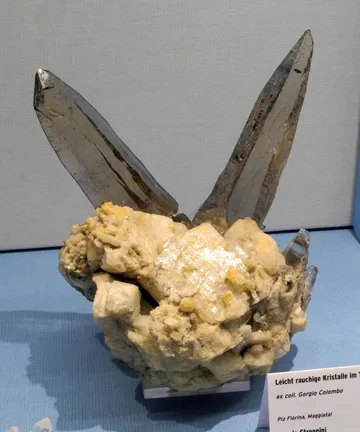
The best-known Valais alpine-cleft specimens come from fractures opened during late Alpine uplift in gneiss, schist, amphibolite, quartzite, marble and serpentinite. These fissures were not ore bodies in the mining sense; they were open spaces where hot aqueous fluids deposited crystals slowly enough to give sharp faces, lustrous terminations and clean associations. Quartz appears as clear rock crystal, smoky quartz, doubly terminated floaters and the coveted twisted gwindel habit. Albite, especially pericline, supplies porcelain-white to cream blocky crystals. Epidote from the Zermatt–Saas Fee area adds deep green, glassy prisms on matrix, in some cases as bright doubly terminated crystals. The common Alpine supporting cast—chlorite, adularia, rutile, hematite, titanite, calcite, fluorapatite, anhydrite and zeolites—gives Valais specimens the visual grammar collectors expect from the central Alps: clean geometry, selective chlorite dusting, and a tension between snowy feldspar, smoky quartz and dark green silicate blades.
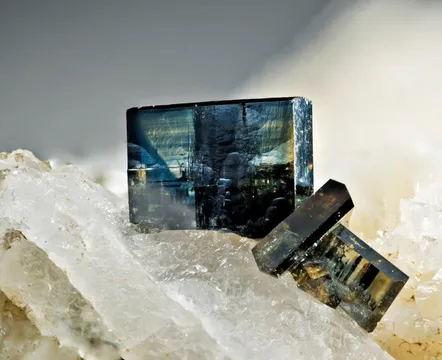
The other Valais is microscopic and metallurgical. At Lengenbach, near Fäld in the Binn Valley, Triassic meta-dolomite of the Penninic Monte Leone Nappe hosts one of the richest sulfosalt assemblages on Earth. Instead of big display crystals, its treasures are tiny, brilliant, chemically exotic sulfides and sulfosalts containing Pb, Tl, Ag, Cu, As, Sb and related elements. Species such as baumhauerite, dufrénoysite, hutchinsonite, sartorite, wallisite, hatchite, lengenbachite, jentschite, sicherite, gabrielite and many others have made the quarry a permanent reference point in systematic mineralogy. A good Lengenbach specimen is not judged by size alone; it is judged by crisp metallic crystals in snow-white dolomite, reliable provenance, and whether the species can be confidently distinguished in hand specimen or under magnification.
Regional View
Country View
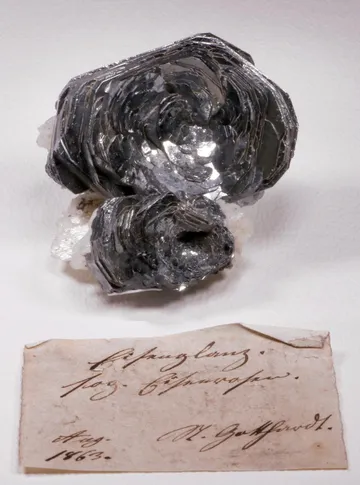
Across Valais, the collector’s eye should read the label carefully. “Valais” can mean a broad canton-level specimen from an old European collection, a precise high-cleft find from Binn, Furka, Zermatt, the Rhône Glacier or the Simplon area, or a micro-specimen from the Lengenbach quarry. Old labels may use Wallis, Binnental, Binntal, Goms, Mattertal, Zermatt–Saas Fee or Simplon rather than the modern locality hierarchy. The finest specimens are those that retain this old paper trail while showing the unmistakable Alpine look: sharp quartz with slight smoke, lustrous green epidote, clean pericline, rutile needles, or white dolomite carrying metallic sulfosalts.

Photo: Wikimedia Commons

Photo: Wikimedia Commons
Search for specimens: View all specimens from Valais, Switzerland
Valais occupies a structurally complicated part of the Swiss Alps, with the Rhône Valley cutting between major Alpine tectonic domains. North of the valley are Helvetic units and crystalline basement massifs; south and southeast lie Penninic nappes, including rocks derived from former oceanic and continental-margin settings. For mineral collectors, this regional geology matters because the canton exposes a wide suite of metamorphic host rocks—gneiss, schist, amphibolite, serpentinite, quartzite, marble and dolomite—crossed by late fractures that acted as crystallization cavities during uplift and cooling.
The principal specimen deposit type in most of Valais is the Alpine fissure or alpine-cleft vein. These are open fractures, commonly in metamorphic rocks, lined by quartz, albite, adularia, chlorite, epidote, calcite, rutile, hematite, titanite, fluorapatite and related species. Their contents vary with host rock: granitic and gneissic rocks favor quartz, feldspar, mica, chlorite and rutile; mafic and calc-silicate settings add epidote, actinolite, titanite and darker chloritic coatings; carbonate settings introduce calcite, dolomite, ankerite and, locally, unusual sulfide or arsenate assemblages. Fine specimens generally come from clefts that remained open long enough for isolated crystals to form without being crushed by later movement.
The Zermatt–Saas Fee and Mattertal region is especially important for epidote and alpine-cleft assemblages. The classic collector material includes intense green epidote crystals from the Pollux Mountain and Rimpfischwäng–Findel Glacier area, associated in the wider district with quartz, albite, chlorite, rutile, anatase, titanite and other Alpine minerals. Much of this material entered old European collections in the mid-20th century, and specimens with Folch, Hauck or other historic provenance are particularly attractive to serious collectors. Because the mountain terrain is high, glaciated and actively changing, exact locality information on older specimens is often more valuable than a broad “Zermatt” label.
The Binn Valley is Valais’s most famous mineral valley. It is known for both visible Alpine cleft minerals—quartz, smoky quartz, pericline, adularia, rutile, hematite, anatase, cafarsite and many others—and the Lengenbach quarry, a small but globally important sulfosalt deposit near Fäld. The valley’s reputation developed in the 19th century as scientists and collectors increasingly bought minerals from local families. Around 1900, mineral searching reportedly provided a significant supplementary income for about twenty Binntal farming families. Today the valley preserves that tradition through guided excursions, museums, a mineral trail, and a regulated collecting culture.
Lengenbach itself is a highly unusual dolomite-hosted sulfosalt occurrence rather than a conventional ore mine. The quarry cuts a white Triassic meta-dolomite sequence within the Penninic Monte Leone Nappe. Mineralization is concentrated in small cavities and realgar-bearing zones that contain complex Pb–Tl–Ag–Cu–As–Sb sulfosalts. Modern descriptions distinguish chemically rich ribbons within the central Tl-bearing zone, including realgar-rich and orpiment-rich bands that may sit only about a meter apart yet differ markedly in thallium-mineral productivity. The old quarry was worked until 1986–1987; since 1987 extraction has been from a newer site slightly higher and east of the original workings. The operation is not run as a metal mine but as a controlled specimen and research locality under the Forschungsgemeinschaft Lengenbach, whose purpose is to preserve scientific access while supplying material to public dumps when possible.
Valais also has a mining history beyond collector clefts. The Gondo gold mines near the Simplon Pass are the best-known example. Gold in the Gondo district occurs in pyrite-bearing quartz veins in gneiss; mining is documented from the 17th century, with possible earlier activity, and the enterprise reached its dramatic peak in the 1890s. During the Gondo gold rush, companies promoted the deposit aggressively, hundreds of men worked in the mountain, and the operation used tunnels, open cuts, mills and cable transport. The boom collapsed quickly, and the last company went bankrupt in 1897. The workings are now a heritage site rather than a specimen-producing mine, but they remain important to the story of Valais mineralization because they show how quartz-vein systems could carry precious metals as well as collector minerals.
The Simplon Railway Tunnel produced another very different class of Valais specimens. Its north section, driven from the Brig side, cut a range of metamorphic rocks and yielded alpine-style minerals including albite var. pericline, quartz, calcite, rutile, anhydrite, hematite, titanite, fluorite, sulfides and many others. Old tunnel specimens are valued because their collecting window was tied to the construction period of the tunnel system—first tube 1898–1905/1906 and second tube 1912–1921—and because some combinations, such as pericline with rutile-lined spaces and fluorescent calcite, are now seen chiefly as historical material.
Collecting access in Valais is not uniform. The canton, municipalities, protected landscapes, private owners and specific local regulations all matter. In Binn, a Strahlerpatent has been required on municipal territory since January 1, 2025. Guided excursions with approved local crystal hunters are the safest and most respectful way for visitors to experience the valley. The Lengenbach quarry itself is an active and research-sensitive locality; collecting is generally associated with designated dump material rather than unauthorized work in the quarry. High-alpine cleft collecting elsewhere in Valais demands local permission, knowledge of current rules, safe mountain travel, and restraint: old Swiss collecting ethics place strong emphasis on respecting existing claims, landscape, property and scientific material.
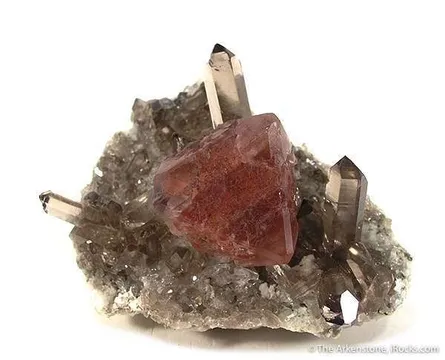
Quartz from Valais is classic Swiss Alpine material: clear to smoky crystals from open clefts, commonly with chlorite dusting or inclusions, albite or adularia, rutile, hematite and calcite. The Binn Valley and Furka–Rhône Glacier area are especially associated with smoky quartz and gwindels, including old mid-20th-century pieces from Binntal with chlorite inclusions and later-collected Furka specimens showing transparent smoky color, twisting and matrix groups. Good Valais quartz is judged by clarity, undamaged terminations, aesthetic positioning on matrix, and the quality of the Alpine habit—especially a well-expressed gwindel twist or a sharp doubly terminated floater. Ordinary examples can be iron-stained, cloudy, cleaved, or chlorite-coated to the point that the form is obscured; the best pieces keep the mountain character while preserving luster and geometry.
Epidote from Valais is best known from the Zermatt–Saas Fee district, especially the Mattertal localities around Pollux Mountain and the Rimpfischwäng–Findel Glacier area, where old specimens show deep green, lustrous prismatic crystals on matrix. Collector-quality pieces may carry transparent to translucent, sharply terminated epidote crystals in small groups, sometimes doubly terminated, and in the classic suite they may be associated with quartz, albite, diopside, byssolitic amphibole, chlorite and other Alpine cleft minerals. The finest Valais epidote is not necessarily large; it is valued for saturated green color, brilliance, clean terminations and old provenance. Average material tends to be darker, more embedded, chloritized, or limited to scattered grains in schist or matrix.
Albite in Valais is most prized as pericline, the blocky to elongated Alpine-cleft habit that forms white, cream or porcelain-like crystals on matrix or as small floaters. Documented Valais occurrences include Binntal, the Ofenhorn–Albrunhorn–Turbhorn area, Natischer Berg near Naters, Lamma near Fürgangen, and the Simplon Railway Tunnel. Good specimens show sharp, lustrous, well-separated crystals, sometimes with clear quartz prisms, rutile, calcite or chlorite; tunnel examples may also carry rutile-lined interstices and calcite, while Binn Valley pieces can be stark white and clean or partly coated with chlorite. Collectors should prefer undamaged crystal edges, fresh luster, strong contrast with quartz or dark inclusions, and a precise locality label, because “Swiss pericline” without locality is far less satisfying than a documented Valais specimen.
Beyond quartz, epidote and albite, Valais is exceptional for species diversity and type-locality minerals. Lengenbach alone has produced a long list of rare sulfides and sulfosalts, with many type minerals including baumhauerite, dufrénoysite, hatchite, hutchinsonite, jordanite, lengenbachite, sartorite, wallisite, jentschite, gabrielite, sicherite, richardsollyite, dalnegroite, tennantite-(Hg) and spaltiite. Cleuson in the upper Val de Nendaz is the type locality for cleusonite, a uranium-bearing crichtonite-group mineral occurring in alpine-cleft veins with quartz, albite, chlorite, calcite, titanite, rutile, uraninite, tennantite and other accessory species. The wider Binntal–Cervandone–Veglia–Devero mineral province is also famous for rare-earth arsenates and complex Alpine species, while other Valais districts have yielded hematite “iron roses,” anatase, rutile, titanite, fluorapatite, adularia, calcite, fluorite, anhydrite, baryte, uranium minerals, cobalt-nickel-arsenic assemblages and small but historically important ore minerals.
The first collecting issue with Valais is locality precision. Old labels may read “Wallis,” “Binnenthal,” “Zermatt,” “Furka,” “Simplon,” or simply “Swiss Alps.” That is not automatically a problem—many genuine 19th- and early 20th-century specimens carry broad labels—but value rises sharply when the specimen can be tied to a named valley, mountain, tunnel, quarry or historic collection. Quartz gwindels, pericline and epidote are particularly vulnerable to broad relabeling because visually similar Alpine material comes from Uri, Ticino, Graubünden, Austria, France, Italy and Pakistan. A good Valais label should ideally give both the modern hierarchy and the older wording if present.
No single notorious, locality-specific fake category dominates Valais in the way some world localities are known for systematic artificial products. The common concerns are more ordinary but important: artificially irradiated smoky quartz being passed as natural Alpine smoky quartz; repaired or reattached quartz and epidote crystals; acid-cleaned specimens whose chlorite, limonite or calcite context has been stripped too aggressively; and micro-minerals from Lengenbach sold under optimistic names without analysis. For high-value Lengenbach species, visual identification alone is often insufficient. Many metallic grey sulfosalts resemble one another, and species confirmation may require analytical documentation, reputable provenance, or expert comparison.
Condition standards are strict for Valais alpine-cleft specimens. Quartz should be inspected for bruised terminations, contact marks hidden by chlorite, rehealed breaks, glued bases and etched areas that may be natural but visually distracting. Gwindels are often naturally contorted and partly contact-developed; that should not be confused with damage, but a pristine, complete twist commands a premium. Epidote is prone to chipped terminations and edge wear, especially on old matrix pieces. Albite var. pericline commonly shows peripheral damage where the cluster was detached from the pocket wall; isolated edge bruises may be acceptable on historic pieces, but fresh, sharp, lustrous crystals are much more desirable.
Handling differs by sub-locality and species. Ordinary quartz, albite and epidote are stable, but Lengenbach material demands more care. Realgar and orpiment-bearing specimens should be kept away from strong light and heat, handled with common-sense hygiene, and stored so that fragile arsenic sulfides do not abrade. Thallium-bearing sulfosalts are scientifically important but should not be treated casually: keep them boxed, avoid generating dust, wash hands after handling matrix, and do not allow children to play with them. Uranium-bearing Valais minerals such as cleusonite and uraninite-bearing alpine-cleft material require appropriate radioactive-mineral storage and labeling. Simplon Tunnel calcite may fluoresce orange under long-wave ultraviolet light, but UV use should be brief on light-sensitive sulfides and arsenic minerals.
Market availability is uneven. Small Valais quartz and pericline specimens are obtainable, especially from Binn, Furka and older Swiss collections, but excellent gwindels with transparency, aesthetics and locality are much scarcer. Fine Zermatt–Saas Fee epidote is not common on the market and old collection pieces are notably desirable. Lengenbach specimens appear regularly as micromounts and small cabinet pieces, but true display-quality examples with obvious, well-identified type minerals are rare and expensive relative to their size. For serious collectors, the premium is paid for three things: exact locality, documented provenance, and mineralogical confidence.
The Binn Valley still has a living Strahler culture, and one of the clearest modern portraits is the story of René In-Albon, a local mineral expert who leads visitors into the valley’s mineral world. The image is wonderfully practical: no romantic crystal wand, just a hammer, a pick, good boots and the uphill patience to read stone. He began collecting rocks as a boy while herding cattle. Later, the search for crystals became part-time work, but the fascination never left. When he shows guests how to break a crystal out of the rock, the lesson is less about force than experience—knowing which glitter is worth following, which crack may be a cleft, and when a plain stone might hide a bright interior.
That same Binntal story has a collector’s punchline. René tells visitors that his most beautiful crystal came from the Ofenhorn. He kept it in his private collection and, as he put it, did not have the heart to give it away. Anyone who has collected Alpine quartz understands exactly what that means. The point of the story is not monetary value; it is the moment every collector recognizes when a find crosses the line from specimen to memory.
The deeper history of Binn is older and stranger than the modern guided walk. The valley park recounts traces of people in the high Alps roughly 10,000 years ago, including hunter camps near the Albrun Pass where crystal fragments were used as tools and to strengthen wooden arrows. Much later, about 2,000 years ago, Celtic-Roman settlers are said to have buried crystals in the Binntal ground, holding them as objects of exchange with traveling traders for tools, weapons and jewelry. For a mineral collector, that continuity is arresting: quartz was not merely admired after cabinets and labels existed; it was useful, tradable and worth hiding.
Around 1900, the mineral economy of the Binntal became personal and local. The park preserves the memory that about twenty farming families earned additional income from Strahlen, in some cases reportedly more than from traditional farm work. That helps explain why old Binntal specimens so often feel different from anonymous industrial mine pieces. They came from a landscape where mineral search, tourism, farming and science overlapped; a crystal pocket might be a supplementary livelihood, a scientific discovery, or the beginning of a specimen’s long path into a European cabinet.
Gondo supplies the dramatic mining story of Valais. In the 1890s, the quiet border valley became the stage for a gold rush. Alcide Froment promoted the mines in 1893 as among the most important in Europe, and in 1894 the Paris-based Société des Mines d’Or de Gondo took over the venture. At the height of activity, up to 500 men worked in and around a village that itself had only about 100 inhabitants. The workings spread through steep slopes and tunnels with names such as Silzaly, Bruno, Fumée, Fontaine, Julie, Maffiola, Rona, Camozetta, Alcide, Minna and Vinasque. Ore moved by cableway; mills and smelting works were installed; water power and electricity were pressed into service. The dream was enormous, but the numbers were cold: from March 1, 1894 to August 1896 just over 5,000 tons of ore were processed, yielding 33 kilograms of raw gold. By May 17, 1897, the company was bankrupt.
The Simplon Tunnel story belongs to engineering as much as mineral collecting, but it shaped Valais mineral cabinets. Excavation of the first tube began in 1898, and the second tube was completed in the early 1920s. The tunnel cut deep Alpine rocks under tremendous cover, and its construction opened temporary windows into mineralized fissures that collectors could never reach by ordinary mountain work. That is why old Simplon Tunnel pericline, rutile, calcite and anhydrite specimens have such a particular aura: they are not just from a place, but from a brief industrial event that exposed Alpine clefts, passed through them, and sealed their context into history.