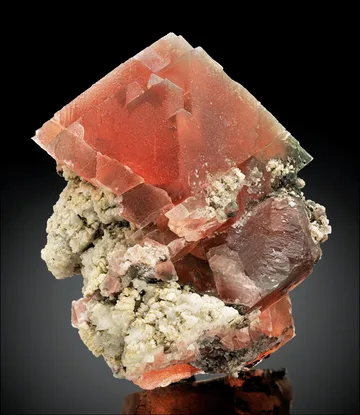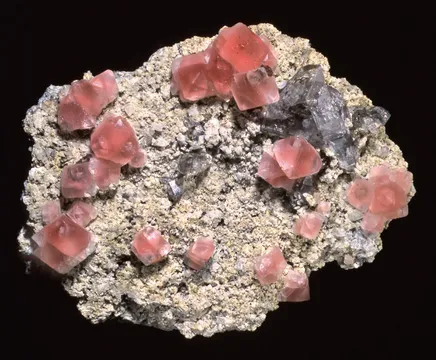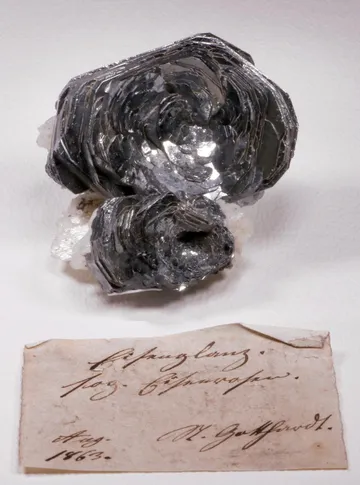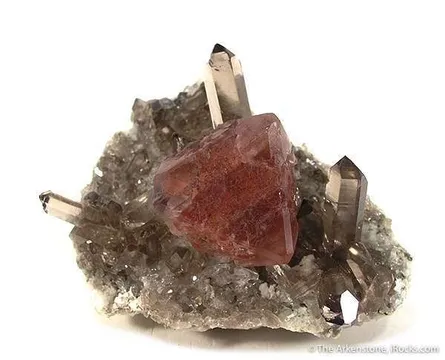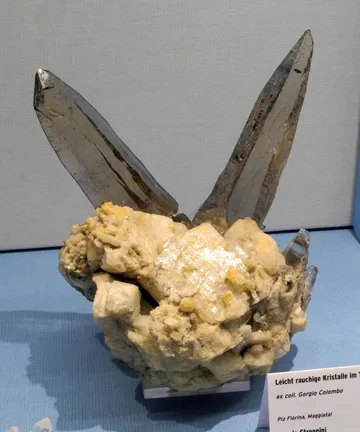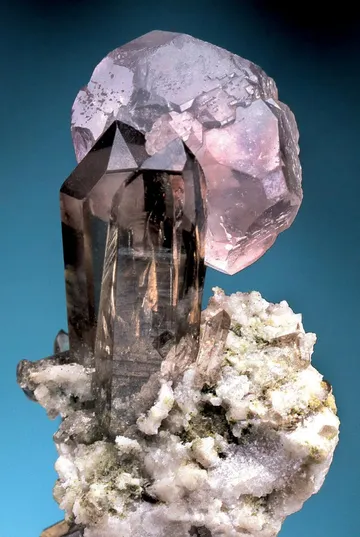
Binn Valley, Switzerland — renowned Alpine locality for quartz, anatase, rutile, magnetite, and the Lengenbach sulfosalt assemblage, prized by collectors.
Key facts
Binn Valley—Binntal in German—has the rare distinction of being both a classic Alpine-cleft province and one of the world’s great chemical oddities. For specimen collectors the name covers several complementary worlds: clear and smoky quartz from the northern schists and gneisses; honey-yellow anatase, rutile, magnetite, and hematite from the Lärcheltini–Gorb–Chollergraben cleft zone; cafarsite and other arsenic-rich rarities from the Wanni Glacier–Cherbadung/Cervandone district; and, above all, the Lengenbach quarry near Fäld, where snowy white Triassic dolomite marble hosts an extraordinary Pb-Zn-Ag-Cu-As-Tl sulfosalt assemblage.
The valley lies in the Penninic Alpine nappes, especially the Monte Leone nappe, where Alpine metamorphism and deformation turned a compact package of dolomite, Bündnerschiefer, gneiss, and older basement rocks into a folded, mineralogically fertile section. Lengenbach’s mineralization is not important because of tonnage or metal production—it was never a normal ore mine in the modern economic sense—but because small druses in white dolomite yielded a succession of crystals that forced mineralogists to name new species. The best Lengenbach specimens are intimate and often microscopic: wine-red realgar, honey sphalerite, brassy pyrite, gray metallic sulfosalt prisms, and tiny black-to-red thallium minerals set like punctuation marks in sugar-white dolomite.
Regional View
Country View
For cabinet-sized aesthetics, the valley’s Alpine-cleft specimens have a different character. Lärcheltini anatase can be lemon to honey yellow, orange, brown, or zoned, with complex faces that make even millimetric crystals look architectural. Magnetite from the Chollergraben–Lärcheltini area is prized for sharp, lustrous octahedra and spinel-law twins. Hematite forms little “iron roses,” commonly enlivened by oriented rutile. Quartz from the Turbenalp, Feldbach, Breithorn, and related northern localities shows the local “Binntal habitus,” with scepters, windowed crystals, faden quartz, smoky quartz, and occasional gwindel-like forms.

Photo: Wikimedia Commons

Photo: Wikimedia Commons
Search for specimens: View all specimens from Binn Valley, Switzerland
Binn Valley is best understood as a district rather than a single mine. The Binna River valley is an eastern tributary of the upper Rhône in the canton of Valais, and the collector’s “Binn” label may refer to Lengenbach, Lärcheltini, Wanni Glacier, Cherbadung/Cervandone, Turbenalp, Feldbach, Mättital, Geisspfad, Ofenhorn, Saflisch, or smaller cleft and dolomite occurrences. That breadth explains why the name appears on everything from thumbnail anatase to micromount sulfosalts, from scepter quartz to cafarsite.
The Lengenbach deposit is the valley’s mineralogical centerpiece. It lies southeast of Fäld at roughly 1660 m elevation, in a band of white Triassic dolomite marble exposed along the southern flank of the valley. The host belongs to the Penninic Monte Leone nappe, where the sequence is overturned and metamorphosed under upper greenschist to lower amphibolite facies conditions. The dolomite layer is part of a larger folded profile that includes Bündnerschiefer and pre-Triassic basement gneisses. Within the dolomite, the mineralized zones are chemically distinctive rather than visually dramatic rock units: realgar-rich and sulfosalt-bearing portions occur as narrow ribbons and small drusy pockets in the pale dolomite.
The Lengenbach ore assemblage is dominated by As-bearing sulfides and sulfosalts with Pb, Tl, Ag, Cu, Zn, Cd, Sn, and related elements. Modern work separates the sulfosalt assemblage into thallium-dominant, lead-dominant, and copper-silver-dominant groups. The old quarry workings, productive before the late 1980s, were best known for Pb sulfosalts such as hutchinsonite, hatchite, wallisite, and related species. The newer workings, opened higher and farther east, exposed material richer in thallium minerals, particularly in the famous Zone 1, where small realgar-rich dolomite ribbons only a few metres across have yielded a cascade of new mineral species.
Although “quarry” is the traditional term, Lengenbach is unusual because its extraction is for specimens and research, not for commercial ore. Metal mining in the valley has a long background, and the Lengenbach area was examined historically in the search for useful ore, but the modern importance of the site is scientific. Since 1958 the locality has been worked systematically for mineral specimens and research material. The Forschungsgemeinschaft Lengenbach has operated measured extraction during the snow-free season, with material studied by associated mineralogists and part of the broken dolomite made available to visitors at the public picking area when fresh material exists.
Access for collectors has changed. Since January 1, 2025, mineral collecting with tools on the municipal territory of Binn requires a paid Strahlerpatent, issued by the municipality. A day permit is required for ordinary tool use, while annual permits are tiered by residence. Hand tools such as hammer, chisel, and Strahlerstock are the permitted style; blasting and mechanical equipment are prohibited unless the municipality grants a specific exception. Merely picking up loose stones without tools is treated differently, and the Lengenbach public picking area is specifically exempt from the general patent requirement, subject to whatever visitor rules or entry arrangements are in force. Collectors should check the current municipal rules before travelling, because the valley is protected, actively visited, and increasingly managed.
Beyond Lengenbach, the Lärcheltini zone is the locality name most serious collectors should know. It occupies gneiss and schist terrain above the valley and includes Gorb, Vorder and Hinter Chollergraben/Kollergraben, Riggi, Spissen, and related sites. The zone is famous for complex yellow anatase, sharp magnetite, tabular hematite, iron roses, short-prismatic rutile, pseudomorphs after ilmenite, monazite, xenotime, and rare arsenic minerals. Much of the material occurs in Alpine fissures, where slow opening, fluid flow, deformation, and late-stage oxidation created compact but highly varied parageneses. Good specimens are often small; the best are valued not by size alone but by perfection, luster, isolated crystal placement, and the precision of intergrowths.
The Wanni Glacier–Cherbadung/Cervandone side of the valley is another mineralogical sub-province. It is important for cafarsite, asbecasite, cervandonite-(Ce), fetiasite, chernovite-(Y), gasparite-(Ce), synchysite, fluorite, beryl including aquamarine, and rare arsenite/rare-earth assemblages. These minerals occur in clefts and narrow veins in orthogneiss and related rocks, in a geochemical environment that links Alpine-cleft crystallization to remobilized Cu-As and rare-element mineralization. Many specimens from this sector are highly localized, and older labels may use Italian or German variants of Cervandone/Cherbadung depending on which side of the border or ridge the material was attributed to.
For quartz collectors, the northern part of the valley—Turbenalp, Feldbach, Breithorn, Chummibort, Saflisch, and related localities—adds another layer. Here Binn is known for rock crystal, smoky quartz, faden quartz, scepter quartz, windowed “Erkerquarz,” doubly terminated crystals, and amethyst-on-smoky combinations. These are not the gigantic Alpine quartz groups of some Swiss massifs, but the better Binn specimens have a crisp, local personality: complex growth, fine luster, and habits that knowledgeable Swiss collectors recognize at once.
Anatase is one of the signature cleft minerals of the Binn Valley, especially from the Lärcheltini zone around Gorb, Spissen, and the Chollergraben area, with additional occurrences such as Turbenalp/Mittlenberg. The classic crystals are small but intensely formed: honey-yellow, lemon-yellow, orange-brown, brown, and locally bluish-zoned, ranging from millimetric individuals to exceptional centimetre-class pieces, including well-known Spissen material around the 17 mm scale. Habits include sharply striated pyramidal crystals, thick tabular forms, elongated prismatic variants, and highly modified “button” or multi-faced crystals; the best examples are transparent, bright, and cleanly perched on adularia, quartz, gneiss, magnetite, or hematite iron roses rather than buried in chlorite or limonite. Associations with rutile, magnetite, hematite, monazite, xenotime, chlorite, mica, calcite, siderite/ankerite, and rare arsenic minerals are characteristic, and the finest Binn anatase pieces are judged by face complexity, glassy luster, color saturation, and the precision of the Alpine-cleft matrix.
Rutile from Binn Valley is most collectible from the Lärcheltini–Chollergraben–Riggi cleft system, where it occurs as short prismatic crystals, twins and multiple twins, sagenitic sprays, and epitactic intergrowths with hematite. The color varies from reddish brown to dark brown, blackish, and locally yellowish in thin needles; many pieces are thumbnail to miniature scale, with individual rutile crystals typically only millimetres long, but a well-placed pair of lustrous prisms on adularia, quartz, hematite, or magnetite can be a very refined Swiss Alpine specimen. The most desirable pieces show oriented rutile on hematite “iron roses,” sharp twinning, high luster, and open placement; ordinary examples are simply iron-stained cleft scraps or dense rutile-hematite aggregates without readable crystal form. Because rutile, anatase, hematite, magnetite, and ilmenite-related alteration all occur together in parts of Lärcheltini, old labels and dealer descriptions should be read carefully, particularly for mixed Ti-Fe oxide specimens.
Binn Valley magnetite has a reputation out of proportion to its usual size because the best crystals from Lärcheltini, especially the Chollergraben/Kollergraben area, are sharply geometric and highly lustrous. Classic specimens show black mirror-bright octahedra, spinel-law twins, and rarer rhombic-dodecahedral crystals, sometimes associated with rutile, adularia, calcite, siderite, hematite, quartz, and gneiss matrix. Literature and collector accounts record crystals to several centimetres, while most market examples are much smaller, commonly fine thumbnails with 5–10 mm crystals; the finest pieces have isolated, undamaged octahedra with crisp edges, visible twinning, and a clean Alpine-cleft setting. Magnetite also plays a role in the locality’s confusing Ti-Fe oxide parageneses: some strongly magnetic “hematite” pieces from the area owe their response to magnetite cores or intergrowths, and ilmenite pseudomorphs may involve hematite, rutile, and magnetite in the same specimen.
Cafarsite is one of the valley’s great rarities and a type-locality species from the Wanni Glacier–west flank of Cherbadung, also known as the Swiss side of the Pizzo Cervandone district. It occurs on cleft faces in orthogneiss and related Alpine fissures as dark brown to blackish cubic and cubo-octahedral crystals, with rough to smooth faces and reddish translucency in thin edges; crystals to about 3 cm are recorded, though attractive collector specimens are much less common than the name’s fame suggests. Typical associations include asbecasite, gasparite-(Ce), chernovite-(Y), synchysite, fluorite, quartz, magnetite, hematite, anatase, rutile, and other rare arsenic and rare-earth minerals from the Wanni–Cervandone system, with some material historically confused under older names such as arsenoferrite. Good Binn cafarsite is not just “a black cube”: it should show intact crystal geometry, readable faces, minimal bruising on exposed corners, and a trustworthy Wanni Glacier/Cherbadung or Lärcheltini-area provenance.
Quartz from Binn Valley comes chiefly from Alpine fissures in the northern valley and associated gneiss-schist zones, with Turbenalp, Feldbach, Breithorn, Chummibort, Saflisch, and the Twingi/Fäld area all represented on collector labels. The valley is known for clear rock crystal, smoky quartz, morion, scepter quartz, faden quartz, windowed crystals, doubly terminated crystals, and amethyst perched on pale smoky quartz; the “Binntal habitus” and transitional Tessin-style habits give many specimens a distinctive Swiss character even when the crystals are modest in size. Good examples have strong luster, transparent interiors, undamaged terminations, and undisturbed growth features such as windows, scepter overgrowths, faden lines, or chlorite phantoms. Quartz also serves as the matrix and paragenetic framework for many cleft minerals here, including anatase, rutile, hematite, adularia, calcite, siderite, mica, and chlorite.
Hematite from Binn Valley is most admired as small but elegant Alpine “iron roses” and tabular crystals from Lärcheltini, Gorb, Chollergraben, and Wanni Glacier occurrences. The crystals may be flat, platy, highly modified, or rose-like aggregates; iron roses to about 15 mm are typical collector-scale classics, while larger tabular pieces from the broader Lärcheltini literature can reach several centimetres. Rutile commonly grows epitactically or in oriented sprays on hematite, and anatase, magnetite, adularia, quartz, chlorite, monazite, xenotime, and siderite/ankerite appear in related cleft assemblages. The best pieces show a balanced hematite rose or sharply tabular crystal with bright metallic luster and cleanly oriented rutile; more ordinary material is dull, limonite-coated, chipped at the thin plate edges, or ambiguous because of magnetite cores, ilmenite alteration, and mixed Ti-Fe oxide pseudomorphs.
Binn Valley’s larger species list is one of the richest in Europe. Lengenbach alone has yielded a remarkable suite of type-locality sulfosalts and related minerals, including names central to the locality’s identity such as lengenbachite, hutchinsonite, rathite, sartorite, dufrénoysite, baumhauerite, wallisite, hatchite, seligmannite, gabrielite, edenharterite, ferrostalderite, richardsollyite, ralphcannonite, eckerite, philrothite, tennantite-(Hg), buynite, interliveingite, drechslerite, and spaltiite. Outside Lengenbach, the Wanni Glacier–Cherbadung/Cervandone and Lärcheltini systems have produced type and classic material for cafarsite, asbecasite, cervandonite-(Ce), graeserite, fetiasite, gasparite-(Ce), and associated rare arsenic and rare-earth minerals. Add to that the Alpine suite—adularia, albite, calcite, fluorite, beryl including aquamarine, titanite, monazite, xenotime, chernovite-(Y), synchysite, and locally demantoid—and “Binn Valley” becomes less a locality label than a compact encyclopedia of Alpine mineralogy.
The first authentication issue with Binn material is locality precision. “Binn Valley” is a broad district label, while serious value often depends on whether a specimen is specifically from Lengenbach, Gorb, Spissen, Chollergraben, Riggi, Wanni Glacier, Cherbadung/Cervandone, Turbenalp, Feldbach, or another named site. Fine anatase, rutile, magnetite, and hematite should ideally carry a Lärcheltini-zone sublocality. Cafarsite should be backed by a Wanni Glacier/Cherbadung/Cervandone or related Binn provenance. Lengenbach sulfosalts are almost always best regarded as analytical minerals unless the species is visually unmistakable or the label comes from a trusted old collection, research group, or specialist dealer.
The second issue is visual misidentification. Lengenbach’s gray metallic Pb-As-Tl-Ag-Cu sulfosalts can be extremely similar under the microscope, and several species occur as intergrowths, lamellae, rims, or inclusions within one another. Older names may no longer match modern species boundaries, particularly in the sartorite, liveingite, tetrahedrite-tennantite, routhierite-stalderite, and related groups. In Lärcheltini material, rutile, anatase, hematite, magnetite, ilmenite, and pseudomorphs after ilmenite can also be confused or over-simplified on labels. “Magnetic hematite” from this district deserves scrutiny, because magnetite intergrowths or cores can explain magnetism that pure hematite would not normally show strongly.
Condition is a major value driver. Binn cleft minerals are commonly small, perched, and edge-sensitive. Anatase crystals may have tiny nicks on pyramidal points; hematite roses chip along thin plates; rutile twins lose terminations; magnetite octahedra show contact marks at the base or bruised edges; and quartz scepters and windowed crystals often have small tip bruises or bottom breakage from extraction. Lärcheltini gneiss splits readily and not always where a collector wants it to split, so matrix trimming can leave excellent crystals awkwardly positioned on a broken edge. Specimens with undamaged crystals centered on clean matrix command a premium.
Cleaning requires restraint. Iron staining can be part of the natural Alpine-cleft presentation, and aggressive treatment may make a specimen look less convincing. Sodium dithionite has been used successfully by collectors on some Lärcheltini pieces, but arsenic minerals may bleach and monazite can be vulnerable to ultrasonic cleaning. Lengenbach material containing realgar and orpiment should be protected from strong light and heat; realgar is famously light-sensitive, and the finest red crystals should not be treated like ordinary display minerals. Arsenic- and thallium-bearing species should be handled with ordinary mineralogical hygiene: do not grind, inhale dust, lick, or store crumbly fragments where children or pets can reach them.
There are no widely publicized modern fake syndromes unique to Binn Valley in the way there are for some gem-crystal localities, but mislabelling is common enough to matter. Generic “Swiss anatase” may be sold as Binn; Italian-side Cervandone material may be loosely folded into Binn labels; and Lengenbach microminerals may be assigned optimistic species names without analysis. Conversely, some old labels use historic names—Binnenthal, Binnatal, Im Feld, Fäld, Lercheltini, Lärchultini, Kohlergraben, Chollergraben, Scherbadung, or Cervandone—that are perfectly legitimate when understood in context.
Market availability is uneven. Quartz, small anatase, small rutile-hematite pieces, and magnetite thumbnails appear periodically from Swiss and European dealers, often as older collection material. Fine large Lärcheltini anatase, sharp magnetite twins, balanced rutile-on-hematite pieces, and undamaged cafarsite crystals are much scarcer. Lengenbach material is available in micromount and small cabinet form, but properly identified rare sulfosalts—especially type species or modern analytical discoveries—are specialist material and often trade through a small network of knowledgeable collectors rather than the broad mineral market.
The story of Binn Valley minerals begins long before specimen labels. In the high Alps of Valais, people were collecting and using crystals thousands of years before mineralogy became a science. Near the Albrun Pass, archaeology records a Stone Age hunters’ camp, and the people there used crystal fragments as tools and to reinforce wooden arrows. Around two thousand years ago, Celtic-Roman inhabitants in the valley are said to have buried crystals in the ground as trade goods, ready to exchange with passing merchants for tools, weapons, and ornaments. The same glitter that now pulls collectors toward Alpine fissures once belonged to a harsher economy of survival and barter.
Tourism and mineral collecting became intertwined in the nineteenth century. English travellers were among the outsiders who helped make the valley known, arriving during the early tourism boom of the second half of that century. The route through the Twingi gorge was improved in 1864, and the Hotel Ofenhorn opened in 1883, giving mineral buyers, scientists, and mountain visitors a more secure foothold in a valley that had previously been harder to reach. Around 1900, crystal hunting in Binn was no quaint sideline: about twenty families earned extra income from Strahlen, and local tradition holds that for some of them the mineral money could exceed what they earned from farming.
Lengenbach tells a very different kind of collecting story. Most famous mineral localities became famous because someone wanted metal, building stone, or gemstones. Lengenbach became famous because its white dolomite kept producing crystals too strange to ignore. The deposit had been known for exotic minerals for roughly two centuries, but its modern life began in 1958, when systematic specimen extraction resumed. From then on, the quarry became something rare in mining history: a working mineral locality whose reason for being was science and collections. The quarry was not a hole dug for ore; it was a small laboratory in the Alps, cut into white dolomite and operated so that tiny crystals could be preserved, studied, named, and distributed.
The most vivid recent episode is the story of spaltiite. In 2009, Walter Gabriel found on the Lengenbach dump a small specimen that would eventually prove to contain the only three crystals then known of a new thallium sulfosalt, Tl2Cu2As2S5. The crystals were not large by ordinary cabinet standards—about 2 mm long and only about 0.2 mm thick—but for Lengenbach that size was remarkable. They were described as the largest single crystals of a new mineral found at the locality in more than a century. The working nickname “spalti” stuck because the mineral cleaves so readily, from the German “spalten,” to split. One crystal went through analysis and structural work; the type specimen was deposited in Basel, with investigated material also placed in Vienna. In a quarry famous for submillimetric, intergrown mysteries, three slender crystals on one small piece became a major event.
Cafarsite has its own discovery drama, set away from Lengenbach in the Wanni Glacier–Cherbadung/Cervandone world. On September 16, 1963, Stefan Graeser found two unfamiliar minerals in clefts of two-mica gneiss in the Monte Leone nappe. One formed lemon-yellow plates only about 0.5 mm across; the other formed dark brown cubic crystals up to about 3 cm with rough surfaces. Both proved new. The yellow mineral became asbecasite, named from arsenic, beryllium, calcium, and silicon; the dark cubic mineral became cafarsite, named from calcium, ferrum, and arsenic. In the summer of 1965, the Binn Strahler Anton Imhof found still larger cafarsite crystals on the Italian southeast side of the Scherbadung/Monte Cervandone area, including pieces over 3 cm on edge and weighing up to 48 grams. The boundary ridge mattered politically, but mineralogically the find belonged to the same extraordinary Wanni–Cervandone arsenic system.
Lärcheltini rewards patience rather than drama. The collector Joachim Peter first came to the Binn Valley in 1989 while still a student, hoping to search the Alpine clefts. For the first years, his attempts in the Lärcheltini zone produced more memories than specimens. Then he and his companions hit a good fissure system and worked it over several seasons. His account is valuable because it makes the locality feel real: the best crystals were usually small, the gneiss split treacherously, and extracting one good hand specimen could require hours of careful hammer-and-chisel work. Haste broke pieces; trimming by hand risked ruining the specimen; a saw was often the safest tool for shaping. That is exactly the collector’s paradox of Binn Valley: the valley is world famous, but its best non-Lengenbach cleft pieces often came not from spectacular pockets, but from disciplined work on little crystals that could easily be missed.
Raber, T. and Roth, P. (2018). “The Lengenbach Quarry in Switzerland: Classic Locality for Rare Thallium Sulfosalts.” Minerals, 8, 409. A concise modern review of Lengenbach’s thallium sulfosalt mineralogy, geology, and working history.
Graeser, S., Topa, D., Effenberger, H. S., Makovicky, E., Paar, W. H., and Dincă, G. (2026). “Spaltiite, Tl2Cu2As2S5, one more new thallium sulfosalt mineral from Lengenbach quarry, Binn, Switzerland.” European Journal of Mineralogy, 38, 27–37. Description of spaltiite and an up-to-date discussion of Lengenbach’s type-mineral count and thallium-rich Zone 1 context.
Roth, P., Raber, T., Drechsler, E., and Cannon, R. (2014). “The Lengenbach quarry, Binn Valley, Switzerland.” The Mineralogical Record, 45(2), 157–196. Major collector-oriented monograph on the quarry, its mineralogy, history, and specimens.
Graeser, S. (1965). “Die Mineralfundstellen im Dolomit des Binnatales.” Schweizerische Mineralogische und Petrographische Mitteilungen, 45, 597–795. Foundational study of Binn Valley dolomite mineral localities, repeatedly cited in later Lengenbach and Binntal literature.
Graeser, S. (1966). “Asbecasit und Cafarsit, zwei neue Mineralien aus dem Binnatal (Kt. Wallis).” Schweizerische Mineralogische und Petrographische Mitteilungen, 46, 367–375. Original description of asbecasite and cafarsite from the Binn Valley.
Handbook of Mineralogy: Cafarsite. Compact reference summarizing cafarsite’s crystallography, occurrence on cleft faces at Cherbadung, associations, and type material.
Natural History Museum Basel: Regional Mineral Collections. Museum note on Basel’s extensive Lengenbach holdings, including thousands of objects and type material.
Landschaftspark Binntal: Mineralien-Liste für das Binntal und direkt angrenzende Fundstellen auf Alpe Devero und Alpe Veglia, 2024. Current regional species list compiled for the Binn Valley and adjacent Devero–Veglia mineral districts.
“Lengenbachite with Jordanite and Calcite from Lengenbach Quarry, Fäld, Switzerland” — Fabre Minerals A rotating specimen video showing a classic Lengenbach sulfosalt association on calcite from an older 1980 find.
“Binn valley: Cleft minerals from the Alps most diverse valley” — JN Minerals Dealer gallery with specimen videos and detailed notes on quartz, anatase, magnetite, rutile, fluorite, cafarsite, and other Binn Valley cleft minerals.
Mindat: Binn Valley, Valais, Switzerland Broad locality page for the valley and its sublocalities, useful for names, spelling variants, and species records.
Mindat: Lengenbach Quarry, Fäld, Binn, Valais, Switzerland Core locality reference for Lengenbach minerals, references, photos, and type-species data.
Landschaftspark Binntal: Minerals Official park overview of Binn Valley mineral diversity, Lengenbach, and the cultural history of Strahlen.
Gemeinde Binn: Strahlerpatente Official municipal information on the collecting permit required in Binn since January 1, 2025.
Landschaftspark Binntal: Lengenbach mineral quarry Visitor information for the Lengenbach quarry, including seasonal access notes and the public picking area.
Landschaftspark Binntal: Geology and rocks of the Binntal valley Official geology-trail information explaining the rock units and educational route from Fäld to Lengenbach.
Forschungsgemeinschaft Lengenbach Specialist source for Lengenbach research news, new species, analytical updates, and quarry activity.
Kristalle.ch: Mineralien von der Lärcheltini-Zone Collector field account and photo-rich overview of Lärcheltini anatase, hematite, magnetite, rutile, arsenic minerals, monazite, xenotime, and extraction issues.
Mineralienvorkommen.ch: Binntal mineral occurrences German-language locality notes with practical sublocality details for Lärcheltini, Chollergraben, Gorb, and related collecting areas.
Seilnacht: Mineralvorkommen in der Region Binntal Accessible German overview of Lengenbach, Lärchultini/Lärcheltini, dolomite outcrops, and common specimen types.
Wikimedia Commons: Lengenbach Quarry Open-image archive of Lengenbach quarry and specimen photographs.
Wikimedia Commons: Cafarsite Open-image archive of cafarsite photographs, including Binn Valley/Cherbadung material.
Smithsonian NMNH: Cafarsite, catalog B13744 Museum specimen record for cafarsite from Alp Lercheltini near Imfeld, Binnental.