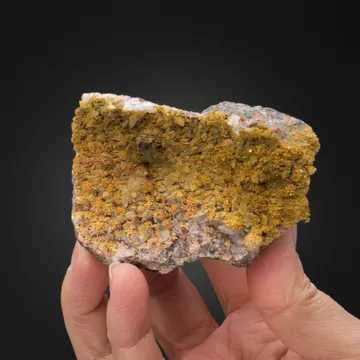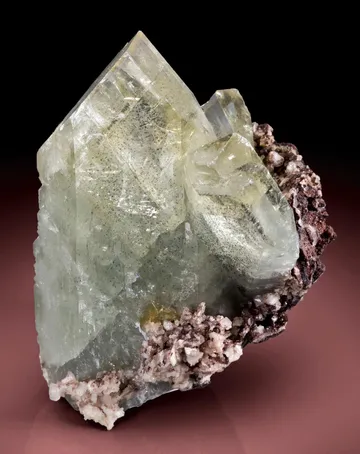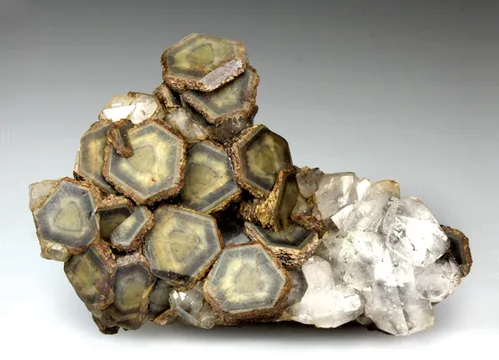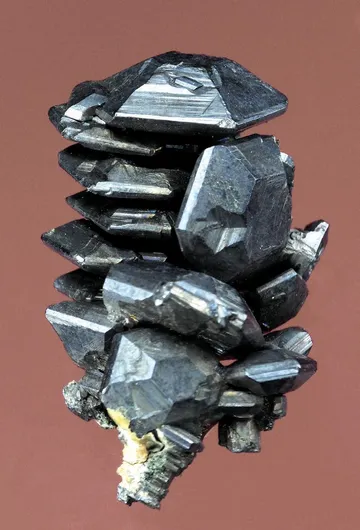
A collector's guide to Torr Works Quarry, UK: its geology, mining history and notable minerals, illustrated with the 43 specimens documented from this locality on EarthWonders.
Key facts
Torr Works Quarry, still widely called Merehead Quarry by mineral collectors, is one of the great paradoxes of British mineral collecting: a colossal limestone aggregate quarry whose collectible fame rests on tiny, chemically extravagant manganese pods. The quarry lies at Cranmore in the eastern Mendip Hills of Somerset, on the southern limb of the Beacon Hill Pericline, where Carboniferous limestones are cut by calcite-filled fractures and locally capped by Jurassic oolitic limestone across a striking disconformity. In those fractures, small lenses and pods of manganese and iron oxides became sealed reaction vessels. Galena-bearing Mendip lead veins, seawater ingress, later hydrothermal heating, and low-temperature alteration combined to make one of Britain’s most remarkable suites of secondary lead minerals.
Collectors prize Torr Works above all for its rare Pb and Pb-Cu oxychlorides and associated lead carbonates: mendipite, hydrocerussite, diaboleite, chloroxiphite, parkinsonite, symesite, mereheadite, rickturnerite, rumseyite, yeomanite, somersetite, plumbonacrite, cerussite, and a supporting cast of crednerite, malachite, wulfenite, mimetite, kentrolite, melanotekite, calcite, aragonite, baryte, and manganese oxides. The best specimens are not large in the showy Alpine sense; they are intricate, intensely localized mineralogical documents. A typical fine piece may show pearly white to pale green hydrocerussite plates, pink-white columnar mendipite, blue diaboleite specks or halos, olive chloroxiphite blades, black manganese oxides, and pale calcite or cerussite in tight, layered association.
Regional View
Country View
The quarry’s historical importance is twofold. Industrially, it became a flagship of the Mendip “superquarry” era, linked to rail transport and supplying vast tonnages of crushed Carboniferous Limestone to southern England. Mineralogically, it opened fresh faces through zones that older mines could never have exposed continuously. As quarrying progressed, collectors and researchers gained access to calcite and manganese veins at bench scale, allowing individual pods, veins, and paragenetic sequences to be studied almost as serial cross-sections through a natural laboratory.

Photo: Wikimedia Commons
Search for specimens: View all specimens from Torr Works Quarry, UK
Torr Works is an active Carboniferous Limestone quarry at Cranmore, near Shepton Mallet and Frome, Somerset. It works a large pit on the south side of the Beacon Hill Pericline, with much of the northern quarry in Black Rock Limestone and younger Clifton Down Limestone and Vallis Limestone cropping out farther south. The limestone beds dip generally south to south-southeast at moderate angles, and the quarry is bounded and influenced by major structures including the Cranmore Fault to the south and the Downhead Fault along the western margin. Locally, Jurassic Inferior Oolite rests unconformably on the Carboniferous Limestone; that contact is more than a stratigraphic curiosity, because uplift, erosion, marine transgression, and circulation of fluids through older fractured limestone are central to the origin of the manganese-pod mineralization.
The collectible mineralization occurs in manganese and iron oxide pods hosted by pre-existing calcite and calcite-baryte veins cutting the Carboniferous limestone. Individual pods are typically small, commonly on the order of metres or less along strike and far thinner across the vein, but internally they are zoned: hard black manganese oxides in the core, more friable layered manganese oxides, powdery black manganese oxide mixed with brown iron oxides, and outer iron oxide zones. Cavities within the manganese oxides are the important collector targets. They are lined or filled by calcite, aragonite, cerussite, hydrocerussite, mendipite, and rare Pb and Pb-Cu oxychlorides; in favourable pods, later or cross-cutting hydrothermal influence introduced quartz and silicate species such as kentrolite and melanotekite.
The genetic model now accepted for the Torr Works manganese pods begins with Mendip-style Pb mineralization: galena lenses and pocket swarms in calcite veins emplaced into Carboniferous limestone. Subsequent exposure of the fractured limestone system to seawater, followed by hydrothermal heating and later low-temperature alteration, produced an unusually alkaline-to-variable microenvironment in sealed pods. Galena was largely destroyed or replaced in the pod zones, releasing lead, while manganese oxides provided reactive, metal-adsorbing, locally impermeable shells. That is why Torr Works specimens so often look like mineralogical sandwiches: black manganese oxide outside, calcite and cerussite/hydrocerussite inside, and rare oxychlorides tucked into protected seams, blebs, fibres, or small cavities.
The quarry was worked systematically from the 1930s as Merehead Quarry, initially by the Merehead Quarry Co. and then Western Trinidad Lake Asphalt Ltd. Foster Yeoman acquired the quarry in the late 1950s and transformed it into a major modern aggregate operation. In 1970 the site was renamed Torr Works in honour of Ron Torr, Foster Yeoman’s chief engineer, and a new rail loading system tied the quarry to long-distance aggregate distribution. Aggregate Industries later operated the site after acquiring Foster Yeoman; in current industry usage the site is part of Holcim UK. Production has been measured in millions of tonnes per year, with much of the material dispatched by rail.
For collectors, the key historical mineral zones were not the whole quarry but particular manganese-bearing veins and benches. The “Number One” vein exposed in the 1970s is especially important because it yielded mendipite-dominated Pb oxychloride assemblages, with associated diaboleite, chloroxiphite, symesite, parkinsonite, and other rarities. Later work exposed further mineralized pods, including notable material from Bench F and Bench G. Field and laboratory work around the early 2000s and mid-2000s documented crednerite-bearing material, large kentrolite, wulfenite, mimetite, mereheadite, symesite, and the hydrocerussite-like assemblages that later proved important for somersetite and plumbonacrite studies.
Collecting access today should be considered closed unless arranged formally through the operator or an organized educational or society visit. Torr Works is a large active quarry with blasting, mobile plant, high walls, deep water-management issues, and strict safety controls. General casual collecting is not appropriate. Even with permission, the classic manganese-pod zones that produced the celebrated oxychloride suite are reported by dealers and collectors to be long worked out or no longer in the active collecting horizon. Consequently, most available specimens now come from older collections, Russell Society-related collecting, dealer stock accumulated from earlier finds, museum duplicates, or carefully retained private suites.
Hydrocerussite is one of the signature visual species from Torr Works, occurring as pearly white, grey-white, and locally pale green plates, stacked aggregates, and pseudohexagonal-looking groups in manganese-pod cavities and in limestone wall-rock cavities adjacent to pods. It is commonly associated with cerussite, calcite, aragonite, mendipite, manganese oxides, and the rarer Pb oxychlorides; some “hydrocerussite-like” pale green material has proved to include somersetite and plumbonacrite, so serious specimens deserve analytical caution. Published descriptions and documented specimens show individuals from millimetre scale to centimetre scale, with especially aesthetic groups around miniature size and exceptional hydrothermal-vein aggregates substantially larger. The best Torr Works hydrocerussites have crisp pearly lustre, clean white-to-mint contrast against black manganese oxide or pale calcite, and visible platy architecture rather than chalky massive seams.
Crednerite from Torr Works is a rare and highly desirable Cu-Mn oxide from the manganese pods, usually forming very dark green to black bladed, platy, or massive aggregates embedded in calcite or aragonite and commonly partly altered or coated by malachite. Most sprays and blades seen from the locality are only a few millimetres across, but exceptional off-matrix specimens with blades to about 2.4 cm have been recorded, placing the best Torr Works examples among the more impressive British crednerites. It is associated with calcite, aragonite, hydrocerussite, cerussite, malachite, chloroxiphite, kentrolite, and other manganese-pod minerals, with notable material from Bench F and a wulfenite- and crednerite-bearing pod on Bench G in June 2006. Fine pieces show sharp, lustrous bladed form, minimal crushing, visible green malachite alteration without total replacement, and enough pale carbonate matrix to make the black blades legible.
Diaboleite at Torr Works is a blue Pb-Cu hydroxychloride best appreciated under magnification, where it appears as blue spots, patches, crude euhedral crystals, or pale blue alteration halos in the manganese-pod oxychloride assemblage. Primary early diaboleite occurs embedded in mendipite and cerussite, and occasionally calcite, suggesting that it grew before later carbonate or oxychloride minerals enclosed it; a second mode forms as alteration around chloroxiphite blades. The classic associations are pink-white mendipite, olive-green chloroxiphite, pale yellow paralaurionite or mereheadite, white hydrocerussite and cerussite, calcite, and black manganese oxides, especially in material related to the old Pb-oxychloride vein systems. The most collectible Torr Works diaboleite specimens are not necessarily those with the largest blue area, but those in which the blue is unmistakable, naturally associated with mendipite or chloroxiphite, and preserved in an undisturbed manganese-pod context.
Malachite from Torr Works is a secondary copper mineral of the manganese-pod system rather than a stand-alone display species in the classic copper-mine sense. It occurs as green films, patches, replacements, and coatings, especially on or after crednerite blades, and also reflects the local oxidation of copper-bearing phases such as chalcopyrite within the Mendip Pb-Cu environment. On good specimens, malachite provides the essential colour contrast: olive to brighter green against black crednerite or manganese oxide, pinkish manganese-bearing calcite, white cerussite or hydrocerussite, and occasional yellow wulfenite or orange-brown silicates. The best pieces retain readable relationships, showing malachite as a reaction product or accent rather than a shapeless green stain; specimens with malachite highlighting sharp crednerite blades are especially desirable.
Calcite is the structural and paragenetic backbone of Torr Works specimens: it fills the original veins, lines manganese-pod cavities, encloses crednerite, supports cerussite and hydrocerussite, and occurs in multiple generations with manganese and iron oxides. Much of it is white, grey, or pale, but manganese-bearing calcite can show pinkish tones, and small crystals or drusy linings are common in the cavities that host the more sought-after rare species. Calcite at Torr Works is seldom collected for cabinet-scale calcite aesthetics alone; its value lies in context, especially where it preserves early crednerite blades, forms clean cavity linings beside manganese oxides, or frames rare oxychlorides and lead carbonates without concealing them. The best calcite-bearing pieces are undamaged, have open cavities rather than broken massive carbonate, and clearly show their role in the sequence of pod formation.
Other documented Torr Works minerals make the locality exceptional far beyond the five species above. The quarry is central to the modern study of rare lead oxychlorides and related lead carbonates, including type-locality or defining material for mereheadite, symesite, rickturnerite, rumseyite, yeomanite, and somersetite, and important material for the redefinition of plumbonacrite. Mendipite remains the visual anchor of many older pieces, often in white to pink columnar masses; chloroxiphite appears as olive-green blades embedded in mendipite; parkinsonite is a minute Mo-bearing rarity; and paralaurionite occurs as pale yellow material in highly specific low-carbonate microenvironments. Wulfenite, mimetite, kentrolite, melanotekite, fornacite, aragonite, cerussite, baryte, celestine, quartz, datolite, apophyllite, and manganese oxides such as manganite and pyrolusite complete a locality assemblage more reminiscent of a tiny Långban- or Tiger-like reaction system than an ordinary English limestone quarry.
Torr Works specimens should be treated as locality-sensitive rarities. Labels may read “Merehead Quarry,” “Torr Works,” “Torr Works Quarry,” or “Merehead Quarry, Cranmore”; these refer to the same collector locality, with Torr Works the modern official quarry name and Merehead the older and still common collector name. A specific caution is that some specimens sold around 2007–2008 as Merehead Quarry material have been reported as actually coming from Durnford Quarry, so recent-looking “Merehead” material without older provenance deserves careful scrutiny. Old labels, Russell Society provenance, Natural History Museum duplicate history, collector names associated with the Mendip suite, and convincing manganese-pod matrix all add confidence.
The most common condition problems are small-scale but important: bruised carbonate edges, cleaved hydrocerussite or cerussite, abraded black manganese oxides, loose fibrous or powdery oxychloride material, and broken calcite seams that make an originally coherent pod specimen look like rubble. Many of the species are soft, dense lead minerals; they should be stored dry, handled over a tray, and kept away from acids. Fibrous yeomanite-like material and other delicate lead oxychloride fibres should not be probed, blown with compressed air, or cleaned aggressively. As lead minerals, Torr Works specimens should be handled with normal toxic-mineral discipline: wash hands after handling, avoid dust, and do not trim or grind indoors.
Analytical verification matters here more than at many localities. “Hydrocerussite” from Torr Works can include visually similar plumbonacrite or somersetite; “crednerite” has been discussed as a potentially complex or variable Cu-Mn oxide assemblage; and several Pb oxychlorides occur as minute grains, blebs, fibres, or inclusions that cannot be reliably named by eye. A dealer label calling out rickturnerite, rumseyite, parkinsonite, yeomanite, or somersetite should ideally be backed by analysis, museum provenance, or a collector history traceable to studied material.
Fluorescence is not generally a selling point for the classic Torr Works rare-species suite. Some calcite from carbonate-hosted environments may respond weakly or variably, but published descriptions for key rarities such as crednerite and yeomanite note no significant fluorescence. Visual appreciation is usually under good white light and, for the rare species, a microscope or macro lens.
Market availability is limited and episodic. Commoner Torr Works labels—calcite, cerussite, hydrocerussite, mendipite-rich pieces, manganese oxides—appear periodically, but good rare-species miniatures and micromounts are much scarcer. Fine crednerite, hydrocerussite crystal groups, and specimens carrying verified rare oxychlorides can command strong prices because the classic manganese-pod zone is not a current collecting source. The finest pieces combine aesthetics, paragenetic clarity, and documentation: black manganese pod matrix, pale carbonates, visible rare colour accents, and a label history that places the specimen in the known productive era.
The most memorable Torr Works story begins not with a mineral cabinet but with scale. A quarry that began as a relatively modest pre-war operation became, under Foster Yeoman, a modern aggregate machine. By the early 1970s output had risen from hundreds of thousands of tonnes to millions of tonnes a year, and the quarry’s rail link allowed crushed limestone to move outward in heavy trains rather than by lorry. In 1970 the old Merehead name gave way to Torr Works, commemorating Ron Torr, the chief engineer whose name now sits permanently on one of Britain’s most mineralogically important quarries. A locality famous among collectors for millimetre crystals is also the site of an 1100-tonne mobile crusher, installed in the 1980s, seven storeys high and capable of processing tens of thousands of tonnes of rock in a day.
The field geology has its own vivid moments. One studied slab from the quarry’s disconformity surface was about 1.5 m on each edge and preserved ripple marks from an ancient sea floor, now inverted as a cast of the original current-marked surface. Above and below that contact lay the wider story: Carboniferous limestones fractured and mineralized, Permian and Triassic strata removed by erosion, Jurassic seas returning across a bored and planed limestone surface. For a mineral collector, the importance is practical as well as poetic. The same long history that made the unconformity made the chemical trap: fractured limestone, earlier lead veins, seawater, manganese oxides, and later hydrothermal fluids meeting in small sealed pockets.
The manganese pods were small, but in the quarry face they could be dramatic. One photographed pod on Bench G in July 2006 was shown in situ with a hammer about 60 cm long for scale, the host calcite vein still traceable through the face. These were not broad ore bodies; they were knots in veins, sometimes no more than black, brown, and carbonate-filled swells within otherwise ordinary limestone. Yet inside those swells were the conditions that made Torr Works famous: hard black manganese oxide cores, friable oxide layers, brown iron oxide margins, and cavities carrying lead carbonates and oxychlorides in arrangements that changed from pod to pod.
The 1970s “Number One” vein has become almost legendary among collectors of British rare species. It was unusually rich in mendipite, the pink-white lead oxychloride that gives many classic Torr Works pieces their columnar, pearly look. Embedded within that mendipite were the colours collectors still hunt for: olive chloroxiphite blades, blue diaboleite, pale yellow paralaurionite and other rare phases. Later study showed that the mineralogy of this vein was not just pretty but chemically exacting. It implied a protected, low-carbonate microenvironment in which pH and chlorine activity shifted through narrow windows while the pod contents were sealed from the ordinary limestone around them.
Bench F and Bench G carried the story into the twenty-first century. Material collected during a Russell Society AGM field trip in April 2002 included “crednerite” forming matt-black bladed crystals with malachite, the view only about 10 mm across but rich enough to become a reference point in later discussion of the species at Merehead. In July 2005, another pod produced mereheadite, symesite, kentrolite, fornacite, and mimetite. In June 2006, a Bench G pod yielded wulfenite, crednerite, kentrolite, melanotekite, and mimetite. Those finds helped show that the quarry’s classic rare-mineral story had not ended neatly with the 1970s; rather, each pod was its own sealed experiment, capable of preserving a different chemical history.
Some of the most striking Torr Works specimens are memorable precisely because they are so small. A honey-yellow wulfenite crystal about 25 mm long was recorded enclosed in pink aragonite and white cerussite from the June 2006 Bench G pod and placed in the Natural History Museum. Another wulfenite, a free-standing crystal about 5 mm on edge, grew on bright white hydrocerussite coating grey cerussite. Kentrolite, once known from only tiny Merehead pieces in older material, appeared in the 2005 and 2006 pods as jet-black euhedral crystals up to 5 mm long, at first easily mistaken for goethite. In a locality where a millimetre-scale colour change may signal a different mineral species, such finds were large events.
There is also a human thread through the mineral names. Rick Turner’s work did much to explain the manganese-pod chemistry and paragenesis, and rickturnerite carries his name. Rumseyite honours Mike Rumsey of the Natural History Museum. Yeomanite honours Angela Yeoman and the Foster Yeoman company that operated the quarry before 2006. Parkinsonite records R. F. D. Parkinson, who first found that species. In that sense, Torr Works specimens are unusually personal: the labels do not merely name minerals; they preserve the collectors, quarry operators, museum mineralogists, and field observers who recognized that an aggregate quarry in Somerset had become a world-class locality for rare lead chemistry.