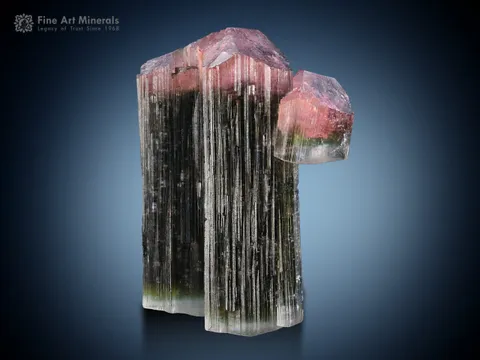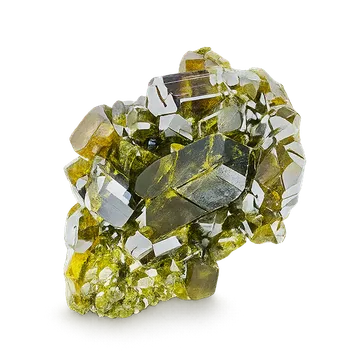
Epidote from Tormiq Valley, Pakistan — pleochroic, glassy crystals with sharp terminations and dramatic color shifts, prized for Alpine-cleft paragenesis.
Key facts
Tormiq Valley epidote is one of the great modern expressions of the Alpine-cleft style outside Europe: sharp, lustrous, pleochroic crystals from the high Karakoram, often so transparent at the edges that a dark olive prism suddenly flashes golden green under transmitted light. The best pieces are not merely “good for Pakistan”; they stand naturally beside classic Alpine epidotes because of their glassy luster, fine striations, sword-like terminations, and habit of forming clean, sculptural groups rather than massive aggregates.

Photo: Wikimedia Commons
The locality sits in the Haramosh Mountains of Gilgit-Baltistan, in a valley that drains toward the Indus between Shengus and Skardu. Mineralogically, it belongs to a family of Alpine-type clefts developed in fractured metamorphic and igneous rocks. The same fissure system that produced epidote also produced clinozoisite, diopside, titanite, adularia, quartz, axinite-(Fe), amphibole-group “byssolite,” fluorapatite, hematite, calcite, and other species. That diversity is a major part of Tormiq’s collector appeal: the epidote is excellent by itself, but the locality also yields combinations that show a full cleft paragenesis.
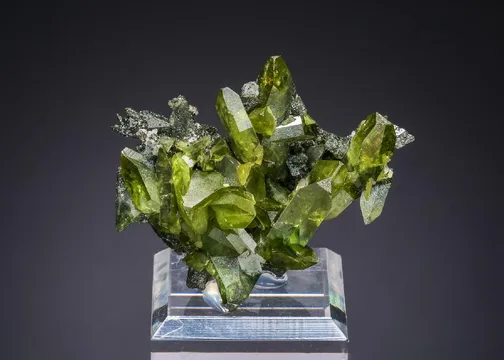
The visual signature is a play of darkness and light. In reflected light, many Tormiq epidotes appear nearly black, bottle-green, or deep olive-brown. Rotate the specimen or backlight a sharp edge, and the same crystal may shift to golden olive, grass green, honey, or “root beer” brown. Collectors prize specimens that combine that pleochroism with undamaged wedge terminations, well-defined longitudinal striations, high luster, and enough transparency to make the crystal feel alive rather than merely dark.

Photo: Wikimedia Commons
Tormiq became known to the international specimen market in the late twentieth century, with references to epidote from the Himalaya and Karakoram appearing in the early 1990s and strong collector circulation by the mid- to late 1990s. Older pieces from those early market years are now scattered through private collections and dealer archives, and fresh top-quality examples are less common than the locality’s fame might suggest.
Search for specimens: View all epidote specimens from Tormiq Valley, Pakistan
Tormiq Valley is recorded in modern mineralogical databases as Tormiq Valley, Haramosh Mountains, Roundu District, Gilgit-Baltistan, Pakistan, with older and alternate spellings including Turmik, Tormic, Tormik, Tormig, and Turmiq. It is a tributary valley to the Indus River between Shengus and Skardu, in a rugged part of the Karakoram where locality names have historically moved through dealer labels faster than administrative boundaries have settled.
The deposit type is Alpine cleft-type metamorphic mineralization. The important specimen pockets are not ore bodies in the usual mining sense; they are fissures, fractures, and open spaces formed in competent rocks during tectonic deformation, then lined or filled by later mineralizing fluids. Mindat’s locality description records granite, amphibolite, and ultramafic rocks in the lower valley near the Indus, with metasedimentary and metavolcanic rocks in the central and upper valley. Tectonism associated with the Main Karakoram Thrust produced many fractures and clefts, and those clefts are the setting for the epidote and its companion minerals.
The broader regional geology places the area near the Ladakh Terrane and Shyok Suture Zone in the Chogo Lungma–Turmik region. Published geological work on that region describes a complex suture-zone environment involving amphibolites, metavolcanic and metasedimentary units, granitoids, and multiple metamorphic and deformational events. For the collector, the practical consequence is a locality with both high-grade regional geological complexity and the late brittle openings needed to grow open-space crystals.
Production has been small-scale and specimen-driven. Tormiq epidote is collected from clefts rather than mined as a commercial commodity, and the specimens that entered the international market were gathered by local diggers and passed through Pakistan’s mineral trade networks into Peshawar, Europe, and the United States. Good material was already known to collectors by the 1990s; later dealer notes record productive early-2000s areas being revisited around 2014 in search of additional epidote–clinozoisite material. Current availability is sporadic: ordinary Pakistan epidote is easy enough to find, but fine, undamaged Tormiq pieces with verified locality and strong aesthetics are not abundant.
Collecting access should be understood as difficult and local. Tormiq is not a public fee-dig site. The valley lies in steep mountain terrain, and specimen recovery depends on local knowledge, seasonal access, land and community arrangements, and safe work in fractured rock. For collectors outside Pakistan, the realistic route is almost always through reputable dealers, older collections, and carefully documented specimens rather than independent field collecting.
Notable finds include lustrous sword-shaped epidote groups, gemmy faden epidote specimens, epidote with quartz, epidote on or with byssolite-like amphibole fibers, epidote with diopside, and epidote-bearing assemblages with adularia, titanite, axinite-(Fe), prehnite, fluorapatite, and calcite. Calcite is considered rare in Tormiq Alpine-type assemblages, which makes calcite-bearing combinations particularly interesting when properly documented.
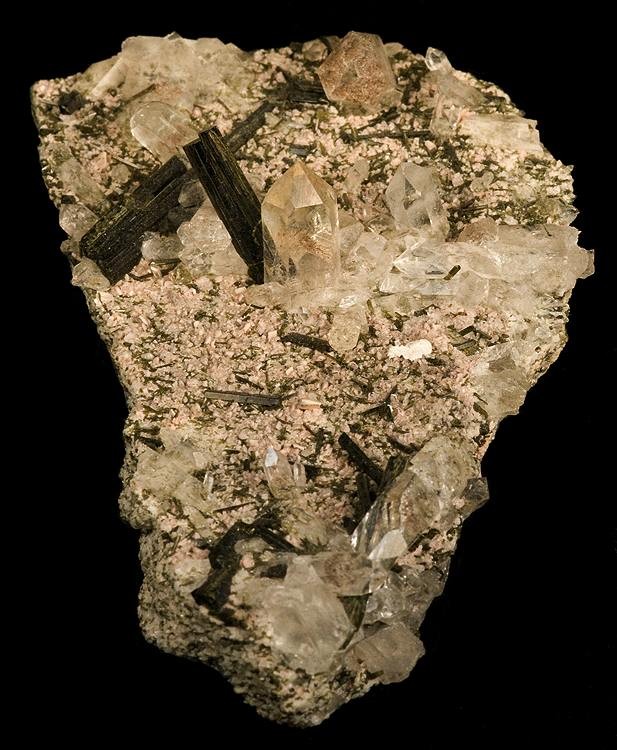
Photo: Wikimedia Commons
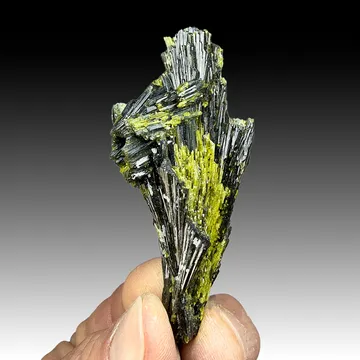
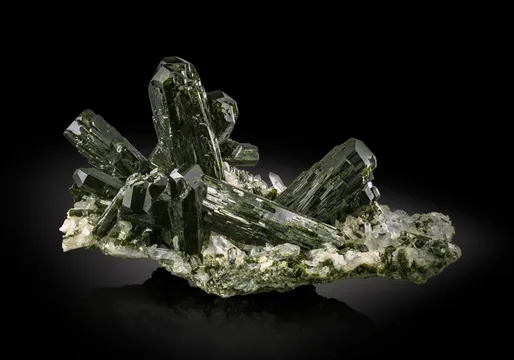
The classic habit is a sharp, elongated prismatic crystal with strong longitudinal striations and chisel- to sword-like terminations. Many crystals are flattened or bladed enough to read as “swords” rather than simple prisms. Groups may be parallel, divergent, or stacked along a faden-like line, and some specimens show multiple terminations or doubly terminated crystals. The best pieces have a crisp architectural quality: long dark blades rising from a pale or fibrous matrix, or loose floater groups with well-finished ends.
Color ranges from deep olive green and bottle green to golden olive, brown-green, coffee brown, and root-beer brown. Thick crystals may look nearly black in reflected light, especially under flat lighting. The collector-grade material changes character when backlit: edges and thinner zones reveal golden green, chrome-green, honey, or olive-oil tones. Pleochroism is a major quality factor for the locality, and a top Tormiq epidote should be examined by rotating it under a strong point light, not judged only from a dealer photo.
Transparency is variable. Many pieces are translucent only along edges and terminations, while the finest miniature crystals can be distinctly gemmy through much of the crystal. The glassy luster is one of the locality’s strengths, and well-preserved faces often show a wet, reflective sheen that makes the striations highly visible.
Typical specimen sizes range from thumbnail and miniature groups to small-cabinet pieces. Verified examples include crystals and groups around 2–5 cm, larger cabinet specimens near 10–12 cm across, and individual crystals reported to several centimeters in length. Dealer records describe crystals to about 7.2 cm on a cabinet specimen and a number of miniatures with principal crystals in the 2–4 cm range. Size alone is not the point: a sharp, gemmy 3 cm Tormiq crystal with full terminations and strong pleochroism is more desirable than a larger but dark, contacted, or dull piece.
Associated minerals are important for both aesthetics and locality confidence. The most common documented associates for Tormiq epidote include amphibole-group byssolite, diopside, K-feldspar var. adularia, quartz, axinite-(Fe), prehnite, talc, titanite, fluorapatite, calcite, hematite, garnet-group minerals, plagioclase, and augite. Dark epidote rising from silky blue-gray to greenish amphibole fibers is especially recognizable. Quartz combinations are less common than single epidote groups but can be highly attractive when clear quartz points contrast with dark green epidote. Diopside–epidote combinations are also collectible because they express the broader Alpine-cleft chemistry of the valley.
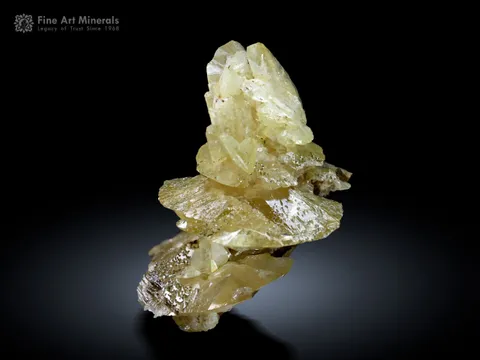
A special point for Tormiq is the epidote–clinozoisite boundary. Clinozoisite, the aluminum-rich analogue in the epidote group, is well documented from the locality, and some brownish to golden prismatic specimens formerly sold as epidote are better described as clinozoisite or as members of the clinozoisite–epidote series. Visual separation is not always reliable. Greener, iron-rich material is more likely to be epidote; pale brown, golden, or low-iron material may require XRD or chemical confirmation. Serious locality collectors should welcome this nuance rather than avoid it: Tormiq is one of the localities where the epidote-group chemistry itself is part of the story.
The first authenticity issue is locality precision. Tormiq material may be labeled “Skardu,” “Haramosh,” “Tormik,” “Tormiq Valley,” or older “Baltistan/Northern Areas” variants. Those labels can all refer to the same collecting region, but they are not equally precise. A label reading only “Skardu, Pakistan” is plausible but weak; a label specifying Tormiq Valley, Haramosh Mountains, Roundu District, Gilgit-Baltistan is stronger. Some market labels have also confused Tormiq with other Pakistan epidote localities such as Alchuri or Balochistan. Habit helps: Tormiq and Alchuri material is typically prismatic, lustrous, and Alpine-cleft-like, whereas some Balochistan epidote is blockier, darker, and more pseudo-octahedral.
The second authenticity issue is species identity. Tormiq produces both epidote and clinozoisite–epidote series material, and clinozoisite has been sold as “epidote” in the broad collector sense. That is not always deception; in older dealer usage, epidote-group crystals were often labeled by appearance unless analyzed. For high-value pieces, ask whether the specimen has been XRD tested, chemically analyzed, or visually assigned. If a brown-golden “epidote” is unusually transparent and low in green tone, clinozoisite should be considered.
No well-documented treatment tradition is associated with Tormiq epidote. The practical condition concerns are physical rather than chemical: contacted terminations, bruised edges, repaired crystals, and fragile fibrous matrix. Because the crystals are elongated and often attached along a narrow base, breaks and reattachments are possible. Examine large crystals under magnification at the base and along any faden-like central seam. Look for glue shine, misaligned striations, cloudy adhesive in fractures, or a termination that does not match the growth direction of the prism.
Natural contacts are common and should be judged intelligently. Cleft specimens grow in confined openings, so a crystal may be pristine on the display face and contacted at the rear, base, or one termination. That is acceptable when disclosed and visually minor. Damage is more serious when the main display termination is chipped, when a sword crystal has a broken tip, or when the luster has been dulled by abrasion.
The best pieces are scarce but not mythical. Small, dark, or contacted Pakistan epidotes remain affordable. Fine Tormiq examples with sharp form, transparency, pleochroism, and old collection provenance trade at a premium, especially if they are matrix specimens or faden groups. Recent market records show miniatures still appearing from older collections, but the descriptions repeatedly emphasize that top examples are harder to find now than during the main market influx of the 1990s and early 2000s.
When buying, prioritize five things: exact locality, undamaged terminations, visible pleochroism, luster, and structural integrity. A good Tormiq epidote should look crisp even before it is backlit; a great one should transform when the light passes through it.
The defining Tormiq story in the specimen world is not a single dramatic mine opening but a slow recognition: collectors who knew European Alpine epidote began seeing Pakistani crystals that did the same things, and sometimes did them with more gemminess. That comparison is repeated across older dealer records because it was the shock of the material. The reference point was Knappenwand in Austria, the nineteenth-century standard for epidote. Tormiq did not replace Knappenwand, but it forced collectors to broaden the mental map of what a top Alpine-cleft epidote could be.
One of the recurring names attached to early fine Tormiq material is Richard “Rich” Kosnar. Kosnar was a serious collector and dealer with a special eye for Alpine and Alpine-type minerals, and multiple Tormiq epidotes from his collection later circulated through the auction market. His pieces show what advanced collectors valued: not simply “Pakistan epidote,” but sharp, gemmy, pleochroic crystal groups with the elegance of European cleft specimens. A cabinet specimen from his collection was described with a largest crystal of 7.2 cm, sitting on hair-like blue-gray byssolite and carrying the rich green to olive-oil color that collectors associate with the locality’s best work.
The faden epidotes add a more intimate story. “Faden” is German for “string,” and in quartz it refers to a white thread-like line produced by repeated opening and healing during crystal growth. Tormiq is one of the few places where collectors regularly discuss faden structure in epidote. In strong backlight, some specimens reveal a dark or fibrous line across the crystal group, the axis from which larger sword-shaped epidotes grew. These are not the largest specimens from the valley, but they are among the most characterful: a little geological scar preserved inside a green-black blade, visible only when the collector handles the specimen correctly.
A later chapter concerns the clinozoisite material. Dealer notes from 2014 describe diggers revisiting an area that had been productive in the early 2000s, hoping to recover more specimens. Some of the crystals from that work were not epidote sensu stricto but X-ray-confirmed clinozoisite, sharp and olive-golden, associated with minerals such as clinochlore and calcite. For a casual buyer this can seem like a complication; for a serious collector it is exactly the sort of nuance that makes Tormiq worth studying. The valley did not simply produce “green sticks.” It produced a chemically variable epidote-group suite in classic cleft habits.