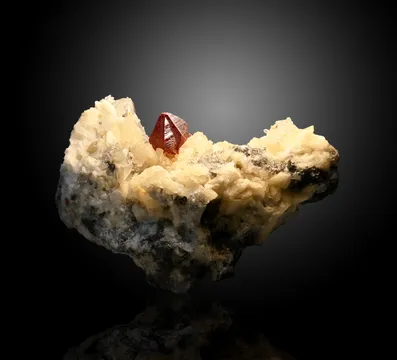
Tongren Mine, China — renowned cinnabar locality famed for cherry-red to blood-red crystals, drill-bit twins on dolomite and quartz, prized by collectors.
Key facts
Tongren Mine is one of the great modern cinnabar names: a Guizhou mercury locality whose best specimens changed the standard by which the species is judged. In strict locality terms it is recorded at Yunchangping Town, Bijiang District, Tongren, Guizhou, China; in the collector trade, “Tongren” has also been used rather broadly for cinnabar from the closely related Tongren–Wanshan–Yunchangping–Dadongla mercury-mining region. That distinction matters, because the best Tongren-style pieces are not just attractive cinnabar crystals—they are products of a specific carbonate-hosted, low-temperature hydrothermal mercury province in the western Hunan–eastern Guizhou belt, where red HgS crystals grew in open spaces with dolomite, quartz and calcite.
The collector look is unmistakable. Fine specimens show cherry-red to blood-red cinnabar as sharp modified rhombs, penetration twins and the celebrated “drill-bit” style twins, often perched dramatically on cream-white dolomite rhombs or on glassy quartz points. Good pieces are miniature to small-cabinet sculptures rather than massive ore: one or several highly lustrous crystals, commonly around 1–3 cm, placed with enough space and contrast that the red crystals read instantly from across a room. The best examples are gemmy at the edges, with a metallic-to-adamantine flash and a dark ruby internal glow under strong light.
Regional View
Country View
Geologically, Tongren belongs to a much larger mercury province that runs along the Tongren–Fenghuang belt, a northeast-trending zone of Cambrian to Ordovician carbonate rocks cut by major faults and subsidiary fracture systems. The ore is a low-temperature hydrothermal assemblage dominated by cinnabar, with dolomite, quartz and calcite as the collector matrices and gangue minerals. Nearby mercury fields such as Wanshan, Yanwuping, Yunchangping/Dadongla and Chatian explain why labels from older collections can be confusing: the mineral market often simplified a group of related Guizhou and western Hunan mercury localities into the familiar “Tongren” name.

Photo: Rob Lavinsky, iRocks.com, via Wikimedia Commons
Historically, the broader Tongren–Wanshan region sits in the heart of China’s cinnabar and mercury story. Wanshan, south of Tongren, is repeatedly described as China’s “mercury capital,” with mining traditions reaching back to the Qin and Han dynasties and documented heritage remains spanning the Tang and Song periods into the late twentieth century. For mineral collectors, however, the decisive moment came much later: Chinese cinnabars began reaching Western collections in quantity from the late 1980s and 1990s, and the sharp Tongren-style crystals quickly displaced many older reference points for the species. Today the mine is not a casual field-collecting destination; it is a market locality, where the label history, the naturalness of the crystal placement and the condition of the crystals matter as much as the red color itself.
Search for specimens: View all specimens from Tongren Mine, China
Tongren Mine is placed at Yunchangping Town in Bijiang District, Tongren, Guizhou, at about 27.75528 N, 109.35778 E. Mindat’s formal entry for the mine lists a concise but important species suite: cinnabar, dolomite, quartz, calcite, graphite and stibnite. The narrow species list fits the collector experience of the locality. Tongren specimens are not complicated polymetallic association pieces; they are typically aesthetic cinnabar-on-carbonate or cinnabar-on-quartz specimens from a mercury system in which open cavities allowed crystals to grow cleanly enough to become display minerals rather than simply ore.
The deposit belongs to the Tongren–Fenghuang mercury belt, also treated in the literature as part of the Xiangxi–Qiandong Pb-Zn-Hg metallogenic belt along the southeastern margin of the Yangtze Block. The belt is roughly 150 km long and 5–10 km wide, and it contains a chain of mercury and mercury-zinc mining districts including Wanshan, Yanwuping, Yunchangping/Dadongla, Chatian and related Hunan localities. Regional studies describe the mercury deposits as hosted mainly by Cambrian carbonate formations, especially dolostone and limestone, with mineralization preferentially developed in slope-facies carbonate rocks between major fault systems. The result is a structurally controlled, carbonate-hosted mercury province, not a volcanic hot-spring deposit in the usual museum-label sense.
At the ore scale, cinnabar occurs as disseminations, veins, fracture fillings, breccia cement and cavity fillings. The collector specimens came from the rare parts of that ore system where open space, clean gangue growth and late-stage crystallization intersected. Dolomite forms the pale rhombohedral matrix on many classic pieces; quartz provides sparkling drusy vugs or small water-clear points; calcite appears as white, tan or colorless late carbonate, sometimes coating or lining the underside of matrix pieces. The broader regional paragenesis includes silicification, carbonatization and asphaltic or bituminous material in the host rocks, with mercury, zinc, antimony and locally selenium-bearing phases documented from related deposits.
The mining history is layered. Ancient cinnabar and mercury exploitation in the broader Wanshan–Tongren region is described in Chinese heritage and environmental literature as reaching back more than two millennia, and archaeological work at Wanshan has identified 36 locations connected with cinnabar mining and mercury production from the Tang and Song dynastic periods through the late twentieth century. Modern industrial production was concentrated in the twentieth century, especially after the 1950s. One historical production summary gives Tongren’s Dadongla mercury-mining area as producing about 784 tons of mercury before 1949 and 5,644.44 tons from 1952 to 1995, for a total of 6,428.4 tons in the periods counted. These figures should be read as mining-history data for the Tongren/Dadongla mercury district rather than as specimen-production statistics.
The best-known collector production arrived internationally in waves. Early Chinese cinnabars surprised Western collectors in the 1980s; by the 1990s and early 2000s, Tongren, Wanshan, Yanwuping, Yunchangping/Dadongla and Chatian names were all appearing in dealer inventories, auction catalogues and magazine photographs. Some pieces were labelled simply “Tongren Mine,” while others carried more specific mine names. The most admired pockets produced lustrous, three-dimensional twins on pale dolomite or quartz, including miniature pieces with single crystals around 1.7–2.2 cm and larger plates with multiple crystals to around 1.2 cm scattered through quartz-lined vugs. Documented market examples include Tongren pieces measuring about 4 x 3.1 x 2.6 cm with a 2.1 x 1.5 cm twinned crystal, 5.2 x 4.8 x 3.6 cm with aerial twinned crystals to 1.3 cm, and 9.2 x 6.1 x 4.6 cm with pristine cherry-red crystals to 1.2 cm in a dolomite-quartz vug.
Collecting access today should be treated as effectively closed for practical purposes. The Wanshan mercury mine complex has been preserved and promoted as an industrial heritage site, and abandoned mercury workings present obvious hazards: unstable underground openings, mercury-bearing mine waste, calcine piles, contaminated runoff and restricted land status. Serious collectors should think of Tongren as a provenance-driven market locality. Original labels, old collection history, dealer notes, and the precise wording—Tongren, Wanshan, Yanwuping, Yunchangping, Dadongla or Chatian—should be preserved, not tidied into a more convenient name.
Cinnabar is the defining mineral of Tongren Mine, and the best pieces show why the locality became a benchmark: sharp modified rhombs, penetration twins and interpenetrating “drill-bit” twins in deep cherry-red to blood-red HgS, usually perched on white to cream dolomite, glassy quartz or pale calcite. Mindat records Tongren cinnabar as blood red on dolomite and darker red on quartz, with modified rhombs and penetration twins to several centimeters; dealer and museum records commonly describe crystals in the 1–3 cm range, with documented miniatures carrying individual twins around 1.7–2.2 cm and larger plates showing multiple crystals to about 1.2 cm. Fine pieces are judged by natural crystal placement, strong luster, undamaged edges, translucency at thin corners, good isolation from the matrix, and the classic red-on-white or red-on-quartz contrast; ordinary examples have scattered small red crystals, bruised terminations, overly sawn bases, weak color, or a crystal that lacks the crisp three-dimensional architecture of the best Tongren material.
Dolomite at Tongren is the essential stage on which the cinnabar performs: white, ivory or cream rhombohedral crystals lining vugs and matrix plates in the carbonate host rock. It is rarely collected from Tongren as a stand-alone species, but on cinnabar specimens it is one of the most important value components, because fresh dolomite rhombs create the crisp red-and-white contrast that made the locality famous. Documented specimens show dolomite as beds of small rhombs, mounded crystalline matrix, and pale accents around quartz-lined cavities; some descriptions note dolomite rhombs around 0.5 cm across, while others emphasize dense bone-white or milky-white crystalline surfaces. The best dolomite-bearing Tongren pieces have clean, bright, undamaged carbonate crystals that look natural around the cinnabar base, whereas dull, dirty, broken or glue-obscuring dolomite sharply reduces confidence and value.
Quartz from Tongren is most valued as a transparent to milky drusy matrix for cinnabar, commonly forming sparkling small points, quartz-lined vugs or glassy needle-like coatings with cinnabar crystals rising from the surface. Mindat photo association data for Tongren quartz strongly ties it to cinnabar and dolomite, matching the classic specimen style in which dark red or cherry-red HgS sits on a glittering quartz ground rather than on massive carbonate. Documented pieces include small colorless quartz crystals to about 0.3 cm associated with a 1.8 cm twinned cinnabar, as well as plates described as “glassy quartz needles” with multiple drill-bit-twinned cinnabars. The strongest quartz combinations have clean, unetched, sparkling quartz that enhances the cinnabar without hiding it; lesser pieces are gray, sugary, chipped, iron-stained or arranged in a way that looks suspiciously reconstructed around the crystal base.
Calcite is a subordinate but legitimate Tongren associate, appearing as white microcrystalline coatings, tan to translucent underside crystals, colorless scalenohedral or rhombohedral crystals, and pale carbonate matrix on cinnabar specimens. It is much less iconic here than dolomite and quartz, but it can make an important combination piece when the calcite is fresh, lustrous and visually distinct rather than merely a dull carbonate coating. Published and dealer-documented Tongren specimens include cinnabar with calcite crystals on matrix, thick tabular cinnabar crystals with calcite, and pieces in which the underside carries tan translucent calcite crystals while the display face presents cinnabar with quartz and dolomite. Good calcite associations add warm color or extra sparkle without confusing the composition; ordinary calcite is massive, cleaved, broken, chalky or so heavily coating the matrix that it weakens the classic Tongren contrast.
Beyond cinnabar and its carbonate-quartz matrix, the formal Tongren Mine mineral list is short but notable. Stibnite is the most important rarity, recorded from the mine with gray-black crystals to 22 cm and cited to Peter Bancroft’s Gem & Crystal Treasures; in the broader Tongren–Fenghuang and Wanshan systems, antimony minerals help explain the regional Hg-Sb character of some districts. Graphite is also listed from Tongren Mine, though it is not a display-specimen mineral from the locality in the way cinnabar is. No type-locality mineral is associated with Tongren Mine in the standard locality record; its mineralogical importance rests instead on world-class cinnabar crystal quality and on the historical and geological role of the surrounding Guizhou mercury province.
Tongren cinnabar has one central authenticity problem: constructed or reassembled matrix specimens. The issue is well documented for Chinese cinnabar, including Tongren- and Yunchangping-style material. In the most common form, real cinnabar crystals are glued into excavated pockets in quartz or dolomite matrix, sometimes with extra quartz chips or carbonate crystals packed around the base to make the join look natural. A specimen may therefore contain genuine cinnabar and genuine matrix but still not be a natural specimen.
Inspection should focus on the crystal base. Use magnification and strong side lighting. Warning signs include glossy adhesive in recesses, suspicious dusting or powdered matrix around the contact, quartz crystals that seem deliberately crowded around the base, a crystal seated in a carved socket, a mismatch between the crystal’s underside and the matrix contact, and a single perfect crystal isolated on otherwise broken or visually unrelated matrix. Ultraviolet light can sometimes reveal glue, but it is not definitive; some adhesives do not fluoresce, and skilled repairs can be hidden under matching powder.
Sawn matrix is common on Chinese cinnabar and does not by itself prove fakery. Dealers have long noted that trimming Tongren-style cinnabar is difficult because breakage lines in the dolomite or quartz matrix may run through the fragile cinnabar crystals, so many legitimate specimens have a sawed back or underside. The collector’s question is not simply “is there a saw cut?” but whether the display face shows a believable growth relationship, undisturbed crystal contacts and consistent matrix texture.
Condition is a serious value factor. Cinnabar is relatively soft and brittle, and Tongren crystals often stand proud of the matrix, so edge bruises, chipped terminations, contacted backs, missing twin points and dull rubbed faces are common. The best pieces have complete twin architecture and undamaged luster on the display side. Matrix damage is more tolerable when hidden on the back, but a broken dolomite or quartz field around the cinnabar weakens the aesthetic and can also raise questions about repair.
Handling should be sensible rather than theatrical. Cinnabar is HgS, and the mercury is far less bioavailable in intact crystalline cinnabar than in mercury vapor, soluble mercury salts or methylmercury, but it is still a mercury mineral. Do not grind, saw, heat, polish or acid-clean it casually; do not lick it; keep dust away from children and pets; wash hands after handling; and store specimens where fragile crystals will not be knocked or exposed to strong heat. Cinnabar can darken with prolonged strong light, so the best Tongren pieces belong in a cabinet, not in a sunlit window.
Market availability is mixed. Ordinary small Tongren or Tongren-style cinnabars remain available because the locality has been traded heavily for decades. Good miniatures and small-cabinet pieces with a single sharp crystal on clean dolomite or quartz are much more selective. Top examples—natural, unrepaired, old-label or well-provenanced specimens with major twins, strong red color, pristine luster and balanced matrix—are genuinely scarce and command a premium. The sharpest collectors buy Tongren cinnabar the way they buy fine emerald or classic silver: with a loupe, patience and a deep suspicion of anything that looks too conveniently perfect.
The small Tongren cinnabar miniatures that reached Western collectors around the turn of the twenty-first century had the drama of much larger minerals. One widely reproduced specimen measured only 5 x 4 x 3 cm, but the description reads like the discovery note for a pocket that suddenly reset expectations: a 1.7 x 1.7 x 1.0 cm cinnabar crystal standing upright on a pedestal of white dolomite, with a cogwheel-like termination and enough gemminess to glow cherry red under strong light. The point was not size alone. Collectors had seen red cinnabar before; what startled them was the combination of saturation, luster, natural pedestal and complete three-dimensional form in a miniature that could sit in the palm of a hand.
Another classic Tongren specimen, only 5.4 x 3.9 x 2.3 cm, carried a 1.8 cm twinned cinnabar perched on colorless quartz crystals to about 0.3 cm and white dolomite rhombs to about 0.5 cm, with tan translucent calcite unexpectedly coating the underside. Its description captured a piece of market history: the feeling that such a specimen might date to the very early 1980s, “one of the very first cinnabars to come out in a trickle that shocked the mineral world.” That phrase explains Tongren’s place in modern collecting better than a price guide can. Before the larger Chinese finds became familiar, a bright, gemmy, twinned cinnabar on quartz and dolomite from Guizhou looked almost improbable.
The greatest Tongren-style specimens also carried a practical problem: they were fragile, valuable and visually easy to improve by dishonest hands. A 2010 Mindat Fakes & Frauds discussion began with a collector examining a Chinese cinnabar under a scope and realizing that the cinnabar was glued into its calcite or carbonate matrix, with more matrix material glued around it. The responses were blunt: experienced collectors had seen constructed Chinese cinnabars before, including pieces with good crystals transplanted from damaged specimens onto cleaner matrix. One particularly memorable example involved about 20 nice twinned crystals on a battered matrix, priced around $20,000; the glue was visible even without a lens. That episode became part of the lore of the locality: Tongren cinnabar can be magnificent, but beauty alone is not proof of natural placement.
The broader district’s industrial story is darker and deeper than the mineral cabinets suggest. At Wanshan, the old mercury mine site preserves tunnels, stone ladders, grooves, pillars and mining marks tied to centuries of cinnabar and mercury work. Chinese heritage accounts describe the site at Tuping village in Wanshan as nationally protected since 2006, later transformed into Zhusha ancient town, and promoted for World Cultural Heritage recognition. The numbers are immense beside a 2 cm collector crystal: heritage reporting gives 33,000 tons of mercury and vermilion produced from 1950 to 2001 at the Wanshan site, more than 80 percent of China’s output during that period. The same red mineral that glows on a dolomite miniature also underpinned a major industrial landscape of furnaces, tunnels, calcines and mercury pollution.