A collector's guide to Qinglong Mine, China: its geology, mining history and notable minerals, illustrated with the 62 specimens documented from this locality on EarthWonders.
Key facts
Qinglong Mine is one of the more unusual Chinese localities in the modern specimen trade because it is not simply a fluorite mine, nor simply a stibnite mine, nor simply an oxidized copper-mineral curiosity. It is the collector-facing name for the Dachang Mine and related workings of the Dachang Sb ore field in Qinglong County, Qianxinan Buyi and Miao Autonomous Prefecture, Guizhou Province: a large epithermal, Carlin-style antimony-gold system in the northwestern Youjiang Basin. The primary ore story is stibnite in quartz-fluorite-bearing, strongly silicified and brecciated Permian rocks; the collector story is what later fluids, open cavities, and oxidation did to that ore system.
The best-known Qinglong specimens divide into several distinct collecting “looks.” One is the violet-edged to purple-gray cubic fluorite, often showing stepped, blocky, skeletal, or “QR code” surface patterns, commonly perched on quartz, calcite, baryte, dolomite, gypsum, or older sulfide-bearing matrix. Another is creedite: glassy colorless to lavender sprays and starbursts, some of them fluorescent and phosphorescent, from fluorite-rich cavity assemblages. A third is the electric-blue secondary suite—cyanotrichite-group material, especially carbonatecyanotrichite on many analyzed specimens—forming felted tufts and velvet-like coatings over calcite, fluorite, and altered matrix. Finally there is the rarities suite: ottensite, carlhintzeite, schubnelite, mikehowardite, thomsenolite, pachnolite, gearksutite, tyuyamunite, hewettite, and related alteration products that make Qinglong a locality where serious collectors now ask not only “is it pretty?” but “has it been analyzed?”
Regional View
Country View
Qinglong’s importance grew in stages. The mine had long been known as an antimony producer and as a source of Chinese stibnite specimens, but it entered the mineralogical literature in a sharper way when ottensite was described from the locality in 2007. That type-mineral discovery was not a grand cabinet mineral in the usual sense: it appeared as red-brown crusts, spheres, and columnar aggregates on stibnite, the sort of material that earlier collectors might have dismissed as mere alteration. The later specimen waves—fluorite and calcite, creedite, carbonatecyanotrichite, woodwardite “waves,” uranyl vanadates, and the rare aluminofluorides reported from 2025 finds—have made Qinglong one of the most analytically interesting Chinese localities of the past two decades.


Search for specimens: View all specimens from Qinglong Mine, China
Qinglong Mine, as used by collectors, corresponds to the Dachang Mine in the Dachang antimony ore field of Qinglong County, Guizhou. The standard collector locality is in the Qianxinan Buyi and Miao Autonomous Prefecture of southwestern China, and published locality databases place it near 25°40′24″ N, 105°10′24″ E. The broader Dachang Sb ore field is not a single neat pocket locality but a district of ore blocks and workings; named areas reported in the geological literature and specimen trade include Dachang, Shuijingwan, Dishuiyan, Gulu, Houpo, Xishe, Sanwangping, and Heishanjing. This matters on labels: a specimen marked simply “Qinglong” may be correct at the district level but imprecise at the mine or pocket level.
Geologically, Qinglong is a large low-temperature hydrothermal Sb-(Au) deposit in the Youjiang Basin, developed along the southwestern margin of the Yangtze Block. The deposit is structurally controlled, especially by northeast-trending faults and folds, with ore bodies concentrated between major fault systems and closely related to the Heishanjing–Houpo anticline. The ore-hosting stratigraphy includes Middle Permian Maokou Formation limestone, the ore-bearing “Dachang layer,” the Upper Permian Emeishan basalt, and overlying Longtan Formation coal-bearing strata. The Dachang layer itself is a particularly important mixed package at the limestone-basalt transition, including strongly silicified rocks, basaltic breccia, and clay-rich altered material.
The antimony ore bodies are described as bedded, stratiform-like, lenticular, and vein-like masses hosted mainly in the Dachang layer. In the lower part, strongly silicified brecciated limestone is an important host; in the middle part, silicified brecciated tuffaceous clay rocks are major ore hosts; in the upper part, altered basalt also hosts mineralization. The ore mineral is dominated by stibnite, while the common gangue minerals are quartz, fluorite, calcite, kaolinite, with lesser baryte and gypsum. Alteration includes silicification, fluorite alteration, argillic alteration, and subordinate carbonatization.
For collectors, the key paragenetic distinction is between the early antimony-rich, fluorite-bearing stage and later antimony-gold mineralization. Published studies describe early ore dominated by quartz-stibnite ± fluorite, or jasperoid + stibnite + fluorite, commonly developed in open-space breccias. Later mineralization comprises quartz-stibnite ± pyrite, with fine-grained stibnite and arsenian pyrite in quartz veins and stockworks. This explains why the mine can produce both robust stibnite-fluorite associations and later drusy quartz, calcite, pyrite, and oxidation-zone secondary species.
The age and fluid history of the deposit have been studied unusually well for a locality known to collectors. Sm-Nd dating of fluorite has placed the mineralization broadly in the Late Jurassic–Early Cretaceous range, with published values around 148–142 Ma and other reported fluorite ages near 141 Ma within error. Fluid-inclusion and isotope work points to low-temperature, low-salinity fluids with contributions from basinal fluids, meteoric water, and deeper magmatic or mantle-influenced components. Fluorite is not a decorative afterthought here; it is one of the central minerals used to reconstruct the ore-forming process.
Mining history is complex. Qinglong was long considered one of southwestern China’s important antimony mines, and state-linked Guizhou Qinglong Antimony operations at Dachang were documented as producing antimony products and also exploiting fluorite. Environmental and mining-rights documents show both a legacy of past production and a modern landscape of suspended or reorganized industrial activity: some studies describe the mine as having ceased production for years, while more recent Chinese legal and administrative notices refer to a mining license held through Qinglong Xinde Antimony, with a permitted mining area of about 41 square kilometers, a stated production scale of 300,000 tonnes per year, and a license period from April 12, 2022 to April 11, 2027. Collectors should not read that as public access. This is an industrial and environmental site, not a recreational collecting locality.
Specimen production has come in waves rather than as a continuous stream. Older Qinglong material included stibnite, fluorite on stibnite, and purple-gray fluorite with quartz and calcite. In the mid-2000s, blue cyanotrichite-group specimens began to appear, many later recognized or suspected as carbonatecyanotrichite rather than true cyanotrichite. Around 2007, ottensite was formally described from Qinglong material. Around 2020, striking woodwardite “waves” with azurite entered the high-end market. The 2021 fluorite-calcite-gypsum material brought sharp lustrous fluorite over scalenohedral calcite, often with fluorescence noted for the calcite. The 2025 finds drew renewed attention because rare aluminofluorides and vanadates—carlhintzeite, thomsenolite, pachnolite, schubnelite, mikehowardite, gearksutite, and related phases—were reported from new material, often requiring Raman, EDX, or more formal analytical confirmation.
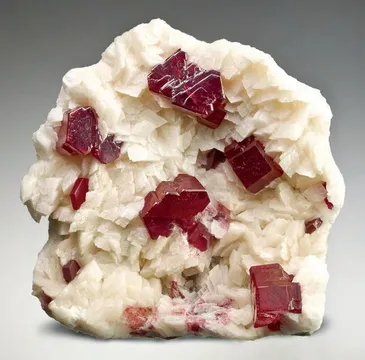
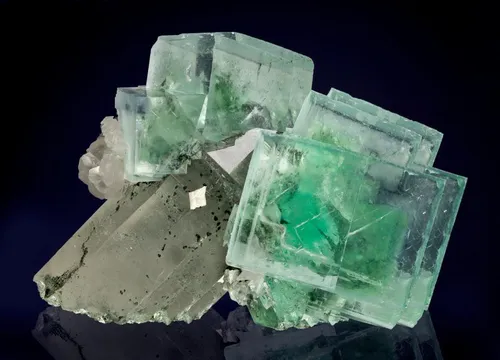
Fluorite is the visual signature mineral of Qinglong: typically cubic, translucent to transparent, pale lilac to gray-purple, and commonly darkest along the edges, with some crystals showing stepped, blocky, skeletal, or “QR code” surface growth that has become immediately recognizable in the trade. It occurs as druses and crusts on quartz, calcite, baryte, dolomite, gypsum, and locally stibnite-bearing matrix; older large specimens reached cabinet size, while many modern pieces are miniature to small-cabinet plates with individual cubes commonly around the millimeter-to-centimeter scale. The best Qinglong fluorites have crisp cubic geometry, strong violet edge-zoning, intact lustrous faces, and an aesthetic contrast with white calcite, quartz druse, or blue secondary copper minerals; ordinary pieces tend to be pale, chalky, abraded, or so heavily coated by gypsum and alteration minerals that the cubic form is muted.
Qinglong creedite is prized for glassy, colorless to lavender crystals in radial sprays, spherical aggregates, and starburst clusters, often seated on iron-stained matrix or associated with fluorite and later rare aluminofluorides. Documented cabinet specimens show bright, gemmy blades to about 3 cm on a 12.7 cm matrix, and Fabre Minerals has recorded a 15.5 cm specimen of violet spheroidal creedite aggregates from Qinglong; more recent finds also show creedite with carlhintzeite, gearksutite, pachnolite, thomsenolite, and unidentified reddish-brown alteration phases. The best examples here are airy, three-dimensional rosettes with transparent terminations, lavender zoning or phantoms, and little bruising on the exposed crystal tips; dense white crusts, broken sprays, or flattened clusters are much less desirable.
Cyanotrichite-labeled Qinglong specimens are typically electric sky-blue to powder-blue, composed of acicular to hairlike tufts, felty coatings, and velvet-like pads on calcite, fluorite, quartz, baryte, and altered matrix, but this is also the species group at Qinglong where labels deserve the most caution. Much of the classic blue material from the mine and district has been reidentified or sold as carbonatecyanotrichite, and visual distinction between cyanotrichite, carbonatecyanotrichite, and related blue copper-aluminum sulfate/carbonate phases is unreliable without PXRD, Raman, or chemical work. The best pieces are not merely blue stains: they show discrete, intact, lustrous to silky tufts, rich continuous coverage, and strong contrast against pale calcite or purple fluorite; worn, dusty, rubbed, or unanalysed “cyanotrichite” labels should be treated conservatively.
Calcite at Qinglong is most collectible as a partner mineral rather than as the deposit’s headline species, but some pieces are excellent: beige dogtooth crystals on purple-gray fluorite, white scalenohedra partly coated by fluorite and gypsum, and honey-colored elongated scalenohedral crystals with strong fluorescence under longwave and shortwave ultraviolet light. Dealer-documented Qinglong calcites include very elongated acute crystals to more than 8 cm on an 11.4 cm specimen, as well as smaller fluorite-calcite-gypsum plates from the 2021 material. Good Qinglong calcite has sharp termination, glassy luster, clean contrast with violet fluorite or white gypsum, and minimal bruising along the narrow scalenohedral points; dull calcite that merely forms a granular substrate for fluorite is far less compelling.
Quartz is fundamental to Qinglong’s ore system and to its specimen aesthetics: it occurs as jasperoid and vein quartz with stibnite in the primary ore, as drusy coatings with fluorite and calcite, and as pseudomorphs or epimorphs after earlier minerals in some specimen cavities. A notable photographed Qinglong fluorite specimen showed two very different faces, with beige dogtooth calcite on one side and light quartz druse plus a quartz epimorph after fluorite on the reverse; other documented material includes quartz pseudomorphs after stibnite with small fluorite cubes. The best quartz pieces from Qinglong are those in which drusy quartz adds architecture, sparkle, or pseudomorphic interest without hiding the fluorite or stibnite association; plain massive vein quartz is geologically important but rarely specimen-grade on its own.
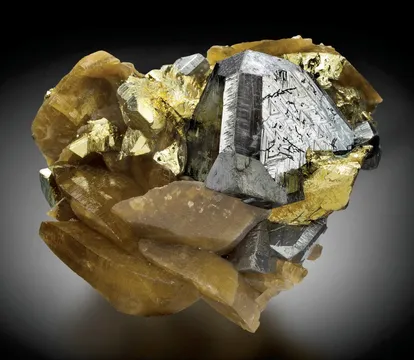
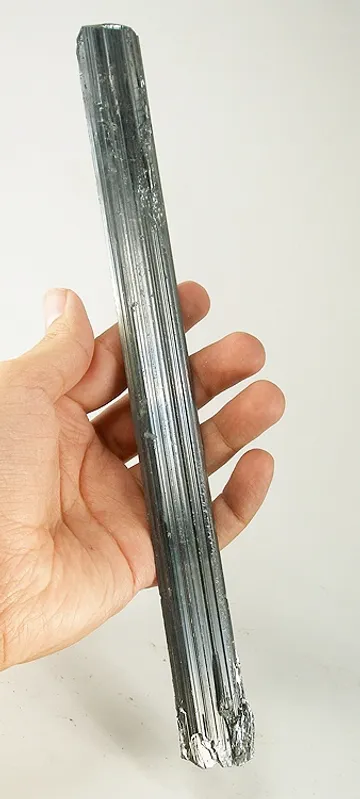
Stibnite is the ore mineral that underpins the whole locality, occurring as early coarse euhedral crystals with quartz and fluorite and as later finer-grained stibnite with quartz and pyrite in the Sb-Au stage. Specimen examples range from clusters of metallic gray blades to dramatic single “sword” crystals; one documented Qinglong crystal measured 30.7 x 2.8 x 2.7 cm, while ottensite-bearing stibnite specimens commonly show smaller terminated blades partly coated by red-brown secondary crusts. The best Qinglong stibnites are bright, sharply striated, well-terminated, and stable-looking, ideally with purple fluorite, quartz, or rare secondary Sb minerals adding context; common problems include bent or bruised blades, dull oxidation films, loose splinters, and coatings that may be mineralogically interesting but visually obscure the stibnite.
Woodwardite from Qinglong is a modern collector specialty, best known from a small 2020 find that produced light, sculptural, blue to blue-green “waves,” tiers, scallops, and botryoidal folds on brown mudstone-like matrix, sometimes dramatically accented by vivid blue azurite rosettes or veinlets. Cabinet and small-cabinet pieces around 8–12 cm have appeared in the trade and at auction, with several described as among the most aesthetic woodwardites known because the material forms displayable three-dimensional masses rather than the usual microscopic coatings. The elite pieces combine rich medium-blue and pale sky-blue banding, deep relief, intact velvety surfaces, and azurite contrast; damaged wave crests, rubbed powdery surfaces, and weakly colored crusts are much less desirable, and because this material was limited, convincing provenance to the early 2020 lot adds value.
Beyond these headline minerals, Qinglong is unusually rich in rare secondary and alteration species. Ottensite, (Na,K)3Sb6(SbS3)O9 · 3H2O, is the locality’s type-mineral claim: a rare red-brown antimony oxysulfide hydrate first described from Qinglong as thin crusts and aggregates on stibnite with fluorite. The mine is also documented for carbonatecyanotrichite, azurite, malachite, baryte, gypsum, kaolinite, allophane, gibbsite, orpiment, realgar, arsenopyrite, pyrite, chalcopyrite, marcasite, stibiconite, valentinite, cervantite, scorodite, jarosite, carlhintzeite, gearksutite, pachnolite, thomsenolite, schubnelite, mikehowardite, fervanite, tyuyamunite, hewettite, metazeunerite, torbernite, sklodowskite, and related uranium-vanadium phases. Several of these require analysis for responsible labeling; Qinglong is now a locality where the microscope and the Raman spectrum are as important as the display case.
Qinglong specimens reward careful labeling. “Qinglong Mine,” “Dachang Mine,” “Dachang Sb ore field,” and simply “Qinglong, Guizhou” are often used interchangeably in the trade, but the district contains multiple ore blocks and workings. The most collector-relevant modern label is Qinglong Mine (Dachang Mine), Dachang Sb ore field, Qinglong County, Qianxinan, Guizhou, China. Watch for erroneous province labels: some marketplace records have used “Shandong” for Qinglong material, but the mineral locality discussed here is in Guizhou.
The biggest authenticity issue is not artificial color so much as analytical identity. Blue Qinglong “cyanotrichite” is frequently carbonatecyanotrichite or a cyanotrichite-group phase, and visual separation is unsafe. Violet “yttrofluorite” labels have also circulated, but analyses of some Qinglong material found no measurable yttrium. Yellow, green, and red micro-minerals from the 2025 rare-species finds should be treated as provisional unless accompanied by analytical documentation, because the assemblage includes visually similar aluminofluorides, sulfates, arsenates, and vanadates.
Condition is a serious value driver. Fluorite cubes chip on corners and along stepped growth surfaces; a perfect violet-rimmed face pattern is worth more than a large but bruised group. Creedite sprays are brittle, and the exposed terminations bruise easily; examine the ends under magnification. Cyanotrichite-group and woodwardite specimens should be handled as delicate surface minerals: the silky tufts and wave crests can mat, rub, or shed if touched. Stibnite is soft, sectile, and easily bent or splintered; even impressive “sword” crystals may have repaired bases, dulled terminations, or cleavage bruises.
Fluorescence is locally important. Qinglong calcite may fluoresce strongly under longwave and shortwave UV, and some creedite specimens have been reported with distinct longwave response, blue mediumwave/shortwave behavior, phantoms, and phosphorescence. Fluorite may show fluorescence as well, but UV response should be treated as an added feature rather than proof of locality or species identity. Uranium-bearing species such as tyuyamunite, torbernite, metazeunerite, sklodowskite, and related yellow-green phases require ordinary radioactive-mineral precautions: store boxed and labeled, avoid dust, wash hands after handling, and do not keep loose friable material in living spaces.
Market availability is uneven. Qinglong fluorite is broadly available, but the finest “QR code” cubes with sharp purple edge zoning and strong aesthetics are much scarcer than ordinary pale examples. Creedite appears regularly but good lavender, undamaged, three-dimensional sprays are selective purchases. Carbonatecyanotrichite and cyanotrichite-labeled pieces are much less common in high quality, and analyzed examples command a premium. Woodwardite “waves” are a finite modern find and already trade as a Qinglong specialty. Ottensite remains a rarity; attractive, well-documented type-locality specimens are far harder to obtain than their small size might suggest.
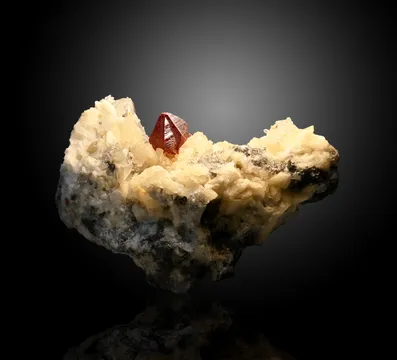
The ottensite story is a cautionary tale every Qinglong collector should remember. The new mineral was not first treasured as a showpiece; it appeared as red to reddish-brown crusts on stibnite, exactly the sort of coating that a specimen preparer might once have removed to reveal a cleaner metallic crystal. Later descriptions of Qinglong ottensite specimens noted that much of the material had been lost before the mineral was formally recognized because it had been “cleaned” off. In hindsight, the red crust was the prize: a type-locality antimony oxysulfide hydrate named for Berthold Ottens, one of the great chroniclers of Chinese minerals.
A second Qinglong story unfolded quietly through the blue tufts. For years, many of the brilliant sky-blue felted specimens were sold as cyanotrichite, an attractive enough label in its own right. Later work on cyanotrichite-group minerals and analysis of Qinglong specimens showed that many such pieces were actually carbonatecyanotrichite, a rarer and more complicated Cu-Al carbonate sulfate hydroxide hydrate. The shift is a classic example of how the Chinese specimen boom forced the collector world to revise labels: the old tag was not always fraudulent, just inadequate for a mineral group where powder X-ray diffraction and chemistry matter more than color.
The 2020 woodwardite find had a different feel entirely. Instead of the usual small coatings, Qinglong yielded blue, light, sculptural sheets that rolled across matrix like frozen waves. Dealers described only a few flats of the best material, with pieces in the 8–12 cm range carrying scalloped blue ridges, botryoidal folds, and in the best cases vivid azurite tucked into the creases. The texture looked so organic that experienced collectors compared it less to ordinary copper minerals than to modern sculpture. Within a few years, the best pieces had largely disappeared into collections, and later offerings were often described as old material from the original stash rather than fresh production.
The 2025 rare-mineral wave was the most analytical chapter yet. Material from the Dachang Sb ore field that looked, at first, like attractive yellow and white crusts proved to contain carlhintzeite, thomsenolite, pachnolite, gearksutite, schubnelite, mikehowardite, scorodite, jarosite, and possibly still-unresolved phases. The specimens were not just bought and resold; some were sent for targeted analysis, with identifications attributed to workers using methods such as Raman spectroscopy and EDX. For collectors, that episode captures the new Qinglong: a locality where a modest-looking association of creedite, fluorite, iron oxides, and pale yellow crusts may carry more mineralogical importance than a larger, flashier but unanalyzed specimen.