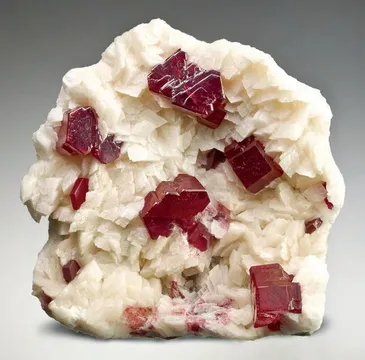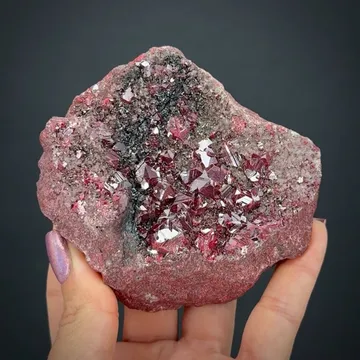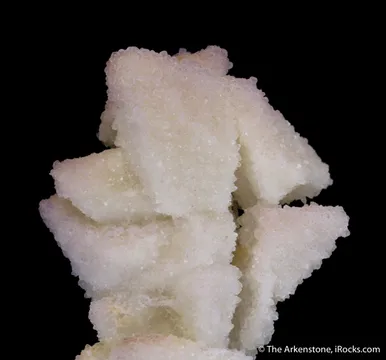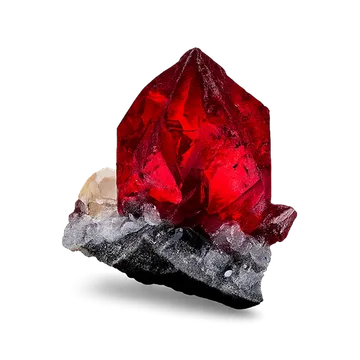
Cinnabar from Tongren Mine, Guizhou — sharp, lustrous HgS crystals in cherry-red to blood-red tones; backlit interiors glow; contrast on dolomite or quartz.
Key facts
Tongren cinnabar is one of the minerals that taught Western collectors to take modern Chinese specimens seriously. The appeal is immediate: sharp, lustrous HgS crystals in saturated cherry-red to blood-red tones, commonly rising from pale dolomite, glassy quartz, or calcite. The best crystals are not merely red on the surface; when a thin edge is backlit, the interiors can glow like dark ruby glass. On matrix, the contrast is textbook—dense red cinnabar against cream-white rhombs or colorless quartz points—and the finest pieces have the sculptural clarity that serious collectors want in a single-species display specimen.

Photo: Rob Lavinsky, iRocks.com, via Wikimedia Commons
The name “Tongren Mine” requires a little collector’s caution. In the strict locality sense, Mindat places Tongren Mine at Yunchangping Town, Bijiang District, Tongren, Guizhou. In the specimen trade, however, “Tongren” has also been used more broadly for cinnabar from the Tongren-Wanshan-Yunchangping mercury-mining region. That broader district is a carbonate-hosted mercury province on the southeastern margin of the Yangtze Block, within the western Hunan–eastern Guizhou mercury belt. It is a low-temperature hydrothermal system in Cambrian carbonate rocks, where cinnabar is the principal ore mineral and the usual collector matrices are dolomite, quartz, and calcite.
What makes Tongren material distinctive is the combination of crystal quality and visual architecture. Fine pieces show modified rhombs or penetration twins, often with a bright metallic-to-adamantine luster. The famous “drill-bit” or cyclic-looking twins can look almost engineered, with crisp edges and stacked triangular faces. The best specimens are not large by cabinet-mineral standards; rather, they are concentrated, jewel-like objects where a 1–3 cm cinnabar crystal can dominate a miniature or small-cabinet matrix.
Historically, the Tongren-Wanshan region belongs to China’s long cinnabar and mercury tradition. Wanshan, south of Tongren, has been described in Chinese heritage sources as the “China Mercury Capital,” and modern archaeological work treats it as China’s largest cinnabar deposit and an important mercury-production center from at least the Tang Dynasty period. For mineral collectors, the locality became famous when specimens began reaching the international market in the 1980s and 1990s, first as a trickle of astonishing crystals and then as a broader flow of commercial material. Today, attractive Tongren cinnabars remain available, but the finest old matrix pieces—especially undamaged twins with strong contrast—are much more selective than their once-common reputation suggests.
Search for specimens: View all cinnabar specimens from Tongren Mine, Guizhou, China
Tongren Mine is listed at Yunchangping Town, Bijiang District, Tongren, Guizhou, China, with associated cinnabar, dolomite, quartz, calcite, graphite, and stibnite. The broader Wanshan mercury ore field, a short distance to the south, is a superlarge carbonate-hosted Hg-(As) deposit whose primary ore is cinnabar. This regional context matters because many commercial labels use Tongren, Wanshan, Yunchangping, Dadongla, or Yanwuping names in overlapping ways. A careful collector should preserve the exact original label wording rather than “correcting” it too aggressively.
Geologically, the Tongren-Wanshan mercury belt is part of the western Hunan–eastern Guizhou Hg mineralization belt. Research on the Wanshan ore field describes mineralization in Cambrian carbonate host rocks, especially dolostone, controlled by faults and folds in the Tongren–Fenghuang belt. Cinnabar occurs as disseminations, fracture fillings, vein material, breccia ore, and cavity fillings. The ore assemblage is comparatively simple for a mercury deposit: cinnabar is dominant, with pyrite, sphalerite, metacinnabar, tiemannite, and selenium-bearing phases reported in the broader district, while quartz, dolomite, calcite, barite, and asphaltic or bituminous material occur as gangue.
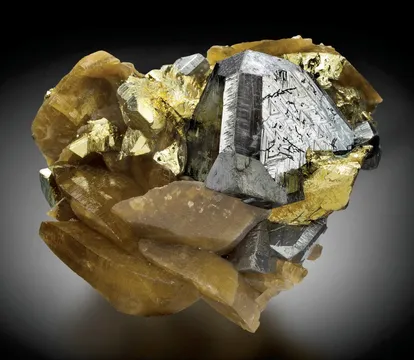
The specimen-producing environment is the attractive part of that ore system: open cavities and vugs in carbonate-rich rock allowed cinnabar to form discrete, lustrous crystals on dolomite, quartz, and calcite rather than only massive ore. The pale matrices are not incidental; they are part of the locality’s aesthetic identity. Dolomite gives the classic white-to-cream backdrop, quartz gives the rarer and more prized glassy contrast, and calcite can add warm amber or tan tones to combination pieces.
The mining history of the region is long and complicated. Wanshan is repeatedly cited as an ancient and major mercury center, with heritage accounts describing hundreds of years to more than two millennia of cinnabar and mercury exploitation. Archaeological work has identified 36 locations connected with cinnabar mining and mercury production, spanning from the Tang and Song dynastic periods to the late twentieth century. Modern environmental studies record Wanshan as China’s largest mercury-producing district, with industrial extraction particularly intense in the second half of the twentieth century and large quantities of calcines left after ore roasting.
For collectors, the important production window is narrower. Chinese cinnabars began entering Western mineral circles in small numbers in the 1980s, and the great penetration twins associated with Tongren-style labels are especially tied to late-1980s and early-1990s finds. By around 2000, substantially more material had reached the market, making ordinary examples more affordable. Later pockets and related Dadongla/Yunchangping material continued to appear, including documented specimens found in 2006, but the exceptional early matrix twins remain the benchmark.
Field access should not be assumed. The Wanshan mercury mine site has been treated as an industrial heritage area, and Chinese sources describe efforts to preserve and promote it for heritage status. Abandoned mercury mines also carry serious safety concerns: unstable underground workings, contaminated calcines, mercury-bearing waste, and restricted or managed land status. For practical collecting purposes, Tongren cinnabar is a market locality rather than a casual field-collecting destination. Provenance, old labels, dealer guarantees, and careful condition inspection matter more than any prospect of visiting and collecting fresh specimens.
The defining crystal forms are modified rhombs and penetration twins. Single crystals may be tabular to blocky, with bright triangular or rhombohedral faces; twinned crystals can show a stacked, spear-like, or “drill-bit” appearance. The most recognizable Tongren pieces have one or several red crystals rising cleanly from a dolomite carpet or quartz-lined vug, with enough separation that the crystal form can be read from across a case.
Color depends strongly on matrix and lighting. On dolomite, the crystals are often blood-red to cherry-red and can be vividly translucent along thin edges. On quartz, many are darker red, sometimes almost wine-red or brownish-red in reflected light, then much brighter when transmitted light catches a thin zone. Luster ranges from adamantine to submetallic; the most prized crystals combine strong luster with enough transparency to flash internal red.
Typical collectible crystal sizes run from a few millimeters to about 1.5 cm. Good miniatures commonly show crystals in the 4–10 mm range, and many attractive small-cabinet specimens carry 1 cm crystals. Fine larger twins of 2–3.5 cm are exceptional and are treated as major locality specimens, especially when undamaged and naturally placed on matrix. Matrix specimens around 4–8 cm across are common in the trade; larger, highly aesthetic plates are much less common than the number of small examples might suggest.
The usual associated minerals are dolomite, quartz, and calcite. Dolomite appears as white, cream, or off-white rhombs and is the classic association. Quartz may occur as clear to milky druse, needles, or vug linings and tends to make the strongest premium matrix when the cinnabar crystal is well isolated. Calcite can appear as tan, amber, or pale crystals, sometimes on the underside or as a secondary accent. Stibnite is listed for Tongren Mine, and the broader Bijiang and Wanshan districts include additional sulfides and mercury minerals, but the collector’s cinnabar specimens are overwhelmingly judged by cinnabar on dolomite/quartz/calcite combinations.
Quality is determined by five factors: crystal integrity, natural placement, color, luster, and matrix contrast. A single undamaged, lustrous 1 cm crystal centered on white dolomite can outrank a larger but damaged cluster. Backlit red is desirable, but reflected-light appearance matters more for display; a specimen that only comes alive with a flashlight is less satisfying than one that glows in normal case lighting. Quartz matrix is scarcer and can command a premium, especially when the cinnabar is perched rather than buried. Untwinned crystals are less common than the familiar twins, but many collectors still prefer the classic Tongren penetration twins because they are so locality-defining.
Tongren cinnabar has one major authenticity issue: glued or constructed matrix specimens. The problem is well documented for Chinese cinnabar in general and for Tongren/Yunchangping-style material in particular. Some specimens use real cinnabar crystals set into excavated recesses in quartz or dolomite, then hidden with glue and added small matrix crystals. Others are repaired crystals reattached to a plausible matrix. The deception can be very well executed, so the fact that the cinnabar itself is genuine does not prove that the specimen is a natural matrix piece.
Inspect the crystal bases under magnification. Look for unnatural gaps, glossy adhesive, dusted-over glue, quartz chips packed around the base, mismatched contact points, or a crystal that seems to sit in a drilled or carved socket. Ultraviolet light may help, but it is not definitive; some adhesives do not fluoresce, and experienced fabricators can hide joins under matching powder. A naturally placed crystal should have a believable growth relationship with the surrounding dolomite, quartz, or calcite, including consistent contact texture at the base.
Condition is the second issue. Cinnabar is soft compared with quartz and many other display minerals, and bright crystal edges can abrade easily. The best crystals have sharp terminations and clean faces; small rubs on high edges are common, but chips on the main termination, cleaved-looking breaks, and bruised corners reduce value sharply. Because crystals are dense and often perched, older specimens may have been knocked loose or repaired. Always ask whether a matrix crystal has been reattached, and preserve any old repair disclosure with the label.
Cinnabar also requires sensible handling. It is HgS, mercury sulfide, and should not be ground, cut, heated, tumbled, worn, or used in any “elixir” or metaphysical preparation. Stable display specimens can be handled cautiously, but wash hands after contact, avoid dust, and keep specimens away from children and food-preparation areas. Do not place cinnabar under hot lamps or in strong, prolonged direct sunlight. Good case storage is best, both for safety and for preserving color and luster.
Market availability is still healthy in thumbnail, miniature, and small-cabinet sizes. Recent dealer and auction records show Tongren cinnabar continuing to trade, with small but attractive examples in the low hundreds of dollars and better small-cabinet specimens rising higher. Truly top pieces—large, undamaged, naturally placed twins on fine matrix, especially with strong provenance—are not common. Old labels from early Western circulation, museum or notable collection provenance, and publication history can matter greatly.
Label discipline is especially important. A specimen labeled “Tongren Mine, Bijiang District” should not automatically be relabeled “Wanshan,” and a specimen labeled “Wanshan mine” should not be casually upgraded to “Tongren Mine” just because the appearance is similar. The trade has historically used these names loosely, while modern locality databases distinguish several nearby mines and ore fields. The safest practice is to record the label verbatim, then add a note such as “Tongren-area cinnabar, Guizhou” when the precise sublocality cannot be proven.
The most striking thing about Tongren cinnabar is how suddenly it changed collector expectations. Before the modern Chinese mineral market opened, good Chinese cinnabars in Western collections were rare, and many older pieces had suffered from decades of handling. Then, beginning in the 1980s, specimens with lustrous red crystals on pale matrix started appearing in the West. A 5.4 x 3.9 x 2.3 cm Tongren specimen photographed by Rob Lavinsky and placed on Wikimedia Commons was described as having a single twinned, gemmy, bright red 1.8 cm crystal perched on quartz, dolomite, and calcite; the note attached to that specimen says it may date back to the very early 1980s and calls such early pieces a “trickle that shocked the mineral world.” That is not dealer hyperbole without context: at the time, a sharp Chinese cinnabar twin on matrix looked unlike the familiar massive ore and tiny European crystals many collectors knew.
Another market story is preserved in a specimen listing for a Tongren cinnabar on quartz from the Warren Johannson collection. The piece was said to have been obtained in trade from Harvard in the 1940s, when such specimens were “incredibly rare mineral treasures.” Its later description captures the change in status perfectly: before China opened more fully to specimen trade, good cinnabars could be nearly unobtainable; by the 1990s they were among the most sought-after Chinese minerals; by around 2000, enough had emerged that ordinary examples became affordable. The great irony is that this wider availability made the locality famous while also making collectors underestimate how scarce the best undamaged twins really are.
The cultural story is older than the specimen market. Wanshan’s mercury mine site, within the broader Tongren mercury district, is promoted in Chinese heritage writing as the “China Mercury Capital.” Reports describe a 970 km network of underground workings and a mining history preserved in tunnels, stone ladders, grooves, markings, pillars, and roadways. The same heritage accounts note that Wanshan cinnabar was admired for its size, redness, and vivid color; by the Tang Dynasty period, “Guangming” cinnabar was important enough to be presented as tribute to the emperor.
Modern archaeology gives that heritage story sharper edges. A 2023 Industrial Archaeology Review article records that Wanshan was an important mercury-production center since the Tang Dynasty, and that a field survey identified 36 locations connected with cinnabar mining and mercury production from the Tang and Song dynasties through the late twentieth century. For a collector holding a 1 cm red crystal on dolomite, those numbers matter. The specimen is not just a pretty sulfide; it is a late chapter in a regional tradition that moved from imperial pigment and mercury technology to industrial mining, environmental cleanup, heritage preservation, and finally the mineral cabinet.