Qinglong County, China - antimony-gold district famed for stibnite blades, barcode-fluorite cubes, quartz, and diverse secondary minerals across Dachang mines.
Key facts
Qinglong County, in southwestern Guizhou, matters to collectors because one locality name—Qinglong, usually meaning the Qinglong Mine or Dachang Mine in the Dachang antimony ore field—ties together several very different collecting stories. It is first a major antimony-gold system of the Youjiang, or Nanpanjiang, metallogenic province: a low-temperature hydrothermal district where stibnite, quartz, fluorite, pyrite and later secondary minerals occupy the brecciated and altered “Dachang layer” between Permian carbonate rocks and Emeishan basaltic volcanic rocks. It is also a modern specimen locality whose best pieces are instantly recognizable: metallic gray stibnite blades and stout prisms; pale to deep purple fluorite cubes with dark edge-zoning that collectors call “QR code” or “barcode” fluorite; white quartz and baryte contrasts; and, for advanced systematic collectors, rare secondary antimony, vanadium, uranium and aluminofluoride species.
Regional View
Country View
The collector’s Qinglong is not a single pocket or small quarry. It is a district name attached to the Dachang Sb ore field and its mine sections, including Dachang, Shuijingwan, Xishe, Gulu, Houpo, Dishuiyan, Sanwangping and Heishanjing. That complexity explains why Qinglong specimens can look so varied. Some are primary ore specimens—stibnite with quartz, fluorite and pyrite. Others are late cavity pieces from fluoride- and sulfate-rich environments, including fluorite on quartz, creedite sprays, gypsum-coated calcite, carbonatecyanotrichite tufts and rare yellow carlhintzeite. Others still are micromineralogical or analytical specimens: ottensite crusts on stibnite, uranium-vanadium species, iron vanadates and disputed or newly recognized secondary phases.

Photo: Wikimedia Commons
The historical importance of Qinglong is twofold. Economically, the Dachang antimony deposit is one of the principal antimony resources of southwestern China, with mining and metallurgical use traced in Chinese summaries to roughly a century or more, and with systematic exploration beginning in the 1950s. Scientifically, the deposit has become a reference example in studies of Sb-Au relationships, fluid mixing, hydrocarbon-bearing ore fluids and the relationship between antimony deposits and nearby Carlin-like gold systems in the Youjiang basin. Mineralogically, the locality is the type locality of ottensite, a rare hydrated sodium-antimony oxysulfide first described from crusts on Qinglong stibnite.
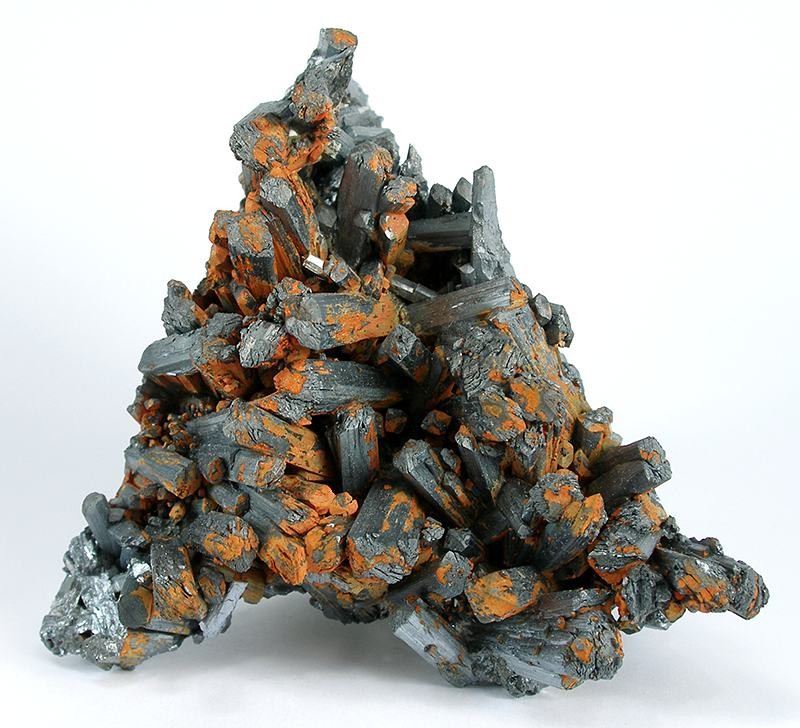
Photo: Wikimedia Commons
Search for specimens: View all specimens from Qinglong County, China
In mineral trade usage, “Qinglong County” most often points to the Qinglong Mine, also called the Dachang Mine, in the Dachang Sb ore field of Qinglong County, Qianxinan Buyi and Miao Autonomous Prefecture, Guizhou Province. The broader county contains other mineralized areas, but the classic stibnite-fluorite-ottensite-carbonatecyanotrichite-creedite suite is tied to the Dachang antimony-gold system. Mindat records the mine locality near 25°40′ N, 105°10′ E, and modern environmental studies place Dachang antimony mine tailings at essentially the same coordinates.
Geologically, Qinglong is best treated as a structurally controlled, low-temperature hydrothermal antimony-gold deposit within the northwestern Youjiang basin. The important host interval is the “Dachang layer,” an altered package developed between Middle Permian Maokou Formation limestone below and Upper Permian Emeishan basaltic rocks above, with Upper Permian Longtan Formation strata also present in the district. Chinese geological descriptions divide the Dachang layer into silicified rocks, breccias and tuffaceous or clay-rich altered units; the most favorable ore hosts are the silicified limestone breccias, siliceous breccias and clay breccias of the lower and middle parts of that interval.
The district is structurally complicated. Ore bodies are controlled by a combination of stratigraphy, lithology and faulting, especially NE- to NNE-trending structures and their intersections with NW-trending faults. Chinese summaries describe more than 100 ore bodies grouped into more than 20 mineralized bodies in the larger Dachang field, with industrial antimony ore bodies chiefly occurring as bedded, stratiform-like and lens-shaped masses in the Dachang layer. The largest industrial bodies are reported on the scale of hundreds of meters in length and width, with meter-scale to tens-of-meters thicknesses. For the specimen collector, that geometry matters because the best crystals are not representative of bulk ore; they came from open spaces, breccia cavities, fracture zones and late mineralized pockets where stibnite, fluorite, quartz and calcite had room to grow.
The main ore mineral is stibnite, Sb2S3. Published paragenetic work separates early antimony ore, dominated by quartz-stibnite with or without fluorite, from later Sb-Au mineralization consisting chiefly of quartz-stibnite with pyrite. Later studies describe early jasperoid-stibnite-fluorite assemblages in open-space wall-rock breccias, followed by quartz veins and stockworks with fine-grained stibnite and Au-bearing arsenian pyrite. Fluid-inclusion work indicates medium- to low-temperature ore fluids, with early-stage fluids generally hotter than the later Sb-Au stage; the ore-forming system involved H2O-NaCl fluids with hydrocarbons and minor CO2, and fluid mixing is repeatedly invoked as a key trigger for stibnite deposition.
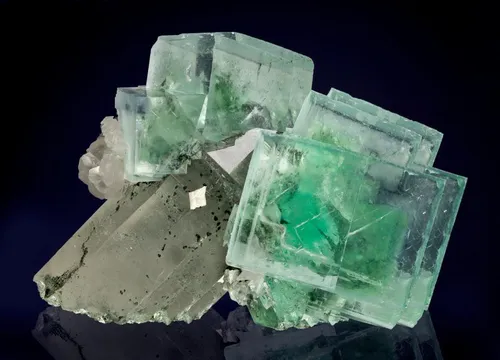
Fluorite is not merely an attractive accessory at Qinglong. In the ore literature it is part of the early Sb assemblage and a major gangue mineral used to study fluid evolution through inclusions, rare-earth-element patterns and Sr-H-O isotopes. Collectors know a different, more visual side of the same fluorine-rich system: purple, lilac, colorless to pale greenish cubes; deep violet edge zoning; stepped corner modifications; fluorite on quartz or baryte; and fluorite with calcite, gypsum, creedite or rare aluminofluoride species. The best fluorites are sharply cubic, lustrous, translucent, three-dimensional and strongly zoned; many ordinary examples are flatter crusts of small cubes on quartz or baryte matrix.
Mining history at Dachang reaches back well before modern mineral collecting. Chinese accounts describe discovery, local mining and primitive smelting as early as the late Ming to early Qing period, while systematic prospecting began in 1953. After 1956, teams of the Guizhou geological bureau carried out broader exploration in the district and its periphery, defining the large antimony field. Published government and industry summaries describe the Qinglong antimony mine as a major mine of Guizhou and southwestern China, with the mine headquarters at Dachang Town, approximately 45 km from Qinglong County seat and 46 km from Xingren. Recent investment documents identify a large mining-rights area and ongoing industrial redevelopment interest, while environmental papers document active tailings yards and continued concern over Sb, As and other metals in mine wastes.
Collecting access today should be understood as trade access rather than public collecting. Qinglong is an industrial and locally mined district, not a fee-dig locality, and the best specimens have reached collectors through miners, Chinese dealers, local specialists, international dealers and later analytical work. Recent years have seen continuing market supply of Qinglong fluorite and secondary minerals, including 2018–2021 fluorite and calcite-gypsum material, mid-2000s to later carbonatecyanotrichite, and 2025 finds of rare aluminofluorides and vanadates. Precise mine-section labels are often weak: a specimen may be sold simply as “Qinglong,” “Qinglong Mine,” “Dachang,” or “Dachang Sb ore field,” even when the pocket came from a particular mine section such as Houpo or another working.

Photo: Wikimedia Commons
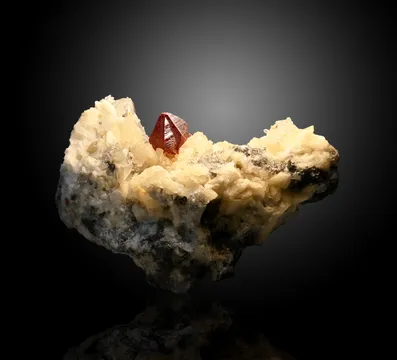
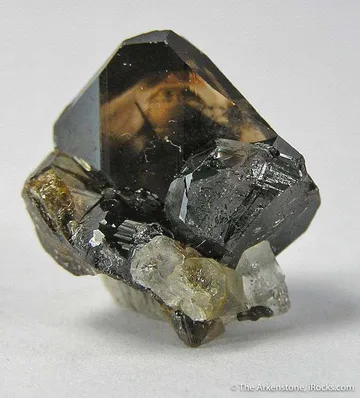
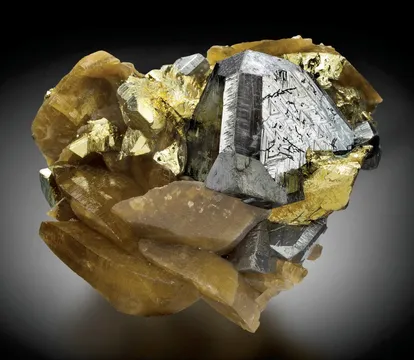
Qinglong stibnite ranges from coarse euhedral to subhedral crystals in the early quartz-stibnite-fluorite ore to finer stibnite associated with later quartz-pyrite Sb-Au veins, and the collector pieces are strongest when they show bright metallic gray luster, crisp longitudinal striations, intact chisel-like terminations and a three-dimensional arrangement rather than massive ore. The locality produced slender “wand” crystals of exceptional length, including a documented 40.5 cm crystal, but more typical display pieces are miniatures to cabinet specimens of short blades or stout prismatic crystals on quartz, fluorite or altered matrix. Associations with white quartz and purple fluorite are especially characteristic of the early ore assemblage, while realgar, orpiment, pyrite, calcite and secondary antimony species occur in the broader system. Fine Qinglong stibnite is judged by brightness, freedom from bends and broken tips, and whether fluorite or quartz enhances rather than masks the stibnite; ordinary pieces tend to be contacted, dull, etched, heavily coated or simply ore-rich rather than aesthetic.
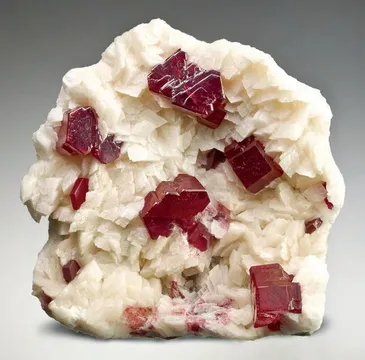
Qinglong fluorite is best known for cubic crystals in pale lilac, purple, bluish green to purple, and colorless-to-purple zoned combinations, often with dark violet edges and corners that create the celebrated “QR code” or “barcode” look. Documented dealer and show records describe crystals from sub-centimeter cubes to approximately 2.5–3.8 cm on edge, on matrices of quartz, botryoidal or druzy quartz, calcite, gypsum and baryte; the ore literature also places fluorite in the early jasperoid-stibnite assemblage. The finest pieces have transparent to translucent cubes, strong luster, sharp modified edges, visible internal zoning, and a clean sculptural matrix rather than a sawn slab of small cubes; good combinations with baryte or quartz pseudomorphs after baryte are notably less common. Qinglong fluorite may show purple or blue fluorescence under UV depending on the specimen and lighting conditions, but the most important visual marker in ordinary room light remains the purple edge-zoning against paler cube centers.
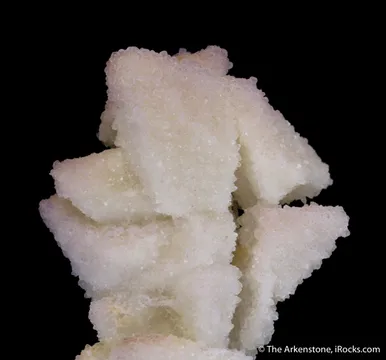
Beyond stibnite and fluorite, Qinglong has become a surprisingly rich systematic locality. Ottensite, (Na,K)3Sb6(SbS3)O9·3H2O in simplified published notation, is the locality’s best-known type-locality mineral, forming reddish brown to orange-red crusts, botryoidal coatings and aggregates on stibnite with fluorite. Other notable documented species from the Qinglong Mine or Dachang ore field include carbonatecyanotrichite as vivid sky-blue to royal-blue felted and acicular crusts, creedite in colorless to lavender prismatic sprays, baryte, calcite, gypsum, pyrite, arsenopyrite, realgar, orpiment, stibiconite, senarmontite, valentinite, mopungite, gearksutite, carlhintzeite, hewettite, schubnelite, mikehowardite, metazeunerite, torbernite and tyuyamunite. The rare-mineral potential is still evolving: recent analytical work has corrected some old labels, added unexpected species, and shown that attractive “blue hair” specimens require care because carbonatecyanotrichite and cyanotrichite cannot always be separated visually.
The most important authenticity issue for Qinglong is not wholesale fakery of the major stibnite-fluorite suite, but misidentification and enhancement in the secondary minerals. Some Qinglong creedite has reportedly been dyed purple with ink to increase saleability; the warning sign is color concentrated in cracks or porous areas, and the dye is reported to be acetone-soluble. Purple creedite from Qinglong can be genuine, so the issue is not “purple equals fake,” but rather whether the color is natural, evenly distributed and supported by provenance or testing.
A second recurring label problem is “yttrofluorite.” Several Qinglong specimens formerly sold or photographed under that name have been analyzed and found to be ordinary fluorite with no detectable yttrium. For collectors, the practical rule is simple: do not pay a premium for yttrofluorite from Qinglong unless the individual specimen has credible chemical data. Purple color, strong fluorescence or unusual zoning is not evidence for yttrium.
Qinglong stibnite needs careful handling. The crystals are brittle, often striated and easily bent or snapped at terminations; many pieces also have natural contacts because crystals grew in narrow voids or were recovered from ore zones rather than spacious geodes. Avoid ultrasonic cleaning, acid cleaning unless professionally assessed, and unnecessary handling of sharp blades. Stibnite is an antimony sulfide; normal display is not a hazard, but dust should not be inhaled, and specimens should not be cut, ground or cleaned aggressively in a home setting.
Realgar and orpiment, both recorded from the district, require their usual arsenic-mineral respect: minimize bright light exposure for realgar-rich pieces, avoid abrasion, and wash hands after handling. Uranium-bearing secondaries such as torbernite, metazeunerite and tyuyamunite are known from the Qinglong Mine mineral list, so radioactive labels should not be dismissed automatically. Most such specimens are small and manageable for an informed collector, but they belong in closed boxes with labels, away from children, food areas and unnecessary dust generation.
Condition varies widely. Stibnite may be etched, dulled, contacted or coated by later crusts. Fluorite cubes may show cleaves, bruised corners, sawed backs or matrix trimming; sawed backs are common enough in the trade that the display face should be judged separately from preparation. Calcite-gypsum pieces can be deceptively delicate because a glossy gypsum skin may be the surface the eye is admiring. Carbonatecyanotrichite and other fibrous secondary minerals should be kept dry, dust-free and untouched.
Market availability is uneven but active. Qinglong fluorite remains obtainable, from modest small plates of QR-code cubes to large cabinet pieces with quartz or baryte. Stibnite is less abundant in fine, undamaged, lustrous form than the number of locality labels suggests; large aesthetic crystals command a premium. Ottensite is genuinely rare and best treated as a systematic specimen rather than a showy cabinet mineral. Carbonatecyanotrichite, creedite and the newer aluminofluoride and vanadate associations appear episodically, often in small lots, and the best examples benefit from analysis, strong provenance, or both.
The ottensite story is the most human episode in Qinglong collecting because it begins as a mistake. When reddish and yellowish crusts on Qinglong stibnite first circulated, they were not immediately recognized as a new species. Some material was reportedly sold under another name, and some of the crusts were simply removed because they looked like unattractive dirt on otherwise saleable stibnite. One Wikimedia specimen note preserves the painful collector’s detail: much of the material was lost before description because it was “cleaned” off. In hindsight, those orange-red crusts were the treasure.
In April 2006, Marcus Origlieri was in Guilin asking dealers about the strange red coatings on stibnite. One dealer told him that perhaps five beer flats of the material had been produced in 2004 and distributed. That is a wonderfully concrete measure of rarity: not tonnes of ore, not a mapped vein, but a few beer flats of specimens passing through the trade before anyone fully understood what they were. The later work by Jiří Sejkora and Jaroslav Hyršl established ottensite as a new mineral, and Origlieri, Thomas Laetsch and Robert Downs clarified its paragenesis. For today’s collector, the best ottensite pieces from Qinglong carry that layered history: antimony ore, supergene alteration, mistaken identity, commercial cleaning, and finally formal mineralogical recognition.
Qinglong’s fluorite had a different entrance. Instead of being overlooked, it became instantly visual. Around 2018–2019, strongly zoned purple-edge cubes began appearing more widely in the mineral trade. The nickname “QR code fluorite” stuck because the darker purple edges and geometric patches on some cube faces resemble printed digital patterns. Good specimens from this find can be startling: pale cube centers, dark violet rims, quartz or baryte matrix, and a crisp architectural look unlike the softer purple masses from many Chinese fluorite districts. The name is informal, but useful; if a collector says “Qinglong QR fluorite,” most modern fluorite specialists immediately know the style.
The 2025 rare-mineral wave added another chapter. Dealers and analysts began seeing Qinglong pieces that did not fit the old stibnite-fluorite-carbonatecyanotrichite story: yellow carlhintzeite, gearksutite, fluellite, schubnelite and other rare or newly recognized phases. Several were tiny, pale, or unattractive by ordinary cabinet standards, which is exactly why they might have been missed earlier. The district’s reputation shifted from “a good Chinese fluorite and stibnite locality” toward something more interesting: a living analytical locality where even modest specimens can carry serious mineralogical significance.
Chen, Yu; Liu, Xiucheng; and Zhang, Qihou (1984). “A Tentative Discussion on the Genesis of the Dachang Antimony Deposit, Qinglong County, Guizhou Province.” Mineral Deposits, 3(3), 1–12. Early Chinese geological paper on the Dachang antimony deposit, the Dachang layer and ore-hosting alteration.
Peng, Jiantang; Hu, Ruizhong; Qi, Liang; and Jiang, Guohao (2002). “REE geochemistry of fluorite from the Qinglong antimony deposit and its geological implications.” Chinese Journal of Geology, 37(3), 277–287. Important fluorite geochemistry reference tying Qinglong fluorite to ore-fluid evolution.
Peng, Jiantang; Hu, Ruizhong; and Jiang, Guohao (2003). Geological Journal of China Universities, 9(2), 244–251. Frequently cited in later work for geological and isotopic context at the Qinglong/Dachang Sb deposit.
Su, Wenchao and coauthors (2015). “Infrared microthermometric study of fluid inclusions in stibnite from the Dachang antimony deposit, Qinglong, Guizhou.” Acta Petrologica Sinica. Chinese-language study focused on fluid inclusions in stibnite and the deposit’s temperature-salinity conditions.
Chen, Jun; Yang, Rui-Dong; Du, Li-Juan; Zheng, Lu-Lin; Gao, Jun-Bo; Lai, Chun-Kit; Wei, Huai-Rui; and Yuan, Ming-Gang (2018). “Mineralogy, geochemistry and fluid inclusions of the Qinglong Sb-(Au) deposit, Youjiang basin (Guizhou, SW China).” Ore Geology Reviews, 92, 1–18. Key modern paper identifying mineralization stages, ore-fluid conditions and the role of fluid mixing.
Chen, Jun; Yang, Rui-Dong; Du, Li-Juan; Gao, Jun-Bo; Zheng, Lu-Lin; Huang, Zhi-Long (2020). “Multistage fluid sources and evolution of Qinglong Sb-(Au) deposit in northern margin of Youjiang basin, SW China: REE geochemistry and Sr-H-O isotopes of ore-related jasperoid, quartz and fluorite.” Ore Geology Reviews, 127, 103851. Detailed study of jasperoid, quartz and fluorite showing links between hydrothermal silica, fluorite, antimony and gold mineralization.
Chen, Jun; Huang, Zhi-Long; Yang, Rui-Dong; Du, Li-Juan; Liao, Ming-Yang and coauthors (2021). “Gold and antimony metallogenic relations and ore-forming process of Qinglong Sb(Au) deposit in Youjiang basin, SW China: Sulfide trace elements and sulfur isotopes.” Geoscience Frontiers, 12(2), 605–623. Modern sulfide geochemistry paper distinguishing early coarse stibnite from later fine stibnite with Au-bearing arsenian pyrite.
Sejkora, Jiří; and Hyršl, Jaroslav (2007). “Ottensite: a new mineral from Qinglong, Guizhou Province, China.” The Mineralogical Record, 38(1), 77–81. Original description of ottensite from Qinglong, naming the locality as the type locality.
Origlieri, Marcus J.; Laetsch, Thomas A.; and Downs, Robert T. (2007). “A note on the paragenesis of ottensite.” The Mineralogical Record, 38(1), 83–84. Short but valuable note on the sequence of stibnite, fluorite and ottensite formation.
Handbook of Mineralogy: “Ottensite.” Mineralogical Society of America. Concise mineral data sheet recording Qinglong as the source of the type material and the National Museum, Prague specimen P1p 1/2006.
Niedermayr, Gerhard (2004). “Ein bemerkenswerter Neufund von Carbonat-Cyanotrichit aus China.” Mineralien-Welt, 15(5), 58–60. Early published notice of Qinglong carbonatecyanotrichite, a species now strongly associated with the locality’s secondary suite.
Guedes, Roger De Ascenção (2023). “Échos de la Minéralogie internationale.” Le Règne Minéral, 29(171), 43–44. Source discussed in later Mindat notes reporting analysis of Qinglong “yttrofluorite” as fluorite with no yttrium detected.
Mindat: Qinglong Mine (Dachang Mine), Dachang Sb ore field — Best single database entry for the mine locality, mineral list, references, type-locality status and specimen-photo links.
Mindat: Qinglong County, Qianxinan, Guizhou, China — County-level locality page useful for separating the broader administrative area from the Qinglong/Dachang mine locality.
ScienceDirect abstract: “Mineralogy, geochemistry and fluid inclusions of the Qinglong Sb-(Au) deposit” — Core modern geological paper on Qinglong mineralization stages and fluid inclusions.
ScienceDirect abstract: “Multistage fluid sources and evolution of Qinglong Sb-(Au) deposit” — Focused source for fluorite, jasperoid, quartz and ore-fluid evolution.
Geoscience Frontiers / Peking University page: “Gold and antimony metallogenic relations…” — Accessible abstract with details on coarse early stibnite, fluorite, jasperoid quartz and later Au-bearing pyrite.
Chinese Geological Survey journal: gravity inversion and deep prospecting potential in the Qinglong Dachang ore concentration area — Useful Chinese-language overview of regional structure, hidden intrusions and deep exploration targets.
Mining industry summary: “Typical antimony mining area—Guizhou Qinglong antimony mine” — Older but information-rich Chinese summary of mining history, ore-field dimensions, ore bodies, grade and associated minerals.
Wikimedia Commons: Qinglong Sb-Au Deposit category — Freely licensed specimen photographs, especially stibnite and ottensite on stibnite.
Mindat discussion: “On the ‘yttrofluorite’ from Qinglong Mine, China” — Important collector note on analysis showing Qinglong “yttrofluorite” material to be ordinary fluorite.
Le Comptoir Géologique: Creedite encyclopedia — Includes the specific warning that some Qinglong creedite specimens were dyed purple with ink.
Stack of Stones: “New mineral discoveries from Qinglong, China (2025)” — Recent collector-oriented summary of 2025 Qinglong rare-mineral discoveries and analytical work.
Mindat: Carbonatecyanotrichite from Qinglong Mine — Focused occurrence page for Qinglong carbonatecyanotrichite, with associated minerals and references.
Handbook of Mineralogy: Ottensite PDF — Compact reference for ottensite formula, occurrence, type material and associations.