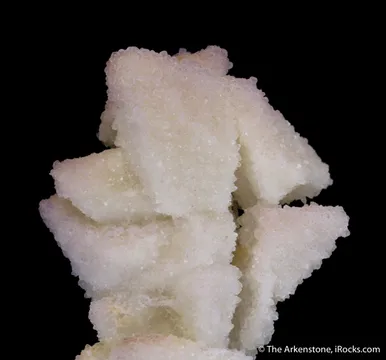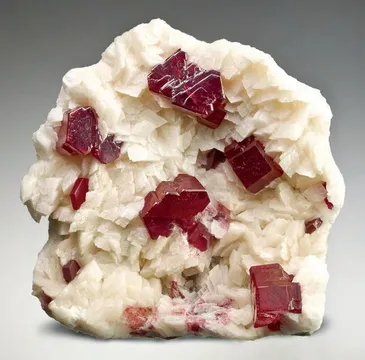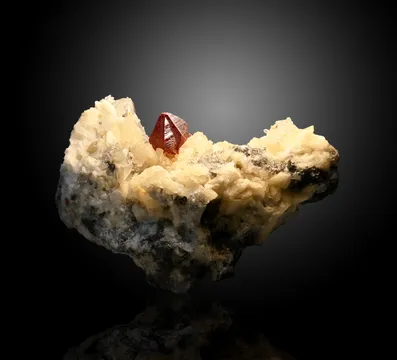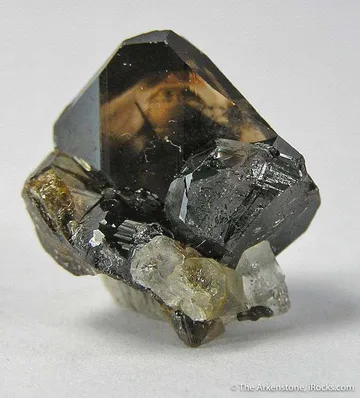
A collector's guide to Guizhou, China: its geology, mining history and notable minerals, illustrated with the 42 specimens documented from this locality on EarthWonders.
Key facts
Guizhou is a collector’s province rather than a single mine, and its mineral identity is inseparable from the karst plateau geology of southwest China: thick Paleozoic carbonate and clastic sequences, faulted and folded along the Yangtze Block margin, repeatedly mineralized by low-temperature hydrothermal systems rich in Fe, Sb, Hg, As, Au, Tl, Ba, F and Cu. For specimen collectors, the province resolves into several very different visual languages. Hezhang in Bijie has given the market the modern classic siderite–chalcopyrite association: translucent brown, lenticular siderite plates carrying brilliant brassy, pseudo-tetrahedral chalcopyrite. Qinglong and the Dachang antimony ore field are known for fluorite, calcite, gypsum, stibnite, rare supergene antimony minerals and the type-locality mineral ottensite. Wanshan–Tongren is the historic cinnabar heart of Guizhou, a carbonate-hosted mercury district whose red crystals helped define “Chinese mineral” in Western collections long before the great late-20th- and 21st-century boom in Chinese specimens.
Regional View
Country View
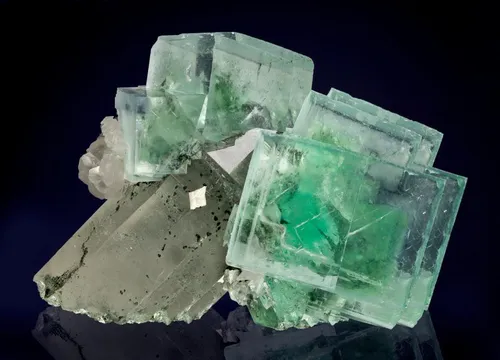
The best Guizhou cabinet specimens tend to be high-contrast pieces: metallic chalcopyrite against brown carbonate; cinnabar red against white quartz or pale dolomite; purple fluorite against creamy baryte, calcite or gypsum; steel-gray stibnite spines carrying pale calcite; or improbably delicate blue-green carbonatecyanotrichite fibers from the oxidation zones. This is not a locality where one species tells the whole story. Guizhou’s strength is the breadth of its hydrothermal systems and the way each district produced a distinct, recognizable aesthetic.

Photo: Fabre Minerals
Search for specimens: View all specimens from Guizhou, China
Guizhou’s collectible minerals come from several deposit families rather than one continuous collecting district. In western Guizhou, the siderite-bearing iron deposits, including the Caiyuanzi and Xiongxiongjia deposits, are mainly hosted by Middle Devonian dolostones. The ore occurs as banded and massive siderite ores and as sulfide–siderite ore; magnesian siderite is the main ore mineral, accompanied by ankerite, dolomite, kaolinite, quartz and carbonaceous material, with pyrite, chalcopyrite and lesser galena, tetrahedrite and enargite. Isotopic studies of the Caiyuanzi and Xiongxiongjia deposits interpret the siderite mineralization as hydrothermal metasomatic replacement of marine carbonate host rocks, with iron plausibly leached from older basement rocks and sulfur in associated sulfides derived from marine sulfate reduction processes.
The specimen locality sold internationally as the Kaiwu Mine, Hezhang County, Bijie, belongs to this western Guizhou siderite–base-metal setting, although the name itself has been questioned. Mindat records that fine chalcopyrite and siderite specimens appeared publicly for the first time at the 2013 Tucson Gem and Mineral Show, and that Berthold Ottens confirmed the locality as Kaiwu; a Chinese geologist at Nanjing University, however, stated that “Kaiwu” does not appear in Chinese documents and that the material came from the Caiyuanzi siderite deposit in Hezhang County. In collector practice, both names matter: “Kaiwu” identifies the familiar market label, while “Caiyuanzi, Hezhang” is likely the more geologically meaningful attribution.
The Qinglong Mine, also called the Dachang Mine, sits in the Dachang Sb ore field of Qinglong County, Qianxinan. It is an epithermal, Carlin-style antimony-gold system with stibnite-dominant mineralization and documented reserves of about 0.27 Mt Sb at 2.6% Sb. The Qinglong system includes eight ore blocks—Dachang, Shuijingwan, Dishuiyan, Gulu, Houpo, Xishe, Sanwangping and Heishanjing—and is associated with lateritic gold and fluorite deposits nearby. For collectors, this district is the source of purple to color-zoned fluorite, fluorite with baryte and quartz, fluorite with calcite and gypsum, stibnite, carbonatecyanotrichite, cyanotrichite, creedite, gearksutite, carlhintzeite, vanadates and rare antimony oxidation products. The type-locality mineral ottensite, a red-brown sodium antimony oxysulfosalt, was described from Qinglong as crusts on stibnite.
The Wanshan–Tongren mercury district represents the province’s older classic identity. Wanshan is a superlarge carbonate-hosted Hg-(As) deposit south of Tongren, with cinnabar as the dominant primary ore mineral and only subordinate sulfides. The four principal historical adits are recorded as Sheng Hsi Hsien, Hei Lung Tsu, Lao Shan Keng and Ta Tung. The ore field was worked at least from the Ming Dynasty, with industrial mining beginning in 1951 and ending in 1994 according to locality records for the field; environmental studies document huge volumes of roasted calcine waste and mercury-bearing mine drainage. Specimen material from Wanshan and Tongren is most valued when cinnabar crystals are sharp, bright red to deep cochineal, well exposed on quartz, dolomite or calcite, and not merely massive ore.
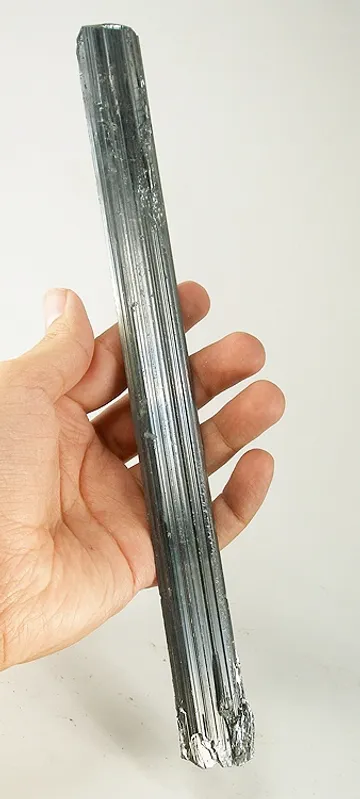
Dushan County and the Banpo antimony mine supplied a sharply different specimen style: thin metallic stibnite prisms, many doubly terminated, associated with scalenohedral calcite and sometimes tiny fluorite. The 2006 report of the Banpo discovery described roughly 150 specimens from a pocket, only about 25 of which survived without significant damage—a reminder that Guizhou’s most elegant sulfide specimens are often the most fragile.
Access today should be understood in practical collector terms: Guizhou is not a casual fee-digging destination for foreign collectors. Most specimens reach the market through commercial mining, Chinese mineral dealers, show circuits and older collections. Active and former mines may be regulated industrial sites, abandoned workings may be unsafe, and the mercury-, arsenic-, antimony-, thallium- and uranium-bearing districts raise real toxicological concerns. Provenance, labels and chain of custody are therefore unusually important for serious Guizhou specimens.
Guizhou siderite of collector importance is chiefly the Hezhang material sold as Kaiwu Mine and probably tied to the Caiyuanzi siderite deposit: dark brown to olive-brown, translucent, bright lenticular crystals and blades, commonly forming rosettes or mounded plates that can reach cabinet scale. The finest pieces are not simply “brown siderite”; they are architectural matrices for chalcopyrite, calcite, dolomite and locally tetrahedrite-subgroup minerals. Good Guizhou siderite has sharp edges, glassy luster, translucency at the rims, a pleasing stepped or bladed rhythm, and enough contrast with brassy chalcopyrite to make the specimen read across a room. Ordinary examples are more massive, dull, bruised, or lacking the sulfide punctuation that made the 2012–2015 Hezhang finds famous among modern Chinese classics.
Guizhou chalcopyrite is most admired from the Hezhang/Kaiwu–Caiyuanzi occurrence, where short disphenoidal to pseudo-tetrahedral crystals of brilliant brassy yellow chalcopyrite sit among lenticular siderite crystals. Individual chalcopyrite crystals on published dealer specimens commonly range from about 1 cm to several centimeters, with exceptional clusters showing larger composite crystals; associated minerals include siderite, calcite, dolomite, pyrite and, much more rarely, tetrahedrite-subgroup minerals partly coated by chalcopyrite. The best pieces show razor-sharp form, mirrorlike metallic luster, light iridescence without looking artificially colored, and balanced distribution over the siderite matrix. Because extraction damage is repeatedly noted for this material, undamaged large cabinet pieces are substantially more desirable than broken plates with scattered brassy points.
Beyond siderite and chalcopyrite, Guizhou is a province of important rarities and district classics. Wanshan–Tongren is a historic cinnabar province, with cinnabar, metacinnabar, native mercury, realgar, orpiment, stibnite, tiemannite, sphalerite, galena, baryte, quartz, calcite and dolomite documented from the mercury ore field. Qinglong has produced fluorite, calcite, baryte, gypsum, stibnite, carbonatecyanotrichite, cyanotrichite, creedite, gearksutite, carlhintzeite, torbernite, metazeunerite, hewettite, schubnelite, mikehowardite and ottensite; ottensite is especially significant because Qinglong is its type locality. Lanmuchang in Xingren County is the type locality for lanmuchangite, TlAl(SO4)2 · 12H2O, a thallium alum-group sulfate from the oxidation zone of the Tl-Hg deposit. The No. 504 uranium deposit at Baimacun, Kaiyang County, is the type locality for antimonselite, Sb2Se3, recorded as microscopic black grains and radiating acicular crystals in U-bearing calcite veins with pyrite, sphalerite, galena, ferroselite, clausthalite and uraninite.
The first authenticity issue with Guizhou specimens is locality labeling. “Kaiwu Mine” is the standard trade name for the celebrated siderite–chalcopyrite pieces, but the locality has been challenged in Chinese geological context and may correspond to the Caiyuanzi siderite deposit in Hezhang County. Serious labels should preserve both the market name and any older dealer attribution rather than silently “correcting” one to the other.
Condition is the second issue. Hezhang siderite–chalcopyrite specimens are notorious for edge bruising, cleaved siderite blades, contacted chalcopyrite corners and broken pocket plates. Large undamaged cabinet pieces deserve a premium because multiple sources note that much of the material was damaged during extraction. Examine the tips and ridges of chalcopyrite under magnification: fresh breaks will show a different texture and brightness from natural growth faces. For siderite, look for crushed blade edges, glued repairs along matrix fractures and artificially trimmed bases.
Guizhou fluorite from Qinglong can be attractive and increasingly available, but recent market material is often loosely labeled only “Guizhou,” “Qinglong,” or “Dachang.” Color-zoned purple fluorite, “purple edge” or “QR-code” patterned material, fluorite with gypsum, calcite or baryte, and fluorite with unusual blue-green secondary copper minerals should be checked carefully against known Qinglong associations. Some Qinglong secondary species—carbonatecyanotrichite, cyanotrichite and other delicate hydrous phases—are fragile, dust-sensitive and vulnerable to abrasion. Do not wash fibrous blue-green specimens casually.
Wanshan and Tongren cinnabar requires both specimen and safety awareness. Cinnabar is stable enough for normal display when handled sensibly, but avoid grinding, ultrasonic cleaning, heating, acid treatment or prolonged handling of friable matrix. Native mercury, if present, should be treated as a hazardous inclusion and never exposed to heat. Realgar and orpiment from Guizhou districts are light-sensitive arsenic sulfides; store them away from strong light and keep dust contained.
Radioactive and toxic-element localities in the province add another layer of caution. Qinglong uranium-bearing secondary minerals and Kaiyang No. 504 uranium-deposit specimens should be identified, labeled and stored accordingly. Lanmuchang material involves thallium-bearing mineralization, and thallium compounds are highly toxic; avoid any dusty, soluble sulfate crusts from Tl-Hg oxidation zones unless the specimen is securely isolated and clearly labeled. Lanmuchangite itself is water soluble, so moisture exposure is inappropriate.
Market availability varies strongly by species. Siderite–chalcopyrite from Hezhang appears regularly on the secondary market, but the finest older cabinet pieces are no longer common. Qinglong fluorite and calcite combinations are more widely encountered, while true ottensite, carbonatecyanotrichite-rich specimens and well-documented antimony supergene rarities are specialist pieces. Good Wanshan cinnabar is a classic Chinese collectible and should be bought with attention to crystallization, matrix, old labels and absence of artificial red enhancement or misleading “Tongren/Wanshan” generalization.
The Hezhang siderite–chalcopyrite story begins with a label that still refuses to sit quietly. When the first fine pieces reached the international market around the 2013 Tucson Gem and Mineral Show, collectors learned the name “Kaiwu Mine,” and the look was instantly memorable: brown, lenticular siderite blades carrying bright golden chalcopyrite, a distinctly Chinese modern classic but unlike the fluorites and stibnites that had already made the country famous. Then came the locality wrinkle. Berthold Ottens, whose work on Chinese mineral localities carries real weight among collectors, reportedly confirmed Kaiwu as the mine name; a Chinese geologist at Nanjing University countered that “Kaiwu” does not exist in Chinese documents and that the specimens came from the Caiyuanzi siderite deposit in Hezhang County. The result is a specimen-labeling compromise that advanced collectors should appreciate rather than erase: the commercial identity is Kaiwu, the geological shadow behind it is Caiyuanzi, and the best labels preserve the uncertainty.
The Banpo stibnite pocket at Dushan reads like a field collector’s heartbreak compressed into one discovery. In 2006, Mineralogical Record’s online report described a new stibnite–calcite association from “Banpo mine, Dushan, Guizhou Province.” The pocket yielded about 150 specimens, but only about 25 came out without significant damage. The reason is obvious to anyone who has handled stibnite: the crystals were thin metallic prisms, many doubly terminated, and some reached 15 cm long. On and between these skewer-like stibnites sat sharp, translucent gray-white calcite scalenohedra to 1.5 cm, with some specimens dusted by colorless cubic microcrystals of fluorite. The report’s uncertainty over the locality—Banpo was not then listed in the major Chinese locality index—captures an era when Chinese mineral specimens were arriving faster than Western reference works could absorb them.
Qinglong’s most elegant story is the birth of ottensite as a named mineral. It was not discovered as great freestanding crystals, but as thin red-brown botryoidal crusts about 1 mm thick on well-formed stibnite crystals up to 5 cm long. The new mineral was named for Berthold Ottens, born in 1942, a German collector, dealer and major authority on Chinese minerals. In a satisfying bit of mineralogical symmetry, the locality that made its name through antimony ore and stibnite specimens also produced a new antimony oxysulfosalt formed by the weathering of stibnite itself.
Wanshan is the darker, older chapter. Mercury mining there dates back at least to the Ming Dynasty, long before Guizhou fluorite and Hezhang chalcopyrite entered the collector market. Industrial mining began in 1951 and stopped in 1994, leaving an ore field remembered both for cinnabar specimens and for the environmental burden of mercury calcines and mine drainage. The ore is deceptively simple—dominantly cinnabar in carbonate host rocks—but the historical scale was immense enough that Wanshan became one of China’s defining mercury districts. A fine cinnabar from Wanshan is therefore not merely a red sulfide on matrix; it is a specimen from a centuries-long quicksilver landscape.
Huang, Xiaowen; Qi, Liang; Meng, Yueming; Chen, Da; Ling, Hude. “Origin of siderite mineralization in western Guizhou, SW China: Constraints from REEs, C, O, Sr and S isotopes.” Ore Geology Reviews 66 (2015): 252–265. Key paper on the Caiyuanzi and Xiongxiongjia siderite deposits, their Middle Devonian dolostone hosts, sulfide–siderite ores and hydrothermal metasomatic origin.
Kaiwu Mine, Hezhang County, Bijie, Guizhou, China — Mindat locality record. Important locality note documenting the 2013 Tucson appearance of siderite–chalcopyrite specimens and the Kaiwu versus Caiyuanzi naming issue.
Qinglong Mine (Dachang Mine), Dachang Sb ore field, Qinglong County, Qianxinan, Guizhou, China — Mindat locality record. Core reference for the Qinglong/Dachang antimony-gold deposit, ore blocks, reserves and documented mineral list.
Hyršl, Jaroslav; Sejkora, Jiří. “Ottensite: a new mineral from Qinglong, Guizhou Province, China.” The Mineralogical Record 38, no. 1 (2007): 77–81. Type description of ottensite from Qinglong, including its occurrence as red-brown crusts on stibnite.
Ottensite — Mindat mineral data. Mineralogical data for ottensite, with formula, IMA approval, type locality, type material and associated minerals.
Ottensite — Handbook of Mineralogy PDF. Concise technical summary of ottensite chemistry, occurrence, association, type material and naming.
Chen Daiyan; Wang Guanxin; Zou Zhenxi; Chen Yuming. “A new mineral — Lanmuchangite.” Acta Mineralogica Sinica 21, no. 3 (2001): 271–277. Original description source cited for lanmuchangite, the thallium alum-group sulfate named for the Lanmuchang Tl-Hg deposit.
Lanmuchang Tl deposit, Huijiabao gold field, Xingren County, Qianxinan, Guizhou, China — Mindat locality record. Detailed locality reference for the Tl-Hg deposit, mineralization stages, ore horizons and lanmuchangite type locality.
Antimonselite from U deposit No. 504, Baimacun, Kaiyang County, Guiyang, Guizhou, China — Mindat occurrence record. Type-locality occurrence record for antimonselite, including habit, microscopic size range and mineral association in U-bearing calcite veins.
Antimonselite — Handbook of Mineralogy PDF. Technical mineral data for antimonselite and its Guizhou type locality.
Zhang, Guoping; Liu, Congqiang; Wu, Pan; Yang, Yuangen. “The geochemical characteristics of mine-waste calcines and runoff from the Wanshan mercury mine, Guizhou, China.” Applied Geochemistry 19, no. 11 (2004): 1735–1744. Environmental and geochemical study of Wanshan mercury mine wastes and cinnabar-dominant ore.
Wang et al. “Characteristics and Formation Conditions of Se-Bearing Metacinnabar in the Wanshan Mercury Ore Field, Eastern Guizhou.” Minerals 13, no. 2 (2023): 173. Open-access study of Wanshan ore types, cinnabar–carbonate and selenide–cinnabar–quartz stages, and Se-bearing metacinnabar.
Luo Yanbi; Huang Zhilong; Xiao Xianguo; Ding Wei. “Contents of Ore-Forming Elements and Geological Significance of Dushan Antimony Ore Field, Guizhou Province, China.” Acta Mineralogica Sinica 34, no. 2 (2014): 247–253. Geological study of ore-forming elements in the Dushan antimony ore field.
Mineralogical Record, June 2006 What’s New article. Contemporary market report describing the Banpo, Dushan stibnite–calcite pocket and its specimen yield.
Mineralogical Record Vol. 44 No. 1.1, “Crystalline Treasures — The Mineral Heritage of China.” China mineral supplement containing a Guizhou Province section and map, with Wanshan–Tongren, Qinglong and Dushan highlighted as collectible-mineral areas.
Guizhou, China — Mindat locality page — Broad provincial entry for minerals and sublocalities across Guizhou.
Kaiwu Mine, Hezhang County, Bijie — Mindat — Essential reference for the Hezhang siderite–chalcopyrite occurrence and naming controversy.
Caiyuanzi and western Guizhou siderite mineralization — Ore Geology Reviews — Best geological source for the siderite deposit model behind the Hezhang specimens.
Qinglong Mine (Dachang Mine) — Mindat — Main locality page for Qinglong fluorite, stibnite, carbonatecyanotrichite, ottensite and related rare species.
Qinglong Mine fluorite with baryte and quartz — Fabre Minerals photo — Useful visual reference for the purple Qinglong fluorite–baryte style.
Wanshan mine — Mindat — Locality reference for the classic carbonate-hosted cinnabar mercury deposit.
Wanshan Mercury Ore Field — Mindat — Regional page covering the Wanshan ore field, historical mining and mineral list.
Se-bearing metacinnabar in the Wanshan Mercury Ore Field — Minerals — Open-access paper on Wanshan ore textures, mineral stages and selenium-bearing metacinnabar.
Lanmuchang Tl deposit — Mindat — Detailed locality page for the thallium-mercury deposit and type-locality lanmuchangite.
Lanmuchangite — Mindat — Mineral data page for the Guizhou type-locality thallium sulfate.
Antimonselite from U deposit No. 504 — Mindat — Type-locality occurrence record for this rare Sb selenide from Kaiyang County.
Dushan antimony ore field study — Institute of Geochemistry, Chinese Academy of Sciences — Geological context for Dushan antimony mineralization.
Banpo Mine stibnite–calcite report — Mineralogical Record — Market-history account of the fragile Dushan stibnite pocket.