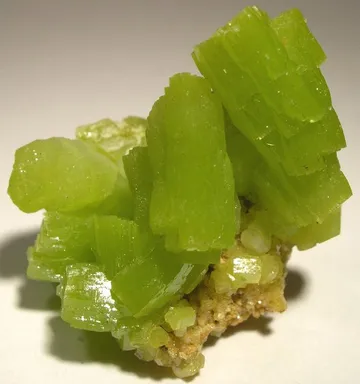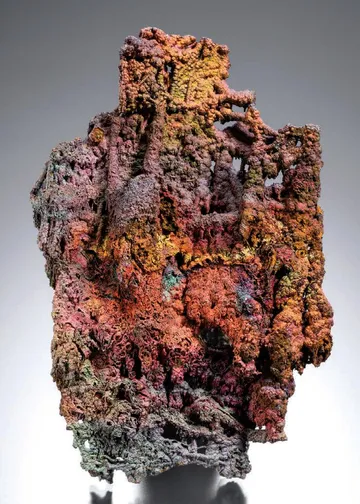
Tharsis, Spain - renowned Iberian Pyrite Belt locality yielding goethite specimens, mimetite and beudantite from oxidized deposits, prized by collectors.
Key facts
Tharsis is one of the great names of the Iberian Pyrite Belt: a historic Huelva mining district built on pyrite-rich massive sulfide bodies, then weathered into iron caps whose secondary minerals have made their own collector history. For ore geologists, the district is a classic shale-hosted, volcanogenic massive sulfide system of the South Portuguese Zone, famous for large bodies such as Filón Norte–San Guillermo, Filón Centro, Filón Sur, Sierra Bullones, Esperanza, Almagrera, La Lapilla, Vulcano, Cantareras and Prado Vicioso. For collectors, the name most often conjures the oxidized portions of those deposits—gossan, limonite, goethite, hematite, jarosite-group minerals, beudantite-group phases, quartz, and scattered arsenates and sulfates born from the long destruction of pyrite.
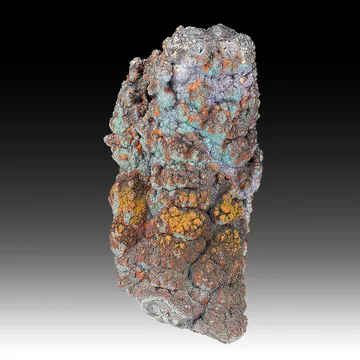
The locality’s specimen identity is strongest at Filón Sur. There, the same gossan that carried economic gold and silver produced some of Spain’s most recognizable iridescent goethite: black to steel-gray, heavy, botryoidal and stalactitic pieces flashing red, pink, gold, orange, purple and green when turned in the light. The district is also a small but attractive mimetite locality, with yellow to yellow-orange crystals and druses from the oxidized exterior of Filón Sur, commonly on limonite-goethite matrix and in association with beudantite. Beudantite itself is more than a specimen accessory here; in the Filón Sur gossan it is an important arsenic- and lead-bearing phase, locally abundant in the lower part of the profile and mineralogically central to understanding the oxidation history of the ore.
Historically, Tharsis is much more than a single pit. Ancient workings, Roman mining features, a nineteenth-century revival under French and then British capital, a Scottish-controlled company, a railway to Corrales, and the long twentieth-century pyrite trade all left their mark. Its pits are now as much industrial landscape as mineral locality: flooded cortas, old workshops, dams, spoil heaps, the remains of processing plant, and the town that grew around the mines.
Regional View
Country View
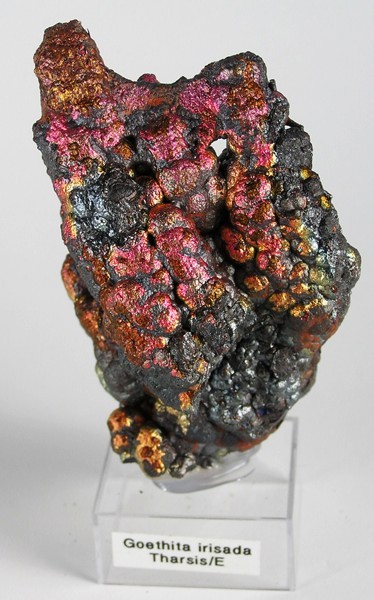
Photo: Rob Lavinsky, iRocks.com, via Wikimedia Commons
The best Tharsis specimens have a look that is hard to confuse once learned. Goethite from Filón Sur tends to be sculptural rather than crystal-faced: rounded bubbles, ribs, columns and stalactitic masses, with the iridescent film doing the visual work. The most desirable examples retain unabraded high points and show strong color over several faces rather than a single lucky patch. Mimetite, by contrast, is a more delicate small-crystal mineral here: bright little yellow tabs, spheroids or barrel-like crystals sprinkled over rusty matrix, sometimes elevated from the surface in drusy carpets. The district therefore appeals to two rather different collecting instincts: the display collector’s love of bold metallic color, and the systematic collector’s interest in an oxidized massive-sulfide gossan with serious geochemical complexity.
Search for specimens: View all specimens from Tharsis, Spain
The Tharsis mines lie near the town of Tharsis in Alosno, Huelva, Andalusia, within the Iberian Pyrite Belt, one of the world’s major provinces of volcanogenic massive sulfide mineralization. The ore district is part of the South Portuguese Zone and is classically described as a shale-hosted to volcano-sedimentary massive sulfide system, with pyrite-dominant bodies and associated stockwork mineralization. The broader belt contains volcanic, volcaniclastic, sedimentary and hydrothermal rocks; at Tharsis, black shales are especially important, and several studies treat the deposit as an unusually large, low-temperature, shale-hosted massive sulfide system formed in an anoxic, restricted marine basin.
Filón Norte is the key geological reference point in much of the technical literature. It is one of the largest pyrite-rich massive sulfide orebodies in the district and has been interpreted as a complex Variscan thrust-stacked system rather than a simple single lens. The mineralization includes several sheets of massive sulfide and shale, with stockwork zones carrying pyrite, quartz and chlorite, and a notable association of Co-As-Fe-S minerals in parts of the system. The massive ores are dominantly fine-grained pyrite, with subordinate sphalerite, chalcopyrite, galena and arsenopyrite, and with minor to trace bismuth minerals, sulfosalts, tellurides, cassiterite, native bismuth and native gold documented in specialist studies.
The district is commonly discussed as a set of multiple sulfide masses rather than a single mine. The main Tharsis group includes northern bodies such as Filón Norte–San Guillermo, Sierra Bullones and Poca Pringue; central bodies such as Filón Centro, Filón Sur, Esperanza and Prado Vicioso; and southern bodies including Vulcano, Almagrera, Nueva Almagrera, La Lapilla and Cantareras. In practical collecting terms, Filón Sur is the most important name to know, because it is the source of the classic iridescent goethite and of the modern mimetite-beudantite specimens seen in the collector market.
The specimen minerals belong mostly to the oxidized cap, or gossan, formed by long weathering of pyritic sulfides. As sulfide ore oxidized, sulfuric acid and metal-rich solutions moved through the rock, destroying primary sulfides and leaving iron oxides and oxyhydroxides such as goethite and hematite, together with jarosite-group minerals, beudantite and related arsenate-sulfate phases, secondary copper and lead minerals, and soluble sulfate minerals in acid mine drainage settings. Filón Sur is especially important because its gossan was not just mineralogically interesting but economically valuable: it carried gold and silver, and a twentieth-century plant was operated to process those precious metals from the oxidized ore.
Mining at Tharsis has an unusually long arc. Ancient and Roman activity is documented in the district, particularly around Filón Sur, where old mining works and slag remains testify to early exploitation of oxidized ores rich in valuable metals. In the modern period, the mines were revived in the nineteenth century. The French engineer Ernest Deligny is central to that revival, followed by the Compagnie des Mines de Cuivre de Huelva in 1855 and, later, the Tharsis Sulphur and Copper Company Limited, the British company most strongly associated with the district’s industrial transformation. Under British control, Tharsis developed large open pits, workshops, an industrial townscape and a railway connection to Corrales for shipment through the Huelva estuary.
Filón Sur itself was an open pit and precious-metal gossan operation. The corta is described as roughly 650 m long, with a width on the order of 150–250 m and a depth around 60 m. Industrial exploitation there ran from the late nineteenth century into the early twenty-first century, with a gold-and-silver processing plant operating from 1937 into the 1960s and later work under Spanish and Canadian-linked ownership. The pit has been inactive since the early 2000s and is now partly flooded by acidic water. Filón Norte, the principal pyrite operation for much of the district’s later history, was also worked on a large scale and later flooded.
Collecting access today should be treated as restricted. Tharsis is not an open recreational collecting site in the sense of a public dump or casual quarry. The landscape includes inactive and flooded open pits, old mine workings, acid waters, unstable waste and heritage-protected industrial remains; current mining rights and redevelopment interests also complicate access. Specimens on the market should therefore be understood as historic mine production, older collection material, dealer-held stock, and pieces recovered during periods of authorized or tolerated access rather than an invitation to enter the mines. Labels that specify Filón Sur open pit, Corta Filón Sur, Minas de Tharsis, Alosno, Huelva, Andalusia are materially better than vague “Spain” or “Tharsis” labels.
The best-documented collector finds are the iridescent Filón Sur goethites and the 2011 and 2017 mimetite occurrences from the external part of the Filón Sur cut. Dealer records describe a 2007 period for many colorful stalactitic and botryoidal goethites from Filón Sur, with miniature to cabinet-size examples displaying metallic reds, pinks, oranges, golds and silvery black areas. The mimetite finds were far more localized: small but sharp yellow to yellow-orange crystals on limonite or goethite matrix, some with botryoidal beudantite microcrystals and, in one especially unusual association, cerussite.
Goethite is the signature collector mineral of Tharsis, especially from the Filón Sur open pit, where oxidation of the pyritic gossan produced botryoidal, stalactitic and columnar masses with exceptionally strong metallic iridescence. Good examples are usually small cabinet specimens to hand-sized pieces, though thumbnails and miniatures can be very fine; the most desirable surfaces show continuous rounded growths with bright angle-dependent flashes of red, magenta, gold, orange, green, violet and steel gray over a black to dark brown iron-oxide body. Associations are those of the oxidized cap—limonite, hematite, quartz, jarosite-group minerals and locally beudantite—and the most distinctive pieces are not simply “rainbow iron oxide” but visibly sculptural gossan specimens with undamaged botryoids or stalactites, strong luster, and color that wraps around the form rather than sitting on one isolated patch.
Mimetite from Tharsis is best known from the external part of Filón Sur, particularly small finds documented in 2011 and later 2017 material, where it occurs as bright yellow, yellow-orange to olive-yellow crystals on limonite-goethite matrix, commonly with beudantite microcrystals and rarely with cerussite. The crystals are typically small—commonly a few millimeters, with dealer-described main crystals around 0.2–0.6 cm—but they can be sharp, lustrous and well isolated, forming tabular, spheroidal or barrel-like “campylite-style” aggregates. The best Tharsis mimetites are judged by crystal sharpness, saturated uniform color, contrast against the rusty matrix, analytical confidence, and clean presentation; ordinary pieces are more crusty, dull or visually lost in the iron oxides.
Beudantite is a defining micro- to small-specimen mineral of the Filón Sur gossan, where studies show it occurs through the oxidized profile and becomes especially concentrated toward the lower gossan, locally reaching major proportions. Collector pieces most often show beudantite as brown, yellow-brown to olive-brown microcrystalline botryoidal coatings or tiny pseudocubic to rhombohedral-looking crystals on gossan, sometimes beneath or around yellow mimetite. Its importance at Tharsis is both aesthetic and geochemical: it is one of the principal phases fixing arsenic and lead during sulfide oxidation, and the best specimens are those where the beudantite is not merely a muddy coating but a visible, lustrous microcrystal carpet that gives texture and paragenetic interest to mimetite or goethite-bearing gossan.
Other documented minerals from Tharsis reflect both primary massive-sulfide ore and supergene alteration. Filón Norte records a sophisticated primary assemblage including pyrite, chalcopyrite, sphalerite, galena, arsenopyrite, pyrrhotite, cobaltite, glaucodot, alloclasite, löllingite, bismuthinite, native bismuth, bournonite, tetrahedrite-group minerals, cassiterite, stannite, joseite, tetradymite, siderite, quartz, chlorite, ankerite, hematite, magnetite and native gold. The oxidized and acid-drainage environments add minerals such as jarosite-group phases, alunogen, chalcanthite, bonattite, copiapite-group minerals, epsomite/hexahydrite-type sulfates and wavellite in parts of the wider Tharsis mine group. Tharsis is better regarded as a major occurrence and research locality than as an IMA type-locality name; the rarities that matter here are the Co-As-Fe-S and Bi-telluride/sulfosalt phases of Filón Norte and the arsenate-sulfate chemistry of the Filón Sur gossan.
The main authenticity concern for Tharsis specimens is locality precision. “Iridescent goethite from Spain” is too broad for a serious label, because visually similar iron oxides circulate from several Spanish and non-Spanish localities. A strong label should specify Filón Sur open pit, Corta Filón Sur or Minas de Tharsis, with Alosno, Huelva, Andalusia. Older labels may use Spanish names such as goethita irisada, mimetesita or Corta Filón Sur; these are useful rather than suspicious.
No well-established, locality-specific fake industry is associated with Tharsis in the collector literature, but iridescent goethite is always vulnerable to exaggeration, mislabeling and artificial-looking surface enhancement in lower-grade trade. Natural Tharsis iridescence is metallic and optical, changing as the specimen is turned; suspect pieces with oily residue, resinous gloss, color pooled in cracks, or color crossing fresh broken edges should be examined carefully. For mimetite and beudantite, analytical confirmation matters more, because yellow microcrystals on gossan can be confused with other lead arsenates, phosphates or jarosite-group phases.
Condition is critical. On goethite, the iridescent skin is the specimen: bruised high points, rubbed ridges and chipped stalactites dramatically reduce value. Pieces should be handled by the matrix or base and wrapped so that protruding botryoids cannot grind against foam or paper. Cleaning should be minimal; aggressive washing, acids, ultrasonic cleaning and oiling are all bad ideas for the best material. Dust can be removed with a soft brush or gentle air, but many specimens are best left alone.
Mimetite from Tharsis is usually modest in size but collectible because it is local, sharp and attractive. The small crystals are easily bruised, and rusty matrix can be friable. Some reported Tharsis mimetite shows minor short-wave UV fluorescence, but fluorescence is not the principal reason to collect it and should not be treated as a universal diagnostic feature. Beudantite contains lead and arsenic in its structure; normal specimen handling is safe if sensible habits are observed, but avoid grinding, soaking, licking, or creating dust, and wash hands after handling.
In the market, Filón Sur goethite is the most available Tharsis material, though top iridescent pieces with vivid multicolor coverage and sculptural form are much scarcer than routine small plates. Mimetite and mimetite-with-beudantite are far less common and tend to appear as small, old-stock miniatures or dealer specimens from the 2011 and 2017 finds. Good labels and provenance to recognized Spanish or European dealers add real value here, because the visual style alone does not prove the pit.
Long before Tharsis became a modern pyrite mine, the oxidized ore had already taught people where the value was. The ancient miners were not chasing the same specimen minerals collectors prize today; they were reading the red-brown iron caps for metals. Around Filón Sur, where later collectors would value iridescent goethite, ancient and Roman workings exploited precious-metal-bearing gossan. The surviving landscape records small galleries, extraction chambers, drainage works, shafts and slag places—evidence that the gossan was not barren waste but the visible skin of a metal-bearing system. The protohistoric site of Pico del Oro and the Roman traces around Filón Sur place the mine within a much older Mediterranean story of copper, silver, lead and gold.
The modern story has a distinctly nineteenth-century cast. In 1853, the French mining engineer Ernest Deligny traveled to Huelva, a moment repeatedly treated in Spanish mining heritage accounts as pivotal for the revival of the province’s old pyrite mines. Two years later, in 1855, the Compagnie des Mines de Cuivre de Huelva was formed in Paris, providing the capital injection needed to begin serious modern work. The early modern phase soon gave way to a larger British period, and by the time the Tharsis Sulphur and Copper Company Limited had reshaped the district, the mines were not just holes in the ground but a complete industrial organism: pits, workshops, offices, reservoirs, crushing plant, railway, port installations and housing.
The railway is one of the great physical facts of Tharsis. Ore from the mines moved toward Corrales on a line of roughly twenty-eight miles, ending at the Huelva estuary where a long iron pier allowed direct loading to ships. Early twentieth-century accounts measured that pier at 765 yards, a striking number that captures the scale of the operation: pyrite broken in the inland hills of Andévalo, carried by rail across the province, and poured into the maritime trade that fed the sulfuric-acid and copper industries. The mines themselves were described as less spectacular than Rio Tinto but still a “notable property,” with annual output around 400,000 tons of ore in one contemporary account and profits large enough to show why foreign capital had transformed the district.
Filón Sur has its own collector chapter, written in iron oxides rather than balance sheets. The pit’s gold-and-silver gossan became an industrial target in the twentieth century; in 1937 the British company installed plant to treat the precious metals contained in the oxidized cap. Decades later, after the old precious-metal work had ended, the same environment yielded the iridescent goethite that made Filón Sur famous in mineral cabinets. The best pieces look almost improbable beside their origin: not transparent crystals, but black, dense gossan masses with ribs and botryoids flashing pink, red and gold as though the mine’s metallurgical history had condensed into a surface film.
The mimetite finds were quieter but delightful. Around the famous Filón Sur cut—near the goethite ground—small yellow to orange mimetite crystals appeared on limonite-goethite matrix, some accompanied by beudantite. Dealer notes from the 2011 find emphasize how localized and unexpected the material was after a long interval with no significant samples. Later, in 2017, additional pieces from the external part of Filón Sur showed spheroidal to barrel-shaped habits reminiscent of campylite. One collection note singles out a mimetite with cerussite association as extraordinarily rare for the locality, a reminder that even in a district dominated by pyrite and iron oxides, the small lead-arsenate pockets can carry the most personal collecting excitement.
Today the drama is visual and environmental. The old cortas are partly flooded, with acidic waters in places where miners once followed pyrite and gossan. The landscape has been formally recognized as heritage, not merely abandoned industry. That change of status alters the collector’s relationship to Tharsis: the locality is no longer simply a source to be worked, but a historic mining basin to be understood, documented and respected.
Tornos, F., González Clavijo, E., and Spiro, B. (1998). “The Filón Norte orebody (Tharsis, Iberian Pyrite Belt): a proximal low-temperature shale-hosted massive sulphide in a thin-skinned tectonic belt.” Mineralium Deposita, 33, 150–169. DOI: 10.1007/s001260050138.
Foundational modern paper on Filón Norte structure, ore textures, low-temperature formation, thrust stacking, stockwork mineralogy and Co-Au enrichment.
González, F., Moreno, C., Sáez, R., and Clayton, G. (2002). “Ore genesis age of the Tharsis Mining district (Iberian Pyrite Belt): a palynological approach.” Journal of the Geological Society, 159(3), 229–232. DOI: 10.1144/0016-764901-142.
Palynological dating reference for the Tharsis ore district and its place in the stratigraphy of the Iberian Pyrite Belt.
Nieto, J. M., Capitán, M. A., Sáez, R., and Almodóvar, G. R. (2003). “Beudantite: A natural sink for As and Pb in sulphide oxidation processes.” Applied Earth Science, 112(3), 293–296. DOI: 10.1179/037174503225003134.
Essential paper for Filón Sur beudantite, showing its importance through the gossan profile and its role in fixing arsenic and lead.
Tornos, F., Solomon, M., Conde, C., and Spiro, B. F. (2008). “Formation of the Tharsis Massive Sulfide Deposit, Iberian Pyrite Belt: Geological, Lithogeochemical, and Stable Isotope Evidence for Deposition in a Brine Pool.” Economic Geology, 103(1), 185–214. DOI: 10.2113/gsecongeo.103.1.185.
Major genetic study interpreting Tharsis as a large shale-hosted massive sulfide system formed in a restricted brine-pool setting.
Chaparro, M. A. E., Sinito, A. M., de Barrio, R. E., and Bidegain, J. C. (2006). “Magnetic studies of natural goethite samples from Tharsis, Huelva, Spain.” Geofísica Internacional, 45(4), 219–230.
A mineral-physics treatment of natural Tharsis goethite, including magnetic measurements, X-ray diffraction and scanning electron microscopy.
Valente, T., Grande, J. A., de la Torre, M. L., Santisteban, M., and Cerón, J. C. (2013). “Mineralogy and environmental relevance of AMD-precipitates from the Tharsis mines, Iberian Pyrite Belt (SW, Spain).” Applied Geochemistry, 39, 11–25. DOI: 10.1016/j.apgeochem.2013.09.014.
Important environmental-mineralogy paper documenting acid mine drainage precipitates and secondary sulfate/iron-mineral assemblages at Tharsis.
Fernández-Remolar, D. C., et al. (2018). “Productivity Contribution of Paleozoic Woodlands to the Formation of Shale-Hosted Massive Sulfide Deposits in the Iberian Pyrite Belt (Tharsis, Spain).” Journal of Geophysical Research: Biogeosciences. DOI: 10.1002/2017JG004144.
Discusses Tharsis massive pyrite within organic- and sulfide-rich shale and the role of anoxic conditions and organic productivity in ore formation.
Kase, K., Yamamoto, M., Nakamura, T., and Mitsuno, C. (1990). “Ore mineralogy and sulfur isotope study of the massive sulfide deposit of Filón Norte, Tharsis Mine, Spain.” Mineralium Deposita. DOI: 10.1007/BF00198999.
Early ore-mineralogy and sulfur-isotope study of Filón Norte, describing pyrite-dominant massive ore with subordinate sphalerite, chalcopyrite, galena and arsenopyrite.
Pérez de Gracia Díaz, G., and Herrera Herbert, J. (2020). Tharsis Mines = Minas de Tharsis. MineHeritage Booklets, 13(5).
Heritage-focused booklet summarizing the mining system, geological setting and historical infrastructure of Tharsis.
“Promotional video of Tharsis Heritage” — YouTube
Short heritage video presenting the Tharsis mining landscape, including open pits, galleries, winding engines, settlements and industrial remains.
“Goethite from Minas de Tharsis, Tharsis, Spain” — Vimeo
Specimen video focused on a Tharsis goethite, useful for appreciating the angle-dependent iridescence that still photographs cannot fully show.