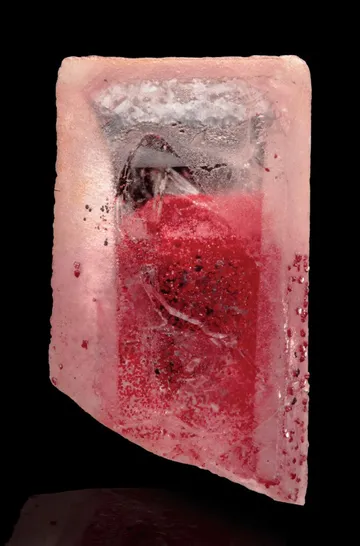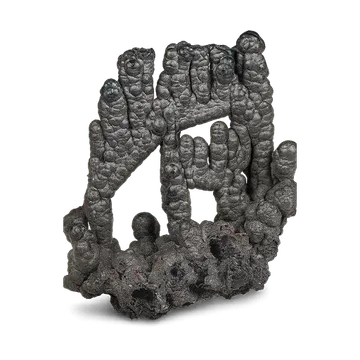
Goethite from Tharsis Mines, Huelva, Spain: iridescent textures and botryoidal fronts; prized by collectors for color, form, and locality.
Key facts
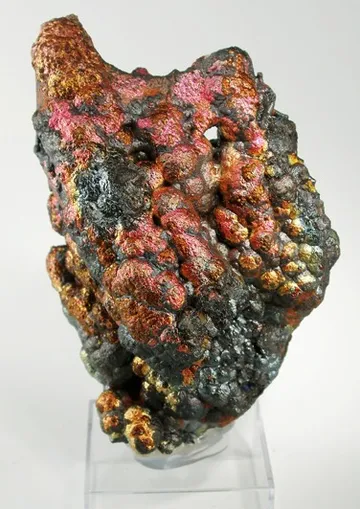
Goethite from the Tharsis Mines is one of the great modern surprises among European iron oxides: a common mineral raised to display-specimen status by an uncommon surface. The collector’s eye goes first to the skin — metallic, glassy to satin-lustrous, and iridescent in shifting bands of magenta, copper-red, bronze, gold, blue-green, violet, and silvery black. The best pieces are not simply “rainbow goethite”; they are sculptural specimens, with stalactitic ribs, botryoidal bubbles, coral-like crusts, and compact columns that catch light differently from every angle.

Photo: Wikimedia Commons
The finest material is associated especially with Corta Filón Sur, the South Lode open pit within the Tharsis mining field near Alosno, Huelva. Filón Sur belongs to the Iberian Pyrite Belt, a world-class belt of volcanogenic massive sulphide deposits extending across southwest Iberia. In the unweathered ore, Tharsis is fundamentally a pyrite-rich polymetallic system with subordinate chalcopyrite, sphalerite, galena, gold, and silver. The goethite prized by collectors is a product of supergene oxidation: the old sulphide masses were capped by thick iron-rich gossans, locally called monteras, where pyrite and related sulphides were altered, leached, reprecipitated, and replaced by iron oxides and oxyhydroxides.
That origin matters for collectors because it explains both the form and the color. Tharsis goethite is not usually sought as sharp individual crystals. It is sought as growth texture: stalactitic curtains, bubbly botryoidal fronts, coralloidal ridges, and laminated skins over iron-rich gossan. The iridescence appears on very thin surface films and micro-layered oxide/hydroxide surfaces, so a good specimen has to combine form, luster, color, and condition. A dull massive chunk of Tharsis gossan is geological context; a bright, undamaged, multi-colored stalactitic spray is the collectible prize.
Historically, Tharsis is much larger than its specimen production. The district has evidence of ancient working, was revived in the nineteenth century, became a major British-linked industrial mining landscape, and later passed through Spanish and modern corporate ownership. Filón Sur itself was important not only for pyrite and iron-oxide gossan but also for gold and silver extraction from the gossan cap. Its collector fame, however, rests on the late-twentieth- and early-twenty-first-century appearance of iridescent goethite specimens, many preserved from mine work, private collecting, and dealer dispersal rather than from casual collecting today.
Search for specimens: View all goethite specimens from Tharsis Mines, Huelva, Spain
The Tharsis Mines lie in the Andévalo region of Huelva, southwestern Spain, near the village of Tharsis in the municipality of Alosno. The relevant collector locality for the celebrated iridescent goethite is principally Filón Sur open pit, also known as Corta Filón Sur, one of the major open pits of the Tharsis mining district. Mindat records goethite from Filón Sur, Filón Norte, and the broader Tharsis Mines entry, but the classic market identity for the bright stalactitic and botryoidal pieces is Filón Sur.
Geologically, Tharsis is part of the Iberian Pyrite Belt, a Devonian to Carboniferous volcanic-sedimentary province famous for immense massive sulphide deposits. The ore is hosted in a folded and tectonized volcanic-sedimentary sequence, with massive sulphide bodies and stockwork zones formed in a submarine hydrothermal environment. Filón Norte has been described in the literature as a large, sheet-like, shale-hosted pyrite-rich massive sulphide orebody, and the broader Tharsis system includes several sulphide masses: Filón Norte, Filón Centro, Filón Sur, Sierra Bullones, Esperanza, Lagunazo, Almagrera, Cantareras, and others.
The goethite-bearing environment is the oxidized cap over the sulphide ore. At surface, the original pyritic masses weathered to thick gossans composed largely of iron oxides and oxyhydroxides, with hematite, limonitic material, goethite, and locally lepidocrocite, together with silica-rich material. In the Filón Sur gossan, mineralogical work has also documented arsenate and sulphate phases such as beudantite and jarosite-group assemblages. This is why collector pieces may show a simple iron-oxide appearance while the geological system behind them is chemically rich and complex.
Mining history at Tharsis spans a long arc. Ancient exploitation in the region is associated with pre-Roman and Roman working of metal-rich zones, and the Tharsis landscape preserves archaeological and industrial traces from multiple periods. Large-scale modern mining developed in the nineteenth century after the work of the French engineer Ernest Deligny and the formation of the Compagnie des Mines de Cuivres d’Huelva. The Scottish-controlled Tharsis Sulphur and Copper Company later transformed the district, developing open pits, processing facilities, worker housing, and the railway connection toward the Huelva estuary.
Filón Sur itself was mined intensively in modern times as an open pit and became especially important for its gold- and silver-bearing gossan. A plant for extracting gold and silver from the gossan was operating from the late 1930s into the 1960s. Later, the property passed through the Compañía Española de Minas de Tharsis and then into modern corporate hands. In the 1990s, Caledonia Mining Corporation became involved with Filón Sur and expanded treatment capacity for gossan, including modernization of crushing and processing facilities. Filón Sur remained active until the early 2000s, after which the pit was abandoned and partly flooded by acidic water.
Access today should be treated as controlled, not open. The pits are industrial heritage sites, hazardous mine workings, and in places flooded or affected by acid mine drainage. Fences, warning signs, unstable benches, old shafts, steep walls, and chemically aggressive waters are all part of the Tharsis landscape. In addition, modern re-evaluation of the district is active: by 2026, a 30-year mining project for the historic Tharsis concessions had entered public environmental review in Andalusia. For collectors, this means Tharsis is not a casual weekend collecting locality. Provenanced specimens on the market are the realistic route, and any field access should be assumed to require permission from the relevant owner or authority.
Tharsis goethite is best recognized by its sculptural iron-oxide habit and bright surface iridescence. The common collectible forms are botryoidal crusts, stalactitic columns, coralloidal or coral-like ridges, compact bubbly masses, and columnar aggregates. Some pieces show parallel stalactites fused together into a ribbed curtain; others look like a metallic grape cluster. The most desirable examples combine several habits on one specimen, with botryoidal surfaces riding over stalactitic cores.
Color is the locality’s signature. Fresh-looking specimens can show black to gunmetal bases flashed with bronze, gold, rose, magenta, violet, aqua, green, and blue. The color is usually strongest on rounded growth surfaces and along thin films where light reflects from micro-layered skins. A piece may look dark from one angle and suddenly flare with copper-red or peacock-blue when turned. This directional play of color is a key reason serious collectors prefer Tharsis pieces in hand rather than judging them from a single flat photograph.
Crystallographically, display pieces are rarely about individual crystals. A magnetic and X-ray study of Tharsis material confirmed goethite with minor hematite and quartz, and scanning electron microscopy showed pulverulent aggregates of irregular grains in the 10–20 µm range, with occasional needle-like crystals only a few micrometers wide. That microscopic reality fits the macroscopic collector experience: Tharsis specimens are aggregate sculptures, not cabinet examples of euhedral goethite crystals.
Typical specimen sizes range from small thumbnails and miniatures up to substantial cabinet pieces. Documented examples include small botryoidal fragments around 1.5 cm, miniature to small-cabinet pieces in the 4–8 cm range, and larger stalactitic specimens over 10 cm. A well-known Wikimedia Commons specimen from Filón Sur measures 18.9 x 5.4 x 3.8 cm, showing that large, showy material exists, though large pieces with complete stalactites and undamaged iridescent surfaces are much scarcer than small fragments.
Associated minerals depend on whether one is considering the specimen surface, the gossan, or the broader mine. For Filón Sur, recorded associated or locality minerals include hematite, beudantite, cerussite, chlorargyrite, chalcanthite, copiapite, coquimbite, epsomite, gypsum, hexahydrite, jarosite, mimetite, and rhomboclase. In practice, most collector goethite pieces are sold as goethite with possible hematite or limonitic iron oxides rather than as rich association specimens. The broader Tharsis ore system also includes pyrite, chalcopyrite, sphalerite, galena, gold, and silver in the primary sulphide environment.
Quality is judged on four main factors: form, iridescence, luster, and preservation. A top piece has three-dimensional stalactitic or botryoidal architecture, strong metallic luster, broad multicolored iridescence rather than isolated dull patches, and minimal bruising on the exposed rounded surfaces. Matrix can be acceptable, especially where it gives the piece stability, but the finest display examples present as free-standing or highly exposed iron-oxide growths. Broken stalactite tips, chipped botryoids, rubbed color, and dead brown limonitic surfaces reduce appeal sharply.
The most important authenticity issue is locality discipline. Iridescent goethite and hematite occur at other localities, and the visual category “rainbow goethite” is used loosely in the trade. Tharsis material should be labeled as Tharsis Mines, preferably Filón Sur open pit, Tharsis, Alosno, Huelva, Andalusia, Spain. Older labels may use “Filón Sur,” “Mina Filón Sur,” “Corta Filón Sur,” or simply “Tharsis, Huelva.” A specimen with a precise old label, a reputable dealer history, or a documented private-collection provenance is preferable to a generic “Spain rainbow goethite” label.
Confusion with hematite is common and not always malicious. Tharsis goethite may contain hematite, and some iridescent iron-oxide specimens are marketed as goethite, hematite, turgite, or goethite-hematite mixtures. Scientific work on Tharsis material has confirmed goethite while also noting minor hematite and quartz, so a mixed iron-oxide identity is not automatically suspicious. For marketplace purposes, the collector should look for whether the seller is describing the specimen honestly as goethite from Tharsis/Filón Sur rather than overpromising sharp crystals or exotic associations.
Iridescence on Tharsis goethite is natural and is central to the locality’s appeal, but that very appeal creates a broader market risk: artificially enhanced or coated “rainbow” stones exist in the decorative-mineral trade. Tharsis specimens should not look like vapor-coated quartz or uniformly metallic titanium-treated material. Natural Tharsis color is usually patchy, angle-dependent, and tied to the botryoidal or stalactitic growth surface. A perfectly uniform, neon, oil-slick coating across breaks, matrix, and recesses should prompt skepticism.
Condition is a serious issue. The best surfaces are thin, lustrous, and easily dulled by abrasion. Botryoidal domes bruise; stalactites snap; iridescent skins can be rubbed by careless handling or old packing. Avoid cleaning with acids, aggressive detergents, or mechanical scrubbing. Even water should be used cautiously, as porous iron-oxide gossan and associated soluble sulphate minerals can react unpredictably. Dusting with a soft brush and storing in a dry, stable environment is usually safest.
The locality is not rare in the sense that no specimens are available; Tharsis goethite appears regularly enough in European and international mineral commerce. But truly fine examples are much less common than the locality name suggests. Small, dark, partially iridescent pieces are obtainable. Bright, complete, sculptural stalactitic specimens with strong color on all display faces are premium pieces, especially with an old label or a known source. The strongest examples deserve a place among classic European iron-oxide specimens, alongside famous iridescent hematite/goethite material from localities such as Rio Tinto and Graves Mountain, while retaining their own distinctive Tharsis habit.
The story of Tharsis begins long before the modern collector label. The old mining landscape is not merely a hole in the ground; it is a palimpsest of ancient workings, nineteenth-century industrial ambition, British capital, Spanish labor, and modern environmental consequence. In the Tharsis mine booklet produced for the MineHeritage project, the prehistoric evidence is concrete rather than romantic: stone hammers, diorite hammers, human-shaped graves cut into stone, and flat sheet-like axes of pure copper. These are the objects that place the mineral district in the deep chronology of Iberian mining, long before goethite specimens were being trimmed for cabinets.
Filón Sur carries one of the district’s most evocative historical layers. The area has been linked by some authors with the Roman place-name Ad Rubras, a mining settlement mentioned in the Itinerary of Antoninus and connected with routes toward Onuba, the Roman Huelva. Whether one approaches that identification cautiously or enthusiastically, the image is powerful: a red, iron-stained mining country in which the gossans themselves announced the buried sulphides below. For a goethite collector, it is hard not to see the mineral name and the archaeology converging — the same oxidized cap that later yielded iridescent cabinet specimens had also marked ore to ancient miners.
The modern mining boom remade the district on a much larger scale. In the nineteenth century, Ernest Deligny’s work helped revive the mines, and the British-backed Tharsis Sulphur and Copper Company turned them into an industrial system. Tharsis became not just a mine but a company town, with worker housing, British staff quarters, railway infrastructure, and export routes. One nineteenth-century description of the settlement recorded housing for 3,500 workers and a population of 10,000 people, arranged on a plain north of Sierra Bullones in broad, regular streets with a market square and inn. That was the scale of the operation behind the specimens now sitting quietly in drawers and display cases.
Filón Sur’s twentieth-century history is especially tied to gossan. In 1937, the British company put a plant into operation to extract gold and silver from the gossan, and those facilities continued into the 1960s. Decades later, renewed work sought to process the same iron-rich cap more intensively. In the 1990s, Caledonia Mining Corporation took control of Filón Sur and aimed to increase gossan treatment to one million tonnes per year, modernizing installations and building a new crushing plant. The collector’s goethite is part of this same gossan story: an aesthetic by-product of the oxidized zone that miners valued for precious metals and engineers treated as ore.
By the time mineral photographers and collectors were documenting the best iridescent goethites, the mine was near the end of its working life. MTI Blog preserves a telling note: J.M. Sanchis photographed iridescent goethites from Filón Sur in 1999–2000, using specimens from private collections. That small detail matters. It places the material at the transition between operating mine and historical locality, when specimens could still circulate from recent activity but were already becoming objects of record. The photographs captured the look collectors now associate with the locality: bright, iridescent iron oxide from a mine whose benches would soon be silent.
The abandoned landscape is not benign. Scientific work on acid mine drainage at Tharsis describes four pit lakes holding 5.2 hm3 of acidic water, about 30 acid drainage sources, and surrounding streams affected by waters that can reach extremely low pH. One measurement recorded pH as low as -0.2 in seepage from sulphide-rich waste, and summer evaporation can leave spectacular soluble salts that are then flushed by the next rains. For collectors accustomed to admiring the rainbow surfaces of goethite, the environmental chemistry is a sobering counterpart: the same oxidation processes that create beautiful iron oxyhydroxides can also mobilize metals, sulphates, and acidity on a district scale.
The latest chapter is still unfolding. Tharsis is being re-evaluated as a modern resource, with drilling, metallurgical studies, and a proposed 30-year project entering the public environmental process in 2026. For collectors, that does not mean the pits are open for specimen hunting; it means the locality remains active in the geological and industrial imagination. Tharsis is no dead name on an old label. It is a historic mine district whose oxidized iron caps produced some of Spain’s most charismatic goethite specimens, and whose deeper sulphides continue to draw attention from geologists, companies, regulators, and the people of Huelva.