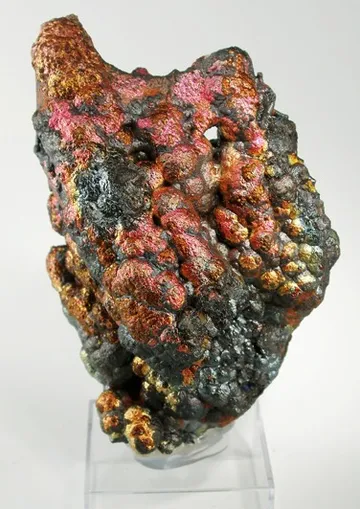
Herrerías, Spain: renowned native-silver locality with filiform, dendritic and arborescent silver, mercury-rich forms, chlorargyrite, in an iron-barite matrix.
Key facts
Herrerías is one of the great Spanish names for native silver: not a sprawling museum label for all of Sierra Almagrera, but the iron–barite–silver deposit at Las Herrerías, beside the lower Almanzora in Cuevas del Almanzora, Almería. For collectors, its identity is wonderfully specific. Where the adjacent Sierra Almagrera is famous for Pb-Ag-Zn veins and argentiferous galena, Herrerías is the nearby stratabound iron–barite–silver system developed in Neogene marine sediments of the Vera-Garrucha basin, cut and influenced by the Palomares fault corridor and tied by many workers to Miocene hydrothermal activity and shoshonitic volcanism. The result is a locality where silver occurs not merely as a chemical accessory in galena, but as visible native silver and mercury-rich silver, commonly accompanied by chlorargyrite.
The classic specimens are not the thick calcite-hosted wires of Kongsberg, nor the heavy sulfide-vein silvers of Freiberg. Herrerías silver has its own look: filiform, dendritic, spongy, sheet-like, and arborescent growths, often with a pale reddish or slightly warm tone where mercury-rich “kongsbergite” material is present, set against red jasper, barite, iron oxides, breccia, and pale to earthy chlorargyrite. The best pieces balance form and context: bright, aerial silver rising from an unmistakably Herrerías matrix, rather than anonymous blackened metal removed from the geology that made the locality famous.
Historically, Herrerías bridges several collecting worlds. It is a nineteenth-century silver rush locality, a later iron and barite working, a field site for modern epithermal and sedimentary-exhalative comparisons, and an archaeometallurgical reference point because native silver and chlorargyrite were present near surface in a landscape exploited or occupied since prehistory. Its specimen reputation rests heavily on old finds from the silver period and on late twentieth-century work at the Santa Matilde open cut, where fresh native silver specimens, many mercury-rich and chlorargyrite-bearing, reached the mineral market and major collections.
Regional View
Country View
The mineralized section at Herrerías has been described as vertically organized into Fe-Mn oxides and hydroxides, a barite-rich sulfate zone, and jasperoid or cherty material, with native silver concentrated in the bonanza parts of laminated barite and upper jasper. That is why good specimens so often look like oxidized, brecciated, iron-rich rock first and silver specimens second: they are products of a near-surface enrichment environment, not clean crystals grown in open carbonate cavities.

Photo: Wikimedia Commons
Search for specimens: View all specimens from Herrerías, Spain
The specimen locality is the Las Herrerías mining area near Sierra Almagrera, in the municipality of Cuevas del Almanzora, Almería, Andalusia. The modern collector names most often encountered are Las Herrerías Mines, Coto Minero Las Herrerías, Santa Matilde open pit or cut, Roza de Santa Matilde, and the Berja mining group. Older labels may use Cuevas de Vera rather than Cuevas del Almanzora, and some specimens are loosely labelled Sierra Almagrera even when they are specifically from Herrerías or Santa Matilde.
Geologically, Herrerías sits within the inner Betic Cordillera, adjacent to the metamorphic rocks of Sierra Almagrera. The Herrerías basin is framed by major faults of the Palomares shear corridor; the eastern fault separates the basin from phyllites and Triassic graphitic schists of Sierra Almagrera, while the western fault separates it from the wider Vera-Garrucha depression. The host rocks of the Herrerías deposit are Upper Miocene marine sediments—marls, silty marls, marly clays, and associated sedimentary units—rather than the older metamorphic vein host that typifies much of Sierra Almagrera proper.
The deposit is best understood by collectors as an iron–barite–silver system with stratabound, exhalative, vein, pipe, crust, and disseminated components. Published descriptions emphasize Fe oxides and hydroxides, barite, chert or jasperoid material, native silver, and local base-metal sulfides including galena, sphalerite, and pyrite. Other work compares the deposit with sedimentary-exhalative barite systems while also recognizing hydrothermal fluid flow along Herrerías fault structures. The epithermal interpretation is important: paragenesis, textures, geothermometry, and geochemistry from Sierra Almagrera and Herrerías have been used to argue that both the vein and stratabound mineralizations are epithermal, with mineralizing fluids related to shoshonitic magmatism.
For specimen purposes, the critical zone is the oxidized and enriched upper part of the deposit. Native silver occurred in bonanza concentrations in laminated barite and upper jasper, and historical accounts describe silver in plates, small crystals, branches, and arborescent masses lodged in cracks, fractures, cavities, and geodes in calcareous conglomerates and cavernous Triassic limestone. The mining vocabulary of the district preserves the practical geology: miners called the silver-bearing cavities “nidos,” or nests.
The nineteenth-century silver episode began after native silver was discovered around 1870, following the earlier regional mining excitement generated by the 1839 discovery of the Jaroso argentiferous galena vein in Sierra Almagrera. Important Herrerías mines named in historical and mineralogical accounts include Unión de Tres, Milagro de Guadalupe, Iberia, Petronila, Santa Matilde, Virgen de las Huertas, and Santa Ana. The silver ore was near surface in some workings close to the Roza and deeper in others; many mines reportedly reached the argentiferous horizon at or below about 50 m.
The productive silver years were brief but intense. One modern environmental-geological study, summarizing earlier mining data, gives 1871-1886 as the period of intensive exploitation and reports about 600 tonnes of silver metal produced, mainly from possible silver sulfides and kongsbergite. The dramatic interruption came on 20 May 1884, when flooding of the Almanzora River inundated the Roza de Santa Matilde and Virgen de las Huertas workings and then affected the Herrerías mines as a whole. After the flood, the locality increasingly shifted from native silver toward manganiferous iron ore, and later toward barite.
Industrial history at Herrerías is strongly associated with Luis Siret, the Belgian mining engineer and archaeologist. The village grew around mining and smelting infrastructure; the Atrevida smelter was established in the mid-nineteenth century, and later mining required transport toward the coast at Villaricos. The Herrerías-Villaricos railway and related facilities belong to the industrial landscape that collectors see in old photographs and heritage accounts, along with mine shafts, the Santa Matilde open workings, mine housing, and Siret-related buildings.
A twentieth-century chapter belongs to Minas de Almagrera S.A., which acquired many concessions and built a flotation plant with a reported average capacity of 800 tonnes per day. Underground exploitation ended in the late 1950s, while later companies reworked dumps and tailings for Pb and Ag. Barite exploitation continued in later decades, especially around the Santa Matilde area. Modern barite and waste handling significantly altered the old topography; published geological work notes that mining since 1993 changed the Cerro Virtud relief, while mineral collectors have recorded that the Santa Matilde quarry is now filled or largely covered by rubble.
Collecting access today should be considered poor. The historically important mines are abandoned, unstable, filled, private, or inaccessible, and the area includes contaminated mine wastes and industrial remains. Responsible collectors should treat Herrerías primarily as a classic specimen locality whose important material is already in collections, museums, and the market, not as a casual field-collecting destination.
Chlorargyrite from Herrerías is the classic “horn silver” companion to the locality’s native silver and mercury-rich silver: soft, sectile AgCl occurring mostly as pale, waxy to earthy, microcrystalline masses, crusts, and disseminations through breccia, barite-rich, jasperoid, and oxidized matrix rather than as large freestanding crystals. Dealer-described and analyzed specimens from the late twentieth-century Santa Matilde finds commonly report abundant chlorargyrite scattered through the silver-bearing material, with dendritic silver on a breccia matrix of microcrystallized chlorargyrite or sharp kongsbergite crystals on matrix with micro chlorargyrite. Good Herrerías chlorargyrite pieces are therefore judged less by showy individual AgCl crystals and more by context: an unmistakable silver-enrichment association, visible pale chlorargyrite in and on the matrix, and preferably native silver or kongsbergite present, rather than a dull, anonymous oxidized lump requiring a label to make the case.
Silver is the defining collector mineral of Herrerías, occurring as native silver and the mercury-rich variety traditionally called kongsbergite, with habits ranging from spongy and filiform aggregates to dendritic sprays, thin sheets, arborescent masses, and sharp metallic crystals on oxidized matrix. The most desirable pieces come from named Herrerías workings and especially from Santa Matilde/Roza de Santa Matilde material, where late twentieth-century work exposed a secondary-enrichment zone that produced solid, aerial silvers with roughly 10% Hg in some analyzed examples and abundant chlorargyrite dispersed through the specimens. Older accounts record spectacular finds as well, including arborescent material from Iberia exceeding 2 kg; in the present market, however, most fine Herrerías silvers are miniatures to small-cabinet specimens, and the best examples show sculptural form, recognizable matrix such as red jasper or barite, a warm fresh metallic surface, and intact delicate branches rather than flattened, dark, detached fragments.
Beyond silver and chlorargyrite, Herrerías has a compact but interesting oxidized and hydrothermal suite. Documented minerals include baryte, quartz, jasperoid/chalcedony, hematite, hydrohematite, goethite, siderite, galena, sphalerite, pyrite, chalcopyrite, gypsum, cerussite, azurite, malachite, cuprite, native copper, and coronadite, with analytical studies of mine waste also recording trace or minor phases such as acanthite, cinnabar, digenite, stannite, jamesonite, canfieldite, aikinite, senarmontite, and soluble sulfate salts. The locality is not chiefly a type-locality story; its modern rarity interest lies instead in the Santa Matilde roméite-group minerals, especially fluorcalcioroméite and oxyplumboroméite on baryte, including pale pink, beige, white, lanceolate, fibrous, or equidimensional crystals interpreted as probable pseudomorphs after stibnite and/or bournonite.
Herrerías labels deserve careful reading. “Sierra Almagrera” is sometimes used broadly, but the specimen character of Herrerías—native silver and kongsbergite with chlorargyrite in iron-barite-jasperoid matrix—is distinct from many Sierra Almagrera vein specimens. More precise labels such as Santa Matilde open pit, Roza de Santa Matilde, Berja mining group, Las Herrerías, Cuevas del Almanzora, Almería are preferable. Older labels reading Cuevas de Vera may still be legitimate for historical material.
The most common mineralogical ambiguity is the silver/kongsbergite distinction. Many Herrerías specimens are sold as native silver, while analyzed late twentieth-century examples are mercury-rich enough to be described as kongsbergite variety. For serious cataloguing, “Silver var. kongsbergite” is appropriate only when the Hg-rich character is supported by analysis or by reliable provenance to an analyzed lot. Avoid assuming every Herrerías silver is kongsbergite simply because the locality is famous for it.
Chlorargyrite creates both opportunity and risk. It is soft, sectile, and photosensitive, and it can darken with light exposure. Specimens with chlorargyrite should be stored away from strong light and handled minimally; greasy fingers, abrasion, and aggressive cleaning can damage the surface. The same caution applies to delicate silver: the best Herrerías pieces often have fine branches, spongy projections, or aerial dendrites that bend or snap easily. Never use chemical dips on these specimens. Brightness bought at the expense of original patina, chlorargyrite, or matrix association is a net loss.
Expect condition variation. Detached silver fragments, flattened wires, broken dendrites, and darkened chlorargyrite are common. Strong pieces retain three-dimensional form and are anchored in matrix. Matrix-rich specimens may look less immediately flashy than isolated silver, but for Herrerías they often carry more locality information and long-term collector value.
No well-established modern fake industry specific to Herrerías is widely documented, but mislabelling is plausible because mercury-rich silver from other localities, ordinary silver fragments, and chlorargyrite-bearing oxidized silver ores can superficially resemble Herrerías material. Provenance to Spanish collections, old labels, dealer analyses, or known Santa Matilde lots adds value. Be cautious with unusually bright, loose, wire-like specimens offered without matrix or documentation.
Market availability is limited but not mythical. Small Herrerías silvers and chlorargyrite-silver combinations appear periodically from Spanish and European dealer inventories, older Jordi Fabre/Jordi Povill-associated material, and collection dispersals. Top material—well-formed dendritic or arborescent silver with clear Herrerías matrix and analytical confidence—is much scarcer than the number of locality mentions might suggest.
The most famous Herrerías stories begin in the language of the miners themselves: a pocket was a “nido,” a nest. In 1875, at the Unión de Tres mine, one such nest reportedly yielded 50 kg of silver in just 24 hours of work. That single figure explains the fever better than any abstract production total. The silver was not imagined as invisible value locked in ore; it was there in cavities and fissures, in plates, crystals, and branching masses, the kind of find a miner could see and pry from the rock.
Another nest at Milagro de Guadalupe passed from mining history into social theatre. The pocket was remembered not only for richness but for beauty, and the owner reportedly presented it to the Pope. The gift brought a title in return: Conde Pontificio, remembered locally as Conde Miguel. Whether read as piety, prestige, or nineteenth-century mining self-fashioning, the episode captures the way Herrerías silver moved instantly from mine to symbol.
The Iberia mine supplied a more specimen-minded legend: arborescent native silver masses exceeding 2 kg, reported in nineteenth-century sources and later repeated in mineralogical accounts. For collectors, this is the tantalizing lost Herrerías—the great branching silver that seldom appears now except as a line in the literature and as a ghost behind smaller modern pieces.
Then came the Almanzora. On 20 May 1884, a major flood inundated the Roza de Santa Matilde and Virgen de las Huertas workings and then the Herrerías mines more broadly. The Roza reportedly took years to dry. The flood did not merely interrupt a mine; it changed the direction of the district. Native silver mining became difficult and expensive to rebuild, a great wall was built to separate Santa Matilde from the river, and attention turned increasingly toward the immense manganiferous iron resources that gave Herrerías its enduring name.
Luis Siret gives the locality a second life in memory. Known to archaeologists for his work on southeastern Iberian prehistory, he was also bound to the mining village: railway, hospital, schools, electricity, water, church, and industrial order all belong to the Herrerías story associated with him. The Church of the Sagrada Familia, inaugurated in December 1905, still carries the unusual note of its Belgian patron in a mining village otherwise built on Spanish silver, iron, dust, and floodwater.
The late twentieth-century Santa Matilde finds created the modern collector chapter. Work in 1999 and around the turn of the century revealed new silver in the secondary enrichment zone, similar in spirit to the old Herrerías material but different from many fragile antique pieces. Some were described as unusually solid, with aerial growths; analyses showed high mercury contents in certain pieces and abundant chlorargyrite dispersed through the specimens. For a brief moment, the old locality spoke again in the language collectors understand best: fresh metallic silver on real matrix, with enough analytical strangeness to make the labels matter.
Martínez Frías, J.; García Guinea, J.; López-Ruiz, J.; López-García, J.A.; Benito García, R. (1989). “Las mineralizaciones epitermales de Sierra Almagrera y de la cuenca de Herrerías, Cordilleras Béticas.” Boletín de la Sociedad Española de Mineralogía, 12, 261-271.
Foundational epithermal interpretation of the Sierra Almagrera veins and Herrerías basin mineralization, linking paragenesis, textures, geothermometry, and geochemistry to shoshonitic magmatism.
Martínez Frías, J. (1993). “The Fe-Mn-Ag deposit of Las Herrerías (SE Spain).” Second Biennial SGA Meeting, Field Trip Guide Book, 45-48.
Cited in later work as a specific field-guide treatment of the Herrerías Fe-Mn-Ag deposit.
López Gutiérrez, J.; Martínez Frías, J.; Lunar, R.; López García, J.A. (1993). “El Rombohorst mineralizado de las Herrerías: Un caso de doming e hidrotermalismo submarino mioceno en el SE Ibérico.” Estudios Geológicos, 49, 13-19.
Important geological reference for Herrerías as a Miocene hydrothermal/submarine system within the local structural setting.
Navarro, A.; Cardellach, E. (2009). “Mobilization of Ag, heavy metals and Eu from the waste deposit of the Las Herrerias mine (Almería, SE Spain).” Environmental Geology, 56(7), 1389-1404. DOI: 10.1007/s00254-008-1234-z.
Detailed modern study of Herrerías mine wastes, including mineral phases such as kongsbergite and chlorargyrite and a useful summary of deposit geology and mining periods.
Pozo, M. et al. (2002). “Cuentas de querargirita en el yacimiento argárico de Fuente Álamo (Almería). Caracterización mineralógica y textural.” Boletín Geológico y Minero, 113(4), 401-414.
Archaeometric study of chlorargyrite beads from Fuente Álamo, identifying Herrerías as the most probable source area for the material.
Murillo-Barroso, M.; Montero-Ruiz, I.; Bartelheim, M. (2014). “Native silver resources in Iberia.” In Metals of Power: Early Gold and Silver, Tagungen des Landesmuseums für Vorgeschichte Halle, 12, 257-267.
Places Herrerías among Iberia’s major native silver resources and discusses its near-surface silver as a potential prehistoric source.
Calvo Rebollar, M. (2003). Minerales y Minas de España, Vol. I: Elementos. Museo de Ciencias Naturales de Álava, Vitoria.
Key Spanish mineralogical reference repeatedly cited for Herrerías native silver and kongsbergite occurrences.
Valladares, M.; Barral, J.-P.; Favreau, G. (2021). “Sierra Almagrera, la fièvre de l’argent.” Le Cahier des Micromonteurs, 153(3).
Modern collector-oriented mineralogical treatment cited for Santa Matilde rarities including fluorcalcioroméite and related roméite-group minerals.
Mindat: Las Herrerías Mines, Cuevas del Almanzora, Almería — Core locality page for the mines and documented mineral list.
Mindat: Santa Matilde open pit, Berja Mines, Las Herrerías — Most useful sublocality page for the late Santa Matilde specimen-producing area.
Mindat: Kongsbergite from Santa Matilde open pit — Occurrence record documenting the silver variety, formula (Ag,Hg), associations, and reference to Calvo.
Fabre Minerals: Silver (variety kongsbergite) from Santa Matilde — Dealer records with analytical comments, mercury-rich silver descriptions, and specimen sizes from the 1999 finds.
Weinrich Minerals: Chlorargyrite with Silver, Las Herrerías Mines — Market example describing dendritic native silver on breccia matrix of microcrystallized chlorargyrite.
Weinrich Minerals: Silver var. Kongsbergite with Chlorargyrite, Roza de Santa Matilde — Market example of sharp metallic kongsbergite crystals with micro chlorargyrite.
Wikimedia Commons: Fluorcalcioroméite-Oxyplumboroméite-Baryte from Santa Matilde Quarry — Freely licensed photograph and description of analyzed roméite-group material from the quarry.
Rosell Minerals: Fluorcalcioroméite pseudomorphs from Santa Matilde — Collector-mineralogical note on the Santa Matilde roméite-group discovery and geological setting.
Foro de Mineralogía Formativa: Las Herrerías name and paragenesis — Valuable Spanish-language discussion compiling historical mine names, silver finds, paragenesis, and old sources.
MTI Blog: Plata de Corta Santa Matilde, Las Herrerías — Photo-rich Spanish collector note on native silver specimens from the Santa Matilde cut.
MTI Blog: Plata nativa del Coto Minero Las Herrerías — Concise illustrated note on the Herrerías silver deposit, its 1870 discovery, and the 1884 flood.
Navarro & Cardellach 2009: Mobilization of Ag, heavy metals and Eu from Las Herrerías mine waste — Best accessible technical source for modern mine-waste mineralogy, Ag mobility, and the silver/chlorargyrite/kongsbergite association.
Murillo-Barroso, Montero-Ruiz & Bartelheim 2014: Native silver resources in Iberia — Archaeometallurgical context for Herrerías as a near-surface native silver source.
Pozo et al. 2002: Chlorargyrite beads from Fuente Álamo — Detailed study connecting Herrerías silver-chlorargyrite mineralization with Bronze Age material culture.
Universidad Complutense record: Martínez Frías et al. 1989 — Bibliographic record for the classic epithermal-mineralization paper on Sierra Almagrera and Herrerías.
Las Herrerías, Almería historical overview — Useful orientation to the village, mining heritage, Luis Siret connections, and surviving industrial landscape.