






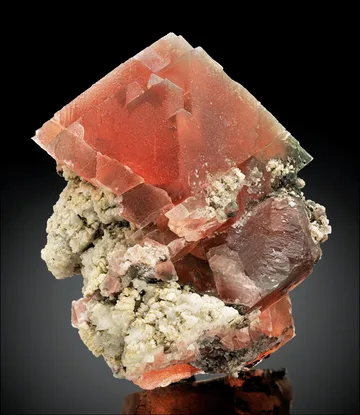
Switzerland: Alpine fissure localities yield clear and smoky quartz, adularia, and fluorite, prized for Alpine precision, crystal beauty, and collecting value.
Key facts
Switzerland matters to mineral collectors because it is one of the great classical territories of Alpine-cleft mineralogy: the country where transparent rock crystal, smoky quartz, twisted gwindels, chlorite phantoms, glassy adularia, and rose-pink fluorite became not just specimens but a collecting culture. The best-known Swiss specimen deposits are not ore veins in the usual mining sense. They are open fissures, or Zerrklüfte, in the crystalline massifs of the Alps, especially the Aar and Gotthard massifs, where tectonic extension during late Alpine metamorphism opened cavities in granite, granodiorite, gneiss, schist, amphibolite, and related rocks. Hot aqueous fluids moved through those fissures, dissolved and reprecipitated silica and accessory elements, and left behind crystals that could grow into free space rather than being locked in massive vein quartz.
The classic Swiss assemblage is instantly recognizable: prismatic clear quartz or smoky quartz, often with chlorite included as green veils or dusted across upper-facing faces; pearly white to colorless adularia; albite, calcite, hematite “iron roses,” rutile, brookite, anatase, titanite, fluorapatite, epidote, and zeolites; and, in a handful of celebrated zones, transparent pink fluorite octahedra perched on quartz. The aesthetic ideal is not mere size, although Switzerland has produced enormous quartz crystals. It is alpine precision: sharp edges, glassy luster, visible growth history, complex but balanced matrix, and a sense that the specimen was lifted from a natural cavity rather than broken from a seam.
Regional View
Country View
Historically, Swiss rock crystal has been sought for thousands of years. Modern archaeology has documented prehistoric procurement of rock crystal in the high Alps, including a site near Fiescheralp in Upper Valais with Mesolithic and Neolithic use. In the medieval and early modern periods, clear Alpine quartz became a prized raw material for reliquaries, monstrances, cups, and carved luxury objects. By the nineteenth and twentieth centuries the Swiss Strahler—the professional or semi-professional crystal hunter—had become a central figure in European mineral collecting, combining mountaineering, field geology, and a code of claim-holding that still shapes collecting access today.
The country’s second great mineralogical identity is very different in scale but equally important scientifically: the Lengenbach quarry in the Binn Valley, Valais. In white Triassic dolomite of the Penninic Monte Leone nappe, Lengenbach has yielded an extraordinary concentration of arsenic-, thallium-, lead-, silver-, and copper-bearing sulfosalts. Many are microminerals, but the locality’s scientific importance is enormous. It is one of the world’s most prolific type-locality districts, and new or exceptionally rare thallium sulfosalts continue to be described from its material.

Photo: Wikimedia Commons
At the finest level, Swiss Alpine specimens reward close looking. A gwindel may twist by a few degrees or by a spectacular corkscrew-like rotation; a smoky crystal may show “window” transparency through tea-brown to morion-black color; chlorite may ruin a face or create a landscape phantom; a fluorite may be ordinary if etched, but exceptional if the octahedron is sharp, transparent, saturated pink, and naturally seated on clean quartz. The best Swiss pieces carry the discipline of the mountains in miniature: severe geometry, spare color, and the unmistakable evidence of having grown slowly in a high-pressure Alpine cleft.
Search for specimens: View all specimens from Switzerland
Switzerland is best treated by collectors as a country-scale mineral province rather than a single mine. Its most famous cabinet specimens come from Alpine fissure deposits in the Central Alps, particularly the Aar Massif and Gotthard Massif and their associated valleys and passes: Grimsel, Göscheneralp, Göschenen Valley, Furka, Tiefengletscher, Galenstock, Val Giuv, Val Strem, Cavradi Gorge, Val Medel, Fibbia, and related localities. These are structurally controlled open clefts formed during the Alpine orogeny and later uplift. The host rocks are commonly granites, granodiorites, gneisses, schists, amphibolites, and related crystalline units, although the exact assemblage varies strongly with host-rock chemistry and metamorphic zone.
In the Alpine clefts, the “ore body” is usually a fissure or fissure system, not an industrial vein. Cavities may be narrow tension gashes only a few centimeters across, or they may open into larger chambers capable of producing major groups. Quartz is generally the dominant mineral, with clear rock crystal, smoky quartz, morion, faden-like growths, double terminations, sceptres, Tessin- or Penninic-habit forms, and gwindels among the characteristic habits. Adularia and albite are common feldspar associates in many districts, while chlorite is both a separate cavity mineral and a major inclusion phase. Calcite commonly represents a later stage; hematite, rutile, brookite, anatase, titanite, epidote, fluorapatite, milarite, zeolites, and sulfides occur depending on locality.
The Grimsel region, in the Aar Massif, is one of the canonical Swiss areas for quartz, smoky quartz, chlorite, calcite, adularia, and pink fluorite. The protected Gerstenegg crystal cleft, discovered in 1974 during excavation of the access tunnel to the Grimsel II power station, is an unusually intact underground example: visitors can view rock crystal, gwindels, chlorite, calcite, and pale pink fluorite still in their natural cleft setting. Its preservation is exceptional because it was encountered deep inside the mountain, shielded from the weathering, frost, acidic surface waters, and erosion that commonly damage Alpine clefts before collectors reach them.
The Göscheneralp and Göschenen Valley area in Uri is another key district, especially for large quartz and pink fluorite. Peaks and sectors such as Planggenstock, Feldschijen, Winterstock, and the broader Reuss Valley have produced important rock crystal, smoky quartz, gwindels, and rose fluorite. Planggenstock became internationally famous in the 1990s and 2000s when Franz von Arx, Paul von Känel, and later Elio Müller recovered enormous quartz and smoky quartz groups with associated pink fluorite from deep clefts in granite. Some pieces reached museum scale, including individual crystals around a meter long and groups weighing hundreds of kilograms.
The Gotthard region, including the Furka and St. Gotthard Pass areas and localities in Uri and Ticino, has long supplied classic smoky quartz, quartz gwindels, adularia, chlorite, hematite, titanite, apatite, and related Alpine minerals. Older literature emphasizes that Gotthard clefts commonly carry quartz and adularia, with chlorite films and inclusions being especially characteristic. Fluorite is not uniformly distributed: compared with the fluorite-rich Grimsel and Göscheneralp sectors, some Gotthard clefts are poorer in fluorite but may be stronger in apatite, adularia, and clean smoky quartz.
Graubünden, especially the Surselva and Tujetsch area, is crucial for smoky quartz, gwindels, chlorite, rutile, hematite, adularia, and rarities. Val Giuv is celebrated for smoky quartz and for its role in milarite history. Cavradi Gorge and Val Curnera have produced distinctive quartz and smoky quartz, often with hematite, rutile, chlorite, and feldspar associations. Val Medel and Val Cristallina are known to collectors for smoky quartz and for fluorite-bearing Alpine assemblages that may include chlorite-dusted or chlorite-included crystals.
Valais contributes both Alpine-cleft material and one of Europe’s great scientific mineral localities. The Lengenbach quarry near Fäld in the Binn Valley is not mined for metal production; it is quarried for specimens and scientific samples. Its mineralization occurs in snowy white Triassic dolostone within the Penninic Monte Leone nappe. The mineralized zones are enriched in arsenic, thallium, lead, silver, copper, and related elements, producing a uniquely complex sulfosalt suite. The Forschungsgemeinschaft Lengenbach has operated the locality as a research and specimen-extraction project, with controlled work during the snow-free season and material made available for study and public collecting on designated dump material.
Swiss specimen history is inseparable from the Strahler tradition. Crystal hunters worked the mountains for centuries as a source of side income and trade, and the practice became highly organized in the modern period through local permits, cantonal and communal rules, and collector associations. In Uri, mineral collecting on corporation land requires a Strahler patent; rules restrict or prohibit machine tools and blasting except under special authorization, and traditional claim-marking is still recognized. In the Ursern corporation area around Andermatt, Realp, and Hospental, a separate patent system applies. In other cantons and communes the regulations differ, and protected areas, nature reserves, tunnel works, private land, and active claims must be respected.
Collecting access today is therefore locality-specific. Casual surface collecting may be possible in some areas, guided excursions exist in places such as Graubünden, and the Lengenbach dumps are a well-known public-facing opportunity in the Binn Valley. But serious Alpine cleft collecting is not a casual roadside activity. The productive fissures are often high, dangerous, snow-season limited, legally regulated, and already known to local Strahler. The best modern finds tend to come from experienced local collectors, controlled quarrying or tunnel intersections, old collections, and museum-caliber historical pockets rather than from easy tourist collecting.
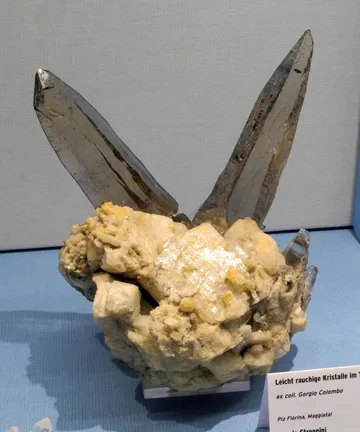
Swiss quartz is the defining Alpine-cleft mineral: clear rock crystal from Grimsel, Gerstenegg, Fiesch, Zinggenstock, Göscheneralp, and many Gotthard and Graubünden clefts; smoky to morion crystals from Furka, Tiefengletscher, Galenstock, Val Giuv, Cavradi, and Planggenstock; and the famous twisted gwindel habit for which Switzerland is one of the world standards. The best specimens are sharp, lustrous, undamaged, and transparent enough that internal veils, chlorite phantoms, fluid inclusions, and rutile needles add depth rather than cloudiness. Cabinet pieces range from thumbnail gwindels and miniature smoky groups to meter-scale museum crystals; ordinary pieces are abundant, but great Swiss quartz is separated by alpine geometry, clarity, natural terminations, well-balanced matrix, and convincing locality provenance.
Smoky quartz from Switzerland is prized for the combination of rich natural color and cleft-grown perfection: tea-brown, cognac, gray-brown, blackish morion, and sometimes zoned crystals with clear tips or smoky cores. The strongest collector localities include Galenstock and Tiefengletscher in Uri, the Furka and Gotthard areas, Grimsel and Oberaar in Bern, Planggenstock and Göscheneralp in Uri, and Val Giuv, Cavradi Gorge, and Val Strem in Graubünden. Good pieces may be single floaters, doubly terminated crystals, groups on granite or feldspar matrix, gwindels, or smoky quartz with chlorite, adularia, hematite, rutile, or pink fluorite; mediocre pieces are dull, rehealed only on one side, heavily bruised, or too chlorite-coated to show form, while top pieces have glassy luster, crisp terminations, strong transparency, saturated natural color, and an unmistakably Alpine habit.
In Swiss Alpine specimens, chlorite is often more important aesthetically than its modest species status suggests, because it gives quartz its green phantoms, mossy inclusions, dark coatings, and layered growth records. At Gerstenegg it is one of the major minerals of the protected cleft and was abundant enough in the rear section to obscure quartz; at Fibbia, Gotthard, Cavradi, Val Giuv, Grimsel, and many Uri and Graubünden clefts it occurs as films, scales, included clouds, and matrix coatings associated with quartz, smoky quartz, adularia, hematite, apatite, bazzite, titanite, and other Alpine species. The finest chlorite-bearing Swiss pieces are not simply “dirty quartz”: the chlorite is positioned in clean phantoms, scenic veils, green caps, or sharp contrast against clear faces, while excessive dull coating, embedded grit, or late mud-filled cracks lower both aesthetics and value.
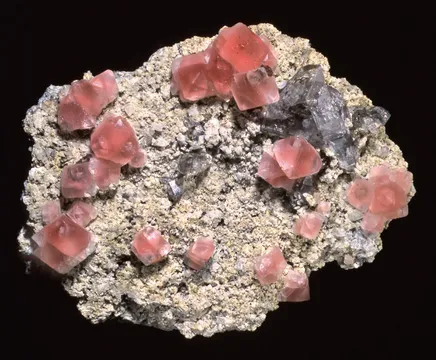
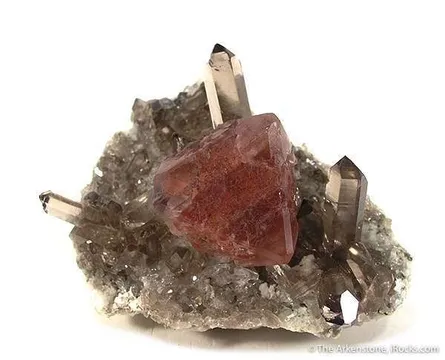
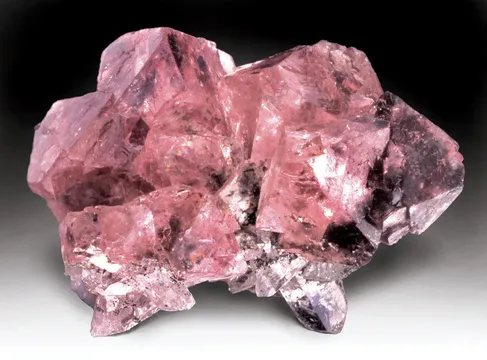
Swiss fluorite is most famous in its Alpine pink form: octahedral crystals, from pale rose to vivid raspberry-pink, seated on rock crystal or smoky quartz from Grimsel, Gerstenegg, Zinggenstock, Göscheneralp, Planggenstock, Winterstock, and related clefts. The crystals may be isolated octahedra, small sprays on quartz plates, or larger transparent individuals; in the best examples they are sharp, lustrous, naturally perched, strongly colored, and only lightly included by chlorite or calcite. Alpine fluorite is vulnerable to corrosion where clefts have been exposed to meteoric waters, so pristine deep-cleft and tunnel-intersected pieces can look dramatically fresher than weathered surface finds. Top Swiss fluorite specimens are judged by color saturation, transparency, intact octahedral edges, absence of cleavage scars, and the quality of the quartz or smoky quartz association.
Beyond the four featured minerals, Switzerland has exceptional breadth. Adularia and albite are essential Alpine-cleft feldspars; hematite “iron roses” from the Central Alps are classics; rutile, brookite, anatase, titanite, epidote, fluorapatite, calcite, pyrite, galena, sphalerite, stilbite, heulandite, laumontite, milarite, bazzite, phenakite, bertrandite, bavenite, monazite, xenotime, and synchysite occur in selected clefts. Val Giuv is historically tied to milarite, while the Binn Valley and Lengenbach quarry form an entirely different world of rare arsenic and thallium sulfosalts, including hutchinsonite, hatchite, wallisite, jordanite, sartorite, rathite, dufrénoysite, lengenbachite, liveingite, marrite, edenharterite, gabrielite, ferrostalderite, ralphcannonite, and the recently described spaltiite.
For Swiss Alpine quartz and smoky quartz, the chief concern is usually not a large-scale fake-specimen industry but condition, restoration, and label accuracy. The market contains many genuine but broadly labeled pieces marked only “Swiss Alps,” “Gotthard,” “Furka,” “Grimsel,” or “Uri.” Such labels may be acceptable for old pieces, but value rises sharply when a specimen carries a precise valley, mountain, cleft, collector, or old collection history. Fine gwindels, Planggenstock material, Grimsel pink fluorite combinations, and important Val Giuv or Cavradi pieces should be held to a higher provenance standard.
Inspect Swiss quartz carefully for repaired terminations, glued bases, rebuilt groups, and artificial mounting. Large Alpine groups often came out of tight clefts and may have natural contacts, rehealed surfaces, or detachable matrix, but clean glue lines, unnatural alignment, mismatched luster across breaks, or sawed display bases should be disclosed. Some historically important large crystals have been repaired or stabilized; that does not automatically make them undesirable, but it changes their commercial tier.
Smoky quartz color should be evaluated cautiously. Natural Swiss smoky quartz is expected, but smoky quartz in general can be artificially irradiated, and a specimen without convincing Alpine morphology or provenance should not be bought on the strength of the word “Swiss” alone. Natural Swiss pieces usually show credible cleft contacts, chlorite or feldspar associations, growth zoning, and a habit consistent with the stated region. Direct sunlight can fade some colored minerals and may alter the display quality of smoky quartz or amethyst over long periods, so strong Swiss smoky specimens are best kept out of constant direct sun.
Pink fluorite from Switzerland deserves especially careful condition review. Fluorite is softer than quartz and has perfect cleavage, so edge nicks, cleaved corners, bruised octahedral tips, and etched surfaces are common. Weathered cleft fluorites may be naturally corroded; tunnel or deep-cleft pieces can be unusually pristine. A bright pink octahedron on smoky quartz from a premium locality is valuable enough that locality inflation, undisclosed repair, and glued-on crystals are realistic risks. Confirm that the fluorite is naturally seated, that the matrix and association make geological sense, and that any damage is reflected in the price.
Chlorite-bearing specimens are often misjudged. A thin green phantom inside clean quartz can be a premium feature, while heavy dull chlorite coating may be a liability. Avoid aggressive cleaning unless you know the paragenesis: some chlorite films are part of the specimen’s identity and may not be removable without damaging luster or leaving an unnatural surface. Iron staining can sometimes be reduced, but historic Swiss pieces are often better left with their natural patina.
Lengenbach specimens are a separate collecting discipline. Many of the important species are microscopic, visually similar, chemically complex, and impossible to identify reliably by appearance alone. Labels should be treated as hypotheses unless backed by analytical work, a reputable Lengenbach specialist, or documented provenance. Realgar, orpiment, and thallium-bearing sulfosalts also require sensible handling: keep them dry, stable, out of strong light, away from children and pets, and avoid creating dust.
Market availability ranges from common to nearly unattainable. Small Swiss quartz points, chlorite-included quartz, and modest smoky quartz appear regularly. Good gwindels, clean doubly terminated smoky quartz, attractive Grimsel or Gotthard matrix pieces, and sharp pink fluorite on quartz are much scarcer and command strong prices. Museum-scale Planggenstock quartz and major Lengenbach type-species material are institutional-level or specialist-market objects. The best Swiss specimens do not circulate often; when they do, old labels, named collectors, precise localities, and honest condition reports are part of the specimen.
In the Swiss Alps, the romance of collecting is inseparable from the word Strahler. The old crystal hunters were not simply walkers with hammers; they were mountain people who read rock faces for subtle signs of a hidden cleft, staked claims by custom, and worked short high-altitude seasons where snow, loose blocks, falling rock, and sudden weather were as much a part of the job as mineralogy. In Uri, the tradition is strong enough that the canton has pushed to recognize Strahlnen as a living cultural practice. That ambition is not sentimental overreach: the trade, tools, claims, and mountain knowledge around Swiss crystal hunting are centuries deep.
One of the great modern episodes began at Planggenstock, high above the Göscheneralp in Uri. In 1993, Paul von Känel and Franz von Arx suspected that a large cleft lay hidden in the upper part of the mountain, beneath a load of loose granite blocks. They spent 23 days clearing roughly 150 cubic meters of rock, with some individual blocks reaching about 25 tonnes. Their reading of the mountain proved correct: a huge cleft opened, yielding large quartz groups, some around 200 kg, with crystal tips up to about 25 cm.
The work did not end there. In 1997 the two men found another major cleft system about 15 meters lower. They worked into the granite year after year, sometimes rewarded, sometimes not, until the operation began to resemble a small mine rather than a seasonal collecting spot. By 2005 they were around 30 meters inside the mountain. After a long, disappointing summer, Franz von Arx shone a flashlight through a small opening into the dark and saw the cavity gleam “like a Christmas tree.” Inside were crystals of extraordinary size and clarity: giant quartz crystals approaching a meter, groups weighing hundreds of kilograms, and associated pink fluorite of exceptional quality.
The recovery was an engineering problem as much as a mineral find. In 2006 the great crystals had to be freed, protected, and moved from deep inside the mountain down to the valley without shattering the very perfection that made them important. One large Planggenstock group on display has been recorded at around 300 kg, with the longest crystal reaching 107 cm. The Natural History Museum Bern later built the find into the public story of Swiss mineralogy, and the “Schatz vom Planggenstock” became one of the defining Alpine discoveries of the modern era.
The Rhône Glacier find of 1960 has a different texture: glacial retreat, a quartz band, and a patient Strahler working against winter. Kasimir Simmen noticed a promising quartz band below the retreating glacier tongue in autumn 1959. The band was about 10 meters long and 1.2 meters high, and other crystal hunters had already worked parts of it with only moderate success. Simmen chose another place to attack the band. In his diary he recorded that 25 blast shots had already been spent, but only small pockets had opened. Winter forced him away. When he returned at the end of May 1960, further work finally opened the cleft. It was filled with clayey sand, and as he removed it, huge crystals emerged. The largest weighed 56 kg, measured 65 cm long, and had a circumference of 91 cm. Other pieces weighed about 45, 30, 20, and 10 kg, with the total find around 300 kg.
The protected Gerstenegg cleft at Grimsel is the rare story of a crystal pocket that was not emptied for the market. On 4 October 1974, workers driving the access tunnel to the Grimsel II power station cut into the forward part of a crystal cave. The operator, Kraftwerke Oberhasli AG, and the authorities recognized that this was not an ordinary tunnel curiosity. After the first crystals were carefully recovered, it became clear that the cavity extended farther than expected, and on 11 December 1974 it was placed under state protection as a natural geological monument. A huge slab that had hidden much of the cave—about 875 kg—was removed and placed in the KWO administration building at Innertkirchen. Later, in the winter of 1985–1986, an observation gallery was built to show the rear section. Today the visitor looks through windows into a cleft that still contains clear quartz, gwindels, chlorite, calcite, and pale pink fluorite in the positions where they grew.
The prehistoric story is older still. Near Fiescheralp in Upper Valais, at about 2575 meters elevation, a high Alpine rock crystal procurement site has been studied as one of the rare European examples of sustained prehistoric crystal quarrying. In the 1990s, amateur archaeologist Gertrud de Vries found unusual rock-crystal objects near construction in a ski area. Later surveys relocated and reconstructed the site, and a 2019 trench documented the original fissure surface where crystals had been quarried. Hundreds of rock-crystal objects were visible in an area of about 20 square meters, with bulbs of percussion, platform remains, and Wallner lines showing intentional flaking rather than natural breakage. The analyzed assemblage comprised 1,134 pieces weighing 2,572 g. Early Mesolithic microliths and microburins, together with younger Neolithic material, tie Swiss rock crystal not only to collectors’ cabinets and church treasuries but to some of the earliest high-mountain resource use in the Western Alps.
At Lengenbach, the drama is microscopic but just as persistent. Richard Harrison Solly, the English specialist who spent many summers around Binn, noticed in 1903 that small blood-red to grayish-black crystals in the white dolomite were unlike ordinary realgar. By 1905, G. T. Prior at the British Museum had shown that the new mineral contained about 20 weight percent thallium. The mineral was named hutchinsonite, and Lengenbach’s modern reputation as an incomparable thallium-sulfosalt locality began. More than a century later, the quarry is still yielding surprises. Spaltiite, formally published in 2026, was found on a Lengenbach dump specimen by Walter Gabriel; the known material consisted of only three slender crystals, roughly 2 mm long and about 0.2 mm thin, in a small piece of white dolomite. In a locality famous for crystals so small they demand microscopes and microprobes, those three laths were scientifically large enough to add another name to one of mineralogy’s most remarkable type-locality lists.
_2_(33846747784).jpg)