






Sterling Hill Mine, USA — premier locality for serious collectors; iconic franklinite-willemite-zincite assemblages, vivid UV fluorescence, and a rich mining h…
Key facts
Sterling Hill is one of the essential American localities for serious mineral collectors: a high-grade zinc-iron-manganese orebody folded into the Precambrian Franklin Marble at Ogdensburg, Sussex County, New Jersey, and the southern counterpart to the Franklin Mine a few miles to the north. The deposit’s fame rests on an assemblage that is at once visually unmistakable and geologically peculiar: black franklinite, tan to reddish or brown willemite, red to orange zincite, and white to gray calcite, with a long fringe of manganese silicates, arsenates, borates, oxides, carbonates, sulfides, and late vein minerals. Under ordinary light, a classic Sterling Hill hand specimen can look like coarse, heavy, dark-speckled marble stained with brick red and peach-brown ore; under shortwave ultraviolet, the same rock may ignite into the district’s signature red calcite and green willemite, with franklinite and most zincite remaining dark and giving the fluorescence its crisp contrast.
Sterling Hill matters historically because its ores were being examined and misread before the chief ore minerals were even scientifically understood. Early workers tried to treat the material as copper or iron ore; later, the property became one of the great zinc mines of the New Jersey Zinc Company. The mine ultimately worked a deep, complex, folded orebody from surface pits and underground levels, produced more than 11 million tons of zinc ore, and closed in 1986. Its afterlife is just as important to collectors: instead of disappearing under development or neglect, Sterling Hill became a mining museum and research locality, preserving access to the upper workings, the orebody’s fluorescence, and mine-run collecting material.
Regional View
Country View
The best specimens from Sterling Hill are not merely “fluorescent rocks,” though the fluorescence is spectacular. They are locality documents in three dimensions: sharp black franklinite crystals embedded in calcite; red to brick-red willemite with the green shortwave response collectors prize; coarse red-orange zincite ore with black franklinite grains; fibrous and mammillary hemimorphite from the old Passaic and Noble pits; and rarer pieces from named structural zones such as the cross-member, outer zincite zone, black willemite zone, and North orebody. For a collector, a good Sterling Hill label should do more than say “New Jersey”: it should separate Sterling from Franklin, state the species confidently, and, when possible, preserve the mine level, pit, ore zone, shaft, or old collection history.

Photo: Wikimedia Commons

Photo: Wikimedia Commons
Search for specimens: View all specimens from Sterling Hill Mine, USA
Collectors commonly say “Sterling Hill Mine,” and that is the familiar market name, but in stricter locality usage the mine is the Sterling Mine on the Sterling Hill orebody at Ogdensburg. The property represents consolidated workings on and under Sterling Hill rather than a single simple opening. The deposit sits in the Franklin Marble, a Mesoproterozoic carbonate unit of the New Jersey Highlands, and belongs to the extraordinary Franklin-Sterling Hill zinc-iron-manganese district. Modern interpretations regard the ores as originally stratiform, metal-rich sediments or exhalative-hydrothermal deposits formed with the carbonate sequence and later transformed by Grenvillian granulite-grade metamorphism, deformation, and folding. That history explains the oddity that makes Sterling Hill so collectible: the principal zinc ore minerals are not ordinary sphalerite-rich sulfides, but franklinite, willemite, and zincite in calcite and calc-silicate assemblages.
The orebody is structurally complex. At the surface and in mine plans it is described in terms of a long east limb, a shorter west limb, and a cross-member or transverse body linking parts of the fold. Deeper mining also followed a northward extension, the North orebody. The main orebody was folded into east and west limbs with keels, offsets, and internal deformation; specimens may therefore record particular structural environments as much as simple species occurrences. Sterling Hill collectors should pay close attention to old labels mentioning the East limb, West limb, cross-member, zero fault, 750-foot level, 1,850-foot level, North orebody, Passaic pit, Noble pit, or Marshall shaft, because those notes can change both scientific and market significance.
The mineralization is zoned. The familiar ore is granular to gneissic franklinite-willemite-calcite material with variable zincite. Zincite-rich material is especially associated with named zones including an outer zincite zone and a central zincite zone; black willemite ore is associated with a reduced-looking transverse or cross-member assemblage in which willemite appears black from microscopic inclusions and related mineralization. Other zones include brown-willemite and pyroxene-rich assemblages, and calc-silicate units carrying minerals such as tephroite, rhodonite-family material, pyroxenes, garnet, gahnite, and many rarer species. Late hydrothermal and oxidation processes added sulfides, arsenates, hydrated zinc minerals, vein calcite, hemimorphite, and a suite of rare secondary minerals.
Sterling Hill’s mining history began in confusion. Early prospectors and landowners encountered red and black ore minerals that did not behave like the copper and iron ores they expected. Lord Stirling, William Alexander, controlled or leased part of the hill in the eighteenth century, and in 1772 several tons of red ore were reportedly sent to Swansea, Wales, for smelting without success. By the nineteenth century the zinc potential was understood, and a patchwork of companies worked the property. The Noble and Passaic open pits yielded secondary zinc ore, especially hemimorphite then widely called calamine. The Passaic Zinc Company, New Jersey Zinc interests, and other operators worked different portions of the hill before the “Great Consolidation” of 1897 unified competing Franklin and Sterling Hill interests under the New Jersey Zinc Company.
After consolidation, attention initially centered on Franklin, but Sterling Hill was redeveloped as a major producer in the early twentieth century. A new shaft and mill were built between 1913 and 1915, and the Sterling Mill processed ore concentrates for shipment to Palmerton, Pennsylvania. As Franklin approached exhaustion and closed in 1954, Sterling Hill became increasingly important. The New Jersey Zinc Company refurbished the mine in the late 1940s and 1950s, added a new five-compartment West shaft, developed the North shaft underground from the 1,850-foot level, and exploited deeper ore. The mine shut down from 1958 to 1961 during economic slowdown and planning, reopened with changed mining methods, and operated until 1986.
Today, underground production has ceased and most of the deep mine is flooded, but Sterling Hill remains unusually accessible for an historic hard-rock mine. The Sterling Hill Mining Museum preserves the upper workings, mine buildings, exhibits, the Warren Museum of Fluorescence, and the famous underground fluorescent display. Public access is by guided tour rather than unguided exploration. Collecting is through the museum’s Mine Run Dump, where the local pile contains high-grade Sterling Hill zinc ore and collectors can check pieces under shortwave ultraviolet in the dump area. Access rules, hours, prices, and age restrictions change, so serious collectors should confirm current museum policy before traveling and should not assume that collecting underground or outside approved areas is permitted.
Important specimen-producing areas include the old Passaic and Noble pits for hemimorphite and weathered-zone classics; the surface and near-surface weathered ore for large crystals of franklinite, gahnite, jeffersonite-augite, and related minerals; the cross-member for black willemite and unusual reduced assemblages; the outer zincite zone for red-orange zincite-rich ore; and deeper mined material, including pieces with level data from the 700-, 750-, 900-, 1,850-foot, and North orebody workings. Much of the collector material now seen comes from old mine production, museum dump collecting, historic New Jersey Zinc Company-era collections, FOMS-connected collections, and older dealers who handled mine-run material before and shortly after closure.
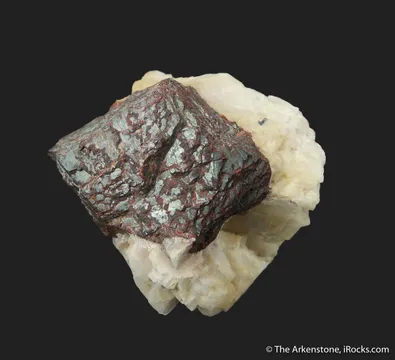
At Sterling Hill, franklinite is the black backbone of the ore: granular to massive in the common ore, disseminated through calcite and willemite, intergrown with willemite in gneissic textures, and locally present as sharp octahedral to modified octahedral crystals embedded in calcite or perched on willemite. Sterling Hill franklinite is typically black, opaque, submetallic to resinous on fresh fracture, and non-fluorescent, giving the classic red-and-green fluorescent pieces their dark framework under ultraviolet. Fine crystals from Sterling Hill are far less routine than massive ore, and the best pieces show isolated, lustrous, well-formed crystals with undamaged faces, visible contrast against white calcite or tan-gray willemite, and preferably an old label tying them to Sterling rather than merely “Franklin, N.J.” Weathered pits at Sterling Hill produced some of the largest intact crystals known from the district, while granular ore specimens are abundant enough that quality depends on crystal definition, texture, heft, and association with visibly red zincite or fluorescent willemite and calcite.
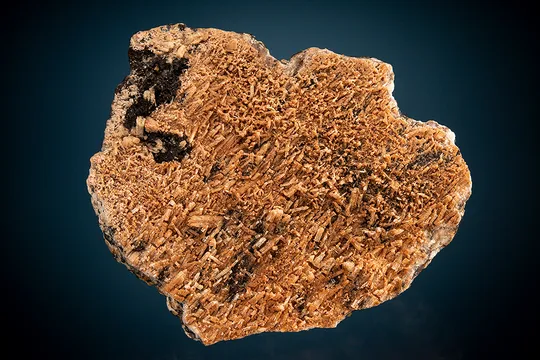
Sterling Hill willemite is a mineral of many faces: tan, brown, red, pinkish, gray, black, or rarely clearer material in daylight, but usually bright yellow-green to green under shortwave ultraviolet, sometimes with a noticeable afterglow. In ordinary ore it occurs as granular aggregates with franklinite, zincite, and calcite; in more specialized Sterling Hill specimens it appears as brick-red “troostite,” black willemite from the cross-member, clear to gray crystals with friedelite, and exsolution lamellae in brown tephroite-rich assemblages. The finest Sterling Hill willemite pieces are not simply the brightest fluorescent chunks; they combine strong UV response with texture, daylight color, and locality character—red or black willemite that fluoresces green, clean crystal faces, crisp association with non-fluorescent franklinite, and documented level or zone information. Pieces from the 750-foot level near the zero fault and black-willemite cross-member material are especially desirable when the label is precise.
Calcite is the principal gangue at Sterling Hill, but calling it “gangue” understates its collector importance. It forms the white to gray host for much of the ore, the red to orange-red fluorescent component in classic shortwave displays, drusy late coatings on franklinite-willemite ore, slickensided surfaces with franklinite, salmon-colored masses, and vein or vug material associated with sphalerite, barite, quartz, hemimorphite, and other late minerals. Good Sterling Hill calcite specimens show either exceptionally strong red to orange-red fluorescence, interesting wavelength behavior, attractive druse or vein textures, or sharp contrast with green-fluorescing willemite and black franklinite. Ordinary massive calcite-rich ore is plentiful; specimen-grade calcite is selected for clean faces, minimal bruising, strong fluorescence, distinct phosphorescent flash where present, and a composition that reads well in both daylight and UV.
Natural zincite from Sterling Hill is far more often a red to orange-red constituent of ore than a freestanding show crystal, and that is exactly where its authenticity and appeal lie. It occurs as disseminated intergranular material in franklinite-willemite ore, shard-like fragments in disseminated and gneissic ore of the outer zincite zone, red to orange matrix carrying black franklinite grains, finger-like and conical masses in calcite, and secondary or recrystallized material in fractures and vugs. The outer zincite zone at Sterling Hill was important enough to affect historical arguments about the deposit’s structure and value, and it remains the source of some of the most visually striking red-and-black ore specimens. Fine collector pieces show saturated natural red to orange zincite in obvious quantity, strong contrast against black franklinite and white calcite, and, ideally, some fluorescence from associated willemite or calcite without implying that the zincite itself is the fluorescent mineral.
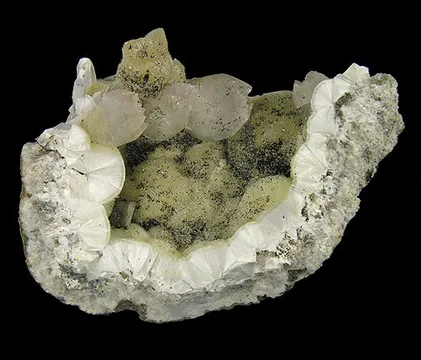
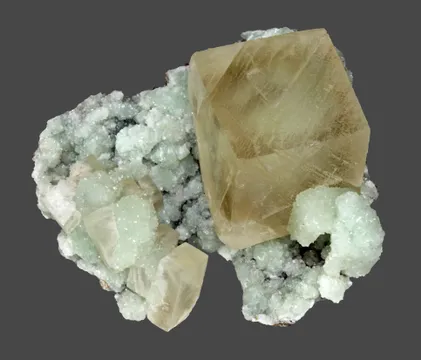
Sterling Hill is one of the great localities for hemimorphite in the Franklin district, especially the old Passaic and Noble open pits, where secondary zinc ore was mined extensively in the nineteenth century under the old name calamine. The classic material forms white, colorless, pale yellow, pale green, or pale blue aggregates: mammillary masses, slabs, stalactitic and crested forms, chalky or fibrous material, and the famous serrated, close-spaced crystal aggregates miners called “maggot-ore.” Individual crystals are commonly small, but the best Sterling Hill hemimorphite is prized for lustrous white surfaces, sculptural botryoidal or crested habit, old Passaic pit or Noble Mine provenance, and clean preparation that preserves the delicate terminations. Large masses exist, even to tens of kilograms, but cabinet specimens with crisp surface texture and historic labels are generally more desirable than bulky, stained lumps unless the form is exceptional.
Beyond the five headline species, Sterling Hill is a systematic collector’s mine of the first order. Documented species include gahnite, tephroite, rhodonite and fowlerite-type material, pyroxenes including jeffersonite-augite, friedelite, sphalerite, löllingite, barite, quartz, arsenates, hydrated zinc minerals, and numerous manganese silicates and oxides. The locality is also tied to type-locality and district-defining minerals, including franklinite and Sterling-associated rarities such as sterlinghillite, chalcophanite, and ogdensburgite, with many additional Franklin-Sterling Hill species either first described from the district or known from few places worldwide. For the advanced collector, Sterling Hill is often less about assembling one showy fluorescent rock and more about building a documented suite across ore zones, alteration stages, named pits, and old mine levels.
Sterling Hill material is abundant in small, massive ore pieces but selective in true specimen quality. The market is full of black-red-white-tan chunks labeled “Franklin, New Jersey” or “Franklin/Sterling Hill,” and many are perfectly legitimate district specimens, but serious buyers should ask whether the specimen is actually from Sterling Hill, the Franklin Mine, the Buckwheat Dump, the Trotter Dump, or merely the broader Franklin mining district. The two great orebodies are related but not interchangeable. A precise Sterling Hill label—especially one naming the Passaic pit, Noble pit, cross-member, black willemite zone, North orebody, or a mine level—is worth preserving and may justify a premium.
The most common misidentification is visual overconfidence. Black grains are often called franklinite, but magnetite and jacobsite occur in the district and can complicate opaque ore identifications. Red material is often called zincite, but red willemite is common at Sterling Hill and fluoresces green; zincite generally does not provide the green response. White material is usually calcite or marble, but fluorescence alone does not prove a clean species identification, because coatings, intergrowths, and mixed ore can make the apparent response misleading. A shortwave UV lamp is essential for evaluating Sterling Hill specimens, but it is not a substitute for magnification, magnet testing where appropriate, specific gravity, acid caution with carbonates, and analytical confirmation for rarities.
Natural Sterling Hill zincite should be judged with particular care. Much of the world’s attractive, sharp, bright red to orange “zincite crystal” material on the market is not natural Sterling Hill zincite at all, but furnace-formed or synthetic material from industrial sources. True Sterling Hill zincite is typically embedded, granular, massive, shard-like, or irregular in ore, not a loose cluster of glassy, perfect, freestanding crystals. A specimen sold as crystallized zincite from Sterling Hill should have exceptional provenance and should fit the known district style.
Condition issues are straightforward but important. Franklinite and massive ore are tough, but calcite cleaves, drusy calcite bruises easily, hemimorphite crusts can be fragile, and surface stains on hemimorphite may be part of its history rather than dirt to be aggressively removed. Acid cleaning can destroy calcite and damage associations; even mild chemical cleaning should be approached conservatively on mixed Sterling Hill ore. Many pieces are heavy for size and can scratch display surfaces. Keep fluorescent display specimens away from prolonged high-intensity UV exposure and do not stare into shortwave lamps; shortwave UV is a viewing tool, not a casual flashlight.
Market availability is broad at the entry level and highly stratified at the top. Mine-run fluorescent ore from the museum dump and older stock remains obtainable, while fine franklinite crystals, black-willemite specimens, well-documented level pieces, old Passaic pit hemimorphite, and uncommon Sterling Hill rarities are much scarcer. Museum-quality pieces with old New Jersey Zinc Company, FOMS, Hauck, Franklin Mineral Museum, or respected dealer provenance should be evaluated as historic objects as well as mineral specimens.
Long before Sterling Hill became a zinc mine, it was a geological riddle that punished ordinary assumptions. Early land records spoke of a “Copper Tract,” and the red ore—later understood as zincite—was easy to mistake for something more familiar. A 1749 survey mentioned old mine holes; later descriptions told of crude shafts only 5 or 6 meters deep in the marble. Even the age of those primitive pits has a story attached: a red cedar growing in the old workings was used to date the disturbance to not later than 1739. By the time Lord Stirling controlled part of the hill in the eighteenth century, the ore had already acquired a reputation for promise and disappointment. In 1772, several tons of red ore were shipped across the Atlantic to Swansea, Wales. The result was failure. The miners and smelters were handling zinc minerals before zincite, franklinite, and willemite had been properly decoded by science.
The nineteenth-century Sterling Hill surface was not a single mine so much as a battleground of competing claims, shafts, pits, and companies. In the Noble pit and Passaic pit, miners dug secondary zinc ore—hemimorphite, then widely called calamine—from weathered ground above the primary ore. The Passaic pit produced great quantities of white, lustrous, rough-surfaced hemimorphite, and the miners’ name “maggot-ore” was not poetic exaggeration: the closely spaced, serrated crystal terminations really do resemble pale clustered larvae. That humble ore, washed in a primitive on-site log-washer, became one of the classic hemimorphite occurrences in the world and sent specimens into systematic collections far beyond New Jersey.
Sterling Hill also had a brief, strange career as an iron mine. At the extreme southern end of the deposit, near the keel where the limbs came together and near the Noble workings, the franklinite ore was unusually iron-rich and zinc-poor. From about 1877 to 1882 it was mined as iron ore, with about 45,000 tons taken in the first two years. The ore left through a 97-meter haulage tunnel driven through the east side of the hill; the opening was reported as still visible from Plant Street. The plan failed for a reason embedded in the mineral itself: as mining advanced, the ore became increasingly zinc-rich and less usable for the iron furnaces of the day. Sterling Hill would not let itself be simplified into an ordinary iron mine.
The “Great Consolidation” of 1897 ended decades of fragmented mining and litigation by unifying Franklin and Sterling Hill interests under the New Jersey Zinc Company. Afterward, Sterling Hill waited while Franklin took center stage. Then, between 1913 and 1915, Sterling was modernized with a new shaft and mill. The Sterling Mill could process 450 tons of ore per day, producing concentrates sent by rail to Palmerton, Pennsylvania. Later, as Franklin neared exhaustion, Sterling Hill was rebuilt again: new crushing facilities, shops, headframe, hoist house, conveyor, shipping equipment, a West shaft, and a North shaft that dropped from the 1,850-foot level to exploit the deep North orebody. The mine was not a relic then; it was a working industrial system chasing a folded orebody deep under the Wallkill River valley.
The final closure came in March 1986, on the eve of Good Friday. The mine had been operating with a near skeleton staff, squeezed by zinc prices, mining economics, and a long property-tax dispute with Ogdensburg. Workings were dismantled, shafts capped, and by 1988 the borough had taken title by foreclosure. On March 7, 1989, the roughly 70-acre property was auctioned in two parcels. The mine parcel sold for $750,000 to Richard Hauck and Phillips Enterprises; Richard and Robert Hauck took title that June and formed the Sterling Hill Mining Company. To collectors and mineralogists who feared Sterling Hill might suffer the fate of Franklin’s vanished industrial landscape, the sale was a rescue.
The rescue was physical, dirty, and immediate. The main adit had been sealed with 20 cubic meters of concrete, and blasting it out risked damaging nearby structures, so the concrete had to be chopped away. Within a week of taking title, the Haucks were back inside the mine. The site needed roofs, heat, electrical service, rewiring, water connections, septic systems, roads, and the restoration of buildings stripped of salvageable equipment. Volunteers came from the mineral world and from the old mining community: ex-miners, geologists, collectors, electricians, plumbers, mechanics, businesspeople, and former New Jersey Zinc employees. They removed debris by the thousands of cubic meters, worked in rock, mud, muck, and grease, and turned an abandoned industrial site into a public museum in less than 15 months.
One of Sterling Hill’s greatest modern collecting experiences was created after the mine closed. The main adit ran 137 meters to the West shaft station, but the museum needed a more dramatic underground encounter with the ore. In 1990, a new 73-meter drift—the Rainbow Tunnel—was driven south toward the open cut. It took 2 tons of dynamite, fired in 49 shots, and was completed on June 6, 1990. Near the end of that new tunnel, a heading was driven westward to intersect the west limb of the orebody, where a small room was opened in the ore itself. Under ultraviolet light, visitors stand inside the mountain as calcite and willemite glow red and green around them, a display made not by painted scenery but by the orebody that built Ogdensburg.
The human memory of the working mine is preserved in unusual detail through John Kolic’s diaries. Kolic began as a miner for the New Jersey Zinc Company in 1972 and worked until the 1986 closure, then returned in 1989 to work for the Sterling Hill Mining Museum until illness forced him to stop in 2013. He died in 2014. His diaries, kept meticulously across ordinary workdays, bridge the last industrial years of the zinc mine and the museum era that followed. For collectors, those pages matter because they remind us that “Sterling Hill” is not only a locality name on a label; it is a workplace, an engineering problem, a community, and a rescued mineral monument.
_3.jpg)
