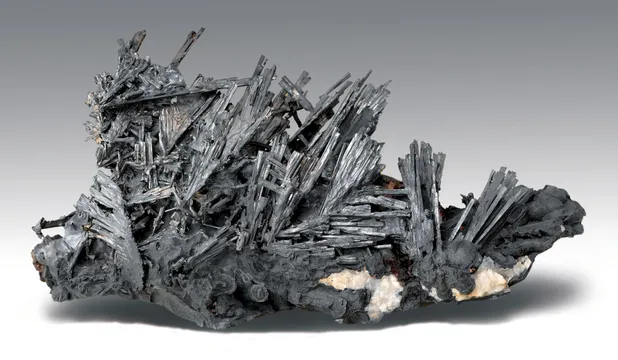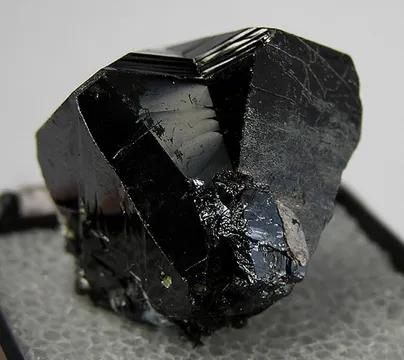
Horní Slavkov, Czech Republic — a classic Bohemian locality known for tin-tungsten greisen districts, with cassiterite, fluorite, quartz, and strong collecting…
Key facts
Horní Slavkov—long familiar on old specimen labels as Schlaggenwald—is one of the classic mineral districts of western Bohemia. For collectors, its importance rests on the Krásno–Horní Slavkov tin-tungsten district, where Variscan, highly evolved Li-F granites of the Krušné hory batholith rise as cupolas beneath the metamorphic rocks of the Slavkov gneiss block. Those cupolas, especially the Huber and Schnöd stocks between Horní Slavkov and Krásno, were profoundly greisenized: feldspars were replaced by quartz, topaz, mica, and fluorine-rich assemblages, and the apical parts of the granite became charged with cassiterite, wolframite, fluorapatite, fluorite, quartz, sulfides, and a remarkable suite of secondary phosphates and arsenates.
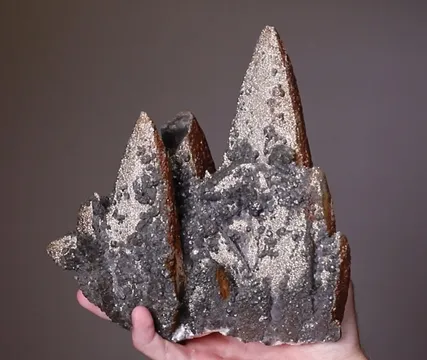
The locality matters because it is not merely a tin mine with good specimens; it is a dense old European mineralogical archive. Its crystals were already in circulation when 18th- and 19th-century mineralogists were defining mineral habits, measuring faces, and comparing classic ore deposits across the continent. Old labels may read Horní Slavkov, Krásno, Schlaggenwald, Schönfeld, Kaiserwald, Huber, Schnöd, or Stannum; all can point into the same historically intertwined district. The best specimens have an unmistakable central-European greisen look: black to deep brown cassiterite twins perched on quartz or clayey greisen, dark violet fluorite cubes and octahedral-looking aggregates, lustrous brassy chalcopyrite sprinkled through quartz-fluorite-sulfide vein material, smoky or clear quartz with unusual interrupted growth forms, and pale to lilac fluorapatite set against zinnwaldite-rich matrix.
Regional View
Country View
The Huber stock is the name most collectors encounter, because it was the richest exposed granite high and because specimens from its open pit, cave-in zones, quartz veins, and clay-filled “bonanzas” entered collections in quantity during both old and modern workings. The district’s specimen tradition is unusually well documented: Beran and Sejkora’s 2006 review treats Horní Slavkov and Krásno as a source of “mineral classics,” not only for cassiterite and fluorite but also for arsenopyrite, fluorapatite, hübnerite, chalcopyrite, carpholite, quartz, molybdenite, rhodochrosite, sphalerite, topaz, and scheelite.

Photo: Rob Lavinsky, iRocks.com, via Wikimedia Commons

Search for specimens: View all specimens from Horní Slavkov, Czech Republic
The Horní Slavkov collecting name covers a mineral district rather than a single small vein. The Krásno Sn-W district lies in the Slavkovský les area of western Bohemia, near the towns of Horní Slavkov and Krásno, and includes the Huber and Schnöd granite stocks, the Gellnauer vein system, the Lánský Dvůr elevation, and related greisen, quartz-vein, and pegmatitic or feldspathic bodies. The district is part of the Saxothuringian zone of the Bohemian Massif and is genetically tied to evolved Li-F granites, particularly alkaline-feldspar lithium-topaz granites of the Čistá type. These granites form cupolas and structural highs beneath gneissic roof rocks; the apical and marginal parts were the favored sites for greisenization and Sn-W mineralization.
Two principal Sn-W styles dominate the collector-relevant geology. The first is disseminated greisen mineralization in the apical and flank zones of Li-F granite stocks. In these rocks, cassiterite and wolframite occur in quartz-topaz-mica greisen, locally with sulfides, fluorite, and fluorapatite. The second is quartz-vein mineralization, especially where quartz veins cut the gneiss envelope or occur around mineralized cupolas. The Gellnauer and related vein systems yielded quartz, cassiterite, fluorite, chalcopyrite, fluorapatite, sphalerite, wolframite, and accessory sulfides in open spaces. Hydrothermal Ag-As-Bi-Co-Ni-U veins form a separate postwar mining story around Horní Slavkov, especially in the uranium district, where uraninite and a suite of secondary uranium minerals occur.
The Huber stock was the key tin body. Its apical part was exposed or very close to the surface, which explains why it was attacked early and why later collapse produced the great funnel-like open pit or subsidence feature associated with medieval workings. The Schnöd stock, by contrast, was covered by tens of metres of gneissic roof pendant. Beran and Sejkora describe the Huber and Schnöd stocks as blunt-cone or bell-like granite bodies that widen with depth and join at deeper levels into a single body. Around the fourth level, the contact plane flattened markedly, and marginal pegmatite—the so-called stockscheider—could reach several centimetres to nearly 4 m in thickness.
Mining began with cassiterite from alluvial deposits, then moved into primary tin deposits. The first reliable written record of tin export from the Krásno area to western Europe and eastern markets is from the Arab merchant Ibrahim ibn Jakub in 965–966. By the 12th century cassiterite placers were being exploited; by the 14th to 16th centuries, underground mining had reached a high level of organization. Horní Slavkov and Krásno were raised as mining towns in the 1350s, and the Huber stock was reportedly discovered in 1516. In the first half of the 16th century Horní Slavkov became one of the great Bohemian mining towns, with tin, silver, and a short-lived minting episode adding to its importance.
The richest early ores could contain 8.5–10 wt. % Sn, but later grades declined; around 1700 some ores averaged only 0.2–0.5 wt. % Sn. The old workings were complex: shafts, inclined workings, galleries, drainage adits, chambers, and narrow adits followed the greisen and veins. Some chambers at Huber and Čistá reached 30–40 m long, 10–20 m wide, and 15–20 m high. The Pluhova adit became one of the important district workings, connecting older mines and eventually serving into the uranium-mining period of the 20th century. Water supply and drainage were engineering problems of district scale; the Dlouhá stoka water channel, begun in the early 16th century, was linked to ponds and reservoirs that served mining and ore processing.
Ore dressing was equally substantial. Early ore was crushed by hand and later by water-powered crushers and stampers; by the later 16th century, dozens of processing sites operated around Krásno and Horní Slavkov. The district’s tin was valued on European metal markets and supported pewter and bell-making trades. Over the entire historic mining period, estimates for tin production in the Krásno-Horní Slavkov area are on the order of 60,000 tonnes of metallic tin, though the early numbers are necessarily approximate because medieval production records are incomplete.
Modern mining repeatedly revived the district. Interest in tin and tungsten rose again during the world wars and under state management after nationalization. The Stannum mine and associated dressing plant worked the Sn-W ores in the postwar period, with modern activity around Huber, Schnöd, and nearby deposits. Mining was definitively finished in January 1991 with the closure of the Stannum mine. The Czech Geological Survey still treats the Huber stock as a significant geological locality, and the old mining ground lies within a protected deposit area.
The uranium story is distinct and darker. After the Second World War, exploration and mining targeted uranium veins around Horní Slavkov. Mining began in 1948 and continued into the early 1960s, using a large and rapidly developed underground system of shafts and galleries. The operation exploited many veins but was small compared with larger Bohemian uranium districts. Its social history is severe: prisoners of war and, later, political prisoners worked in the district, and camps such as Prokop, Ležnice, Svatopluk, and Camp XII were established near shafts. Collectors encounter this legacy mainly through rare uranium minerals and altered uraninite specimens, but the historical context is inseparable from the locality.
Collecting access today must be approached conservatively. Some visible features around Huberův peň are recognized geological and mining remains, and the area is close to roads and paths, but old mine ground, protected deposit status, private land, safety restrictions, and possible residual contamination all matter. The collector market is therefore dominated by old collection material, specimens recovered during earlier legal activity, and pieces dispersed from European collections rather than by routine modern field collecting. Labels with historical German names are a virtue, not a red flag, when the mineral, matrix, and paragenesis fit the locality.
Cassiterite is the signature mineral of Horní Slavkov. In the Huber stock it occurs as grains from fractions of a millimetre to about 2 cm in greisen and altered granite, but the collector pieces that define the locality came from quartz-vein cavities and clay-rich “bonanzas” in the upper parts of the stocks. The crystals are honey-brown to black, transparent only in thin splinters, with brown to red shades in transmitted light; lustre ranges from vitreous to adamantine, and twinning is so common that true single crystals are unusual. Historical collections preserve multiple twins up to about 20 cm, while loose crystals up to 5 cm were found in numerous pockets in the last decades of mining, with small crystals under 2 cm abundant in the Huber open pit. Top specimens show sharp twin geometry, glossy faces, three-dimensional form, minimal bruising, and attractive association with quartz, muscovite or zinnwaldite, topaz, fluorite, sulfides, or pale clayey greisen; ordinary examples are darker, massive, fractured, or poorly developed greisen grains.
Fluorite from Horní Slavkov is widespread but at its best highly distinctive: dark violet is the classic colour, with lighter violet, green, and colour-zoned material also recorded. It occurs as impregnations, veinlets several centimetres wide, and crystals in quartz gangue, greisen, and vein cavities. In the Gellnauer vein cluster, Beran and Sejkora describe fluorite as 4 cm octahedra made of tiny hexahedral crystals; similar light-violet, partly transparent fluorite came from the Huber open pit and from quartz veins around the 500 m level, commonly with fluorapatite. Old-time specimens with deep purple cubes to a few millimetres on zinnwaldite-rich matrix, or purple fluorite with chalcopyrite and quartz, are especially desirable; the best pieces combine strong colour, lustre, contrast, and undamaged isolated crystals, whereas common material is massive, bruised, or merely colour-stained vein filling.
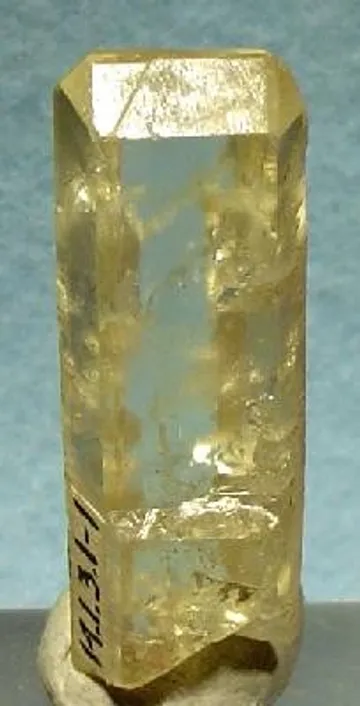
Quartz at Horní Slavkov is not just gangue; it is the structural stage on which many of the district’s classic specimens formed. Quartz occurs in greisen, quartz-topaz greisen, quartz-cassiterite and quartz-cassiterite-sulfide veins, and gneiss-hosted wall-rock veins; in the collector suite it carries cassiterite, fluorite, fluorapatite, chalcopyrite, sphalerite, scheelite, wolframite, and topaz. The strongest quartz specimens are cabinet pieces with odd growth histories—interrupted or capped crystals, smoky quartz, drusy cavities, and sharp colourless to smoky crystals hosting later cassiterite or fluorite. A good Horní Slavkov quartz specimen is valued less for isolated perfection than for paragenesis: lustrous quartz with sharp cassiterite twins, violet fluorite, scheelite, or sulfides tells the district’s story far better than plain massive vein quartz.
Chalcopyrite is a documented and attractive accessory in the Sn-W system rather than a bulk showpiece species. It occurs as impregnations with other sulfides in apical parts of the stocks, with sphalerite in the upper greisen of the Schnöd stock, in greisen at Huber with arsenopyrite and other sulfides, and as crystallized material in quartz veins within both granite stocks and the gneiss envelope. Compact chalcopyrite aggregates several centimetres long were recorded at the tenth and eighth levels of the Schnöd stock near the Kaiser shaft at about 500 m a.s.l., accompanied by quartz, sphalerite, bornite, tetrahedrite, and other minerals; workings around a ventilation shaft exposed massive decimetre-scale chalcopyrite aggregates with sphalerite and cassiterite, probably belonging to the Ondřejská vein. Fine specimens show bright brassy crystals, often 0.5–1 cm, with purple fluorite, quartz, cassiterite, fluorapatite, chalcedony, wolframite, or sphalerite; many crystals are small and some are coated by blue to blue-violet covellite, so sharp, fresh, well-associated examples are much scarcer than the species list might suggest.
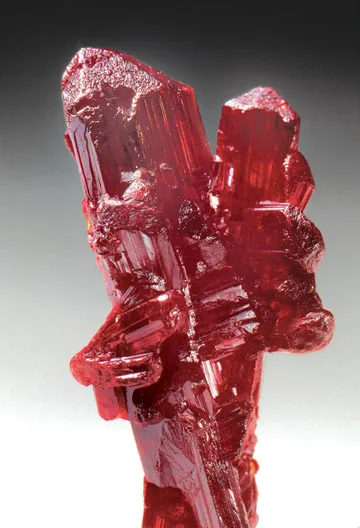
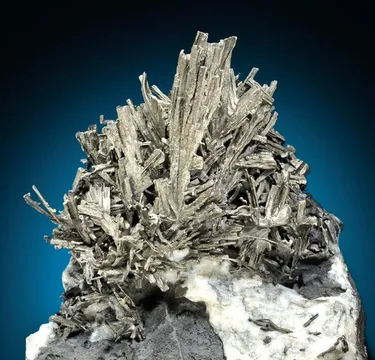
Beyond these four headline species, Horní Slavkov is a collector’s mine of secondary and accessory minerals. The district has produced superb fluorapatite, topaz, hübnerite, wolframite, scheelite, molybdenite, arsenopyrite, sphalerite, rhodochrosite, bismuth minerals, and an extensive phosphate assemblage. Carpholite has special historical weight: the species was first described from Schlaggenwald, and in the Schnöd stock it occurs as fibrous to radiating aggregates and veinlets in altered greisen, with exceptional acicular crystals to about 4 cm reported from the Kaiser shaft 500 m level. The later uranium district adds uraninite, autunite, torbernite, zeunerite, uranophane, sodiumuranospinite, compreignacite, carnotite, and related supergene species. Slavkovite, Cu13(AsO4)6(AsO3OH)4·23H2O, was described from Horní Slavkov and Jáchymov material and named for the Slavkov occurrence; the broader Krásno–Horní Slavkov area also became a proving ground for new or poorly understood phosphate phases, including benyacarite, natrodufrénite, morinite, phosphosiderite, rockbridgeite, strengite, triplite, and bendadaite-bearing assemblages.
Horní Slavkov specimens are most often judged by label integrity, paragenesis, and matrix. Old German names—Schlaggenwald for Horní Slavkov and Schönfeld for Krásno—are expected on antique labels, and are often more desirable than modern simplified labels. Problems arise when specimens from the wider district are collapsed into “Horní Slavkov” without specifying Huber stock, Schnöd stock, Krásno, the Stannum mine, or the uranium district. For general display that may be acceptable, but for serious cataloguing, those sublocalities matter.
The main authenticity issue is not a flood of documented fakes but loose locality attribution. Cassiterite twins from Horní Slavkov can be confused with material from Cornwall, Saxony, Portugal, Bolivia, or Minas Gerais if labels are missing. Classic Horní Slavkov cassiterite tends to show dark brown to black twinned crystals in greisen or quartz, often with muscovite or zinnwaldite and sometimes fluorite, fluorapatite, topaz, or sulfides. Large, sharply twinned, undamaged crystals deserve extra scrutiny because the locality is famous enough to invite optimistic relabelling. A credible old label, matching matrix, and a history through a European collection add real value.
Condition is a major grading factor. Cassiterite is hard, but the large twins commonly have bruised terminations, contacted backs, clay-filled recesses, and partly dulled faces. Fluorite is much more vulnerable: edge wear, cleaved corners, broken cubes, and scratched faces are common on old specimens. Slight damage may be accepted on antique fluorite or cassiterite from Schlaggenwald, especially where the piece has early labels, but modern pricing still strongly favours sharp, isolated crystals and lively lustre. Chalcopyrite may tarnish or carry covellite coatings; those blue-violet coatings can be natural to the district, so they should not automatically be treated as damage or artificial colour.
Fluorescence is not usually the reason to buy Horní Slavkov fluorite, though individual pieces may respond modestly under UV. Scheelite-bearing quartz is a better target for UV interest, and any suspected scheelite should be tested gently with shortwave UV if available. Uranium-district specimens require normal radioactive-mineral discipline: keep them boxed, avoid dust, do not store them in living or sleeping areas, wash hands after handling, and be alert to fragile secondary crusts. Secondary uranium minerals and hydrated arsenates can be physically delicate and may suffer from changes in humidity.
Market availability is uneven. Small cassiterite, fluorite, quartz, and mixed greisen specimens appear regularly from old Czech and German collections, but top-tier cassiterite twins, deep-purple fluorite with strong aesthetics, fine chalcopyrite-fluorite pieces, and documented old-label specimens are much less common. The best Horní Slavkov specimens carry a premium because they combine classic European pedigree, closed-mine status, and mineralogical importance.
The old mines at Huber and Schnöd were not tidy modern tunnels following a neat engineer’s plan. The early workings were a labyrinth made by generations of miners chasing greisen and vein ore through a granite cupola. By about 1550 the district had moved toward a more unified concept of mining, but before that the Huber and Schnöd stocks were worked by shafts, inclines, galleries, and chambers that must have looked more like an underground quarry than a modern mine. Some chambers at Huber and Čistá reached 30–40 m long, 10–20 m wide, and 15–20 m high. In places, miners worked with fire at the tunnel face to break the rock, then used hammers, wedges, and crowbars. A single miner could advance only 25–30 cm of rock per week, or 40–45 cm under favourable conditions; in tight adits as little as 30 cm per week was typical.
The district’s hunger for water and wood shaped the landscape almost as much as the ore itself. Pumps were powered by water wheels 3 to 14.5 m in diameter, and the wheels could drive pumping systems with capacities up to 1,000 cubic metres per week. By the end of the 14th century, a channel from the Rota River had been constructed; in 1531–1536 a new channel, the Dlouhá stoka, was put into operation. Later it was connected to five large ponds and thirteen smaller reservoirs with a total capacity of 630,000 cubic metres. Timber demand was just as dramatic. Early extensive tin mining consumed wood equivalent to about 300 hectares of forest per year, and by the end of the 16th century wood was being hauled to Horní Slavkov from distances of 30 km.
One of the most striking episodes in the mining history came in 1568, when a major collapse of underground workings occurred in the Huber stock, followed shortly by a similar disaster in the Schnöd stock. The consequences were felt above ground, with damage reported even to public buildings in Horní Slavkov. The collapse was not a small accident in a single stope; it was the surface expression of centuries of aggressive mining inside a granite high. The funnel-like open pit now associated with the Huber stock owes much of its character to that history of underground extraction and subsequent failure.
The Pluhova adit reads almost like a spine through the district’s mining history. It was important because it linked older workings and remained useful long after its original tin-mining context. By 1587, after 48 years of uninterrupted work, it had reached 3,393 m; by 1655 it had reached 5,920 m, with its face 117 m below the surface. It had seven crosscuts, thirteen light wells, and four shafts, and it later served drainage needs during the uranium period. For a locality guide aimed at collectors, that matters because it explains why specimens from apparently separate parts of the district can share deep physical and historical connections.
The 20th-century uranium episode is the district’s hardest story. After the Second World War, uranium became strategically urgent, and Horní Slavkov was rapidly developed because the geological situation was already well known from older mining. From 1948 into the early 1960s, the uranium district was driven at speed: 26 shafts and 30 galleries were excavated in a relatively small area, with over 5,000 m of shafts, about 135 km of cross drifts, and more than 227 km of adits or galleries following veins. A total of 111 uranium-bearing veins were included under the economic standards of the time, and the operation yielded 2,668 tonnes of uranium. The work force included prisoners of war in the first stage and then political prisoners; camps near the shafts supplied labour directly to the mines. The landscape scars—dumps, caved-in areas, altered drainage, destroyed ponds, and disrupted historic workings—are part of the same history as the rare uranium minerals now preserved in collections.
Pavel Beran & Jiří Sejkora, “The Krásno Sn-W ore district near Horní Slavkov: Mining history, geological and mineralogical characteristics,” Journal of the Czech Geological Society 51(1–2), 3–42, 2006. The essential modern locality paper for geology, mining history, deposit descriptions, and the classic specimen minerals of the Krásno–Horní Slavkov district.
Full PDF of Beran & Sejkora, 2006. Includes figures of classic cassiterite, fluorite, chalcopyrite, carpholite, and historical mine maps and workings.
Jakub Plášil, Jiří Sejkora, Petr Ondruš, František Veselovský, Pavel Beran & Viktor Goliáš, “Supergene minerals in the Horní Slavkov uranium ore district, Czech Republic,” Journal of the Czech Geological Society 51(1–2), 149–158, 2006. The key published treatment of secondary uranium minerals and postwar uranium workings at Horní Slavkov.
Jiří Sejkora, Radek Škoda & Petr Ondruš, “New naturally occurring mineral phases from the Krásno - Horní Slavkov area, western Bohemia, Czech Republic,” Journal of the Czech Geological Society 51(1–2), 159–187, 2006. Describes eleven probably new natural phases, mainly supergene phosphates, from the Krásno–Horní Slavkov area.
Jiří Sejkora, Jakub Plášil, Petr Ondruš, František Veselovský, Ivana Císařová & Jan Hloušek, “Slavkovite, Cu13(AsO4)6(AsO3OH)4·23H2O, a new mineral species from Horní Slavkov and Jáchymov, Czech Republic: description and crystal-structure determination,” The Canadian Mineralogist 48, 1157–1170, 2010. Formal description of slavkovite and its crystal structure.
Martin Šťastný & Miloš René, “Argillization of topaz-bearing granites in the Hub stock, Horní Slavkov–Krásno Sn–W ore district (Bohemian Massif, Czech Republic),” Acta Geodynamica et Geomaterialia 11(3), 255–267, 2014. Focused study of clay alteration in the Hub stock, including dickite, illite, tosudite, and smectite assemblages.
Miloš René, “Development of greisenization at the Horní Slavkov Sn-W deposit (Bohemian Massif).” Useful concise summary of the granite cupola setting and greisenization controls.
Jiří Sejkora, Jaromír Tvrdý, Jiří Čejka, Luboš Vrtiška & Zdeněk Dolníček, “Bendadaite from Krásno near Horní Slavkov (Czech Republic), description and Raman spectroscopy,” Bulletin Mineralogie Petrologie 27(1), 63–68, 2019. Documents bendadaite from the Krásno–Horní Slavkov area and its spectroscopic characteristics.
Mindat: Horní Slavkov, Sokolov District, Karlovy Vary Region, Czech Republic — Broad locality entry with mineral list, photos, sublocalities, and historical name Schlaggenwald.
Mindat: Horní Slavkov uranium ore district — Focused entry for the uranium district and its secondary uranium-mineral suite.
Mindat: Stannum mine, Huber stock, Krásno — Useful for the modern mine locality tied to the Huber stock and postwar Sn-W production.
Czech Geological Survey: Horní Slavkov - Huberův peň — Official geological-locality page for the Huber stock collapse/open-pit feature and protected deposit context.
Town of Horní Slavkov: About the City — Local historical overview with mining-town status, tin output, the mint, the Pluh adit, Stannum closure, and uranium-mining legacy.
Geopark Karlovy Vary: Krásno-Hubský peň a Hornické muzeum — Regional geological and mining-tourism context for the Hub stock and Krásno mining museum.
Wikimedia Commons: Minerals of Horní Slavkov — Open-image category with cassiterite, fluorite, quartz, scheelite, topaz, and wolframite photographs from the locality.
Wikimedia Commons: Cassiterite and quartz from Horní Slavkov — Large photo set of cassiterite-quartz specimens useful for studying matrix, habit, and display character.