






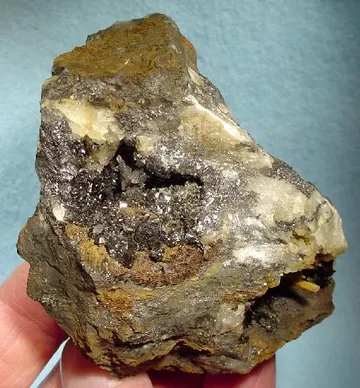
Soudan Mine, USA - premier Vermilion Range locality, bluish hematite with quartz-filled vugs, historic Minnesota iron-ore site prized by collectors.
Key facts
Soudan is one of the essential American iron-ore localities: not a broad, soft, open-pit Mesabi deposit, but a deep Vermilion Range mine driven through hard Neoarchean iron formation and greenstone on the south side of Lake Vermilion in northeastern Minnesota. For collectors, its reputation rests on the contrast between massive, bluish-black, high-grade hematite ore and the vugs that opened along ore-body margins—small cavities lined with sharp quartz, red-stained quartz, specular hematite, chlorite, and occasional sulfides or copper minerals. The finest pieces have a distinctly Soudan look: dense iron-ore matrix, steel-gray hematite faces or coatings, and water-clear to reddish quartz prisms perched in tight cavities rather than the broad, open alpine-style plates seen from many quartz localities.
The mine’s geology is inseparable from its historical importance. The Soudan Iron-formation lies within the Archean Vermilion Greenstone Belt, where iron formation is interlayered with volcanic and volcaniclastic rocks of the Ely Greenstone. In the mine area, geologists described greenish-white chert rich in quartz, lean jasper, and jaspilite—banded quartz-hematite-magnetite or martite rock—as the principal iron-formation types. Later replacement concentrated the ore into hard, dense, bluish hematite bodies, commonly bounded by greenstone or schist. That replacement history matters to specimen collectors because the cavities most likely to yield quartz and hematite crystals were especially common near ore-body borders and in brecciated hematite cemented by quartz.
Historically, Soudan is the place where Minnesota’s iron-mining era began. Mining started in the early 1880s, ore shipments began in 1884, and the operation eventually followed steep ore bodies down to the 27th level, 2,341 feet below the surface. It became the state’s oldest and deepest iron mine, later preserved as a National Historic Landmark and then as part of Lake Vermilion-Soudan Underground Mine State Park. Collectors encounter Soudan today mostly through old miner-collected material, museum pieces, and specimens saved during the working life of the mine; the mine and surrounding state park are protected, and rock collecting is not permitted.
Regional View
Country View

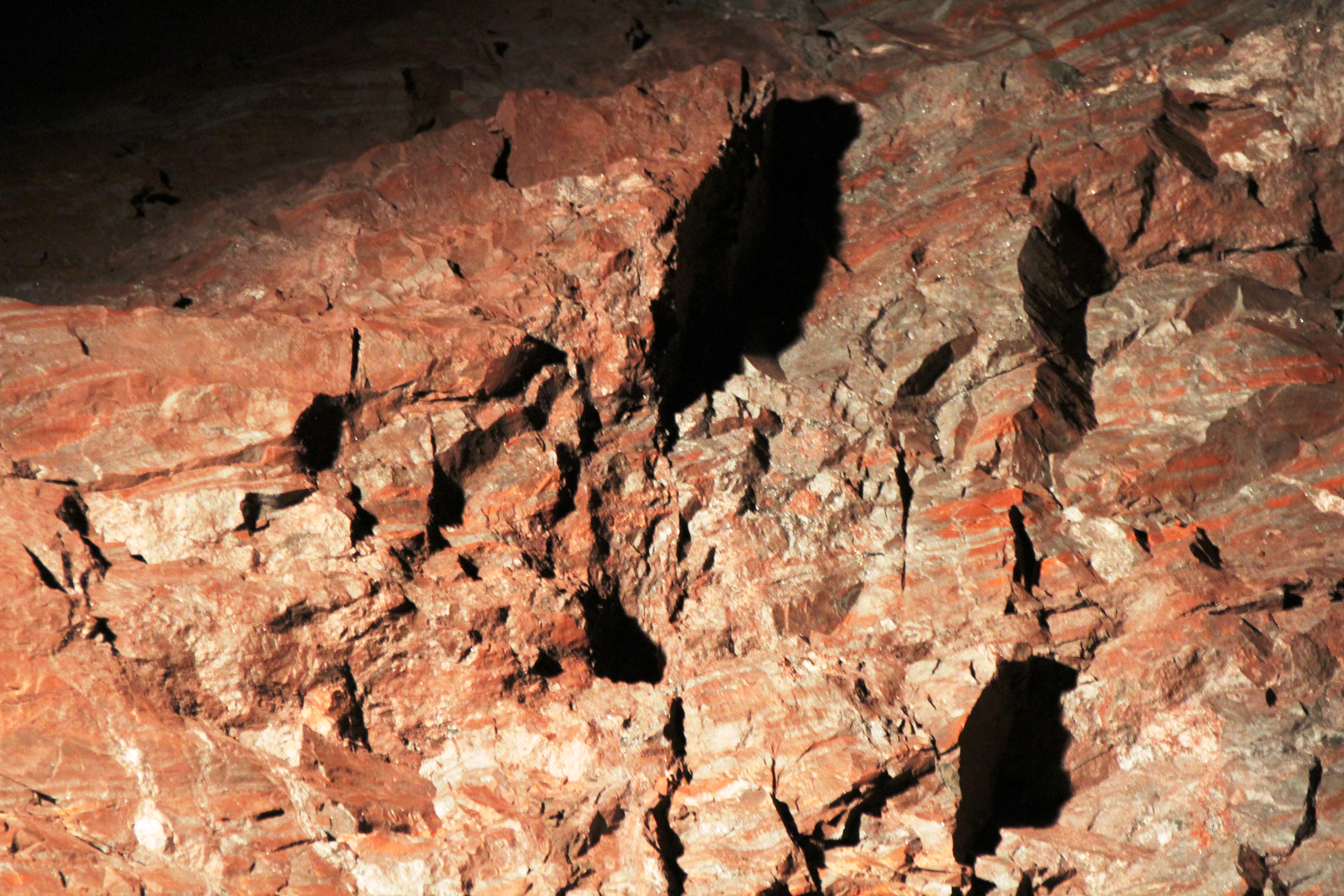
The specimen story is more selective than the mine’s industrial story. Soudan produced millions of tons of ore, but the mineral specimens sought by collectors came from comparatively small openings: quartz-lined vugs, hematite-coated cavities, ore-wall contacts, and rare copper-bearing pockets. A very good Soudan piece has three things at once: unmistakable dense hematite ore, undamaged quartz or hematite crystals, and a label tying it to the mine rather than merely to the broader Vermilion Range.
Search for specimens: View all specimens from Soudan Mine, USA
Soudan Mine is in the Vermilion Range of St. Louis County, northeastern Minnesota, near the town of Soudan and the south shore of Lake Vermilion. Geologically, it is part of the Archean Vermilion Greenstone Belt on the southern margin of the Canadian Shield. The mine exploited high-grade hematite ore bodies developed in the Soudan Iron-formation, a banded iron formation interlayered with volcanic and tuffaceous rocks assigned to the Ely Greenstone. In the mine district, the iron formation is not a simple flat-lying sheet; it is folded, steep, and structurally complex, with narrow beds and lenses of ferruginous chert, lean jasper, and jaspilite caught up with greenstone and schist.
The ore deposit is best understood as a hard, high-grade hematite replacement system localized in the iron formation. Classic descriptions of the mine emphasize dense bluish hematite ore, irregular ore-body outlines in the plane of the iron formation, and strong control by the width and position of jaspilite beds. At many places the hematite replaced the jaspilite from wall to wall, leaving greenstone as the footwall or hanging wall. Elsewhere, ore gave way into jaspilite or schist. Quartz cemented brecciated ore locally, and crystal-lined vugs were common near ore-body margins; miners recognized these vugs as practical signs that an ore body was ending.
The mapped iron-formation types explain much of the specimen assemblage. Greenish-white chert is principally quartz with minor chlorite and pyrite. Lean jasper consists chiefly of quartz and hematite with martite or magnetite and generally has less than 20 percent iron. Jaspilite is a banded rock of quartz, jasper, hematite, and martite or magnetite, averaging somewhat more than 30 percent iron in published descriptions. The commercial ore, however, was much richer: hard, massive hematite that made Soudan famous as a lump-ore mine. Minor minerals recorded in and around the ore include quartz, chlorite, sericite, kaolinite, chalcopyrite, pyrite, native copper, cuprite, bornite, brochantite, siderite, dolomite, and other late or accessory phases.
Mining began as surface work. The Minnesota Iron Company opened the site in the early 1880s with open pits where ore was close to the surface. As the pits deepened and the steep ore columns were followed downward, the operation shifted underground for safety and efficiency; by the 1890s it was essentially an underground mine. The Duluth and Iron Range Railway reached the mine on July 30, 1884, and the first shipment of nearly 3,000 tons left the following day for Agate Bay, now Two Harbors, before being loaded onto Great Lakes steamers bound for Cleveland. Operators changed over time: the Minnesota Iron Company gave way to New York investors, the Oliver Iron Mining Company, and ultimately U.S. Steel ownership through Oliver.
Production was long-lived and historically consequential. Soudan shipped ore from 1884 until closure on December 15, 1962, with more than fifteen million tons shipped over the life of the mine. Its peak year was 1892, when 568,471 tons of ore were shipped. The mine ultimately reached twenty-seven levels and a working depth of 2,341 feet. Although expensive to mine, the ore had special metallurgical value: its high oxygen content made it useful in steelmaking, especially as a blending or furnace charge component for improving the behavior of lower-oxygen ores. Changing steelmaking technology, competition from open-pit operations, and the economics of taconite helped end production.
After closure, U.S. Steel donated the mine and surrounding land to the State of Minnesota in 1963. The property became Tower-Soudan State Park, later Soudan Underground Mine State Park, and today is part of Lake Vermilion-Soudan Underground Mine State Park. The site is a National Historic Landmark, preserving Shaft No. 8, the headframe, engine house, crusher house, drill shop, machine shop, open pits, ore trestle, stockpile, underground drifts, and other mine features. Public underground tours descend to the 27th level, then travel by train into the last and deepest mining area, including the Montana stope. As of the 2026 season, underground tours resumed after June 2024 flooding and subsequent cleanup and repairs, but specimen collecting remains prohibited under state-park rules.
The most collectible Soudan mineral specimens came from underground vugs and ore contacts, not from bulk ore production. Old accounts and specimen labels point repeatedly to quartz-lined cavities in hematite, red hematite-stained quartz, small specular hematite crystals, chloritic wall-rock pieces, pyrite, and occasional copper minerals. A particularly interesting historical note records native copper with hematite specimens bought from a miner in the early 1960s, near the end of mine life. Such pieces are scarce because underground collecting was incidental to mining, later access became regulated, and the site is now preserved rather than worked.
Hematite is the mineral that defines Soudan: the mine’s commercial ore was mainly hard, dense, bluish to black hematite, and the collectible specimens range from massive ore with bright vugs to small, sharp, silvery metallic hematite crystals on altered iron-ore matrix. The best pieces show crisp specular hematite faces or lustrous coatings associated with quartz rather than merely heavy, massive ore; ordinary examples are dense and historically interesting but lack open crystal surfaces. In vugs near ore-body borders, hematite may appear as sparkling linings, inclusions in quartz, or reddish staining toward quartz terminations, giving Soudan specimens their characteristic iron-red and steel-gray contrast.
Quartz is Soudan’s most important specimen-forming gangue mineral, occurring as clear, milky, smoky, or hematite-reddened prisms lining vugs in the hematite ore and iron formation. Collectors prize clusters where sharp quartz crystals sit directly on dense hematite matrix, especially when the crystals are transparent and show internal red hematite inclusions or red-stained terminations; documented specimens include pieces about hand size with crystals in the centimeter range, while many examples are smaller vug sections. Quartz also occurs as chert and jasper in the iron formation, but the display-quality material is the open-space vug quartz that records the late stages of ore replacement and breccia cementation.
Chlorite at Soudan is chiefly a wall-rock and alteration mineral rather than a showy crystal species: it occurs in green to dark-green chloritic schists, chlorite-sericite schists, and as fine folia or coatings associated with quartz, hematite, and shear-zone rocks on the underground levels. The most meaningful chlorite specimens from this locality are those with strong geologic context—yellowish-green to dark-green schistose pieces from the 27th-level shear-zone assemblage, or hematite-bearing chloritic material near ore contacts—rather than isolated chlorite masses. Good collector examples preserve the foliated texture, contrast with quartz eyes or hematite inclusions, and retain reliable labels linking them to Soudan’s ore-zone alteration.
Pyrite is a minor but persistent Soudan mineral, noted in greenish-white chert, local iron-formation beds, and some ore-related assemblages with quartz, chlorite, hematite, and rare copper minerals. It is not the locality’s aesthetic centerpiece, and most pieces are small grains, disseminations, or modest crystals rather than large freestanding cubes, but pyrite is important because it helps mark reduced or sulfide-bearing portions of the iron formation and late fracture assemblages. The better Soudan pyrite specimens are those showing fresh brassy sulfide in direct association with hematite ore or quartz-lined cavities; weathered material may lose contrast quickly and is less desirable.
Other documented Soudan minerals include magnetite and martite in the banded iron formation, goethite as an oxidation product, dolomite and siderite in vugs or carbonate-bearing zones, chalcopyrite and other copper sulfides in minor ore impurities, and secondary copper minerals including native copper, cuprite, malachite, azurite, brochantite, and probably bornite in copper-bearing pockets. Smoky quartz is specifically recorded from the mine, and kaolinite has been described along fractures and in vugs near ore. No valid mineral species is widely established as having Soudan Mine itself as its type locality, but the mine area is a defining reference locality for the Soudan Iron-formation and for the mineralogy of high-grade Archean hematite ore in Minnesota.
Soudan specimens should be judged first by label quality. The name is sometimes used loosely for Vermilion Range banded iron formation, polished jasper-hematite material, or tourist pieces from the broader Lake Vermilion area. A collectible Soudan Mine specimen should be labeled specifically to Soudan Mine, Soudan, Vermilion Range, St. Louis County, Minnesota, ideally with an old collection, miner provenance, or a note tying it to an underground find. “Soudan Iron Formation” on a label is not automatically the same thing as a mine specimen; it may refer to surface jaspilite outcrops in the park or surrounding area.
No well-documented, locality-specific fake industry is associated with Soudan specimens, but mislabeling and enhancement are the practical concerns. Hematite-stained quartz from Soudan has a natural red color that can be confused with iron-oxide stained quartz from many iron mines, Lake Superior iron ranges, or even artificially iron-stained quartz from unrelated localities. Clean, sharp quartz on massive hematite matrix is plausible for Soudan; loose quartz clusters without iron-ore matrix require stronger provenance. Polished jaspilite slabs are attractive and geologically authentic to the district, but they should not be sold as crystal specimens unless they actually show collectible mineral growth.
Condition issues are typical of hard iron-ore vug material. Quartz points are easily bruised at terminations, and red hematite staining can make small chips difficult to see in photographs. Specular hematite surfaces may show rubbing, edge wear, or dulling from handling because dense ore specimens were often saved as mine curios rather than wrapped as delicate mineral specimens. Pyrite-bearing pieces should be kept dry and watched for instability, especially if they come from sulfide-rich fractures rather than massive dry ore. Soudan’s dense hematite pieces can be unexpectedly heavy for their size; cabinets and shipping boxes should be planned accordingly.
Fluorescence is not a major collecting feature at Soudan. The primary appeal is visual and historical: deep-mine hematite, red quartz, and the association with Minnesota’s first great iron mine. Market availability is limited but not impossibly rare. Small hematite-quartz specimens appear occasionally from old collections, while better vug sections with undamaged quartz and bright specular hematite are much harder to replace. Native copper with hematite and well-labeled early-1960s miner material should be treated as especially desirable. Collecting at the present state park is not allowed; modern Soudan pieces on the market should therefore be understood as old-stock, legally deaccessioned, or collection-circulated material rather than newly field-collected specimens.
The Soudan story begins with logistics as much as geology. Charlemagne Tower and the Minnesota Iron Company were working at the edge of settlement, and the mine could not become a mine in the modern sense until iron could get from a ridge near Lake Vermilion to Lake Superior. Supplies such as sawmill machinery and steam boilers were hauled by oxen and on foot from Duluth to Lake Vermilion and then to Soudan along the Vermilion Trail, a roughly 100-mile route associated with the earlier Lake Vermilion gold rush. At the same time, about 1,400 laborers were put to work building the Duluth and Iron Range Railway from Lake Vermilion to Agate Bay. When the railroad finally reached the mine on July 30, 1884, ore was ready: nearly 3,000 tons left the next day, then went by steamer—on the Ironton and Hecla—across the Great Lakes to Cleveland.
The mine’s name carries one of the better pieces of Iron Range folklore. In 1883, George Stone hired Elisha Morcom, a Cornish-born mining man by family tradition and experience, to captain the Minnesota Mine. Morcom recruited experienced miners from Michigan’s Menominee Range; by early 1884, about 350 men, women, and children had signed on for the move, and the workforce grew to about 500 as the first shipment was prepared. The climate on the exposed, clear-cut mine hill could be bitter in winter and brutally hot in sun, and one version of the story has Morcom jokingly calling the place “Sudan” after the African region. The spelling shifted to Soudan, but the name stayed.
The working mine earned an unusually polished nickname: “The Cadillac of Mines.” That was not because it was easy work, but because Soudan’s hard ore and stable rock allowed underground rooms and stopes with less bracing than many iron mines, and because wages were remembered as better than those at neighboring operations. The ore bodies descended steeply, almost like columns, and miners followed them downward level after level until the mine reached nearly 2,500 feet in overall excavations and the public tour route’s 27th level at 2,341 feet. In 1892, at peak production, Soudan shipped 568,471 tons of ore and employed a large workforce. Its ore was valuable enough that hard underground mining remained worthwhile for decades after easier surface ores were known elsewhere.
The mine also built a town around itself. Soudan began as a company settlement, with the mining company and community deeply entwined. The company built houses, a hospital, a community center, wells, and other infrastructure; Tower, the nearby independent village, became a service center for the mine and its workers. One later reminiscence described the company clubhouse plainly: it gave miners a place to play pool and relax, and it kept them out of saloons. The social life, the ore trains, the pits, the headframe, and the underground workings were all part of the same organism.
Closure came in 1962, not because the mine lacked every ton of ore, but because the world around it had changed. Oxygen-rich Soudan hematite had once been especially useful in furnace practice, yet steelmaking technology and taconite mining altered the economics. Miners transferred to other Iron Range operations—Pioneer at Ely, Reserve Mining at Babbitt, Erie at Hoyt Lakes, and Minntac at Mountain Iron. U.S. Steel donated the mine and about 1,000 acres to Minnesota in 1963, and the site’s second life began almost immediately. Instead of disappearing into flooded silence, Soudan became a state park and a preserved underground classroom.
That second life took an unexpected turn toward particle physics. Beginning in the late 1970s and 1980s, the depth and ancient low-radioactivity rock that had made Soudan such a challenging mine made it an attractive underground laboratory. Experiments such as Soudan 2, CDMS II, and MINOS used the mine’s shielding from cosmic rays to study rare particle interactions deep below the Minnesota woods. It is a remarkable juxtaposition: hematite ore mined by Cornish and immigrant iron miners, followed decades later by detectors searching for proton decay, dark matter, and neutrino behavior.
The modern tour has its own industrial drama. After closures related to the COVID-19 pandemic and major shaft work, the 2023 renovation required replacement of concrete shaft lining and 85-year-old structural steel in a dark, narrow shaft where the old cage remained the key transport. A steel fabrication plant and concrete plant were erected on site. Hoist operators kept work moving around the clock. Crews removed 866 cubic yards of rock and debris and 40,000 square feet of concrete and corrugated steel lining, while 2,000-pound steel beams and tons of concrete went down load by load in the same 5-by-6½-foot cage that visitors ride. Then flooding in June 2024 closed the underground tours through the 2024 and 2025 seasons, making the 2026 reopening another chapter in the mine’s long habit of surviving changes in technology, water, and economics.
_55_(18602978984).jpg)
