






Sierra County, USA - diverse mineralizing systems yield rare collector specimens from Hillsboro and Lake Valley, including ramsdellite, fluorite, and wulfenite.
Key facts
For mineral collectors, “Sierra County, USA” means Sierra County, New Mexico: a rugged, historically rich slice of the southern Rio Grande rift and Black Range country where small but unusually diverse deposits crowd into a compact area. Its collector reputation rests on several very different mineralizing systems rather than on one single mine: Laramide porphyry copper and radiating gold-silver-copper veins at Hillsboro and Copper Flat; carbonate-hosted silver-manganese replacements at Lake Valley; skarn and contact-metasomatic assemblages in the Iron Mountain and Cuchillo Negro areas; fluorite-barite-galena vein systems; and the unusual tin-bearing rhyolites of the Black Range. The result is a county list that swings from native gold and vein quartz through fluorite, wulfenite, vanadinite, willemite, descloizite, helvine-group minerals, manganese oxides, zeolites, and uncommon manganese silicates.
The great specimen name here is ramsdellite from Lake Valley, the type locality for the species. The best pieces are not anonymous black ore: they show lustrous steel-gray to black, radiating, acicular to prismatic MnO2 crystals, commonly in small thumbnails and miniatures, with the sparkle and crystal definition that make a difficult oxide species visually satisfying. Lake Valley also anchors the county’s mining mythology through the Bridal Chamber, the extraordinarily rich silver-chloride ore pocket that made the camp famous in the early 1880s. Hillsboro supplies the gold story, especially placer gold derived from the erosion of Laramide porphyry and vein systems around Copper Flat, while the Black Knife group in the Cuchillo Negro district has become a modern collector name for quartz pseudomorphs after calcite, green fluorite, mottramite-coated pieces, and rare, manganese-bearing oddities.
Regional View
Country View
The county is not a place of enormous, open, modern specimen mines. Its best minerals are tied to old workings, dumps, weathered replacement pods, narrow fissures, oxidized stopes, and collector-scale releases from long-quiet properties. Provenance matters. A ramsdellite label reading only “Sierra County” is usually trying to say Lake Valley; a quartz pseudomorph with green fluorite and dark vanadate coatings usually belongs in the Black Knife–Prospectors Delight part of Cuchillo Negro; gold should be separated between Hillsboro placer material and true gold-in-quartz lode material. The finest specimens are therefore as much about locality precision as mineral beauty.


Search for specimens: View all specimens from Sierra County, USA
Sierra County’s specimen mineralogy is best understood district by district. The Hillsboro district, in the Animas Mountains, centers on the Copper Flat quartz monzonite porphyry and breccia-pipe system. The porphyry is Laramide in age, with a quartz monzonite stock and related latite to quartz-latite dikes intruding Cretaceous andesites and Paleozoic sedimentary rocks. Around this central intrusive body, polymetallic veins radiate outward, and more distal carbonate-hosted replacement deposits occupy favorable limestone and dolomite horizons. This zoning is critical to reading specimens: copper-molybdenum-gold-silver material belongs near the porphyry center, gold-silver-copper veins follow dikes and fractures, and lead-zinc-barium-vanadium-manganese assemblages are more likely in the outer carbonate replacement environment.
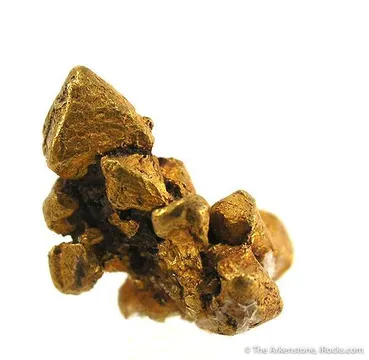
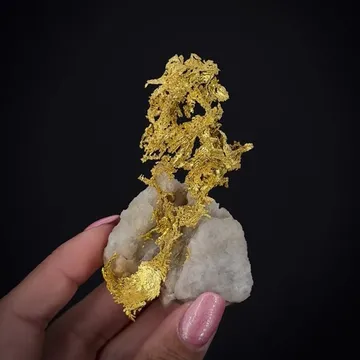
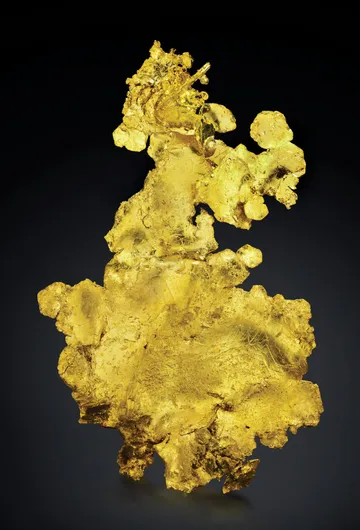
Gold production in the county is historically tied most strongly to Hillsboro and the Las Animas placer district. The placer fields occupy dissected alluvial fans and gulches draining the Copper Flat area and its radiating vein systems. The gold was mechanically weathered from porphyry and vein sources and concentrated in multiple gravel units ranging from Miocene to Holocene age. Serious specimen gold from the county is therefore usually either placer gold, with the naturally worn surfaces expected of transported material, or rarer lode gold in quartz from vein systems where gold occurs with sulfides such as pyrite, chalcopyrite, and bornite.
Lake Valley is a very different environment: carbonate-hosted silver-manganese mineralization in Paleozoic limestone, famous above all for oxidized silver ore and later manganese mining. The celebrated silver pockets were dominated by silver chlorides and bromides, especially chlorargyrite in the old terminology. Later interest in manganese brought attention to the black oxide assemblages, and Lake Valley became the type locality for ramsdellite. For collectors, the important distinction is that Lake Valley manganese specimens can look superficially similar—pyrolusite, “psilomelane”-type material, romanechite-like botryoids, and ramsdellite may all present as black oxides—so crystal habit, provenance, and analytical confirmation carry real weight.
The Cuchillo Negro district lies in the Sierra Cuchillo, where Paleozoic carbonate rocks were intruded by quartz monzonite and rhyolite-related bodies. Much of the historic ore was contact-metasomatic or replacement mineralization in limestone near intrusive contacts and fractures. The Black Knife group is especially relevant to collectors because it has produced attractive quartz pseudomorphs after calcite, commonly with calcite, mint-green fluorite, and dark to yellow-green vanadate coatings historically called mottramite. The best pieces show sharp scalenohedral calcite forms preserved by a quartz crust, with exposed hollow interiors revealing repeated episodes of quartz coating and later dissolution or partial preservation of the original calcite.
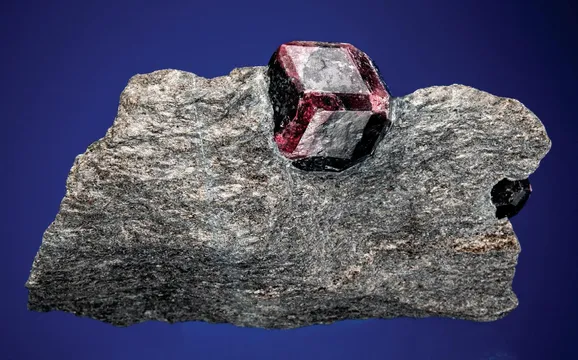
The Iron Mountain No. 2 district adds a skarn chapter to the county. Its mineral list includes garnet-epidote-clinozoisite-vesuvianite-magnetite-scheelite-willemite-fluorite associations, and it is one of the areas that makes Sierra County more than a precious-metal locality. The county also includes rhyolite-hosted tin occurrences in the Taylor Creek area of the Black Range, important in mineralogical literature for bixbyite and pseudobrookite from tin-bearing rhyolite. These occurrences are not usually represented by showy cabinet specimens, but they matter to systematic collectors because they broaden the county’s mineralogical personality well beyond gold and silver.
Mining history begins with late-1870s discoveries and accelerates through the early 1880s. Hillsboro grew after gold discoveries in 1877; Lake Valley followed as a silver camp, with its richest and most famous moment in 1881–1882; many districts were then hit hard by the 1893 collapse in silver prices. Manganese mining revived parts of Lake Valley in the twentieth century, especially around wartime demand, and activity continued intermittently into the 1950s. Copper Flat saw modern exploration and development interest because of its porphyry copper resource, but specimen collecting there is not comparable to the old-time open collecting of mine dumps and small prospects.
Access today is a matter of land status and hazard awareness, not romance. Some historic areas are on public land, some are private, some are patented or actively claimed, and some are protected cultural resources. Lake Valley Historic Townsite is managed as a historic site; visitors may tour stabilized buildings and walk interpretive routes, but artifact collecting and metal detecting are not permitted there. Old mines, stopes, shafts, and dumps elsewhere in the county should be treated as potentially dangerous, and collecting should be done only where access is legal and permission is explicit.
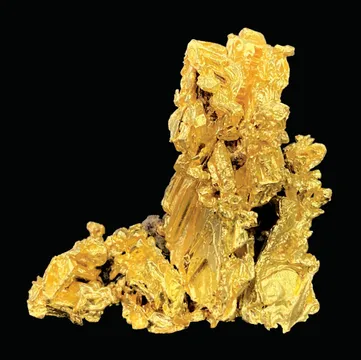
Gold from Sierra County is most convincingly tied to the Hillsboro–Las Animas system, where eroded Laramide porphyry and vein deposits fed placer gravels in gulches radiating from Copper Flat, and where lode gold occurred in quartz veins and pay streaks with pyrite, chalcopyrite, bornite, silver, and locally telluride minerals. Typical collector pieces are small placer grains, flakes, or nuggets with naturally rounded forms, while the more desirable specimens show gold visibly seated in white to gray quartz rather than merely enclosed in massive ore. Better Sierra County gold has strong contrast, clear native-metal identity, and a label that distinguishes placer gold from lode gold-in-quartz; ordinary material is often small, flattened, waterworn, or too sparsely disseminated in quartz to make an aesthetic specimen.
Quartz is the county’s great recorder of hydrothermal activity: it occurs as vein quartz in the Hillsboro gold-silver-copper system, as white to amethystine quartz in precious-metal fissures, as silicification in carbonate replacement settings, and as the crisp pseudomorphic shell that preserves calcite forms at the Black Knife group. The most distinctive Sierra County quartz specimens for collectors are not generic points but quartz-after-calcite pieces: sharp scalenohedral forms, sometimes hollow or broken open to reveal the earlier calcite core or cavity, and commonly accompanied by calcite, fluorite, or mottramite-like coatings. Fine pieces have complete geometry, minimal peripheral breakage, attractive white-to-gray druse or transparent microcrystals, and, when present, a clean accent of mint-green fluorite; lesser examples are iron-stained, bruised, or too incomplete to show the original calcite habit.
Laumontite is a minor and decidedly specialist Sierra County species rather than one of the county’s famous showpiece minerals, and labels should be read carefully because New Mexico’s zeolite literature more often highlights analcime and related cavity minerals from volcanic and rift-associated settings. Sierra County laumontite specimens encountered in collector circulation are expected to be pale cream to white, prismatic to bladed, fragile zeolite crystals or sprays on altered fracture surfaces with quartz and calcite rather than large freestanding crystals. The best examples are those that remain lustrous, sharp, and intact, with no chalky dehydration crust; ordinary examples are friable, partly powdered, or so visually similar to other white zeolites that an old label alone is not enough for a rigorous systematic collection.
Ramsdellite is the county’s essential type-locality mineral: Lake Valley material introduced collectors and mineralogists to orthorhombic MnO2 as a distinct species, and the best specimens remain among the most desirable U.S. examples. Lake Valley ramsdellite is black to steel-gray, metallic to submetallic, and occurs as radiating acicular aggregates, bladed sprays, short prismatic crystals, and crusts on manganese-oxide matrix; thumbnails and small miniatures are the norm, though individual crystals on exceptional pieces may be unusually large for the species. The finest specimens show bright, directional luster and recognizable crystals rather than dull massive oxide, and they should be separated from pyrolusite, “polianite,” and mixed manganese-oxide material unless the habit and provenance are convincing or the species has been analytically checked.
Inesite from Sierra County is a rare, collector-level manganese silicate associated with the Black Knife group in the Cuchillo Negro district, where lead-copper-silver-zinc replacement and contact-metasomatic mineralization developed in limestone near porphyry contacts and fracture zones. Inesite is expected here as small pink to rose, fibrous, bladed, or sheaflike aggregates rather than large display crystals, and its significance is amplified by the manganese-rich, quartz-calcite-fluorite-vanadate context of the district. Good specimens must show definite pink inesite with clean contrast and believable association; ordinary or questionable pieces are easy to confuse with other pale manganese silicates or stained fibrous material, so a precise Black Knife provenance and, ideally, analytical confirmation add real value.
Other documented Sierra County minerals make the locality unusually rewarding for systematic collectors. Lake Valley contributes native silver, chlorargyrite, bromargyrite, pyrolusite, and manganese-oxide assemblages alongside ramsdellite. Hillsboro and Copper Flat add chalcopyrite, bornite, molybdenite, pyrite, sphalerite, galena, telluride-bearing precious-metal associations, and oxidized copper species. The Black Knife and related Cuchillo Negro occurrences add galena, cerussite, anglesite, azurite, malachite, smithsonite, fluorite, calcite, quartz, mottramite-like coatings, and other vanadate-rich micro material. Iron Mountain No. 2 is important for skarn species such as andradite, epidote, clinozoisite, helvine-group minerals, magnetite, scheelite, vesuvianite, willemite, and fluorite, while the Black Range tin rhyolites are known in the literature for bixbyite and pseudobrookite.
Sierra County specimens demand careful locality control. “Sierra County, USA” is too broad for a serious label; the next line should normally identify Lake Valley, Hillsboro/Las Animas, Copper Flat, Black Knife group, Cuchillo Negro, Iron Mountain No. 2, Taylor Creek, or another precise district or mine. Without that, the mineral association may not make sense. Ramsdellite should be labeled as Lake Valley when possible, and gold should specify placer versus lode. Quartz pseudomorphs after calcite should distinguish Black Knife, Prospectors Delight, or the Mottramite Pocket where known.
The main authenticity problem is not elaborate fabrication but misidentification. Ramsdellite is easily confused with pyrolusite and other black manganese oxides; some Lake Valley material may be mixed, altered, or better described as pyrolusite after ramsdellite. Dealer labels using older names such as “polianite” should be treated historically rather than accepted as a modern species identification. At the Black Knife group, dark coatings on quartz-after-calcite specimens have often been called mottramite, but not every coating has been analyzed. Inesite should be considered a verification species unless the specimen has a strong provenance and convincing optical character.
Condition is especially important. Ramsdellite sprays and acicular crusts abrade easily; bright crystals can be dulled by handling, oil, or over-cleaning. Quartz pseudomorphs after calcite may be hollow, thin-walled, and naturally incomplete, so damage around exposed cavities is common. Fluorite from the Black Knife area is attractive but often contacted or chipped along octahedral edges. Laumontite requires extra care because it can dehydrate and become chalky; it should be kept away from prolonged heat, desiccation, and aggressive cleaning. Iron staining is common on older Black Knife quartz pieces, and while collectors sometimes clean such specimens, acid or chelating treatments can change the appearance of delicate coatings and associated calcite.
Market availability is uneven. Small Hillsboro placer-gold pieces and gold-in-quartz specimens appear periodically, but top-quality, well-labeled lode pieces are scarcer. Lake Valley ramsdellite remains obtainable, especially as older thumbnails and miniatures, but truly sharp, lustrous crystal groups are not common and command a premium among U.S. systematic collectors. Black Knife quartz-after-calcite and fluorite specimens have circulated more recently and are usually modestly priced unless unusually complete or aesthetic. Inesite and laumontite from Sierra County are specialist acquisitions: buy them for locality and species significance, not because they are visually comparable to the world’s best examples of those species.
Lake Valley’s great story begins with a room. In 1881, miners opened into the ore body that later became famous as the Bridal Chamber, a silver-rich cavity so spectacular that it turned a remote mining camp into a national mining sensation. Accounts differ on exactly how much silver the chamber produced, but contemporary and later sources agree on the essential facts: this was not an ordinary vein. The ore pocket consisted of silver chlorides and bromides, chiefly chlorargyrite in the old terminology, and parts of the chamber were described as a couple of hundred feet long and about 25 feet thick. Assays as high as 20,000 ounces of silver per short ton were reported, and the largest exhibition sample—a 640-pound mass of chlorargyrite—was sent to the National Mining Exposition in Denver in 1882.
The human cast around the discovery has the texture of frontier mining promotion. The district was associated early with Mr. McEverts, a rancher; George W. Lufkin; Chris Watson; and John A. Miller of Fort Bayard. By 1881, ownership and investment had passed into the hands of people who organized the Sierra Grande, Sierra Bella, Sierra Plata, and Sierra Apache companies. The claims and workings became a miniature geography of expectation: the Twenty-Five cut, Thirty stope, Bridal Chamber, Carolina, Emporia incline, Harrison, Bella Chute, Bunkhouse, Columbia, Last Chance, Strieby, Apache, Bacon, and Plata. John Leavitt, who held a lease on one of the claims, is credited in historical accounts with discovering the Bridal Chamber. The names still read like a map of optimism drawn over limestone, silver chloride, and investor fever.
The Bridal Chamber also made Lake Valley a place of tall newspaper language. In one much-repeated report, a visitor described testing the soft silver-rich mass with a pick and knife; with a candle applied, native silver globules were said to fall. Whether every flourish can be taken literally is less important than the effect: the story sold Lake Valley to the outside world. Money and people arrived. The town acquired mills, stores, hotels, saloons, newspapers, churches, and a school. Gunfighter Jim “Longhair Jim” Courtright was hired as town marshal in 1882, a detail that fits the boom perfectly: enough money to attract trouble, enough trouble to hire a famous gunman, and enough publicity to make every rich stope sound like the next national bonanza.
Then came the less glamorous part of mining: depletion, weather, roads, and price. By late 1883 and 1884, operators were still shipping ore but struggling to find a second Bridal Chamber. Shipments could stall in miserable weather, and before the railroad reached Lake Valley the ore had to move by road to Nutt, about 13 miles away. Mine manager Fredrick Endlich complained in February 1884 that shipments were nearly stopped by “wretched weather and bad roads,” with the road strewn with broken wagons and no certainty when ore would reach its destination. That sentence is as revealing as any assay: rich ore is only half a mine; roads, weather, transport, and capital decide whether wealth stays underground.
The county’s silver era ended not in a single collapse underground but in policy and price. In 1893, the United States moved away from silver backing for the dollar, silver prices fell sharply, and silver camps throughout the territory faltered. Lake Valley’s mines, already searching for another great pocket, lost their economic foundation. People left. Buildings emptied. A mining camp that had briefly seemed permanent began to become a ghost town.
The final theatrical blow came before dawn on June 1, 1895. A fire started at William Cotton’s saloon and billiards hall near Main Street and Railroad Avenue, blamed in local accounts on a man named Mr. Abernathy. Wooden buildings and high desert wind did the rest. Flames crossed Main Street, entered doorways and rooms, consumed a general store, restaurants, drug stores, a hotel, a barber shop, and the post office. The fire spread so fast that residents saved almost nothing. A local report said “the rapidity with which the fire spread gave no opportunity to save anything,” and told of C. M. Beals waking, pulling on pants and slippers, grabbing an armful of books from an office, and then finding the fire ahead of him when he tried to return for his trunk. In about thirty minutes, the business district was gone.
Lake Valley lived on in reduced form. Manganese mining brought a twentieth-century afterlife, particularly around wartime demand, and the district continued intermittently into the late 1950s. Much later, BLM stabilization turned the remaining buildings and scattered objects into a quiet outdoor archive. The modern visitor sees a restored schoolhouse, a chapel, stabilized ruins, water towers, mining debris, old cars, and private-property signs. It is not a collecting ground; it is a place where the mineral story can still be read in the landscape.
For collectors, the most important afterlife of Lake Valley is the little black ramsdellite specimen. It is easy to overlook a thumbnail of black manganese oxide beside showier minerals, but a sharp Lake Valley ramsdellite carries the whole arc of the district in miniature: carbonate-hosted mineralization, oxidized ore, manganese mining, mineralogical research, and a type-locality label. The best pieces are not merely black; they glitter in tiny radiating sprays, showing that even after the silver chamber was gone, Lake Valley still had one more mineralogical surprise to give.
.jpg)
