Red Ledge Mine, USA, gold locality famed for bright leaf gold in quartz pockets; rare chromite ore and redledgeite type locality, prized by collectors.
Key facts
Red Ledge is one of the classic California gold specimen mines: a small, shallow, high-grade pocket mine in the Washington Mining District of Nevada County, southwest of the historic town of Washington on the South Yuba River. Its fame rests on an unusually collector-friendly expression of gold mineralization. Rather than being known chiefly for bullion ore, Red Ledge became celebrated for bright crystallized and leaf gold, commonly in quartz cavities and along narrow veinlets in an altered carbonate-rich zone at the contact between serpentinized ultramafic rock and metamorphic wall rocks of the western Sierra Nevada.
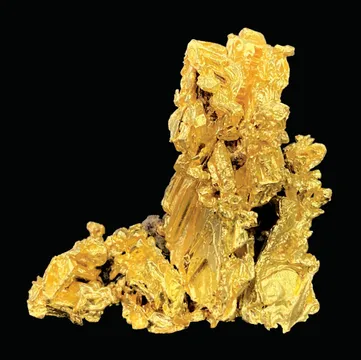
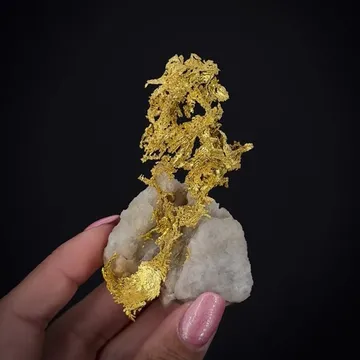
The best Red Ledge gold has a look that is immediately recognizable to experienced California-gold collectors: thin to sturdy leaves, dendritic plates, foils, and crystalline edges of exceptionally bright yellow gold, sometimes draped around white quartz or set off by green mariposite-bearing gangue. The mine also has a second, very different claim to mineralogical importance. Its chromite-bearing part produced the rare Ba-Cr-Ti oxide redledgeite, named for the mine, making Red Ledge not just a gold locality but a type locality of real systematic significance.
Regional View
Country View
The deposit was discovered late for a California gold locality, in 1908, yet it quickly became famous because the pockets yielded specimens attractive enough to be collected, traded, mounted as jewelry, and ultimately dispersed into major private and museum collections. The same property also shipped high-grade chromite ore during the World War I period, tying a celebrated specimen mine to the wartime strategic-minerals story of the northern Sierra Nevada.

Photo: Wikimedia Commons
Search for specimens: View all specimens from Red Ledge Mine, USA
The Red Ledge Mine is in the Washington Mining District, also historically called the Omega District, in Nevada County, California. The mine is about two miles southwest of Washington, a small Gold Rush settlement on the South Yuba River. Mineral-locality databases place the mine at roughly 39° 20' 39" N, 120° 48' 3" W, and the mine should not be confused with the separate Red Ledge locality in Sierra County, California, a recurrent source of labeling confusion in the gold trade.
Geologically, Red Ledge belongs to the gold-bearing metamorphic and ultramafic belts of the northern Sierra Nevada. The gold lode follows a major structural contact between serpentinized ultramafic rocks and metamorphic rocks described in older reports as Calaveras slate and in modern locality summaries as amphibole schist of the Tightner Formation. The productive zone is not a single clean vein in the textbook sense. It is an altered lode, commonly 10 to 30 feet wide in historic descriptions, made up of ankeritic and dolomitic material cut by numerous quartz stringers and veinlets. Mariposite, the chromium-bearing green mica so closely associated with many California gold districts, accompanies the richer pockets.
In the oxidized upper part of the lode, weathering of ankerite produced an iron-stained cap cut by quartz stringers. Those stringers carried coarse leaves and plates of gold, the habit for which the mine became famous. Historic descriptions note that the lode strikes roughly northwest and dips steeply east, and that the gold occurred in “bunches,” with one pay shoot described as about 70 feet long. Modern locality summaries describe the lode system as extending about 8,000 feet, while the patented property described in the Mineralogical Record article covered approximately 150 acres along about a mile of lode.
Red Ledge was both a gold mine and a chromite mine. The gold-quartz pockets supplied the great leaf and crystalline gold specimens. The chromite occurred separately as lenses and pods in the serpentinite near the contact with the metamorphic rocks. During 1918-1919, the mine produced chromite ore of strategic value; one MRDS-derived summary records 1,265 long tons of ore averaging about 42% Cr2O3, while locality summaries report ore grades around 45%. The chromite assemblage is the setting for redledgeite, found as small brilliant crystals associated with chromite and chromium-bearing clinochlore.
The modern collecting story is strongly tied to Sam P. Tracy, who purchased the mine in 1952 and worked it for specimens until his death in 1968. Red Ledge gold from the Tracy period entered the market through collectors and dealers who recognized that intact crystallized gold was worth preserving as mineral specimens rather than sending to the refiner. Charles Crespi of Angels Camp acquired many important Red Ledge pieces from this era, and when the Crespi collection was later dispersed, Red Ledge specimens entered major institutional and private collections. Earlier pieces exist, including significant pre-Tracy specimens, but confidently attributed early Red Ledge gold is much scarcer.
One of the most productive specimen zones was the Butterfly adit or decline. It was driven on three narrow quartz veins that alternately produced large pockets of crystallized gold. Large specimens were removed by hand, while the pocket material around them was trucked to a three-stamp mill on the property. The Butterfly structure reportedly faulted out at about 60 feet, but not before producing hundreds of specimens. The mine’s three-stamp mill, once at the main portal, was later donated by Stella Tracy to the City of Grass Valley, where it became a local mining-history monument.
Later attempts to revive the mine for specimen recovery continued into the 21st century. In August 2009, heavy equipment was used in the Red Ledge open pit to remove rock and expose gold-bearing veins, and the project involved Barry Yampol, Terry Szenics, Trenton Davis, and others. The effort ran into the practical realities of modern mining: road work, safety upgrades, dump expansion, machinery overhaul, neighboring-property constraints, and permitting. The state did not approve the year-round operating plan that would have justified the expense, and after Barry Yampol’s death in June 2023 the mine was described as idle and awaiting further developments. For collectors today, that means Red Ledge is a classic closed or effectively dormant source, not a casual collecting locality. Access should be treated as private, controlled, and legally restricted unless explicit permission is obtained from the appropriate land and mineral-rights holders.
Gold from Red Ledge is prized above all for brilliant leaf, foil, dendritic, and crystalline plate habits, usually bright yellow and high-purity in appearance, with sharply textured edges and microscopic octahedral growth features on the better leaves. Most specimens are small cabinet size and below, but the mine produced famous large pieces, including multi-inch leaves, a 14 x 12 cm tree-root-associated specimen found in 1959, a 21 cm leaf nicknamed “The Flame,” and historic museum pieces far larger than the thumbnails and miniatures now most often seen on the market. Associations include white quartz, clear quartz crystals, mariposite-bearing green gangue, ankerite, and iron oxides from the oxidized zone. The best Red Ledge gold is not merely a yellow leaf: it has sculptural openness, strong luster, crisp crystallized margins, undamaged delicate projections, and convincing Nevada County provenance, ideally tied to the Tracy, Crespi, Leicht, Yampol, or other well-documented California-gold lineages.
Quartz at Red Ledge is important less as a stand-alone display species than as the matrix and pocket host that frames the gold. It occurs as white vein quartz, quartz stringers, and, more rarely, clear crystals associated with the gold-bearing cavities. Complete, well-formed quartz crystals attached to Red Ledge leaf gold are notably uncommon despite the gold forming in quartz veins; that contrast is part of what makes certain Red Ledge pieces visually distinctive. Ordinary quartz from the mine is abundant as vein material, but collector-grade quartz pieces are those that retain an aesthetic relationship with gold: a clean white core wrapped by leaves, a crystal penetrating or attached to gold, or open cavity quartz that helps prove the specimen’s pocket origin without overwhelming the gold.
Beyond gold and quartz, Red Ledge is mineralogically notable for redledgeite, Ba(Ti4+6Cr3+2)O16, the mine’s type-locality species and the reason the locality matters to systematic collectors as well as gold specialists. The chromite assemblage includes chromite, magnesiochromite, clinochlore and chromium-bearing clinochlore, uvarovite, knorringite, rutile, talc, serpentine-group minerals, and muscovite varieties including mariposite and phengite. The broader lode assemblage also includes ankerite, calcite, arsenopyrite, pyrite, galena, stibnite, and native copper. Redledgeite specimens are generally micromount material rather than showy cabinet pieces, but as type-locality material on chromite with chromium-bearing clinochlore they have enduring appeal for rare-species specialists.
Red Ledge gold has two major authenticity issues: locality confusion and style-based misattribution. There are multiple “Red Ledge” mine names in California records, including a separate Sierra County Red Ledge, so a label reading only “Red Ledge Mine, California” is incomplete. Serious labels should specify Washington Mining District or Omega District, Nevada County, California. Provenance is especially valuable when it links a specimen to the Tracy workings, the Charles Crespi collection, Kristalle, Barry Yampol, a named museum, or a long-standing California-gold collection.
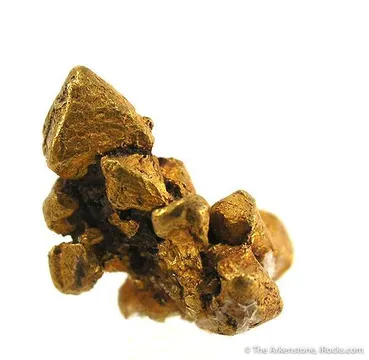
The best visual clue is habit. Red Ledge gold is characteristically bright, leafy, dendritic, and platey. Large chunky octahedral masses, dull surfaces, suspiciously low-color gold, or heavy rounded forms should be treated cautiously unless supported by strong provenance. Such pieces may be genuine California gold but not necessarily Red Ledge. Conversely, a bright crystallized leaf with Nevada County Red Ledge documentation is a plausible match for the locality’s known production.
Condition matters intensely. Thin leaf gold is vulnerable to bending, flattening, edge bruising, and loss of tiny dendritic projections. Many specimens are naturally delicate, and cleaning or repeated handling can soften the very crystallized surface texture that collectors prize. Pieces with quartz matrix may have been etched, trimmed, or stabilized; acid preparation is common in the world of gold specimens because quartz and feldspar can be removed to expose leaves, but an etched specimen with no matrix should still show natural crystallized texture rather than an over-bright, smoothed, or mechanically distorted surface. Handle Red Ledge leaves by the base or mount, not by the gold.
Redledgeite and the chromite-associated rarities are a different collecting category. They are generally microscopic, dark, and easily overlooked, and should not be confused with showy gold specimens from the quartz pockets. For redledgeite, analytical confirmation or trusted rare-species provenance is much more important than visual appeal alone. The mineral is best represented as labeled type-locality micromount material on chromite with chromium-bearing clinochlore.
Market availability is limited. Small Red Ledge leaf-gold thumbnails surface from old collections and dealer stock, while fine miniatures and cabinet pieces are much scarcer. Top historic examples are locked into museums or major private collections. The mine is not a steady modern producer, so quality Red Ledge gold should be viewed as classic California material rather than routine contemporary production.
The most memorable Red Ledge story begins only a few feet below the surface. In 1959, miners opened a pocket directly under a fallen pine tree. The roots had grown into the cavity and around the gold itself. One resulting specimen, later famous in the Kristalle circle and associated with the Charles Crespi collection, preserved the root captive in the gold; removing it would damage the specimen. The pocket was filled with dirt and loose gold, and the specimen carried another surprise: a clear quartz crystal attached to the gold, rare enough at Red Ledge that Wayne Leicht singled it out despite the mine’s quartz-vein setting. The piece measured 14 x 12 cm, and its afterlife was as improbable as its formation. Before it became a famous California gold, Lyla Tracy, daughter of mine owners Sam and Stella Tracy, was allowed to take it to elementary school for “show and tell.”
That same specimen later appeared at the Calaveras County Fair, where Wayne Leicht saw it as a young man. At the time it belonged to Charles Crespi, the Bank of America manager in Angels Camp whose private California crystallized-gold collection became legendary. The Crespi holdings were eventually purchased by Wayne and Dona Leicht of Kristalle, and Red Ledge pieces from that line helped define what sophisticated collectors meant by classic California leaf gold. In the strange economy of specimen gold, a pocket that began as dirt, roots, quartz, and loose leaves under a pine tree became a bridge between a family mine, a small-town fair, one of the great California gold collections, and the international fine-mineral market.
The Butterfly adit produced a different kind of drama: not one named specimen, but a run of pockets. Driven on three narrow quartz veins, the decline repeatedly found cavities rich enough that the large crystallized-gold pieces were removed by hand. The less spectacular pocket material was not wasted; it went by truck to the three-stamp mill on the property. The Butterfly faulted out at about 60 feet, a brutally abrupt end for a productive structure, but by then it had produced hundreds of specimens. Among the photographed Tracy-era pieces were specimens around 1955 measuring roughly six inches and weighing about 10 ounces, and another over five inches long and about 8 ounces that Stella Tracy nicknamed the “dragon.”
The three-stamp mill has its own afterlife. It stood at the main portal and processed many tons of gold-bearing ore from the property. Family accounts credit Paul Hinkley, a master mechanical engineer, with engineering it, and Hinkley, Sam Tracy, and miner Herman Popoff with building it—three men described as being in their mid-60s when they undertook the job. Stella Tracy later donated the mill to Grass Valley, where a plaque records its connection to Red Ledge and dedicates it to the Cornish “Cousin Jack” miners whose hard-rock knowledge shaped the Nevada County gold mines.
One of the great Red Ledge specimens predates the Tracy years. A crystallized gold found in 1914 in the south drift on the 200-foot level of the No. 3 adit became one of the most admired California gold specimens. It entered the Cranbrook Institute collection in Bloomfield Hills, Michigan, in 1937, reportedly as a gift to the institute’s founder. That single fact is a useful reminder that Red Ledge’s reputation did not begin with the mid-century collector market. The mine was producing specimen-grade gold early enough for elite institutional collecting to notice.
In the 1920s, another extraordinary Red Ledge specimen emerged while the mine was under bond: a feather-like gold and quartz piece described as 43 cm long with a gold weight of about 1.5 kilograms. When first found, it reportedly had a large “cauliflower leaf” gold mass attached on the opposite side of the matrix from the feather, but that portion disappeared before the later photograph was taken. The story has the peculiar ache common to old gold localities: the surviving specimen is already extraordinary, yet the original was better.
The modern revival attempt had a different tone—less romance, more machinery and regulation. In August 2009, heavy equipment was brought into the open pit to remove large volumes of rock and expose gold-bearing veins. Barry Yampol, Terry Szenics, Trenton Davis, and others were photographed at the mine. But the old protective dump material had to be removed from the pit, the dump had to expand to accommodate it, the road needed widening, safety improvements were required, and machinery that had sat idle for more than a decade needed overhaul. Negotiations to buy adjacent property failed. The state would not approve year-round operation, and without that, the economics of reopening did not work. Barry Yampol continued to plan for the mine, but his death in June 2023 left Red Ledge idle again, its reputation carried mainly by the bright leaves already in collections.