Mariposa County — a premier gold locality with native gold in quartz and rare Trumbull Peak minerals; prized for display-worthy specimens and mining lore.
Key facts
Mariposa County sits at the southern end of California’s Mother Lode country, where the western Sierra Nevada foothills carry a long, broken train of gold-bearing quartz veins, altered slates and greenstones, serpentinized ultramafic rocks, and younger granitic intrusives. For specimen collectors, the county has two quite different claims to fame. The first is the classic California suite of native gold in quartz: bright yellow, lustrous, commonly crystallized gold emerging from milky white quartz seams and pockets. The second is the county’s unusual barium-silicate mineralogy at Trumbull Peak, where rare minerals such as sanbornite, fencooperite, and titantaramellite tie Mariposa County to the literature of type localities as firmly as the famous gold mines tie it to the cabinets of collectors.
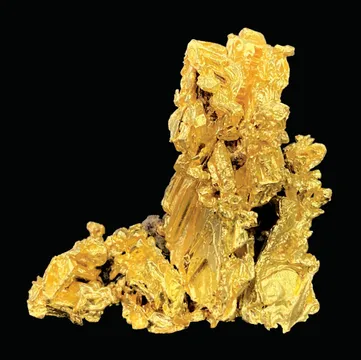
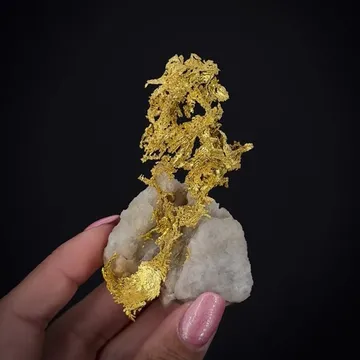
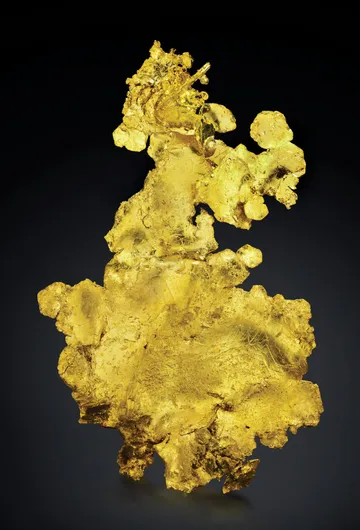
The finest Mariposa County gold is not merely “gold ore.” It is display-quality native gold: arborescent clusters, skeletal octahedra, leaves, wires, thick herringbone growths, and compact crystalline masses, often perched on or rising from quartz in a way that gives the specimen both contrast and architecture. Colorado Quartz, Mockingbird, Diltz, and related Whitlock-area mines are the names collectors watch most closely, while the older Mother Lode mines—Mariposa, Princeton, Pine Tree, Josephine, Mount Ophir, and others—belong to the county’s deeper mining history.
Regional View
Country View
The county is historically important because hard-rock quartz mining began here astonishingly early in the California Gold Rush. By July 1849, ore from the Mariposa mine was already being treated in a stamp mill, and the Las Mariposas land grant of John C. Frémont complicated ownership across a major stretch of the local Mother Lode. That mix of geology, law, wealth, and specimen survival is part of the place’s character. Much gold that would now be saved for collectors was crushed or melted; the pieces that escaped that fate, or were recovered during modern specimen-conscious mining, carry an extra historical charge.

Photo: Wikimedia Commons

Photo: Wikimedia Commons
Search for specimens: View all specimens from Mariposa County, USA
Mariposa County’s collectible mineral identity is anchored in orogenic gold-quartz vein systems of the Sierra Nevada foothills. The county occupies the southernmost Mother Lode region, but its specimen gold does not come only from the main Mother Lode belt. The historic mining geography is divided into the Mother Lode belt, the East Belt, and the West Belt or Hornitos belt, with placer deposits along streams and gravels such as the Merced River, Mariposa Creek, Agua Fria Creek, Hornitos Creek, Mormon Bar, and remnants of Tertiary and Quaternary gravels.
The bedrock geology is complex but collector-relevant. In western Mariposa County, Jurassic slates, phyllites, metasandstones, greenstones, schists, serpentinized ultramafic bodies, and dikes host quartz veins and stringer systems. The classic Mother Lode veins are associated with fault and fracture zones, especially where quartz, carbonate, mica, chlorite, pyrite, arsenopyrite, galena, sphalerite, tetrahedrite-group minerals, and native gold were introduced into altered wall rock. The larger production mines often carried low- to moderate-grade ore over considerable stoping lengths; visible native gold was not always common in such mines. The collector pieces, by contrast, generally came from small, rich pockets where open space, clay, iron and manganese oxides, and quartz-lined cavities preserved crystalline gold.
The Whitlock district, north of Mariposa and east of the main Mother Lode, is the collector’s prime address. The district includes the Colorado, Sherlock Creek, and Whiskey Flat areas, and its numerous north- and northwest-striking quartz veins commonly contain small but rich ore shoots. Many veins are one to five feet thick and locally roll or bend; those bends and rolls were exactly the places where high-grade pockets appeared. The Diltz mine, for example, famously yielded masses of gold and quartz weighing 52 and 40 pounds in 1932, and the district has a long reputation for specimen ore rather than only milling ore.
The Colorado Quartz and Mockingbird mines belong to this Whitlock-area specimen tradition. Both are associated with the Colorado dike system, an altered mafic dike hosted by graphitic slate locally referred to in the literature as Briceburg Formation or equivalent to the Mariposa Formation. At the Mockingbird mine, the productive setting is not a single huge vein but small “floor” veins, commonly only a few centimeters to a few tens of centimeters thick, that cut the dike and slate contact zones. The best pockets were found where these veins intersected cross-fractures or “cutters,” particularly near the dike-slate contact. Such pockets could be small—on the order of hand-sized cavities—but when filled with clay and oxides they sometimes protected superb gold crystals.
The Mockingbird mine was known before 1900 as the Talc and Lacey claim and is adjacent to the Colorado Quartz and Artru properties. Early miners undoubtedly found good gold there, but much of the old specimen material was melted. A short, well-publicized episode in 1915 produced about 145 ounces of crystallized gold, but the mine’s modern status changed dramatically after John and Lucretia Emmett acquired the claim in 1996. Modern, specimen-aware mining with metal detectors and careful pocket work culminated in the 2006 third-level discovery, about 30 meters below the surface, where approximately 26 crystalline gold specimens from thumbnail to cabinet size were recovered from clay-filled pockets. The following year produced further world-class pieces, including the “Golden Coral,” a large floater from a black-clay vug.
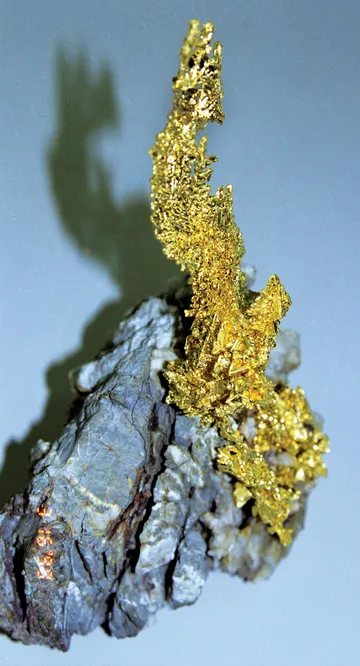
The Colorado Quartz mine is even more famous internationally. It has been treated in the specimen literature as a modern source of crystallized gold since the early 1980s, and its reputation was magnified by the 1998 recovery of the “Dragon,” an 18 cm-tall crystallized gold specimen now associated with the Houston Museum of Natural Science. Colorado Quartz gold is prized for sculptural growth, bright luster, and the way thick leaves and hopper-like or skeletal crystals can rise from white quartz matrix. The mine remains one of the key names by which serious collectors evaluate modern California gold.
The older Mother Lode mines tell a broader mining story. The Mariposa district lies around the town of Mariposa at the southeast end of the Mother Lode belt. The Mariposa mine was reported as discovered in 1849 by Kit Carson, and the first stamp mill in California was installed there the same year. The district’s rocks include northwest-trending belts of Upper Jurassic Mariposa Formation slate, serpentine, and greenstone, with massive quartz veins in slate or greenstone carrying free gold, pyrite, and arsenopyrite. The Mariposa mine was developed to an inclined depth of about 1,500 feet.
Northwest of town, the Mount Bullion district includes Agua Fria and Mount Ophir and was placer-mined as early as 1848. The Princeton mine, discovered in 1852, became one of the county’s great producers and at times one of California’s largest gold mines. Its vein occupied a fault cutting Jurassic Mariposa Formation slate, with ribboned milky quartz, pyrite-rich ore shoots, minor galena, sphalerite, tetrahedrite, and rarely visible native gold. The main shaft reached about 1,660 feet on the incline and roughly 1,250 feet vertically, with nine levels and extensive drifts, crosscuts, raises, and stopes. This is mining history more than specimen-mining history, but Princeton and related mines help define the district context from which Mariposa County labels derive.
Bagby and Bear Valley, including the Pine Tree and Josephine mine complex, are also central to the county’s gold story. The Josephine mine is especially important to mineral collectors because mariposite—the green chromium-bearing mica variety that gave a visual signature to altered gold-vein rocks of the region—was originally described from Mariposa County material and is tied in the literature to the Josephine mine. In the field and in collections, “mariposite” may mean the mica itself or a decorative rock rich in green chromian mica with quartz and carbonate.
Mariposa County is not an open collecting free-for-all. The famous specimen gold mines are private properties and are not open to casual collecting. Many older workings are on private land, patented claims, active or intermittently active mining ground, or hazardous abandoned mine sites. Responsible collecting today generally means acquiring well-documented specimens from old collections, reputable dealers, mine owners, or material released from modern specimen-mining operations. Roadcut mariposite and stream placer localities have attracted casual interest, but collectors should confirm land status, road restrictions, and safety before touching anything in the field.
Gold from Mariposa County is best known as bright, rich yellow native gold in and on milky quartz, with the most desirable pieces showing distinct crystallization rather than simply massive metal. Colorado Quartz and Mockingbird specimens may show arborescent growths, thick leaves, skeletal octahedra, hopper-like crystals, ribbed or herringbone surfaces, and branching seams rising out of quartz; Mockingbird crystals have been documented to nearly 2 cm across, while complete specimens range from thumbnails to dramatic cabinet pieces. The finest examples came from clay- and oxide-filled pockets along vein intersections, dike contacts, and rolled or folded parts of the vein system, especially in the Colorado dike environment. What separates a great Mariposa County gold from an ordinary one is not just weight: it is open sculptural form, undamaged crystal edges, strong buttery luster, contrast against natural quartz matrix, and a locality label that can be tied to a specific mine such as Colorado Quartz, Mockingbird, Diltz, or another documented Whitlock-area source.
Beyond gold, Mariposa County rewards collectors who look past the obvious. Quartz, ankerite, calcite, pyrite, arsenopyrite, galena, pyrrhotite, sphalerite, chalcopyrite, tetrahedrite-group minerals, chlorite-group minerals, limonite, wad, sericite, and mariposite form the ordinary gangue-and-ore vocabulary of the gold veins. Mariposite, a green chromium-bearing phengitic muscovite variety with formula commonly given as K(Al,Cr)2(Al,Si)4O10(OH)2, is historically rooted in the county and occurs in schists and ankerite-quartz rocks of the gold veins. The rare-mineral side of the county is concentrated at Trumbull Peak in the Clearing House district, a barium-silicate locality known for sanbornite, gillespite, celsian, alforsite, macdonaldite, pellyite, bigcreekite-related assemblages, titantaramellite, fencooperite, and esquireite. Mindat lists Mariposa County as the type locality for three valid minerals: sanbornite, fencooperite, and titantaramellite, with mariposite recorded as a first recorded locality for the variety rather than as a separate IMA-valid species.
For Mariposa County gold, locality precision matters. “California gold,” “Mother Lode gold,” and “Mariposa gold” are not equivalent labels in a serious collection. A Colorado Quartz piece, a Mockingbird piece, a Diltz piece, and a generic Mariposa County placer nugget occupy very different positions in the market. Insist on old labels, mine-owner provenance, dealer documentation, or a credible chain of custody whenever paying specimen premiums. The best pieces are commonly valued far beyond melt because they combine crystallization, aesthetics, locality, and survival; a heavy but shapeless mass may be less important to collectors than a much lighter but sharply crystallized miniature on quartz.
Condition is critical. Native gold is soft, and thin leaves, wires, and skeletal crystal edges can be bent, bruised, flattened, or polished by careless handling. Do not rub a crystallized gold specimen, even with a soft cloth. Handle by the quartz or by a mount, and store pieces so no crystal edges touch foam, cotton, or another mineral. Quartz matrix can be bruised, chipped, or acid-etched; clay remnants and iron or manganese oxides may be natural pocket material, not “dirt” to be aggressively removed.
Preparation should be disclosed. Many fine California gold specimens have been professionally cleaned, trimmed, etched, air-scribed, water-gunned, or otherwise prepared to expose the gold from quartz, clay, carbonate, or oxide matrix. This is not automatically a defect; it is part of the modern history of specimen gold. However, acid removal of quartz, reattachment of broken gold, concealed repairs, or reshaping can materially affect value. The “Dragon” from the Colorado Quartz mine is famous in part because its discovery, cleaning, repair, and exhibition history have been openly published. That transparency is the model: repairs do not have to be fatal, but undisclosed repairs are.
Fakes and misleading labels are more likely than outright synthetic gold. Watch for placer nuggets glued into quartz, cast or electroformed gold masquerading as natural crystallized growth, and generic gold-in-quartz pieces upgraded to “Colorado Quartz” or “Mockingbird” without proof. Natural Mariposa County crystalline gold should show convincing metal continuity into matrix or natural growth surfaces, not isolated flakes sitting suspiciously on gluey contacts. Under magnification, good specimens often reveal natural crystal faces, skeletal ridges, pocket oxides, and gold that penetrates cracks or seams rather than merely decorating a surface.
Mariposite has its own label problems. In the lapidary trade, “mariposite” is often used loosely for green-and-white decorative rock, sometimes from outside Mariposa County and sometimes for materials that are not demonstrably chromium-bearing mica. True county material should be described as mariposite-bearing rock or chromium-bearing muscovite/phengite in quartz-carbonate rock unless the mica has been identified. It is attractive, historically important, and locally abundant in places, but it is not a substitute for well-crystallized gold in collector value.
The barium-silicate minerals from Trumbull Peak are specialist material. Sanbornite and associated Ba-silicates may occur as fine-grained aggregates rather than dramatic freestanding crystals, and some species require analytical confirmation. These pieces are of high mineralogical interest, especially for systematic collectors, but many are visually modest and should be bought for verified identity and provenance rather than showiness. Fluorescence, where present in associated minerals, should be checked with both longwave and shortwave ultraviolet, but do not assume fluorescence as a diagnostic test for a rare Trumbull Peak species.
Market availability is uneven. Mariposa County gold appears periodically because modern and old-stock specimen material exists, but top Colorado Quartz and Mockingbird pieces are tightly held and expensive. Good miniatures and small cabinet specimens on quartz are far more obtainable than major named display pieces. Diltz and older Whitlock or Mother Lode labels can be scarcer than their fame suggests, especially with convincing provenance. Trumbull Peak systematic specimens are usually encountered through specialist dealers, old California collections, or micromount channels rather than mainstream gold dealers.
One of the strangest facts about Mariposa County is that its most important gold ground was once tied up in a Mexican land grant that could move. Las Mariposas began as a floating grant—ten square leagues that could be placed within a broader area—and John C. Frémont bought it in 1847 for $3,000 before the full mineral value of the region was understood. Once gold discoveries transformed the foothills, Frémont “floated” the grant over the richer ground. The result was not romance but years of litigation, angry miners, contested mineral rights, and a legal landscape almost as fractured as the veins themselves. By 1856 the United States patent recognized his claim, and by 1859 the courts confirmed his mineral rights, but the delay and conflict shaped mining across a large part of the county.
The early pace of hard-rock mining was startling. Gold Rush memory usually begins with pans and sluices in gravel, but Mariposa County moved quickly into quartz. By July 1849, ore from the Mariposa mine was already being processed in a stamp mill. The district later remembered Kit Carson as the discoverer of the Mariposa mine, and the mine became a symbol of the shift from picking gold out of creeks to following it underground in quartz veins. It was a brutal transition for specimens: the very rock that might have held superb gold crystals was fed to stamps for bullion.
A small piece of Mariposa’s gold country even went to Washington. In June 1850, California’s first governor, Peter Burnett, sent a large chunk of gold ore from Mariposa County to Washington, D.C., for use in the base of the Washington Monument. The note that accompanied it was plain and memorable: “from Mariposa Diggins, near Fremont’s mines.” It is a perfect early-Gold-Rush object—part ore sample, part political statement, part advertisement for the new state’s mineral wealth.
The Mockingbird mine’s modern story reads like a collector’s dream because its owners understood what earlier miners often did not: a crystallized gold specimen could be worth far more intact than crushed or melted. John and Lucretia Emmett acquired the Mockingbird claim in 1996 after John had already worked at the nearby Colorado Quartz mine. The old workings were shallow, chaotic, and pocket-hunted, with timbered drifts, small stopes, and dike-following tunnels left by miners who had chased the Colorado dike. With metal detectors and a careful eye for subtle underground signs, the Emmetts and their crew began finding pockets missed by earlier generations.
In April 2006, the Mockingbird mine delivered the kind of pocket that changes a locality’s reputation. On the third level, about 30 meters below the surface, miners found a pay zone roughly 6 by 12 meters near a fold in the dike. A clay seam 15 to 25 cm wide filled the fold, and small grains of gold in the clay hinted that larger crystals might be nearby. The pocket series yielded about 26 crystalline gold specimens, from thumbnails to cabinet specimens. The best pieces were not anonymous bullion; they were aesthetic mineral specimens—gold rising, branching, curling, and crystallizing against white quartz or freed from dark clay.
The 2007 Tucson Gem and Mineral Show gave collectors a first taste of that new Mockingbird material. Bryan Lees and Collector’s Edge prepared and marketed selected pieces from John and Lucretia Emmett’s 2006 and 2007 discoveries. Five top 2006 specimens were intended for display; two sold before they were ever shown. That detail says more about the market than any price list could. Serious collectors recognized that Mockingbird gold had joined Colorado Quartz in the top tier of modern American specimen localities.
Then came the Mockingbird “Golden Coral,” a cabinet-size floater from a black-clay vug. Unlike the more quartz-associated pieces, it stood out for mirror-bright luster and a branching form that justified the name. It measured about 14 cm wide by 18 cm tall, sold immediately, and entered the MIM Museum in Lebanon. In an older mining era, such a piece might have disappeared into a crucible. In the modern specimen era, it became a named object with a story and a destination.
The Colorado Quartz mine has its own legend, and the “Dragon” is the centerpiece. Discovered in 1998 by the mining group of Larry Lehto, Noble Sparks, Bryan Lees, and John Emmett, it was an unusually aesthetic, sculptural crystallized gold specimen—about 18 cm tall—recovered at a moment when miners and preparators were learning how to treat gold specimens as fragile mineral art rather than as ore. It was cleaned and repaired by Collector’s Edge, exhibited, and ultimately became one of the most recognized gold specimens in the world. Its story matters because it made visible the new rules of high-end specimen gold: careful extraction, professional preparation, documentation, and open discussion of repair.
Mariposa County’s quieter rare-mineral story sits far from the glitter of the gold cases. At Trumbull Peak, collectors and mineralogists found a Ba-silicate world of sanbornite-quartz lenses, gillespite, celsian, macdonaldite, pellyite, alforsite, fencooperite, titantaramellite, and related species. These are not the minerals that stop casual visitors at a show, but for systematic collectors they are pure California mineralogy. Fencooperite, for example, occurs as black aggregates only a few millimeters across in barium-silicate-rich lenses. That small scale is part of the charm: Mariposa County’s mineral greatness ranges from museum gold dragons to black grains that require a microscope, a probe, and a paper in The Canadian Mineralogist to fully appreciate.
F. L. Ransome, 1900, “Mother Lode District folio, California,” U.S. Geological Survey Geologic Atlas Folio 63 — The classic USGS folio for the Mother Lode district, including geology and maps relevant to Mariposa County’s gold belt setting.
Adolph Knopf, 1929, “The Mother Lode System of California,” U.S. Geological Survey Professional Paper 157 — Foundational treatment of the Mother Lode system, including Mariposa Estate mines, ore mineralogy, and discussion of mariposite from the Josephine mine.
A. H. Koschmann and M. H. Bergendahl, 1968, “Principal Gold-Producing Districts of the United States,” U.S. Geological Survey Professional Paper 610 — Includes Mariposa County gold production figures and district summaries for the county.
W. B. Clark, “Gold Districts of California,” California Division of Mines and Geology Bulletin 193 — Essential district-by-district reference for Mariposa, Mount Bullion, Whitlock, Hornitos, Bagby, and related gold districts.
Peter C. Keller and Anthony R. Kampf, 1982, “The Colorado Quartz mine, Mariposa County, California: a modern source of crystallized gold,” The Mineralogical Record, 13, 347–354 — The classic modern publication establishing the Colorado Quartz mine as a major crystallized-gold locality.
R. H. Weir and D. M. Kerrick, 1987, “Mineralogic, fluid inclusion, and stable isotope studies of several gold mines in the Mother Lode, Tuolumne and Mariposa counties, California,” Economic Geology, 82, 328–344 — Technical study of Mother Lode ore-forming fluids, alteration, and gold-bearing quartz-vein mineralogy.
Robert B. Cook, Bryan Lees, and Carl A. Francis, 2009, “The Colorado Quartz Gold Mine,” Rocks & Minerals, 84, 396–413 — Detailed modern account of the Colorado Quartz mine and its specimen gold.
Robert B. Cook and Thomas M. Gressman, 2008, “The Mockingbird Gold Mine, Mariposa County, California,” Rocks & Minerals, 83, 392–401 — Principal article on the Mockingbird mine, its geology, modern mining, and 2006–2007 specimen discoveries.
Collector’s Edge Minerals, “The Mockingbird Mine, Mariposa County, California” — Web version drawing on the Rocks & Minerals article, with photographs, history, geology, pocket descriptions, and specimen notes.
Mark Ivan Jacobson, 2023, “The discovery, repair and exhibition of the Dragon Gold specimen, Colorado Quartz Mine, Mariposa County, California,” The Mineralogical Record, 54, 463–475 — Published history of the discovery and preparation of the “Dragon” gold specimen.
Austin F. Rogers, 1932, “Sanbornite, a new barium silicate mineral from Mariposa County, California,” American Mineralogist, 17, 161–172 — Original description of sanbornite from the Trumbull Peak area.
John T. Alfors and Adolf Pabst, 1984, “Titanian taramellites in western North America,” American Mineralogist, 69, 358–373 — Publication tied to titantaramellite from Trumbull Peak and related western North American Ba-silicate occurrences.
Joseph F. Cooper and Gail E. Dunning, 1999, “Barium Silicate Minerals from Trumbull Peak, Mariposa County, California,” The Mineralogical Record, 30, 411–417 — Collector-oriented treatment of the Trumbull Peak rare barium-silicate assemblage.
Andrew C. Roberts, Joel D. Grice, Gail E. Dunning, and Katherine E. Venance, 2001, “Fencooperite, Ba6Fe3+3Si8O23(CO3)2Cl3 · H2O, a new mineral species from Trumbull Peak, Mariposa County, California,” The Canadian Mineralogist, 39, 1059–1064 — Original fencooperite description, including formula, crystallography, and occurrence as black aggregates in Ba-silicate lenses.
Kenneth G. Snetsinger, 1966, “Barium-vanadium muscovite and vanadium tourmaline from Mariposa County, California,” American Mineralogist, 51, 1623–1639 — Important study of unusual vanadium-bearing mica and tourmaline from the county.
Smithsonian National Museum of Natural History GeoGallery: Gold, NMNH 176204 — Museum entry for a crystallized gold specimen from the Mockingbird Mine, described as one of the finest known from that locality.
“Meet the Dragon - The World’s Best Gold Specimen,” The Gold Vlog — Short video focused on the “Dragon” gold specimen from the Colorado Quartz mine.
“17-Ounce Gold Specimen | Full Journey from Discovery to Museum-Quality specimen Colorado Quartz Mine,” Goldbay.com — Modern footage showing discovery, extraction, cleaning, and final reveal of a large Colorado Quartz gold specimen.
“Modern Gold Mining in California - Dave Varabioff - 2021 Dallas Mineral Collecting Symposium,” The Arkenstone - iRocks.com — Lecture-style presentation on work at the Colorado Quartz Gold Mine, including modern exploration, extraction, and specimen preparation.
“Gold from Diltz Mine, Mariposa, USA,” Fabre Minerals — Specimen video of a small but high-quality Diltz mine gold in quartz, useful for seeing crystal habit and scale.
Mindat: Mariposa County, California, USA — Broad mineral list, locality hierarchy, photos, and references for the county.
Mindat: Colorado Mine / Colorado Quartz Mine, Mariposa County — Locality page for one of the world’s classic crystallized-gold mines.
Mindat: Mockingbird Mine, Mariposa County — Locality page for the modern Mockingbird crystallized-gold producer.
Western Mining History: Mariposa County California Gold Production — Concise county production history and district summaries based on USGS work.
Western Mining History: Whitlock District — Especially useful for the Colorado Quartz, Mockingbird, Diltz, and related specimen-gold setting.
Western Mining History: Mariposa District — Good summary of the Mariposa mine, early stamp mill, and local Mother Lode geology.
Western Mining History: Mount Bullion District — District history for Agua Fria, Mount Ophir, Princeton, and related mines.
Western Mining History: Princeton Mine — Detailed MRDS-derived mine page with geology, workings, production, and references.
California Geological Survey: Mariposa County Mineral Resource Publications — State publication index for Mariposa County geology, mining, and mineral resources.
Mariposa County: Mining — County page on mining as a current economic and planning topic.
Mariposa County: On Hold History Narratives — Local history notes, including the Mariposa gold ore sent for the Washington Monument.
Wikimedia Commons: Gold-Quartz-34577.jpg — Freely licensed image of crystallized gold on quartz from the Colorado Quartz mine.
Wikimedia Commons: Mariposite Rock at Well Known Road Cut near Coulterville — Freely licensed field photograph of mariposite-bearing rock in Mariposa County.