






Garnet Ledge, Alaska — iconic Wrangell locality yielding deep red almandine garnets in schist; prized cabinet-class crystals and a key metamorphic reference.
Key facts
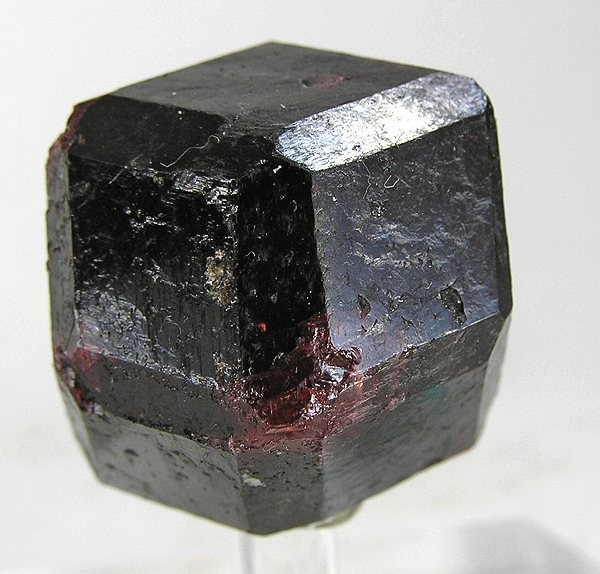
Garnet Ledge is the classic Wrangell almandine locality: a rain-forest, tidewater garnet deposit on the mainland side of the Stikine River mouth, north of Wrangell in southeastern Alaska. For collectors it matters because it produced exactly the sort of specimen that becomes a locality signature—a sharp, deep red to wine-red almandine crystal, commonly dodecahedral or modified by trapezohedral faces, set in dark gray to silvery mica-rich schist. The best pieces have the immediate recognizability of a cabinet classic: isolated red-black garnets standing proud from schist, with enough matrix left to make the geological story visible.
Geologically, Garnet Ledge is not a pegmatite pocket locality and not a skarn in the specimen-mining sense. It is a metamorphic garnet deposit developed in quartz-biotite schist and related pelitic rocks near quartz diorite of the Coast Plutonic Complex. Modern metamorphic work has made the locality more than a source of attractive garnets: Garnet Ledge has been used as a textbook-quality example for tying garnet growth, pressure-temperature conditions, and pluton emplacement together in a contact-metamorphic setting. Its garnets grew during Late Cretaceous metamorphism, shortly after emplacement of the adjacent pluton, and the assemblage around them includes biotite, muscovite, sillimanite, staurolite, plagioclase, graphite, chlorite, and ilmenite in the broader schist package.
Historically, the ledge sits at a remarkable intersection of science, commerce, and community. Specimens labeled “Fort Wrangell,” “Wrangell garnet,” “Alaska garnet,” or “Stikine River” entered collections for well over a century, and early writers already noted garnet-bearing slabs being brought to Wrangell for tourist-season cabinet specimens. The deposit was later worked for abrasive garnet, most memorably by the Alaska Garnet Mining & Manufacturing Company, an unusually early woman-run mining and manufacturing corporation formed in the opening years of the twentieth century. Since the 1960s, the locality’s identity has been defined by its unusual stewardship: Garnet Ledge is private land held for the benefit of the children of Wrangell, who alone are traditionally allowed to mine and sell the garnets.
Regional View
Country View
The finest Garnet Ledge specimens are not valued simply because the garnets are large; they are valued because the crystals are cleanly formed and visually separated from the host. Ordinary material may show bruised, embedded, or broken garnets crowded in schist. Better specimens show one or several complete crystals, typically around 1 to 3 cm, with glossy faces, dark cherry-red transmitted color on thin edges, and a natural seat in the schist rather than the look of a loose crystal glued back into place. Large matrix plates with multiple exposed crystals are especially desirable because collecting here commonly involves hard chiseling through tough schist, and both the garnets and their matrix are easily damaged during extraction.

Search for specimens: View all specimens from Garnet Ledge, USA
Garnet Ledge lies near the mouth of Garnet Creek on the east side of the Stikine River mouth, roughly 7 to 8 miles north of Wrangell by boat. The historical mine site is only a short distance inland from the Stikine shoreline, at low elevation, in the wet, heavily timbered terrain typical of the lower Stikine delta and adjacent Coast Mountains. Older specimen labels often say “Fort Wrangell” because Wrangell was the shipping and selling point; modern locality work places the deposit on the mainland near Garnet Creek, not in the town itself.
The deposit is a metamorphic garnet occurrence hosted by quartz-biotite schist and associated pelitic schist/hornfels. USGS descriptions treat it as a garnet mine in which dark red, euhedral to subhedral almandine crystals occur disseminated through several layers of quartz-biotite schist, with individual crystals reported up to about 3 cm in diameter in the formal ARDF summary. Earlier mining literature described garnet-bearing beds 10 feet or more thick, lying near intrusive quartz diorite and interpreted as contact-metamorphic in origin. Bressler’s 1950 study placed the schists in the Wrangell-Revillagigedo metamorphic belt along the western margin of the Coast Range batholith, with garnet formation stimulated by intrusion of an outlying quartz diorite stock adjacent to the schist.
The richest garnet-bearing ground described by Bressler was concentrated near Garnet Creek, particularly on the patented Ruby No. 1 and Ruby No. 2 claims. The mapped high-grade body was described as a narrow triangular zone extending about 450 feet southeast from the confluence of the two forks of Garnet Creek, reaching roughly 250 feet in maximum width. Bressler estimated more than 2,810,000 cubic feet of garnet-bearing rock above the level of the creek forks, and two representative samples from between the forks gave 4.85 and 9.26 percent garnet by weight. On an assumed average of at least 5 percent commercial garnet, he estimated more than 11,000 tons of garnet above that datum, with a larger figure possible if comparable material extended below it.
The old mine workings were modest. The principal adit on Ruby No. 1 was described as being on Garnet Creek, about 265 feet southeast of the creek forks, and the underground workings amounted to about 260 feet of drifts. The workings explored schist with minor injection gneiss near the entrance and an increasing proportion of injection gneiss farther in. For specimen collectors, that history matters because the locality’s best pieces came not from open crystal pockets but from selective extraction of garnet-bearing schist layers—splitting, trimming, and exposing crystals while trying not to shatter the garnets.
The early history is partly obscured by tourist trade and shifting locality names. Gold seekers on the Stikine River probably knew of the garnets by the 1860s, and an analysis of Wrangell garnet was cited in the 1892 edition of Dana’s System of Mineralogy. By the early 1900s the deposit had attracted formal mining attention. F. E. and C. W. Wright mentioned the garnets in USGS work on the Ketchikan and Wrangell districts, and the Alaska Garnet Mining & Manufacturing Company became the best-known operator. The company filed on the principal garnet ground, patented claims, and worked the deposit intermittently; other short-lived leases and operations followed. Production for abrasive use was never large, and by the time Bressler wrote in 1950 there had been no production for roughly a quarter century, although the garnets remained famous as specimens.
Ownership and access are unusually important here. In 1962, Fred Hanford deeded the property to the regional Boy Scout council with a provision that it be used for Scouting purposes and that the children of Wrangell be permitted to take garnets in reasonable quantities. When the regional Boy Scout council could no longer maintain and monitor the site, the property reverted to the First Presbyterian Church of Wrangell in 2006. The church has continued to treat the ledge as land held in trust for Wrangell’s children. Present-day collecting is not open casual collecting for adult visitors: the ledge is private property, access is by boat or, in suitable conditions, floatplane, and permission must be arranged locally. Rules publicized by the stewards prohibit dynamite, hydraulic mining, and large equipment; the tradition is hand tools, family trips, and children doing the collecting.
There are no named “pockets” in the pegmatite sense. Instead, notable finds are better understood as especially good sections of garnet-rich schist from the Ruby claim area and related outcrops near Garnet Creek. Old-time pieces may be loose single crystals, small blocks of schist with one crystal, or larger cabinet plates with several exposed almandines. Contemporary finds are constrained by access, stewardship, hand-tool collecting, and safety concerns at the ledge, so fresh matrix pieces enter the collector market irregularly rather than as organized commercial pocket production.
Almandine is the mineral that made Garnet Ledge famous, occurring as dark red to wine-red, often near-black crystals in gray to dark mica schist, commonly with dodecahedral form and, in better examples, additional trapezohedral modifications that give the crystals a complex, sharply faceted look. Formal USGS summaries report dark red euhedral to subhedral crystals up to about 3 cm in several quartz-biotite schist layers, while historical and market records show that exceptional pieces may display crystals around 2 to 3 cm standing cleanly from matrix and occasional larger plates carrying multiple garnets. Associations are principally the schist-forming minerals—especially biotite and muscovite, with sillimanite, staurolite, plagioclase, graphite, chlorite, and ilmenite documented from the broader contact-metamorphic assemblage. Good Garnet Ledge almandines have intact faces, strong luster, visible burgundy translucence on edges or in transmitted light, and a natural, undisturbed relationship to the schist; ordinary pieces are more commonly dark, chipped, partly buried, or broken free of matrix during the hard work of extraction.
Beyond almandine, the locality is best approached as a mineralogically important rock assemblage rather than a multi-species cabinet locality. Mindat’s verified specimen-mineral listing is spare—almandine and biotite—but geological studies of the Garnet Ledge schists document a richer metamorphic association, including muscovite, sillimanite, staurolite, chlorite, plagioclase, graphite, and ilmenite. These minerals are important for interpreting the pressure-temperature history of the deposit, yet they rarely appear as separately collected display species from the ledge. No type-locality mineral is associated with Garnet Ledge in the standard locality records; its scientific importance rests instead on the quality of the almandine and on the use of garnet growth zoning and dating to reconstruct a tightly constrained contact-metamorphic history.
Garnet Ledge specimens are frequently sold under several overlapping historical names: “Wrangell garnet,” “Alaska garnet,” “Fort Wrangell,” “Stikine River,” “Wrangell Island,” and “Garnet Ledge.” The collector should understand the difference between historic trade language and precise locality. “Fort Wrangell” is a traditional label and may be perfectly legitimate on an old specimen, but the actual ledge is near Garnet Creek by the Stikine River mouth, north of Wrangell. “Wrangell Island” appears often on dealer and museum-style labels, largely because the town of Wrangell is on Wrangell Island; the classic garnet ledge itself is on the nearby mainland. Such labels are not automatically wrong in a historical sense, but they should be clarified in cataloging.
No standard reference documents a persistent fake industry for Garnet Ledge almandine, but repairs and reattachments deserve careful inspection. Garnets must be worked out of very tough schist, and both old and modern specimens can show broken crystals, bruised faces, glued stabilization, or crystals reset into cavities. This is especially worth checking on pieces where a garnet appears unusually isolated, perfectly perched, or surrounded by fresh-looking adhesive in the mica. A repaired Wrangell specimen may still be attractive and collectible, but it should be priced and described honestly.
Common condition issues are mechanical rather than chemical. Almandine is hard, but the crystals fracture and spall under hammer blows; dark faces can hide chips until the specimen is turned in strong light. Schist matrix cleaves, sheds mica, and may undercut the garnet seat, so matrix specimens should be handled by the rock, not by the crystal. Avoid aggressive cleaning: water and a soft brush are generally safer than acids or ultrasonic cleaning, which can open fractures, loosen mica, or reveal repairs. Garnet Ledge almandines are not noted as a fluorescence locality; their appeal is crystal form, luster, color, and matrix contrast.
Market availability is paradoxical. The locality produced large numbers of garnets over more than a century, and small loose crystals or simple schist pieces still appear regularly. Fine matrix specimens are much scarcer. Access restrictions, private stewardship, hand-tool collecting, and the tendency for garnets to break during extraction all limit the supply of fresh cabinet-quality pieces. The strongest collector demand is for old-label specimens, sharp complete crystals of 2 cm or more, multiple-crystal plates, and pieces with unambiguous Garnet Ledge/Wrangell provenance.
The oldest descriptions already sound like the beginning of a tourist-mineral legend. In the late nineteenth century, visitors to Fort Wrangell could find gray mica slate “like plums in a pudding,” set with big garnet crystals or sprinkled with smaller red points. Slabs were blasted from a creek near the Stikine River mouth and brought by boat to town, where they were broken into cabinet specimens for the summer tourist season. That picturesque trade explains why so many old labels say “Fort Wrangell” rather than Garnet Creek: the crystals were born in the schist ledge, but they entered the world of collectors through Wrangell’s dockside commerce.
The Alaska Garnet Mining & Manufacturing Company gives the locality one of the more unusual chapters in American mineral history. In the winter of 1906–1907, a group of women in Minnesota organized a company capitalized at $1,000,000 to mine and manufacture garnets from Alaska. Contemporary newspaper notices made much of the fact that the board and stockholders were women. Later accounts identify Anna E. Durkee as the controlling figure—secretary, general manager, promoter, and the kind of person one researcher summarized as “a woman to be reckoned with.” The company’s ambition was not merely to sell pretty crystals. It planned ornaments and manufactured goods, and part of the industrial plan involved crushing garnet for abrasive use. For collectors accustomed to thinking of Garnet Ledge as a children’s hand-tool locality, it is startling to remember that it once belonged to a serious, capitalized mining-and-manufacturing venture with patented claims, agents, leases, workers, and ambitions far beyond souvenir stones.
The modern story is just as distinctive, though on a very different scale. When Fred Hanford transferred the ledge in 1962, his deed carried the phrase that still governs the place: the land was to be used for Scouting purposes and the children of Wrangell were to be allowed to take garnets in reasonable quantities. Hanford imagined the 37 acres as a showplace and recreation ground for young people, with cabins, grills, sanitary facilities, and community support. Decades later, when the Boy Scout council could no longer maintain the site, the property moved to the First Presbyterian Church of Wrangell, which chose to keep the promise alive. The result is one of the few classic mineral localities in the United States where the right to collect is not primarily a matter of fee digging, claim ownership, or club permission, but of local childhood.
A contemporary family trip to the ledge is not a casual hour with a rock hammer. Alaska Magazine’s account of the Ritchie family reads almost like a field-camp supply list: food, clothing, water, firewood, first-aid supplies, sleeping bags, a rifle, then hammers, chisels, crowbars, buckets, gloves, packs, and totes for the skiff ride. The boat run from Wrangell is only about seven miles, but the work begins after landing—gear up from the beach, a base at the A-frame public-use cabin if reserved, then a muddy trail through alder, devil’s club, spruce, and hemlock. Older Wrangell residents remember loose garnets being picked from the stream; today, children and parents work the bedrock. Adults may knock off larger flakes of schist, but the tradition is that the smaller hands do the garnet work.
The work is hard enough to give every good specimen a little biography. Bonnie Ritchie described using “a really big hammer” and then letting the children pound the rock, always trying not to smash the garnets. A lot break anyway. The survivors—marble-sized to golf-ball-sized in that account—go into backpacks for the muddy walk back to the cabin, and then the whole routine repeats. Bears are not a theoretical danger. Bella Ritchie, then thirteen, put it plainly: there is “a very high chance” of encountering one, and a rifle is something you would want with you. The locality’s modern specimens carry that reality with them: these are not bench-picked crystals from a warehouse flat, but stones won from rain, mud, bugs, schist, and bear country.
The dockside selling tradition has become part of the mineral’s identity. Families sort garnets by size; one Alaska Magazine photograph shows a muffin tin doing duty as a display case. Bella Ritchie described herself as sixth-generation Wrangell and said her great-grandmother had sold garnets when she was young. Jack Carney, whose children sold Wrangell garnets, saw the process as more than mining: the children had to decide how to greet visitors, tell the story, price the pieces, and run a tiny business. His son Jackson took the role so seriously that tour boats dubbed him “The Rock Man”; by age nine he had signs and business cards. In Wrangell, a classic mineral specimen can still pass directly from the hands of the child who mined it to a visitor at the dock.
_2_(14881887939).jpg)
