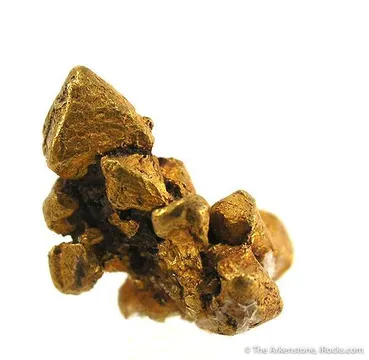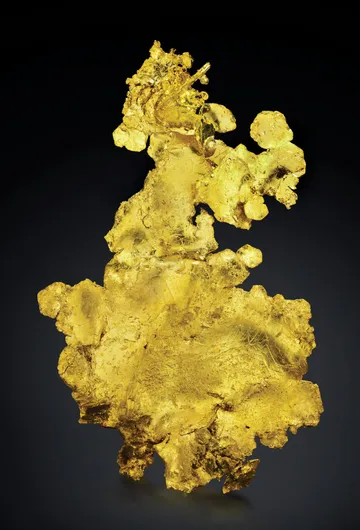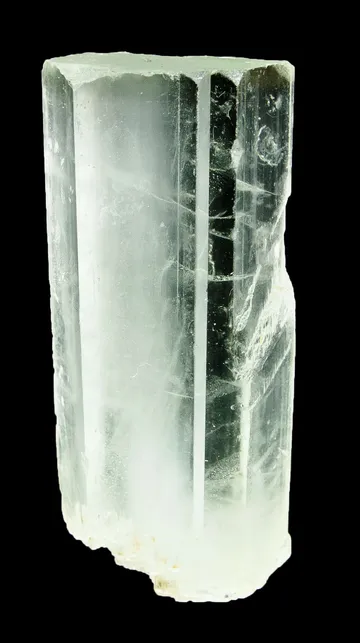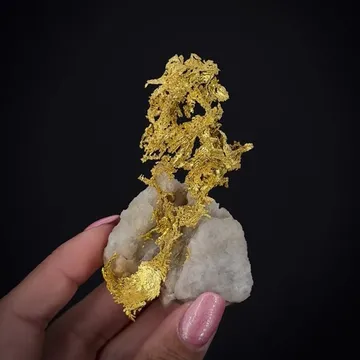
Placer County, USA: crystallized native gold from Michigan Bluff and Eagle's Nest; sculptural specimens with strong locality character and collectible appeal.
Key facts
Placer County occupies one of the most consequential pieces of California’s northern gold belt: the western slope of the Sierra Nevada, where bedrock gold-quartz veins, Tertiary auriferous river channels, modern stream placers, and later hydraulic and drift workings all overlap within a compact collecting geography. For the specimen collector, the county’s name is inseparable from native gold, not merely as rounded placer grains from ravines and bars, but as crystallized, sharply formed lode gold from the Michigan Bluff–Foresthill area, especially the Eagle’s Nest and related De Maria/Garbe workings. The best pieces are not anonymous yellow metal; they are sculptural mineral specimens—flattened octahedra, herringbone growths, wires, leaves, dendritic networks, and thick arborescent masses standing against white quartz or limonite-stained seam material.
Regional View
Country View
Historically, Placer County was first and foremost a placer-gold county. Gold was found at Auburn Ravine in 1848, and by the 1850s miners were working bars of the American River and its tributaries, drift-driving into ancient buried channels on the Foresthill Divide, and tearing down cemented auriferous gravels around Dutch Flat, Gold Run, Iowa Hill, Yankee Jims, and Michigan Bluff. Lode mining followed the surface discoveries, and the Ophir district near Auburn became the county’s most productive hard-rock gold district. Yet the county’s modern mineral-collecting fame rests disproportionately on a smaller, more specialized phenomenon: pockety, near-surface crystallized gold in narrow quartz veins and seams in the Michigan Bluff district.

Photo: Daderot, Wikimedia Commons
A cabinet-quality Placer County gold specimen should show three things at once: recognizable crystal morphology, a natural sense of architecture, and honest locality character. Eagle’s Nest pieces are often comparatively flat because they grew in narrow vein openings, but the finest examples break out of that constraint with curling leaves, intergrown plates, wires, open dendritic frameworks, or three-dimensional masses perched in or on quartz. Ordinary pieces are merely attractive gold; superior pieces are unmistakably mineralogical.
Search for specimens: View all specimens from Placer County, USA
Placer County’s specimen story begins with two related but distinct deposit settings. The first is detrital: auriferous gravels in modern streams and, more importantly, older Tertiary river channels preserved along the Sierra Nevada foothills and commonly capped by volcanic rocks. These channels were worked by hydraulic methods where exposed and by drift mines where buried, especially around Dutch Flat–Gold Run, Foresthill, Iowa Hill, Yankee Jims, Damascus, and Michigan Bluff. The second is lode mineralization: gold-bearing quartz veins and seams in the metamorphic and intrusive rocks of the western Sierra Nevada, including slate, schist, metavolcanic rocks, granodiorite, quartz diorite, and related dikes. The placer deposits are the historical engine; the lodes are the source of most serious cabinet specimens.
The Dutch Flat–Gold Run district sits on Tertiary channel gravels extending southward from Nevada County. Gold Run was historically considered either a separate district or part of the larger Dutch Flat system, depending on the source, and its ancient channel gravels include well-cemented lower beds that were worked both by drifting and by hydraulic mining where exposed. Historic descriptions record major water use, bedrock drain tunnels, and cemented bottom gravels that required blasting before washing. These are not the usual source of crystallized mineral specimens, but they explain why Placer County became a leading gold county: it possessed immense volumes of old auriferous gravel at elevations high above modern drainage.
The Foresthill Divide, between the North and Middle Forks of the American River, is one of the county’s great ancient-channel terrains. The district’s gravels were extensively drift mined, with peak productivity in the 1860s. The Independence, New Jersey, and Jenny Lind mines were among the best-known early producers, and the Hidden Treasure mine in the broader Foresthill-Damascus channel system became one of California’s famous drift mines in auriferous Tertiary gravel. Here the collector should picture long underground workings following buried river beds, not open crystal-lined cavities; the collectible minerals from this setting are chiefly placer gold, heavy-mineral concentrates, and occasional quartz or ore material from intersected lode structures.
The Ophir district, near Auburn, is the county’s classic lode-gold district. Its ore bodies occur in gold-bearing quartz veins emplaced in Jurassic metavolcanic rocks and in quartz diorite of the Lower Cretaceous Penryn Pluton. Historic sources note that Ophir gold was commonly lower in fineness than the California average, and some specimen gold was produced, though Ophir is better known to mining historians than to the present specimen market. Associated sulfides in county lode veins include pyrite, galena, chalcopyrite, sphalerite, and arsenopyrite, with oxidized zones producing limonite, manganese and iron oxides, and occasional secondary minerals.
The Michigan Bluff district is the heart of Placer County’s modern specimen reputation. The district includes placer and quartz gold mines around Byrds Valley, Chicken Hawk Ridge, Sage Hill, Michigan Bluff, and adjacent drainages near Foresthill. The Eagle’s Nest Mine, on private land near Sage Hill and Lady Canyon, is the name now most widely attached to the county’s best crystallized gold specimens. Older labels may read Michigan Bluff district, Mystery Wind, De Maria, Garbe, or De Maria/Garbe; serious labels should preserve those historical names when documented but should not treat them carelessly as interchangeable without provenance.
At Eagle’s Nest and the related De Maria/Garbe workings, the gold occurs in a narrow, near-surface vein and seam system rather than in broad stopes of massive ore. Historic accounts describe free crystallized gold in quartz seams in decomposed rock or porphyry dike material; modern descriptions emphasize flattened crystal aggregates formed in restricted openings, commonly with quartz and minor sulfides. The gold may occur in white quartz, in fractures or veinlets cutting earlier massive quartz, or in limonite-rich seam material after oxidation of sulfides and host rock. This is why many specimens show a tension between delicacy and compression: they are grown as true crystals, but in tight spaces.
Placer County remains a living mining jurisdiction. County records list the Eagle’s Nest Mine as an active lode-gold operation, with recent reclamation-amendment documentation tied to waste-rock dump expansion and continued underground mining. That matters to collectors because it means the locality is not merely a nineteenth-century label surviving in old cabinets; it has had modern specimen production, and exceptional finds have continued to reach the market. It also means access is not casual. Eagle’s Nest is an operating mine on controlled land, and collecting there is not a public rockhounding opportunity.
For field collectors, Placer County must be approached with the usual Gold Country caution. Many historical workings are on private property or active claims, old adits and hydraulic cuts are dangerous, and public-land collecting is constrained by mining claims, park rules, water-quality regulations, and local access restrictions. Modern recreational panning may be possible in some permitted public settings, but specimen collecting from mines, dumps, or claims requires explicit permission. The specimens that define the county in high-end mineral collections have overwhelmingly come through mining operations, old collections, or legitimate dealer channels rather than casual surface picking.
Placer County gold ranges from rounded placer grains and nuggets of the American River drainage and Tertiary-channel districts to sharp lode crystals from Michigan Bluff, with Eagle’s Nest furnishing the county’s premier collector material: rich yellow native gold in wires, leaves, dendritic plates, flattened octahedra, herringbone forms, and arborescent masses, commonly with white quartz or limonite-stained seam material. The most desirable pieces show bright luster, recognizable crystallography, open negative space, and a composition that reads as a natural sculpture rather than a trimmed bit of metal; matrix pieces with quartz contrast are especially prized, while ordinary examples are flatter, more massive, more heavily prepared, or visually congested.
Quartz in Placer County is both the county’s great gangue mineral and, in a few settings, a specimen mineral in its own right: milky to translucent vein quartz hosts lode gold at Eagle’s Nest, De Maria/Garbe, Ophir, Damascus, and other gold districts, while quartz-rich gravels dominate many of the ancient-channel deposits. In specimen terms, the best quartz is not sought as isolated perfect crystals so much as matrix—clean white or translucent quartz that frames native gold without overwhelming it, or fractured vein quartz carrying visible gold, galena, pyrite, or iron oxides; pieces with honest gold-in-quartz relationships are far more desirable than broken quartz simply stained by limonite or sprinkled with ambiguous brass-colored sulfides.
Beyond gold and quartz, Placer County’s documented mineral suite reflects its mixture of gold-quartz veins, oxidized seam deposits, ultramafic and metamorphic rocks, and western-valley industrial deposits. Sulfides and ore minerals recorded from county localities include pyrite, arsenopyrite, galena, chalcopyrite, sphalerite, acanthite, and chlorargyrite; oxidized or secondary minerals include limonite, manganese oxides, and coquimbite from copper-silver occurrences near Lincoln and Whiskey Hill. Rocklin-area records include hercynite and the chrome-bearing variety picotite, while other county entries include brookite, rutile-bearing quartz, tourmaline, actinolite, amphibole minerals, native copper, native silver, native tellurium, and placer platinum-group minerals in broader regional records. These are rarely the reason collectors seek Placer County specimens; the county’s international stature rests on crystallized native gold.
The first collecting issue with Placer County gold is locality precision. “Placer County” is a broad label covering many unrelated gold settings, and “Michigan Bluff,” “Eagle’s Nest,” “De Maria,” “Garbe,” and “Mystery Wind” have all appeared on specimen labels. A serious label should give the most specific locality supportable by provenance: Eagle’s Nest Mine, Sage Hill, Michigan Bluff Mining District, Placer County, California, USA, for firmly documented Eagle’s Nest material; De Maria/Garbe only where older provenance or collection history justifies it; and simply Michigan Bluff district or Placer County when the mine attribution is uncertain.
Preparation is the second major issue. Many Eagle’s Nest-style gold specimens were liberated from quartz or seam material, and some have had quartz selectively removed to expose the gold. That preparation can be legitimate and aesthetically excellent, but it should be disclosed. A natural gold-on-quartz specimen, a partially etched specimen, a cleaned seam specimen, and a reconstructed or glued piece are very different market objects. Look for continuous gold penetrating the quartz, natural attachment points, consistent color and luster, and plausible crystal relationships. Be especially cautious of loose gold leaves perched on quartz with suspicious contact points, modern adhesive, or matrix that does not match the county’s usual vein material.
Mislabelling is more common than outright fakery. California crystallized gold from the Colorado Quartz Mine, Mockingbird Mine, 16 to 1 Mine, Red Ledge Mine, and Eagle’s Nest can all be confused in the trade when old labels are lost. Eagle’s Nest pieces tend to be relatively flat, highly crystallized, and often associated with white quartz or oxidized seam material, but habit alone is not proof. Good provenance—old dealer label, collection tag, publication record, mine-run documentation, or a credible chain of ownership—adds real value.
Condition matters intensely. Gold is malleable, and fine wires or leaves can be bent by careless handling. Quartz matrix is harder but brittle, and the junction between exposed gold and quartz is the vulnerable zone. Avoid repeated handling, ultrasonic cleaning, aggressive brushing, and any attempt to “improve” the specimen mechanically. Iron oxides and limonite can be part of the natural setting; removing them may damage both context and value. There is no meaningful fluorescence issue for native gold itself, and reported Placer County gold is not collected for ultraviolet response.
Market availability is uneven. Small gold-in-quartz pieces and modest crystallized gold specimens appear periodically, but top Eagle’s Nest pieces with size, luster, three-dimensionality, and old provenance are scarce and expensive. Modern activity at the mine has renewed market interest, including notable recent pockets, yet fine specimens remain far less common than generic placer gold, bullion nuggets, or low-grade gold-quartz ore. For a serious collection, one excellent, well-provenanced miniature can be more meaningful than several larger but shapeless gold masses.
In the old Placer County gold towns, the mineral story begins not with glass cases but with water, gravel, and altitude. Dutch Flat was founded in the spring of 1851 by Joseph and Charles Dornback, and for nearly three decades it was a hydraulic-mining town of consequence. Gold Run, first called Mountain Springs, followed in 1854. Ophir, one of the county’s earliest camps, was populous enough in 1852 to poll 500 votes before a July 1853 fire nearly erased it; it later became the county’s quartz-mining center. These were not scenic names on a mineral label—they were working communities built around ancient river gravels and gold-bearing veins.
Gold Run gives one of the most concrete pictures of hydraulic mining at scale. By 1873, the workings had reached levels where natural outlets were choking with tailings, so miners drove a 4,000-foot bedrock drain tunnel to let them keep attacking the lower gravels. In one recorded 60-day run, they treated 237,400 cubic yards of cemented bottom gravel and recovered $64,564.81 in period gold value. The operation used dynamite and black powder to break an 80-foot depth of cemented gravel, then blasted the ground with 2,000 miner’s inches of water under 450 feet of head. That is the geological ancestry of the county’s name made physical: gravel, water pressure, and gold concentrated by vanished rivers.
The Foresthill Divide tells a quieter but equally rich underground story. The old river channels did not simply lie open on the surface; miners had to drift into them, following buried gravel under volcanic caps and ridge crests. Before 1868, the Independence, New Jersey, and Jenny Lind mines alone produced $2,400,000 in gold, and the district’s peak came in the 1860s. A drift mine in this terrain was a pursuit of an ancient river in darkness—miners tunneling not for a vein but for the bed of a river that had vanished from the landscape millions of years before.
The De Maria/Garbe story is the hinge between Placer County mining history and modern specimen collecting. In 1917, Clarence Waring described a Michigan Bluff district mine where free crystallized gold occurred in quartz seams in a porphyry dike and was recovered by placer methods. The point is subtle but important: this was lode gold, grown in place as crystals, yet the decomposed nature of the rock and the loose seam material allowed miners to wash it rather than mine it like ordinary hard quartz ore. That hybrid character—crystallized lode gold recovered from friable seam material—helps explain the peculiar beauty and preservation of some Placer County specimens.
The Eagle’s Nest Mine emerged into the mineral-collecting consciousness much later. In 1982, crystallized gold specimens from what is now recognized as Eagle’s Nest began appearing in the collector literature under the broader Michigan Bluff district label. Over the following decades, the mine became one of California’s most recognizable sources of crystallized native gold. Its pieces could be astonishingly flat, as if squeezed between pages of quartz, yet the best examples grew into leaves, branching plates, thick crystal weaves, and complex structures that seem too delicate to have survived blasting, extraction, trimming, cleaning, and travel through the specimen trade.
One specimen even entered the literature under a name: “the Eagle,” a 1.75-inch gold crystal specimen from Placer County published in connection with the Joseph A. Freilich Collection. The nickname fits the way collectors talk about the locality. Eagle’s Nest gold invites pareidolia—dragons, feathers, seahorses, trees, halos—not because the names are scientific, but because the crystals are genuinely sculptural. Good Eagle’s Nest gold is not a nugget; it is a frozen gesture.
The modern chapter reopened dramatically. After years of dormancy, Eagle’s Nest was acquired by Daniel Trinchillo in 2019. With mine manager Keith Wentz and geologist Ian Merkel, the operation entered a new specimen-producing era. On Valentine’s Day 2024, miners encountered a pocket of significant crystallized gold, subsequently known in the trade as the Valentine Pocket. The find was notable because it produced complex, large, three-dimensional pieces after a long interval in which the mine had been regarded by collectors as a sleeping giant. For a locality with roots in the Gold Rush, that 2024 pocket gave Placer County something rare: not just history, but a current event worthy of the old stories.