Shuikoushan Mine, China — southern Hunan locality renowned for brilliant sphalerite crystals in honey-yellow to ruby-red on quartz, with calcite and galena; pr…
Key facts
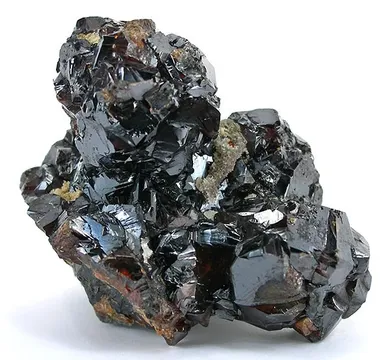
Shuikoushan sits in southern Hunan’s great Nanling metallogenic province, a belt where Mesozoic intrusions, carbonate rocks, faults, and long-lived hydrothermal systems produced some of China’s most important polymetallic ore fields. For mineral collectors, the name is attached above all to brilliant sphalerite: honey-yellow, orange, red-orange, and deep ruby-red crystals perched on sparkling quartz, often with calcite and galena. The best pieces have an unmistakable Chinese aesthetic of the early twenty-first-century market—glassy, complex sphalerite crystals with many modified faces, sharp edges where they are not naturally rounded by growth, and a lively contrast against pale drusy quartz.
Geologically, Shuikoushan is not a single simple vein locality but a district-scale Fe-Cu-Pb-Zn-Au-Ag system. The classic mining area includes skarn-style Cu-Pb-Zn mineralization close to the Shuikoushan granodiorite contact and hydrothermal Pb-Zn-Au-Ag bodies and calcite-quartz-sulfide veinlets away from the intrusive contact, especially in faulted and brecciated ground. That breadth matters to collectors because it explains the specimen palette: sulfides and carbonates from skarn and hydrothermal zones, with sphalerite, quartz, calcite, galena, pyrite, and a suite of silver and bismuth-bearing accessory minerals all belonging to the same broader metallogenic story.
Regional View
Country View
Historically, Shuikoushan is one of China’s landmark nonferrous mining districts. Modern state-backed development began in the late Qing period, and the district became closely associated with lead, zinc, copper, silver, gold, and industrial smelting. Its specimens entered the international fine-mineral market much later: the memorable collector pieces are chiefly modern finds from the Shuikoushan ore field, especially material sold under the Shuikoushan and Kangjiawan labels from the 2000s onward. At their best, they compete not by sheer exotic rarity, but by color, transparency, balance, and the unusually rich sculptural habit of the sphalerite.
Search for specimens: View all specimens from Shuikoushan Mine, China
The collector label “Shuikoushan Mine” is commonly used for specimens from the Shuikoushan ore field around Changning County, Hengyang, Hunan Province. In stricter geological usage, Shuikoushan includes several related deposits and mines, among them the Shuikoushan Pb-Zn-Cu-Au Mine and the Kangjiawan Pb-Zn-Ag-Au deposit. This distinction is worth keeping: many of the finest collector sphalerites have circulated as Shuikoushan or Kangjiawan material, and both names point into the same mineralized district rather than to distant, unrelated sources.
The Shuikoushan Pb-Zn-Cu-Au Mine is a skarn-type Cu-Pb-Zn deposit at the contact between the Shuikoushan granodiorite lopolith and Carboniferous-Permian carbonate rocks. Regional studies describe Devonian to Triassic carbonate and clastic sequences folded and faulted in a north-south structural grain, with granodiorite as the volumetrically dominant intrusive rock in the ore field. Where the granodiorite meets carbonate wall rocks, garnet-, diopside-, magnetite-, hematite-, pyrite-, sphalerite-, and chalcopyrite-bearing skarns developed; farther from the garnet-bearing skarn, calcite-quartz-pyrite-sphalerite-galena veinlets occupy faulted breccia.
The ore field is large by any collector’s standard. Published modern summaries describe Shuikoushan as one of South China’s largest Pb-Zn-Au polymetallic magmatic-hydrothermal systems, with skarn Cu-Pb-Zn, vein-type Pb-Zn-Au-Ag, and epithermal Au-Ag mineralization all recognized within the broader field. The principal named deposits include Kangjiawan, Yagongtang, Laoyachao, and Longwangshan, with nearby Baifang also important in the broader mining complex. Recent geochronology places key granodiorite and mineralizing events in the Jurassic, with mineralization tied to a prolonged magmatic-hydrothermal system rather than a single brief pulse.
Kangjiawan is especially important for understanding the ore mineralogy behind many Shuikoushan specimens. It is a blind hydrothermal Pb-Zn-Ag-Au deposit developed away from the main granodiorite contact, with orebodies occurring hundreds of meters below the surface. Published work describes seven large and 25 small ore lenses distributed over a north-south belt about 2500 by 800 meters, with many of the major orebodies in or near a silicified breccia zone at the unconformity between Jurassic and Permian rocks. The ores are mainly pyritic, pyrite-Pb-Zn, and Pb-Zn types, with sphalerite, galena, arsenopyrite, silver sulfosalts, electrum, quartz, and calcite.
Mining history at Shuikoushan is unusually deep for a specimen locality. Official company histories trace the modern enterprise to the Shuikoushan Lead-Zinc Mining Bureau established in 1896. Early milestones include construction of a steam-powered mechanized inclined shaft in 1905, a modern gravity concentrator in 1909, a Western-style lead smelter in 1910, a light railway from Shuikoushan to Songbai in 1912, and a major gravity concentrator in 1917. By the twentieth century, Shuikoushan had become not simply a mine but a mining, milling, smelting, refining, and metallurgical complex.
Today the district is an industrial mining and metallurgical area associated with Hunan Shuikoushan Nonferrous Metals Group Co., Ltd., part of the China Minmetals orbit. Company documents describe an integrated enterprise in Changning’s Shuikoushan Town, with mining, beneficiation, smelting, processing, and trade centered on lead, zinc, copper, precious metals, and associated products. Current production-unit listings include Kangjiawan Mine, a lead-zinc mine, Baifang Copper Mine, a concentrator, and smelting/refining units. This is not a public rockhounding locality; collecting access should be regarded as closed except through legitimate mine channels, authorized recovery, or the specimen trade.
The notable collector finds are not documented in the old European style of named pockets and pocket maps. Instead, they are reconstructed from specimens that reached the market: transparent to translucent red, orange, and honey sphalerite on quartz, with calcite, galena, pyrite, arsenopyrite, and occasional fluorite or dolomite as associates. Fine examples are recorded from 2004, around 2005, 2008-2010, 2019, and even later labels, suggesting more than one productive episode rather than a single isolated pocket. The recurring features—microcrystalline quartz matrix, red to orange multifaced sphalerite, rhombohedral or lenticular calcite, and local galena—fit both the published ore assemblage and the market record.
Shuikoushan sphalerite is the signature collector mineral of the locality: ZnS crystals ranging from honey-yellow and orange to intense red and deep red-orange, typically transparent to translucent and notably lustrous, set on pale microcrystalline or drusy quartz with calcite and galena frequent associates. Published ore studies from Kangjiawan show that most sphalerite is iron-bearing and zoned, but they also document a small amount of very low-iron reddish sphalerite, mainly in the northern part of the deposit, with rhombic dodecahedral morphology that cuts or replaces earlier iron-rich sphalerite; this provides a good geological explanation for the brighter red collector material. Dealer-documented specimens show individual crystals commonly around 1 cm, with better pieces reaching roughly 2-3 cm and exceptional matrix plates carrying numerous complex, multifaced crystals; one 2004 specimen records a main sphalerite crystal about 3 × 2.6 cm, and later examples from the 2000s and 2010s show similarly showy cabinet pieces. The best Shuikoushan sphalerites combine saturated red-orange color, transparency, crisp or richly modified faces, freedom from edge bruising, and a poised arrangement on sparkling quartz rather than crowded, dark, massive ore.
Quartz at Shuikoushan is usually the stage on which the sulfides perform: white to colorless drusy coatings, microcrystalline crusts, and small euhedral crystals lining breccia and ore openings, commonly intergrown with pyrite and later cut or overgrown by sphalerite and galena. In Kangjiawan fluid-inclusion work, quartz from orebody I was described as white euhedral crystals about 0.3 to 1 cm across, while quartz from orebody IV was white and massive; both preserve evidence that quartz formed early in the pyrite stage, before sphalerite and galena filled fractures. As collector material, the most desirable quartz is not usually sought as a standalone species but as a bright, clean, sharply crystallized matrix that gives contrast to orange-red sphalerite, metallic galena, or translucent calcite. Ordinary pieces have dull, gray, or broken quartz crusts; better ones show clean sparkling druse, open vugs, and enough topography to lift the sphalerite crystals off the matrix visually.
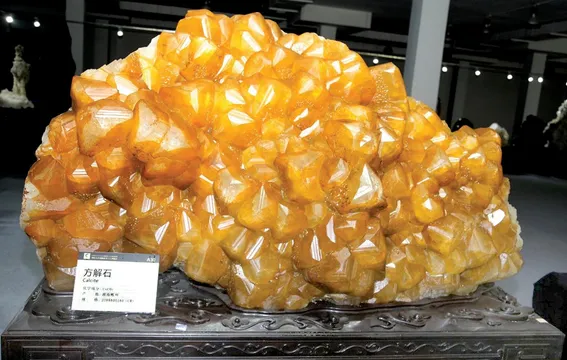
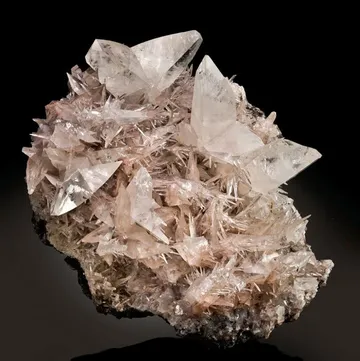
Calcite at Shuikoushan appears in the published ore assemblage as one of the principal gangue minerals with quartz, and in specimens it is the pale carbonate counterpoint to the red sphalerite and metallic sulfides. Collector examples include rhombohedral, lenticular, and complex equant crystals, from small white rhombs scattered with sphalerite and quartz to transparent yellow-orange crystals with golden reflections; documented calcite crystals on Shuikoushan/Kangjiawan specimens reach roughly 2-3 cm in good examples. Some dealer records note calcite fluorescence under longwave and shortwave ultraviolet light, so calcite can add both display value and an identification clue, though not every specimen should be assumed fluorescent. Good Shuikoushan calcite pieces have sharp, undamaged crystal form, transparency or warm internal glow, and balanced placement with sphalerite on quartz; more routine examples are merely white carbonate patches or bruised rhombs that add context rather than beauty.
Beyond the three market staples, Shuikoushan has a substantial ore-mineral inventory. Galena is a major PbS ore mineral and occurs in more than one generation at Kangjiawan, including massive coarse galena and later fine-grained galena veinlets with calcite and silver minerals. Pyrite is abundant; arsenopyrite, chalcopyrite, pyrrhotite, bournonite, electrum, acanthite, hessite, native silver, argentian tetrahedrite, freibergite, pearceite, polybasite-arsenpolybasite, and pyrargyrite-proustite have all been documented in the silver-bearing ores. Skarn and associated assemblages add andradite, grossular or hessonite, diopside, vesuvianite, magnetite, hematite, epidote, fluorite, baryte, scheelite, cassiterite, stannite, molybdenite, uraninite, chalcocite, bornite, bismuthinite, aikinite, emplectite, dolomite, aragonite, K-feldspar including adularia habit, sericite or muscovite, chlorite, and tourmaline-group records. Shuikoushan is not known to collectors as a classic type-locality destination for an accepted display species; one should also treat old-style or quoted species names, especially “Dognácskaite,” with caution because the name has a complicated and discredited history outside Shuikoushan and is not a modern display-specimen selling point here.
The main authenticity issue with Shuikoushan specimens is not widespread fabrication but locality precision. “Shuikoushan,” “Shuikoushan Mine,” “Shuikoushan ore field,” “Kangjiawan,” and sometimes older or misspelled forms such as “Kangjianwan” appear in the specimen trade. For fine sphalerite on quartz, Kangjiawan within the Shuikoushan ore field is a particularly common and credible source designation. A label that says only “Shuikoushan Mine, China” may still be commercially understandable, but advanced collectors should preserve any older dealer label, mine name, year, and association data because these distinctions affect provenance.
Condition is the chief practical concern. Shuikoushan sphalerite can be bright and gemmy, but sphalerite has perfect dodecahedral cleavage and is softer than quartz; exposed crystal edges, re-entrant twin angles, and high points on drusy matrix are vulnerable. Inspect red crystals for small bruises that flash lighter orange or gray, cleaved corners, contacted backs, and quartz dust caught on old repairs. The quartz matrix is usually durable, but fine druse abrades easily and can hide small chips. Calcite is softer and reactive to acids, so any cleaning should be conservative: no acid baths, no aggressive ultrasonic cleaning, and no prolonged soaking without knowing what sulfides and carbonates are present.
Fluorescence is possible in calcite from the locality, including examples recorded as fluorescent under both longwave and shortwave UV, but fluorescence should be treated as an added feature rather than a guarantee. Sulfide-rich specimens should be stored dry and away from acidic environments. Galena-bearing pieces should be handled with normal common-sense hygiene—wash hands after handling and avoid generating dust. Uraninite is documented in the ore field and mine records, but it is not part of the typical aesthetic sphalerite-quartz-calcite market suite; any unusually heavy, black, radioactive-looking ore specimen should be checked rather than assumed harmless.
Market availability is moderate but uneven. Small to medium Shuikoushan sphalerites on quartz remain obtainable, especially from older 2000s finds and later dealer inventories, but top cabinet specimens with large transparent red-orange crystals, strong aesthetics, and minimal damage have become harder to replace. The best pieces are now established modern Chinese classics: not rare in the sense of a single-pocket mineral, but genuinely selective in high quality. Fine calcite-dominant specimens from the locality are scarcer than sphalerite-dominant ones, and quartz-only specimens are usually valued mainly when they carry attractive sulfides.
The industrial story of Shuikoushan begins like a hinge between old China and modern mining. In 1896, in the last years of the Qing dynasty, the mine was brought under official development as the Shuikoushan lead-zinc mining bureau. Within a decade the district was no longer a traditional workings alone: in 1905 it had a steam-powered mechanized inclined shaft, described in company histories as China’s first of its kind. Four years later came a modern gravity dressing plant, and in May 1910 a Western-style lead smelter was completed. By 1912 a light railway linked Shuikoushan to Songbai, giving the mine a physical artery to move ore and metal. By 1917, the gravity concentrator was described as one of the largest and best-equipped lead-zinc dressing plants in the Far East.
The place also became part of China’s revolutionary memory. Company histories record that in 1922, under Mao Zedong’s guidance, Communist Party and Youth League organizations were established among the Shuikoushan miners. The mine’s labor movement became famous well beyond the district, and figures including Song Qiaosheng and Geng Biao are remembered as having passed through Shuikoushan before joining the revolutionary road toward Jinggangshan. For a collector holding a glossy red sphalerite from the district, it is easy to forget that the same ground is layered with labor history, metallurgical modernization, and political memory as well as mineral chemistry.
A more modern scene is the Kangjiawan smart-mine control center described in local media in 2024. Instead of candles, rails, hand sorting, and steam, the image is a large high-definition screen—production data, equipment states, ventilation, drainage, transport, and safety monitoring feeding into a “smart brain.” The report emphasizes 5G communications, the Internet of Things, big data, cloud computing, artificial intelligence, three-dimensional visualization, and integrated dispatch systems. It is a striking contrast: the same ore field that produced hand specimens cherished for their natural geometry is now managed through digital models, remote monitoring, and automated control.