A collector's guide to Kangjiawan Pb-Zn-Ag-Au deposit, China: its geology, mining history and notable minerals, illustrated with the 31 specimens documented from this locality on EarthWonders.
Key facts
Kangjiawan is one of the important modern Chinese localities for specimen-quality sphalerite, and a scientifically studied Pb-Zn-Ag-Au orebody within the Shuikoushan ore field of Changning County, Hengyang, Hunan. To collectors, its name means sharp, translucent to gemmy red-brown and cherry-red sphalerite crystals perched on sparkling drusy quartz, commonly with galena and locally calcite or baryte. To economic geologists, Kangjiawan is a concealed, structurally controlled polymetallic system on the southern margin of the Hengyang Basin, tied into the great Qin-Hang metallogenic belt of South China and now widely interpreted as part of a distal skarn to magmatic-hydrothermal system.
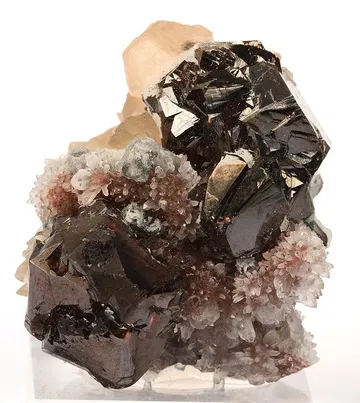
The locality’s best specimens are immediately recognizable: complex sphalerite crystals with rich red, orange-red, cinnamon, honey-brown, or deep resinous tones, often isolated enough on pale quartz crusts to display their modified faces and spinel twinning. Fine cabinet pieces can show sphalerite crystals in the 1–3.5 cm range, with the most desirable examples combining saturated transparent color, crisp geometry, balanced placement on matrix, and contrasting white to rusty quartz. The locality also matters beyond the display cabinet because Kangjiawan has yielded well-studied silver sulfosalts in galena, including pyrargyrite-proustite, pearceite, polybasite-arsenpolybasite, argentian tetrahedrite, and freibergite, making it a useful natural laboratory for Ag-Sb-As sulfide mineralogy.
Regional View
Country View
Kangjiawan’s collector fame developed from mine-produced specimens, not from surface digging. The deposit is blind, with orebodies beginning well below the surface, and the attractive crystals are products of underground mining in a working industrial Pb-Zn-Au-Ag mine rather than an accessible collecting field. That distinction is important: the locality has supplied outstanding specimens, but it is not a public-collecting destination.

Photo: Wikimedia Commons

Search for specimens: View all specimens from Kangjiawan Pb-Zn-Ag-Au deposit, China
Kangjiawan lies in the Shuikoushan ore field, Changning County, Hengyang, Hunan Province, central-southern China. The wider district is one of China’s classic Pb-Zn-Au-Ag mining centers, with more than a century of production history at Shuikoushan, while Kangjiawan itself is the younger, concealed deposit that became a major underground source of polymetallic ore and, intermittently, of collectible sphalerite-quartz specimens.
The deposit is hosted principally in Lower Permian carbonate and argillaceous-carbonate strata, especially the Dangchong Formation mudstone, siliceous rocks, and Qixia Formation limestone. Older district descriptions treated Kangjiawan as a hydrothermal Pb-Zn-Ag-Au deposit developed away from the obvious granodiorite contact, but recent mineral-chemical and geochronological work has strengthened the case that it belongs to the distal part of the Shuikoushan magmatic-hydrothermal/skarn system. In specimen terms, that helps explain why the mine produces both low-temperature vein-style associations and mineral chemistry that points back toward hotter, intrusion-related fluids at depth.
The structural architecture is essential. Kangjiawan’s ore is controlled by silicified breccia zones, bedding-parallel to lenticular orebodies, and the major F22 fault system. Published descriptions distinguish numerous Pb-Zn vein-type and lensoidal bodies, with seven historically treated as the major orebodies. Orebodies I–V are developed in silicified breccia in or near the Jurassic-Permian unconformity, while VI and VII occur in Lower Permian argillaceous limestone in the hanging wall of F22. They generally trend north-south, dip mainly west, and dip at low to moderate angles, roughly 15–40 degrees. One published account gives the largest orebody, orebody I, as about 1490 m by 520 m by 9 m; another more recent locality summary emphasizes the large IV-3 body, described as 859 m long, 33–174 m wide, and averaging about 6 m thick.
The ore assemblage is dominated by pyrite, sphalerite, and galena, with arsenopyrite, chalcopyrite, pyrrhotite, bournonite, electrum, and silver sulfosalts as important minor to trace constituents. Gangue is chiefly quartz and calcite, with local white mica, chlorite, K-feldspar of adularia habit, and skarn minerals reported from deeper or related zones. The mineralization is usually divided into three stages: an early quartz-pyrite stage; a main quartz-pyrite-galena-sphalerite stage; and a late calcite-pyrite-galena-sphalerite stage. For collectors, the middle and late stages matter most, because they account for the bright red to brown sphalerite on quartz and the galena-quartz-sphalerite combinations that have circulated internationally.
Kangjiawan was discovered in 1976 and was already being discussed in Chinese geological literature by the mid-1980s as an important concealed Pb-Zn deposit. Exploration was reported as completed in 1982, and mining began in 1989. By the 2000s it was described as the most actively mined deposit in the Shuikoushan district, with annual ore capacity quoted in environmental and mining studies at more than 400,000 tonnes. Modern company and market reports place Kangjiawan within the mining-rights framework of the Shuikoushan lead-zinc mine, now associated with Zhuye Group and Shuikoushan Nonferrous Metals under the China Minmetals/Hunan Nonferrous corporate system; recent reports describe mine-and-beneficiation capacity for the broader mining unit in the range of about 860,000 tonnes of raw ore per year.
Reserve and grade figures vary by date, reporting standard, and whether the author is discussing ore reserves, metal reserves, or remaining resources. Older mineralogical work quoted average ore grades near 3.9 wt.% Pb, 4.5 wt.% Zn, 86.8 g/t Ag, and 2.68 g/t Au. A 2022 sphalerite-geochemistry paper cited a proven ore reserve of 1.96 Mt at 4.70% Zn and 6.02% Pb. A 2024 cadmium-focused study described the deposit as containing 16.59 million tonnes of ore reserves, with about 0.5 Mt Pb metal and 0.56 Mt Zn metal. Current corporate reserve reporting for the mining area is higher still because it reflects ongoing resource accounting rather than only the sample frame of earlier academic studies.
Specimen production appears to have been episodic rather than continuous. Dealer and museum-style specimen records document attractive sphalerite on quartz from at least the late 1990s, with notable market appearances from roughly 2004–2010 and later examples still surfacing. Some labels use “Kangjianwan” or simply “Shuikoushan,” so older specimens should be interpreted carefully; the finest red sphalerites on drusy quartz, especially those with galena and calcite, are normally attributed to the Kangjiawan mine within the Shuikoushan ore field.
Today Kangjiawan is an active underground industrial mine, not a collecting site. Any access would require permission from the landholder, mine operator, and relevant authorities, and underground entry should be assumed closed to private collectors. Modern specimens reach the market through old stocks, mine-run recoveries, former dealer inventories, and collection dispersals rather than from casual field collecting.
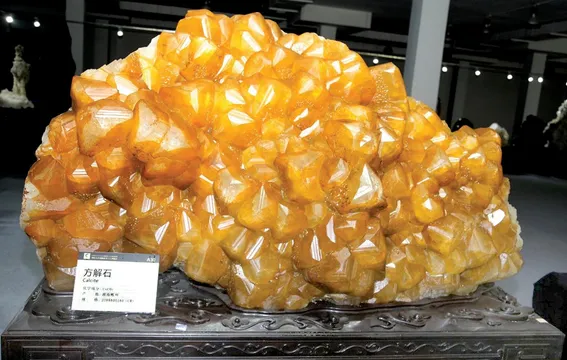
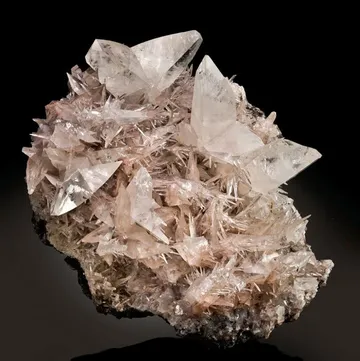
Kangjiawan sphalerite is the locality’s signature collector mineral: complex, modified, commonly twinned crystals in red-brown, cherry-red, honey-brown, orange-red, and cinnamon tones, usually translucent to gemmy rather than opaque black. Scientific work distinguishes multiple generations, including main-ore sphalerite associated with pyrite, galena, chalcopyrite, and quartz, and later sphalerite with calcite, pyrite, galena, and lower-temperature fluids; older ore-mineralogy also notes small amounts of reddish, low-iron sphalerite with rhombic-dodecahedral morphology chiefly in the northern part of the deposit, cutting or replacing earlier iron-rich sphalerite. Collector specimens typically show crystals from a few millimeters to around 2 cm, with exceptional documented pieces carrying crystals around 3–3.5 cm, set on sparkling microcrystalline quartz and sometimes accented by cuboctahedral galena, calcite rhombs, or baryte. The best pieces combine strong red transparency, sharp complex faces, obvious twinning or sculptural form, minimal edge wear, and clean separation from the quartz matrix; ordinary examples are darker, more crowded, more contacted, or partly dulled by mine abrasion and quartz overgrowth.
Quartz is both an ore-stage gangue mineral and the aesthetic stage on which Kangjiawan’s sphalerite performs. In the deposit, quartz appears in the early pyrite-quartz stage and in the main Pb-Zn-Ag stage with pyrite, galena, and sphalerite; fluid-inclusion studies have used quartz from the major orebodies to reconstruct the evolving hydrothermal system. On specimens, the most familiar quartz is a sugary to drusy white or pale gray crust coating breccia or sulfide matrix, sometimes rusty red from hematite inclusions and sometimes forming small prismatic crystals rather than mere sparkle. Documented standalone quartz clusters are typically small-cabinet scale, around 6–7 cm across, while sphalerite combinations may show broad quartz-coated plates supporting isolated red crystals. Better quartz specimens from Kangjiawan have lively, even coverage, good luster, and a color contrast that enhances associated sphalerite or galena; less desirable examples are visually flat, iron-stained without definition, or represent sawn and trimmed matrix with little crystal relief.
Other documented Kangjiawan minerals broaden the locality far beyond its display sphalerites. The ore suite includes galena, pyrite, arsenopyrite, chalcopyrite, pyrrhotite, bournonite, bornite, chalcocite, acanthite, hessite, native silver, native gold as electrum, and a particularly important group of silver sulfosalts hosted mainly in galena: pyrargyrite, proustite, pearceite, polybasite-arsenpolybasite, argentian tetrahedrite, and freibergite. Gangue and alteration minerals include calcite, aragonite, dolomite, baryte, fluorite, dickite, chlorite, muscovite/sericite, adularia/valencianite, and skarn-related andradite, diopside, epidote, magnetite, tremolite, vesuvianite, and serpentine-group material. Kangjiawan is not chiefly known as a type-locality source for valid mineral species; its rarity value lies instead in its exceptionally well-documented Ag-Sb-As sulfosalt paragenesis and the trace-element record preserved in its multiple generations of sphalerite.
Kangjiawan specimens are generally straightforward to recognize when they show the classic association: red to brown transparent sphalerite on glittering white or hematite-tinted drusy quartz, commonly with galena and sometimes calcite. The main label problems are geographic rather than mineralogical. Older labels may say “Shuikoushan,” “Kangjianwan,” “Kangjiawan Mine,” or “Hengyang, Hunan,” and not all Shuikoushan specimens necessarily come from the Kangjiawan Pb-Zn-Ag-Au deposit. Fine red sphalerite from Kangjiawan can also be confused in the marketplace with red sphalerites from Spain, Romania, Kosovo, Bolivia, or other Chinese Pb-Zn districts, so matrix, associations, provenance, and old dealer labels are important.
No well-documented, locality-specific fake or treatment problem appears to be attached to Kangjiawan sphalerite in the sources checked. That said, the style invites ordinary collecting caution: isolated sphalerite crystals on drusy quartz can be repaired, reattached, or visually improved by trimming, and sawn backs or heavily trimmed matrix are not unusual in mine specimens. A convincing Kangjiawan piece should show natural contact between sphalerite and quartz, consistent surface luster, and no suspicious glue meniscus around the crystal base under magnification.
Condition is the central grading issue. Sphalerite has perfect cleavage and is softer than quartz, so prominent crystals often show tiny edge nicks, bruises on high points, or dulled faces from extraction and transport. Galena, when present, may be bright on fresh pieces but can be slightly matte or oxidized; some dealer descriptions specifically note minor outside-edge contacts even on otherwise fine examples. Quartz crusts can conceal breaks or saw marks on the matrix, but they also protect the visual composition when the sphalerite sits proud and undamaged.
Kangjiawan sphalerite is available but not common in top quality. Small to medium red-brown sphalerites on quartz appear periodically from old stocks, dealer archives, and collection resales; large, gemmy, undamaged crystals with balanced matrix and attractive galena/calcite associations are much scarcer. A few specimen records note fluorescence on the quartz matrix under both shortwave and longwave ultraviolet light, but fluorescence is not the main reason to buy the locality. Buy Kangjiawan for color, transparency, crisp crystal architecture, and the unmistakable quartz contrast.
Zeng, N.; Izawa, E.; Motomura, Y.; Lai, L. (2000). “Silver Minerals and Paragenesis in the Kangjiawan Pb-Zn-Ag-Au Deposit of the Shuikoushan Mineral District, Hunan Province, China.” The Canadian Mineralogist, 38(1), 11–22. The key English-language mineralogical paper on Kangjiawan’s Ag-Sb-As sulfosalts and galena-hosted silver mineral paragenesis.
Shen, H.; Zhang, Y.; Zuo, C.; Shao, Y.; Zhao, L.; Lei, J.; Shi, G.; Han, R.; Zheng, X. (2022). “Ore-forming process revealed by sphalerite texture and geochemistry: A case study at the Kangjiawan Pb-Zn deposit in Qin-Hang Metallogenic Belt, South China.” Ore Geology Reviews, 150, 105153. Establishes multiple sphalerite generations and argues for a distal skarn-type interpretation tied to the Shuikoushan granodiorite system.
Qin, J.; Huang, F.; Zhong, S.; Wang, D.; Seltmann, R. (2022). “Unraveling evolution histories of large hydrothermal systems via garnet U-Pb dating, sulfide trace element and isotopic analyses: A case study of Shuikoushan polymetallic ore field, South China.” Ore Geology Reviews, 105063. Places Kangjiawan in the broader Shuikoushan polymetallic system and summarizes ore/gangue assemblages, alteration, and stages across the ore field.
Xia, Z.; Zhao, Z.; Zou, X.; Liu, L. (2024). “A Late Jurassic Epithermal Pb-Zn Deposit: Insights from Rb-Sr Dating of Quartz-Hosted Fluid Inclusions and Sphalerite Chemical Composition.” Minerals, 14(5), 485. Reports an Rb-Sr age of 150 ± 4 Ma from quartz-hosted fluid inclusions and discusses sphalerite chemistry and ore-forming temperature.
Shu, et al. (2024). “Oxidative fluids facilitate Cd enrichment in a magmatic-hydrothermal system: An example from the Kangjiawan Pb-Zn polymetallic deposit, South China.” Ore Geology Reviews, 165, 105926. Focuses on cadmium enrichment in multiple sphalerite generations and contrasts high-temperature Mn-rich sphalerite with low-temperature Cd-rich sphalerite.
Zhang, L.; Song, Y.; Hou, K.; Zhao, P.; Yuan, S. (2024). “Genetic link between the Kangjiawan gold deposit and late Jurassic granitic magmatism, South China: Constraints from in situ calcite U-Pb dating, sulfur isotope and trace elements of pyrite.” Ore Geology Reviews, 171, 106191. Uses calcite U-Pb dating and pyrite chemistry to link Kangjiawan gold mineralization to Late Jurassic magmatic-hydrothermal activity.
Qin, J.; Zhong, S.; Wang, D.; Huang, F.; Seltmann, R.; Rahnama, Z. (2025). “In situ compositional and sulfur isotopic analyses of banded sphalerite from the Kangjiawan Pb-Zn deposit, South China: Insights into incorporation mechanisms of critical metals (Cd, Ga, In).” Ore Geology Reviews, 187, 106994. A recent in-situ study of banded sphalerite and critical-metal incorporation, especially Cd, Ga, and In.
Mindat locality page for Kangjiawan Pb-Zn-Ag-Au deposit — Best single locality index for coordinates, alternate names, mineral list, rock types, and reference trail.
Wikimedia Commons category: Kangjiawan Pb-Zn-Ag-Au Deposit — Freely licensed specimen photographs, including sphalerite, quartz, and calcite from the locality.
Fabre Minerals reference page: Chinese sphalerites from Kangjiawan/Shuikoushan — Useful dealer archive documenting crystal sizes, associations, and market appearance dates for fine Kangjiawan sphalerites.
Quebul Fine Minerals archive specimen: gemmy sphalerite, galena, quartz — A concise market record of a small-cabinet Kangjiawan specimen with sphalerite, galena, and quartz.
Weinrich Minerals archive specimen: sphalerite with quartz — An example of miniature-scale Kangjiawan sphalerite on quartz from a documented collection provenance.
China Minmetals 2026 news item mentioning underground Kangjiawan Mine levels — Confirms the modern active industrial status of Kangjiawan within Shuikoushan operations.
Shanghai Metals Market note on Zhuye Group mining rights and Shuikoushan/Kangjiawan capacity — Current industry context for mining rights, mine capacity, and corporate operation.