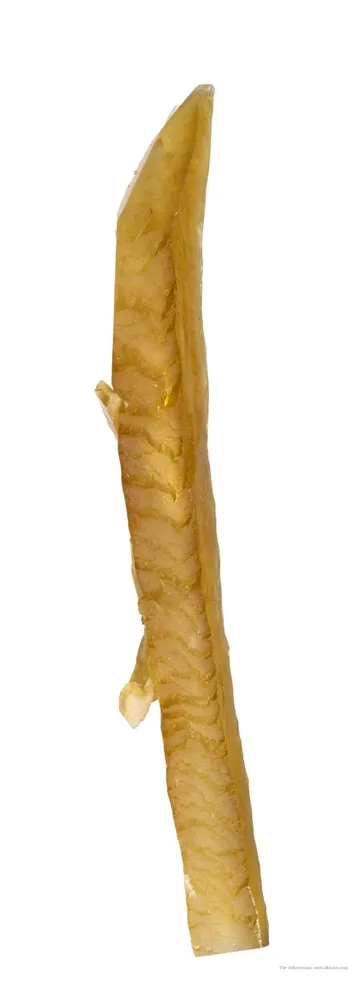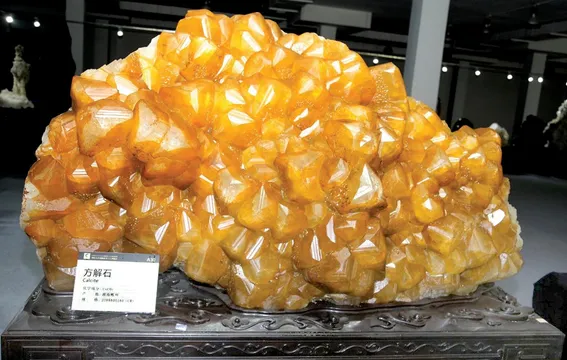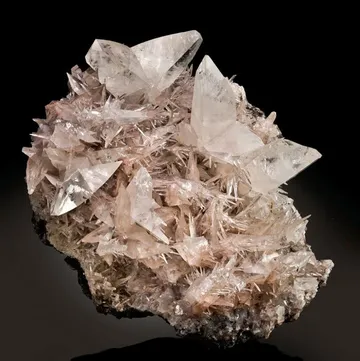
Taolin Mine, China - renowned fluorite-sulfide locality in Hunan, yielding green to purple fluorite on quartz with sphalerite and galena, prized by collectors.
Key facts
Taolin Mine is one of the great old names in Chinese fluorite–sulfide collecting: a large Pb-Zn-F deposit at Linxiang, in northeastern Hunan, on the northwestern flank of the Dayunshan–Mufushan granitic complex within the Jiangnan Orogen. Its collector importance rests on a distinctive magmatic-hydrothermal vein and breccia assemblage—fluorite, quartz, sphalerite, galena, chalcopyrite, pyrite, baryte and calcite—formed as open-space fillings in a major fault zone where granite meets Neoproterozoic metasedimentary rocks. The scientific literature has treated Taolin as a benchmark deposit because its fluid inclusions, isotopes and ore textures record the evolution of a medium- to low-temperature hydrothermal system tied to Early Cretaceous magmatism.
For collectors, Taolin is far more than an ore deposit. The best pieces have a look that is immediately separate from the better-known Hunan W-Sn localities: transparent to translucent green or blue-green fluorite cubes and cuboctahedra on sparkling white quartz; purple fluorite combinations with galena and sphalerite; and lustrous, gemmy orange-red to cherry-red sphalerite crystals perched on quartz plates. Many fine specimens date from the 1990s to early 2000s, with older production filtering into collections under labels such as Taolin, Linxiang, Yueyang, Hunan. The mine’s industrial story is equally important: it was developed as one of the major state mining projects of early People’s Republic industrialization, rose to a very large Pb-Zn-fluorite producer, and then passed into closure, resource exhaustion, flooded workings and post-mining redevelopment.
Regional View
Country View
Taolin specimens are seldom dominated by one species alone. Their strength is contrast: sharp green fluorite against snow-white quartz; dark sulfide blebs and crystals visible beneath translucent fluorite; cherry-red sphalerite glowing through an otherwise sober quartz matrix; or baryte and galena giving the combinations a dense metallic weight. The best fluorites are not merely green cubes: they show glassy windows, frosted bevels, polycrystalline stepped growth, cuboctahedral outlines, phantom-like color zoning, or a clean three-dimensional placement on quartz. The best sphalerites show real internal color rather than opaque brown-black massing, and their value rises quickly when they are isolated, lustrous, undamaged and set off by quartz.

Photo: Wikimedia Commons

Photo: Wikimedia Commons
Search for specimens: View all specimens from Taolin Mine, China
Taolin Mine lies in Linxiang County-level City, Yueyang, Hunan Province, roughly east of Yueyang in the northeastern Hunan metallogenic belt. The mineralized system is a large Pb-Zn-fluorite deposit developed in and around the Taolin fault zone, where the Neoproterozoic Lengjiaxi Group—slates, phyllites and metasiltstones—lies close to the Dayunshan–Mufushan granitic complex. The broader district includes Neoproterozoic, Cretaceous, Paleogene and Quaternary strata, but the collector minerals of interest come from hydrothermal veins, breccias and open cavities in the fault-controlled ore system rather than from weathered surface float.
Geologically, Taolin is best understood as a medium- to low-temperature magmatic-hydrothermal Pb-Zn-Cu-F system. Older studies emphasized the uncertainty of its genetic classification—Mississippi Valley-type, epithermal or mesothermal—because the deposit combines open-space filling textures with relatively cool fluid-inclusion temperatures and a strong structural control. More recent isotope and geochronological work ties the ore system to Early Cretaceous magmatism of the Mufushan area. Sphalerite Rb-Sr dating and zircon U-Pb work on associated monzogranite point to closely spaced Early Cretaceous magmatic and mineralizing ages around 136–135 Ma, while broader work on the Dayunshan–Mufushan region places Taolin among a cluster of northeastern Hunan Pb-Zn-(Cu) polymetallic systems formed during repeated Late Jurassic to Early Cretaceous magmatic-hydrothermal events.
The deposit contains more than 0.98 million tonnes of combined Pb + Zn metal at an average grade around 2.35%, with fluorite as an economically important associated commodity. Chinese mine records and later resource summaries describe lead, zinc and fluorite concentrates as the principal products, with copper recovery added after 1978 and associated elements such as sulfur, silver, gold and gallium recovered during smelting. Ore and gangue minerals occur as cherty to coarse quartz, fluorite, baryte, chlorite and calcite with sphalerite, galena, chalcopyrite and pyrite. Texturally, the deposit includes quartz-sulfide veins, brecciated ore with fluorite and chalcopyrite around wall-rock fragments, massive sulfide-quartz ore, and stockwork quartz-fluorite-sulfide zones cut by later quartz.
Published paragenetic work divides Taolin’s hydrothermal history into successive stages. A coarse barren or weakly mineralized quartz stage was followed by a main ore stage of quartz + fluorite + chlorite + sphalerite + galena + chalcopyrite; a later quartz + baryte + pale sphalerite + galena + chalcopyrite stage; then late quartz with or without chalcopyrite; and finally fine-grained quartz. These relationships match what collectors see in hand specimens: quartz is almost always the architectural base, fluorite and sphalerite occupy the most visually important cavities, and galena, chalcopyrite, pyrite and baryte appear as accessories that can either enrich or clutter the composition.
Historically, small-scale exploitation goes back to the late Qing dynasty. Local accounts place the first widely remembered discovery in the Guangxu period, when a farmer at Zhongtangchong reportedly found a heavy, silver-bright ore stone while clearing a spring basin. By 1901, private mining companies were working lead ore in the district, including early activity at Shangnanchong and other named hills and gullies. Modern state-led exploration began after the founding of the People’s Republic. The Central-South Geological Bureau’s 405 Team worked the Yinkongshan, Shangtangchong, Duanshandong, Guanshan, Dujiacong and Qiuping’ao sectors in the 1950s, and the formal exploration report on Taolin became one of the early major reserve documents approved in the new national system.
Large-scale mine construction began in the late 1950s. The mine was formally established in 1957 and developed as one of the First Five-Year Plan’s 156 major industrial projects. Early production combined shallow open-cut work above the 80 m level with underground development below, eventually using a central double-shaft system, diagonal ventilation through wing shafts, 40 m-level spacing, and underground stoping methods appropriate to the vein and breccia ore. The design capacity was about 1 million tonnes per year; by the early 1970s the operation had approached that scale in both mining and milling. The principal mined sectors included Shangtangchong, Yinkongshan, Dujiacong, Guanshan and Duanshandong.
The mine’s industrial peak came in the late twentieth century, when it was described in Chinese sources as one of the largest nonferrous mining enterprises in the country and, in local development accounts, as a major mining center of the Asia-Pacific region. Production records cited in official materials give tens of millions of tonnes of ore mined and milled over the life of the operation, with a large tailings complex at Yutan. By the end of the main state-mine period, resource exhaustion and declining viability led to closure and bankruptcy proceedings. The mine was declared closed and bankrupt in December 2002, and later local records place the final bankruptcy handover into 2003. Subsequent attempts to rework parts of the old district faced flooded workings and the legacy of tailings and subsidence, while parts of the former industrial area have been incorporated into post-mining redevelopment and heritage planning.
For specimen collectors, this history matters because Taolin is not a modern, open specimen producer with routine access. Most fine cabinet pieces in circulation are older mine-run or dealer-held specimens from the active or closing years, especially material seen on the international market around the late 1990s, 2001–2003 and the early 2000s. The mine workings and tailings areas are industrial and post-industrial sites, not public collecting grounds. Any visit would require permission from the current land, mining-rights or local authorities, and underground access should be considered unsafe where workings are flooded, unstable or affected by old stopes and subsidence.
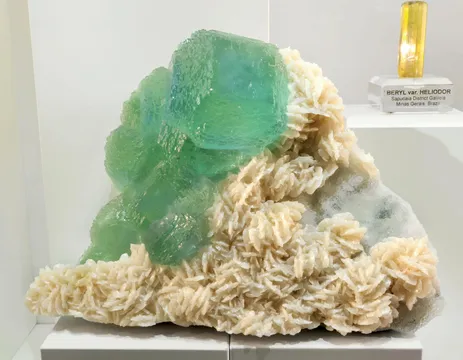
Taolin fluorite is the locality’s signature collector mineral, most often seen as transparent to translucent green, blue-green, colorless-green zoned, or rarer violet cubes and cuboctahedral to stepped polycrystalline crystals on quartz. Documented specimen crystals commonly range from about 1 to 3 cm, with exceptional cabinet pieces showing fluorites to roughly 2.5–2.8 cm and older descriptions noting green octahedral-looking or cuboctahedral forms with glassy faces and frosted bevels. The classic association is white quartz, sometimes with sphalerite, galena, chalcopyrite or pyrite; some fluorite fluoresces purple or shows fluorescence under long- and short-wave ultraviolet light. The best Taolin fluorites separate themselves by transparency, clean luster, saturated but not muddy green color, crisp stepped growth, attractive placement on sparkling quartz, and freedom from cleaved corners—a common weakness in this brittle species.
Quartz at Taolin is both a gangue mineral and the visual stage on which the collectible fluorite and sphalerite sit. It occurs as coarse early quartz, later fine-grained quartz, drusy white quartz plates, water-clear prismatic crystals, microcrystalline sparkling crusts and, in the wider mineral record, amethyst and rose quartz varieties. On good specimens, the quartz is not merely matrix: it forms thin, bright, snow-white to colorless plates that contrast sharply with green fluorite or red sphalerite, and in some pieces it partly invests fluorite crystals in ivy-like or sugary overgrowths. Collector-quality quartz is judged by brightness, cleanliness, and the way it frames the ore minerals; dull massive quartz with embedded sulfides is common ore, while crisp sparkling quartz plates with isolated fluorite, sphalerite or galena are the desirable Taolin style.
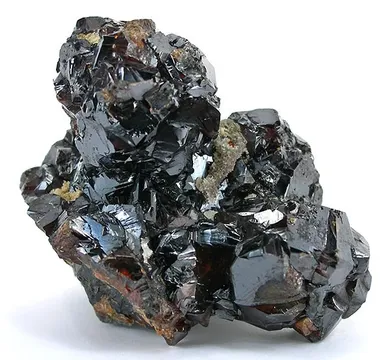
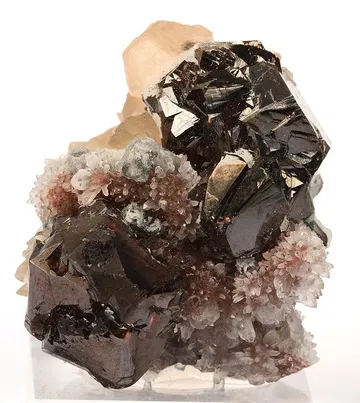
Taolin sphalerite is prized when it breaks from the ordinary dark ore habit into sharp, lustrous, gemmy orange-red, amber-red or cherry-red crystals on quartz. Fine examples include crystals around 1–2 cm, sometimes scattered across quartz plates or grouped beside fluorite; one widely illustrated specimen carries a 1.6 cm cherry-red crystal with smaller sphalerites on a quartz-covered matrix, while other market and photo records describe 1.9 cm sphalerite, orange-red sphalerite with galena on quartz from a small 2001 find, and cabinet combinations with sphalerite adjacent to blue-green fluorite. The scientific literature distinguishes generations of sphalerite at Taolin, including earlier clay-brown sphalerite and later pale-yellow sphalerite in the main Pb-Zn stages, and recent trace-element work shows Taolin sphalerite can be enriched in Cd and Ga. For collectors, the best pieces are those that backlight to warm amber or red, show sharp complex twinned forms, and sit visibly on contrasting quartz rather than disappearing as dark masses under fluorite.
Other documented minerals from Taolin include galena, chalcopyrite, pyrite, baryte, calcite, acanthite, covellite, malachite, muscovite-sericite, chlorite-group minerals and limonite, with “alaskaite” also reported in the locality record as an unclassified name rather than a standard display species. Galena is most interesting when it appears as sharp cubo-octahedral metallic crystals on quartz with fluorite or sphalerite; chalcopyrite is more often an ore and accessory mineral, though brassy grains can give contrast in fluorite-quartz-sulfide pieces; baryte marks one of the important ore stages and is occasionally present in collectible combinations. No type-locality mineral is central to Taolin’s collector reputation; its real importance lies in the quality of the fluorite-quartz-sphalerite association and in the unusually well-studied hydrothermal record of a major Hunan Pb-Zn-F system.
Taolin specimens deserve careful locality scrutiny. The documented market problem is not a famous suite of outright fakes, but mislabelling and over-broad Chinese labels. Green fluorite on quartz with sulfides is often casually sold as “Hunan, China,” and older Taolin pieces can be confused with or even attributed to better-known Hunan localities such as Yaogangxian. The Taolin look tends to favor fluorite on bright quartz with gemmy red sphalerite and Pb-Zn accessory minerals, rather than the broader W-Sn assemblage typical of Yaogangxian; labels naming Linxiang, Yueyang, Taolin, Shangtangchong or Yinkongshan, plus old dealer or collection provenance, add real confidence.
Condition is crucial. Fluorite from Taolin commonly shows edge wear or cleaved corners, and even one clean green fluorite crystal can dominate the value of a piece if the surrounding quartz is bright and undamaged. Inspect stepped fluorite clusters from several angles, because cleaves often hide along back edges or at corners facing into the quartz. Sphalerite is softer and more brittle than quartz, so prominent red crystals may have bruised high points, broken twin edges, or tiny chips that show as dull spots under magnification. Quartz plates can be deceptively fragile: the points that make the matrix sparkle are also the first areas to abrade in old flats or poorly packed shipments.
Cleaning should be conservative. Avoid acids unless a knowledgeable preparator has identified exactly what needs removal and how the sulfides will react; galena, sphalerite and chalcopyrite associations can tarnish, loosen or stain surrounding quartz when treated carelessly. Ultrasonic cleaning is risky for pieces with cleaved fluorite, undercut quartz crusts or sulfide crystals sitting on narrow attachment points. A soft brush, distilled water, and patient drying are safer for most display specimens. Fluorite specimens with strong color or delicate phantoms should be kept out of prolonged direct sunlight, and any piece with sulfides should be stored dry.
Taolin fluorite may fluoresce, with some specimens showing purple response and dealer records noting long- and short-wave fluorescence. Fluorescence is an attractive bonus, not the main grading factor. In the market, Taolin is not abundant compared with active Chinese fluorite localities. Ordinary small or cabinet pieces still appear, especially fluorite-quartz-sphalerite combinations from old stock, but fine, undamaged, well-provenanced examples with gemmy green fluorite or red sphalerite are much scarcer and can command strong prices. The best old-cabinet specimens are now often ex-collection pieces rather than fresh mine production.
The Taolin story begins, in local memory, not with a drill rig but with a thirsty woodcutter. During the Guangxu years of the Qing dynasty, a farmer named Li Zhenglin from Zhongtangchong was cutting firewood in the hills when he stopped at a small cold spring. The water was too shallow to scoop easily, so he used his wood knife to pry stones from the basin. One of them was heavy, bright and silver-colored. He carried the “treasure stone” home, and a local landlord, Fang Zhisheng, later took it for identification. The verdict—remembered in local telling as “three parts silver, seven parts lead”—turned an ordinary spring into the discovery scene for one of Hunan’s great lead-zinc deposits.
By 1901, the find had become an enterprise. Fang Zhisheng founded Baocheng Company and opened lead workings at Shangnanchong. The early mining field was fragmented among private firms: Ruichang, Fengda, Kanghui, Yuli and Taishun appear in the local chronicle of the district, each working named hills, ravines or mine sites such as Shixing Mountain, Xiangxing Mountain, Dujiacong and Duanshan. The ore was known, but the system was not yet understood. The old workings barely scratched what later surveys would show: by the mid-1950s, geological teams concluded that the ore already mined amounted to less than one ten-thousandth of the whole.
The modern mine was born in the urgency of early industrial China. In January 1953, the Central-South Geological Bureau’s 405 Team began the systematic exploration campaign that would define the Taolin ore field. In four years it completed work across Yinkongshan, Shangtangchong, Duanshandong, Guanshan, Dujiacong and Qiuping’ao. On January 1, 1955, team members including Ao Hanhe and Cui Guangzhong submitted the geological exploration summary for the Hunan Linxiang Taolin lead-zinc mine. The report became a milestone: local accounts describe it as the first exploration report of the new China approved by the national reserve committee, and at the time it established Taolin as the country’s largest known lead-zinc deposit.
The scale of construction changed the landscape. In 1956, the Central Nonferrous Metals Design Institute worked with Soviet specialists and provincial and local agencies to choose the site. On June 11, 1956, the Ministry of Metallurgical Industry approved Yutan as the location for the concentrator. Mine construction moved into full force in 1958. The original plan called for open-pit mining, but the operation became a hybrid of shallow open work and underground development, with rail, road, reservoir and workers’ village infrastructure built around it. At Tingfan were the mining fields; at Yutan were the mine headquarters, concentrator and transport departments. Schools, hospitals, public security and logistics systems grew with the enterprise, turning a remote mountain district into a mining town.
One striking engineering decision was to alter the water system to protect the mine. To remove the threat posed by the Xinzeng River to the workings, the mine built a dam at Dujiacong, roughly 500 m upstream of the mining area, beginning in 1958. The dam created the Zhongfang Reservoir, with a crest more than 90 m above sea level and a large catchment feeding storage measured in tens of millions of cubic meters. An 1150 m spillway was cut at Zigecang on the right bank so that reservoir water could be diverted away from the Yinkongshan sector. It is an example of the hidden infrastructure behind a specimen locality: the green fluorites and red sphalerites came from a mine whose survival required reshaping the hydrology of the valley.
By the early 1980s, Taolin was at its height. Local and national development sources describe a comprehensive mining and milling capacity around 1 million tonnes per year, and the mine was praised as one of the great Pb-Zn mining centers of the region. The surrounding economy reorganized around it. A once-isolated mountain area acquired a commercial and service radius of more than 15 square kilometers centered on the mine. Workers’ families, schools, shops, roads, medical services and transport all became part of the Taolin identity. Later city records state that from 1953 to 2000 the original Taolin operation mined about 20 million tonnes of ore and produced more than 100,000 tonnes of copper, lead and zinc metal; other official project records give still larger cumulative ore and mill-throughput totals through the late 1990s, reflecting the scale and complexity of the operation.
The ending was less romantic. After decades of extraction, the ore was depleted and the old state enterprise could not continue. On December 5, 2002, Taolin Lead-Zinc Mine was formally declared closed and bankrupt. The mine area covered 6.92 square kilometers in the Tingfan and Yutan districts and carried the social weight of an industrial town: a resident population of about 27,000, including nearly 20,000 workers’ family members; more than 8,000 enterprise employees listed in local transition records; retirees, injured workers, dependents and transferred administrative responsibilities. The specimen locality familiar to collectors was, for the people of Linxiang, also a difficult post-mining community.
One of the most vivid remains of that age is the Yutan tailings reservoir. After the mine closed, the reservoir stopped receiving tailings, but local reporting describes it as having accumulated about 70 million tonnes of tailings and becoming Hunan’s largest tailings impoundment by capacity, accumulation and height. In later years, redevelopment and reclamation projects began treating the old mine not only as a pollution and safety problem but as a resource and heritage landscape. The former mine district was included in independent mining-area transformation planning, with road, water, power, public-service and ecological projects intended to turn the old Pb-Zn center into a new industrial, agricultural and tourism district.
There is also a collector’s field-note thread. Jeffrey Scovil’s 2004 China trip with Guanghua Liu documented the broader Hunan mineral world at the moment when Chinese specimens were transforming the international market. His published account includes Taolin imagery—miners, headframe and sphalerite—and places the mine among a route of now-classic Hunan localities visited for mineral documentation. For collectors who first saw Taolin specimens in the 1990s and early 2000s, this was the period when the mine’s distinctive fluorite-quartz-sphalerite combinations entered Western collections in numbers large enough to define a style, but not large enough to make fine examples common.
Roedder, E., and Howard, K. W. (1988). “Taolin Zn-Pb-fluorite deposit, People’s Republic of China: An example of some problems in fluid inclusion research on mineral deposits.” Journal of the Geological Society, 145(1), 163–174. DOI: 10.1144/gsjgs.145.1.0163. A foundational English-language paper on Taolin fluid inclusions, deposit classification and open-space filling in the granite–metasediment fault zone.
Yu, Deshui; Xu, Deru; Zhao, Zhaoxia; Huang, Qinyi; Wang, Zhilin; Deng, Teng; and Zou, Shaohao (2020). “Genesis of the Taolin Pb-Zn deposit in northeastern Hunan Province, South China: constraints from trace elements and oxygen-sulfur-lead isotopes of the hydrothermal minerals.” Mineralium Deposita, 55(7), 1467–1488. DOI: 10.1007/s00126-019-00947-8. Important modern genetic study dividing the hydrothermal ore-forming process into quartz, quartz-fluorite-sulfide, quartz-baryte-sulfide and later quartz stages.
Xu, Deru; Yu, Deshui; Wang, Zhilin; Li, Bo; Chi, Guoxiang; Zhou, Yueqiang; and coauthors (2022). “Zircon U-Pb and muscovite 40Ar/39Ar dating of Pb-Zn-(Cu) polymetallic deposits in northeastern Hunan Province, Jiangnan Orogen: Evidence for large-scale mineralization in South China at ca. 150–120 Ma.” Ore Geology Reviews, 150, 105200. DOI: 10.1016/j.oregeorev.2022.105200. Places Taolin in the broader Dayunshan–Mufushan and Jiangnan Orogen mineralizing episode, with muscovite 40Ar/39Ar evidence around ca. 121 Ma for ore-bearing pegmatitic material.
Shan, Liang; Jiang, Junsheng; Kang, Bo; and coauthors (2023). “Magmatism and mineralization of the Taolin Pb-Zn-Cu deposit in the Mufushan area, central Jiangnan Orogen (South China): Insights from zircon U-Pb and sphalerite Rb-Sr geochronology, and H-O-S-Pb isotope geochemistry.” Ore Geology Reviews, 153, 105266. DOI: 10.1016/j.oregeorev.2022.105266. Open-access geochronology and isotope study linking 136–135 Ma monzogranite and Pb-Zn-Cu mineralization at Taolin.
Yu, Deshui; Wang, Shoujing; Zhao, Zhaoxia; Xu, Deru; Ma, Chi; and Wei, Fushuai (2024). “Fluid origin and evolution of the Taolin Pb-Zn deposit in northeastern Hunan Province, South China: Insights from fluid inclusions and H-O-He-Ar isotopes.” Geochemistry, 84(3), 126149. DOI: 10.1016/j.chemer.2024.126149. Recent fluid-inclusion and isotope work interpreting Taolin ore fluids as mixed magmatic and meteoric waters, with fluid mixing and cooling as key ore-precipitation mechanisms.
Mindat locality page for Taolin Mine — The central collector reference for the locality name, coordinates, mineral list, formulas, references and photo links.
Wikimedia Commons: Category Taolin Mine — A useful image set of Taolin fluorite, quartz and sphalerite specimens, mostly credited to Rob Lavinsky and iRocks.com.
USGS Publications Warehouse: Roedder and Howard 1988 — Accessible abstract and bibliographic record for the classic Taolin fluid-inclusion study.
ScienceDirect: Magmatism and mineralization of the Taolin Pb-Zn-Cu deposit — Open-access 2023 Ore Geology Reviews paper on zircon U-Pb, sphalerite Rb-Sr and isotope constraints.
ScienceDirect: Fluid origin and evolution of the Taolin Pb-Zn deposit — Recent Geochemistry paper on fluid inclusions and H-O-He-Ar isotopes.
Bulletin of Geological Science and Technology: Dispersed elements in Taolin sphalerite — Current study of Cd, Ga, In and other trace elements in Taolin sphalerite.
Linxiang local-history article on Taolin Lead-Zinc Mine — Rich Chinese-language historical account of the discovery legend, early companies, 1950s exploration and mine construction.
Linxiang gazetteer entry on closure and bankruptcy — Local record with dates, mine-area statistics, worker population and formal closure information.
National Development and Reform Commission article on Taolin mining-area transformation — Official account of the post-mining industrial-area redevelopment and infrastructure work.
Linxiang report on Yutan tailings re-use — Local reporting on the former Taolin tailings reservoir and reclamation/re-use activity.
Yan, Zhiqiang; Kang, Bo; Wu, Jun; Long, Jingjie; Wen, Zhilin; Zhou, Yueqiang; Li, Yinzhong; and Wu, Yang (2026). “Compositional characteristics and enrichment mechanisms of dispersed elements in sphalerite from Taolin Pb-Zn deposit, Hunan Province.” Bulletin of Geological Science and Technology, 45(4), 38–52. DOI: 10.19509/j.cnki.dzkq.tb202601023. Detailed LA-ICP-MS study of Taolin sphalerite, including Cd, Ga and In enrichment and element zoning in different sphalerite generations.
Scovil, Jeffrey A. (2005). “A Mineral Excursion to China: 2004.” Rocks & Minerals, 80(1), 12–22. DOI: 10.3200/RMIN.80.1.12-22. Field-travel article documenting Hunan mineral localities, including Taolin imagery and a sphalerite specimen from the mine.
Ottens, Berthold (2013). “Crystalline Treasures: The Mineral Heritage of China.” Mineralogical Record, 44(1), supplement. Includes an illustrated Taolin fluorite-on-quartz specimen and places the locality within the broader rise of Chinese minerals on the collector market.
Minfind: Taolin fluorite, quartz and sphalerite market example — Recent market record for an old-time Taolin fluorite-quartz-sphalerite combination.
Minfind: Taolin fluorite with sphalerite on quartz — High-end market example showing how strongly fine old Taolin combinations are valued.
Fabre Minerals: Jan Buma collection Taolin fluorite examples — Dealer archive with useful descriptions of Taolin fluorite color zoning, transparency, quartz association and fluorescence.