Manaoshan Mine, China — Chenzhou locality famed for sea-green fluorite, pastel calcite, and drusy quartz; prized for color, fluorescence, and provenance.
Key facts
Manaoshan is one of those Chenzhou localities whose best specimens are instantly recognizable even though the mine itself is less famous than its great Dongpo neighbors. It lies in the Dongpo ore field of Suxian District, Chenzhou, southern Hunan, within the Nanling metallogenic belt: a granite-related W-Sn-Mo-Bi-Pb-Zn-Ag province built around the Qianlishan magmatic system. In economic-geology terms, Manaoshan is recorded as an iron-manganese mine and as a skarn-type Fe-Mn-Pb-Zn deposit with associated precious-metal and polymetallic mineralization. In collector language, it is the source of a compact but memorable suite: sea-green to pale green fluorite, sparkling drusy quartz, pale salmon to pink saddle dolomite, and pastel manganoan calcite with pyrite dusting and a strong warm fluorescence.
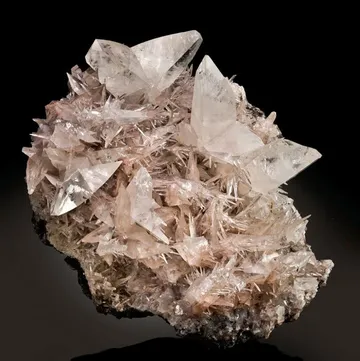
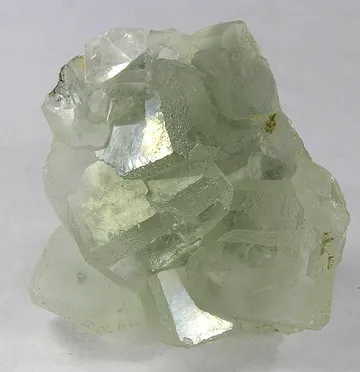
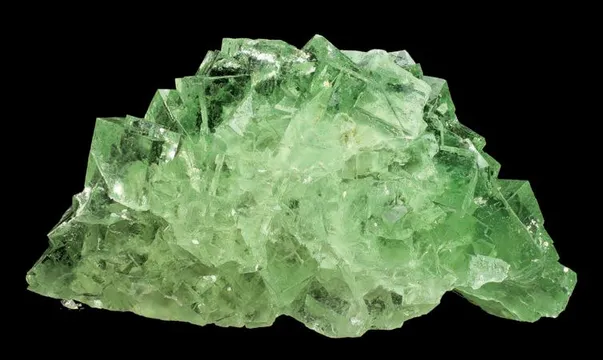
The finest Manaoshan fluorites came to broad collector attention from the 2015-2016 period: transparent green cubic to cubo-octahedral crystals, often with stepped and frosted surfaces and blue to purple internal zones, set on white quartz and accented by pink dolomite. Their color harmony is very Hunan, but their identity is not Shangbao or Yaogangxian; the combination of glassy green fluorite, pearly saddle dolomite, and bright sugary quartz is the Manaoshan signature. The mine’s calcites are a second, older classic: flattened, translucent to pastel-pink rhombs and nailhead forms, commonly edged by tiny golden pyrite crystals and, in manganese-bearing pieces, glowing neon orange-pink to red under ultraviolet light.
Regional View
Country View
The name is often translated by dealers as “Agate Mountain,” a mildly ironic label for a hill better known to collectors for fluorite and calcite than for chalcedony. The locality has also been traded under looser labels such as “Green Fluorite mine,” “Manaoshan Mountain,” and simply “Dongpo ore field,” so specimen provenance matters. Good Manaoshan pieces are not just green fluorite from Hunan; they are three-dimensional mineral compositions with clean crystal faces, intact dolomite rosettes, sharp quartz matrix, and enough translucency to reveal the internal zoning that made the 2016 fluorites desirable.
Search for specimens: View all specimens from Manaoshan Mine, China
Manaoshan Mine is in the Dongpo ore field, Suxian District, Chenzhou, Hunan Province, China. The Chinese locality name is given as 玛瑙山锰矿, literally the Manaoshan manganese mine. It belongs to the southern Hunan segment of the Nanling mineral province, where late Mesozoic granites and related hydrothermal systems generated world-class tungsten, tin, molybdenum, bismuth, lead, zinc, silver, fluorite, and associated skarn-greisen and vein deposits. The better-known nearby Dongpo deposits include Shizhuyuan, Jinchuantang, Yejiwei, Congshuban, Hehuaping, Hengshanling, Chaishan, and Shexingping; Manaoshan sits within that same crowded and geologically complicated district.
The regional mineralization is tied to the Qianlishan pluton and its associated magmatic-hydrothermal system. Published work on the Dongpo ore field describes systematic zoning: proximal W-Sn-Mo-Bi skarn-greisen mineralization around the intrusive center and more distal Pb-Zn-Ag vein systems hosted by carbonate and siliciclastic rocks. Manaoshan is specifically listed in the literature as a skarn-type Fe-Mn-Pb-Zn deposit, and later work records economically important W-Sn ores in the deeper parts of the Manaoshan area. That economic framework explains the collector assemblage: fluorite, quartz, calcite, dolomite, pyrite, sphalerite, galena, magnetite, hematite, rhodochrosite, siderite, manganese oxides, and rare sulfides and tellurides all belong to a skarn and late hydrothermal environment rather than to a simple single-stage vein.
The mine is not a single romantic adit with a tidy collecting history. Collector accounts and dealer records consistently describe Manaoshan Mountain as a group of workings or tunnels in the same mineralized hill. Material from different tunnels was not always tracked separately, and different generations of specimens have quite different appearances: manganoan calcites from about 2009-2010, green-blue fluorites with dolomite and quartz from the 2015-2016 period, and later smaller market parcels labelled more broadly as Manaoshan or Dongpo.
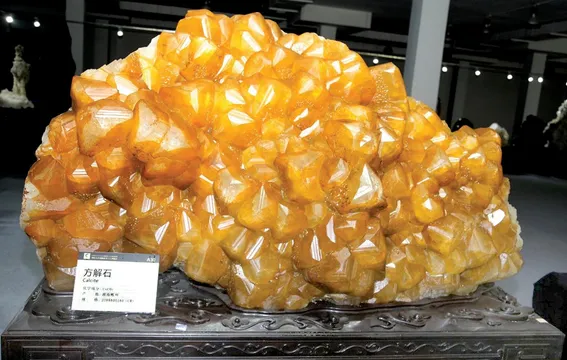
The notable specimen-producing events are best understood by assemblage. The circa 2009 calcite finds produced pink to pale manganoan calcite in flattened rhombs, discs, stacked nailhead forms, and pagoda-like clusters, many with micro-pyrite preferentially deposited on crystal edges. Some large pieces reached cabinet scale, including a 28 cm calcite with pyrite microcrystals illustrated in Chinese-mineral literature and gallery records. The fluorite-dolomite-quartz find followed a few years later. Dealers described it as limited, with fewer than 50 good pieces from one pocket according to one auction description, and recorded crystals to several centimeters, cabinet-size combinations, and a distinctive palette of sea-green fluorite, blue-purple internal zones, white drusy quartz, and pink saddle dolomite.
Mining access today should be treated as closed to casual collectors. A Hunan provincial planning document for adjacent mining rights listed Hunan Manaoshan Mining Co. Ltd.’s Manaoshan Mine as a producing underground operation with a 150,000 t/a scale and permitted elevation range from +850 m to +248 m; the listed commodities include iron, manganese, lead, pyrite/sulfur, bismuth, tin, and tungsten. In addition, local restoration documents note steep artificial slopes, waste dumps, active and former workings, and heavy-metal environmental controls in the surrounding mining area. For collectors, the practical route is the specimen market—not ad-hoc field collecting.
Manaoshan fluorite is best known from the limited mid-2010s green fluorite find, with transparent pale green to sea-green crystals showing broad glassy cubic faces, stepped octahedral to cubo-octahedral modifications, frosted outer surfaces, and blue to purple internal cores or “windows.” Reported specimens range from miniatures around 5 cm across to large-cabinet groups, with individual fluorite crystals recorded to about 7 cm in the early reports and to 4.5 cm in dealer descriptions of matrix specimens. The best pieces are not simply large green cubes: they show vivid internal zoning, clean modified form, bright luster under the frosting, and placement on sparkling white quartz with pale pink saddle dolomite or occasional calcite and pyrite accents; ordinary examples tend to be massive, chipped at the cube edges, too cloudy to show the blue core, or lacking the contrasting matrix that makes the locality distinctive.
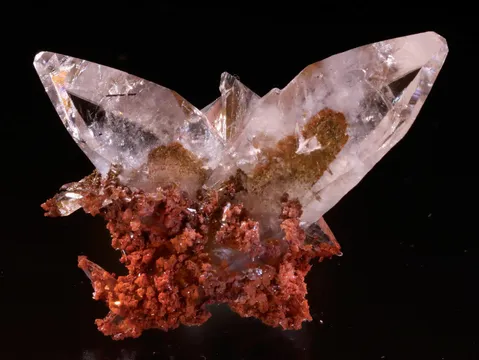
Quartz from Manaoshan is usually the stage rather than the soloist: a sugary to drusy white quartz crust or plate that carries green fluorite, pink dolomite, and, less commonly, calcite. In the best fluorite-dolomite-quartz combinations the quartz is bright, fine-grained, and continuous enough to frame the pastel carbonate clusters without visually competing with the fluorite; in documented dolomite-on-quartz specimens it forms a sparkling matrix beneath salmon-pink curved rhombs, sometimes with a colorless doubly terminated calcite crystal around 15 mm. Better quartz-bearing pieces have fresh, lustrous druse and an undamaged display surface; mediocre examples are dull, iron-stained, broken along the plate edges, or reduced to a nondescript massive base under more important minerals.
Manaoshan dolomite is the soft-pink counterpoint to the mine’s green fluorite: light salmon, pastel pink, beige-pink, or pearly rose-colored curved rhombs, often saddle-shaped and gathered into flower-like clusters, corsages, or dense little forests on drusy quartz. Documented specimens include dolomite crystals to about 15 mm on 6 cm quartz plates, larger rosette groups to about 3.8 cm across, and cabinet specimens where pearly dolomite covers much of the display face while green fluorite appears at the edges or underneath. The finest dolomites from Manaoshan combine sculptural open “rose” form, pearly luster, intact curved rhomb edges, and a clean quartz base; less desirable pieces are flat, abraded, heavily contacted, or visually overwhelmed by massive fluorite or calcite.
Calcite is one of Manaoshan’s true classics, especially the manganoan calcite with pyrite from finds around 2009-2010. The characteristic specimens are pastel-pink to translucent flattened rhombs, discs, nailhead crystals, or stacked pagoda-like groups, commonly with glittering golden pyrite microcrystals concentrated along the edges rather than evenly across the faces. Documented crystal sizes reach about 5 to 5.5 cm across on individual flattened rhombs, with specimens from miniature through large cabinet size and a 28 cm calcite-with-pyrite example illustrated from the locality. Strong pieces have sharp, complete calcite edges, rhythmic stacked architecture, bright pyrite outlining, and manganese-related orange-pink to red fluorescence; lesser pieces show sparse pyrite, bruised perimeters, dull surfaces, or broken plate margins.
Beyond the four main collector species, Manaoshan has a much broader documented ore and skarn assemblage. Mineral lists and locality references record actinolite, alabandite, arsenopyrite, brucite, calaverite, cerussite, chalcopyrite, chlorite-group minerals, chondrodite, clay minerals, diopside, epidote, feldspar-group minerals, galena, hematite, magnetite, marcasite, marmatite, muscovite, phlogopite, plumbojarosite, proustite, psilomelane, pyrite, pyrolusite, pyromorphite, pyrrhotite, rhodochrosite, rutile, serpentine-subgroup minerals, siderite, sphalerite, spinel, titanite, tourmaline, tremolite, vesuvianite, wad, and knebelite in the fayalite-tephroite series. For the collector market the important rarities are mostly specimen-scale curiosities rather than display classics: calaverite is significant for the gold-telluride side of the system, alabandite and rhodochrosite underscore the manganese-rich chemistry, and pyromorphite, cerussite, galena, and sphalerite link the locality to the Pb-Zn part of the Dongpo mineralizing system.
Manaoshan material needs locality discipline. Many green Chinese fluorites with blue cores, quartz, and dolomite have been loosely sold as Dongpo, Shizhuyuan, Shangbao, or generic Hunan fluorite, and some early Manaoshan fluorites appeared under the name “Green Fluorite mine.” The safer labels are those that preserve the full chain: Manaoshan Mine, Dongpo ore field, Suxian District, Chenzhou, Hunan, China. Older dealer labels may instead say Yizhang District or simply Chenzhou; because administrative and marketing labels have varied, the specimen’s style and provenance should be weighed together.
The strongest authenticity concern is not a known systematic fake from Manaoshan, but mislabelling and overbroad attribution. Fluorite-dolomite-quartz pieces from several Hunan localities can share a family resemblance, and the blue-heart green fluorites have also been discussed by collectors in the wider context of Chinese locality confusion. A convincing Manaoshan fluorite usually shows the pale to sea-green modified fluorite habit, blue to purple internal zoning, frosted-stepped surfaces, drusy white quartz, and salmon-pink saddle dolomite. A label alone is less persuasive when the specimen lacks that assemblage.
Condition matters sharply. Fluorite is softer than quartz and brittle at modified cube corners, so check the high points, stepped edges, and any protruding blue-window crystals under raking light. Frosted surfaces can hide bruising. Dolomite rosettes are easily rubbed or cleaved, especially on exposed saddle edges. Calcite plates commonly show peripheral wear because the flattened rhombs present many high, thin edges; the best examples have undamaged central crystals even if the matrix margin is naturally contacted.
Fluorescence is an important bonus. Manganese-bearing calcite from Manaoshan can show a strong orange-pink to red response, and at least some fluorite-dolomite pieces have been described as showing purple fluorescence under longwave ultraviolet. Display these specimens out of direct sunlight: fluorite color stability varies, but strong light and heat are unkind to many fluorites over time, and the safest long-term practice is low-UV cabinet lighting.
Market availability is uneven. Small fluorites and calcites appear intermittently, but the top pieces from the limited fluorite-dolomite-quartz find are scarce and tend to be absorbed quickly by Hunan and fluorite specialists. Good manganoan calcite with rich pyrite edging is also far less common than its decade-old market memory suggests. Current offerings range from modest miniatures to expensive cabinet pieces; price is driven less by bulk size than by the combination of provenance, undamaged crystal architecture, visible fluorite zoning, dolomite freshness, and fluorescence in calcite specimens.
The best Manaoshan story is not a single heroic pocket with a named miner and a tidy date, but the odd way the mountain keeps changing its face. Collector accounts describe a hill close enough to Chenzhou’s mineral-show orbit that visiting dealers could speak of having been in several tunnels there, yet the underground provenance was loose enough that nobody consistently kept track of which tunnel produced which style. That is why Manaoshan can seem, at first glance, like several different localities: one tunnel produced the pink manganoan calcites with glittering pyrite edge-lines; another yielded the green fluorite and dolomite combinations; another decade might produce something that looks unrelated again.
The calcite find has the kind of depositional quirk collectors remember. Instead of pyrite scattered randomly across the crystal faces, tiny golden pyrite crystals preferentially outlined the edges of flattened pastel-pink calcite rhombs. On the best pieces the calcite faces remain translucent while the edges sparkle, as if the crystals had been gilt after growth. Some descriptions emphasize that pyrite also lies just under the surface of larger calcite faces, but the defining visual trick is the edge-only concentration. Under ultraviolet light the manganese turns the calm pink daylight specimen into a hot orange-pink or red fluorescent object.
The fluorite story arrived later, around the end of 2015 into 2016, and it changed Manaoshan’s collector identity. A limited pocket produced green fluorites whose crystal form was not plain cubic but modified, stepped, and frosted, with blue to purple core zones visible through the green. The best specimens looked composed rather than merely mined: green fluorite crystals rose from drusy white quartz while pink saddle dolomite gathered around them like little corsages. One auction description estimated that fewer than 50 good pieces came from that pocket, which explains why the best examples now feel much scarcer than their recent date might suggest.
There is also a quiet lesson in the locality labels. Early reports noted essentially the same material being offered under “Green Fluorite mine, Manaoshan Mountain” by one source and more generally as “Dongpo Ore Field” by another. For a collector, that is not a trivial footnote. The Dongpo field is a maze of adjacent deposits, workings, administrative names, and dealer shorthand. Manaoshan specimens reward careful labels and punish vague ones, because the difference between “Hunan green fluorite” and a documented Manaoshan fluorite-dolomite-quartz combination is exactly the difference that future collectors will pay for.