A collector's guide to Shimen Mine, China: its geology, mining history and notable minerals, illustrated with the 106 specimens documented from this locality on EarthWonders.
Key facts
Shimen Mine is the collector name most often used for the Jiepaiyu Mine in the Shimen arsenic deposit of Shimen County, Changde, Hunan Province. For mineral collectors it is one of the great modern localities for arsenic sulfides: a carbonate-hosted realgar–orpiment deposit that produced vivid red realgar, yellow to orange orpiment, and glassy white to colorless calcite in combinations that are instantly recognizable across a room. The best pieces are not merely colorful ore specimens. They are pocket specimens: sharp, lustrous red realgar crystals perched on calcite; yellow-orange orpiment blades rising from carbonate matrix; and, in the finest combinations, all three species arranged in a dramatic red–yellow–white palette.
Geologically, Shimen matters because the deposit concentrated arsenic sulfides in carbonate rocks within a tectonic- and karst-controlled epithermal system. Published descriptions place the principal ore in Upper Cambrian dolostone and Lower Ordovician limestone, with a three-part arrangement of siliceous rocks, lenticular breccias, and massive orpiment–realgar ore. That breccia-pipe architecture is the reason specimen pockets could form at all: broken carbonate host, open space, reactive walls, and later low-temperature arsenic-sulfide mineralization gave collectors crystals instead of only massive arsenic ore.
Historically, Shimen is even more remarkable. The district has been worked for more than 1,500 years and is described in the modern literature as the largest carbonate-hosted arsenic deposit in Asia and the largest realgar mine in China. The same deposit that supplied arsenic-bearing material for medicine, industry, pesticides, fireworks, and chemical production also gave the mineral world some of its most important realgar and orpiment specimens. The classic specimen-producing period belongs especially to the late twentieth-century opening of Chinese mineral localities to the international market, when Shimen material began appearing in major collections and dealer inventories.
Regional View
Country View
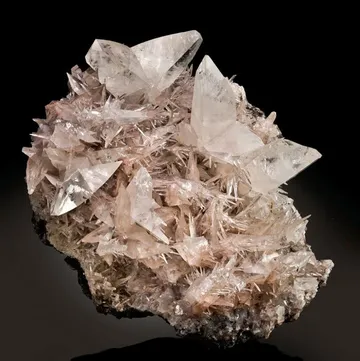
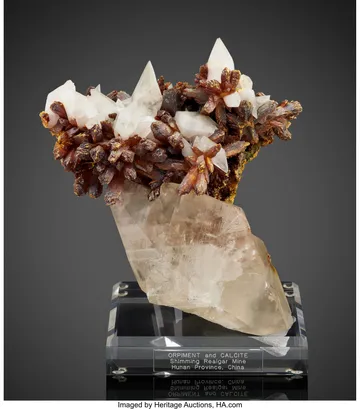
A fine Shimen specimen has a look unlike ordinary realgar or orpiment from most localities. Realgar may be cherry-red, gemmy to translucent, tabular or prismatic, and grouped on white calcite. Orpiment may form lustrous, elongated blades or prismatic crystals rather than only powdery coatings. Calcite is not just matrix here; it is part of the architecture, forming scalenohedra, dogtooth crystals, translucent crystals, or sparkling druses that set off the arsenic sulfides. The contrast is the locality’s signature.

Photo: Wikimedia Commons
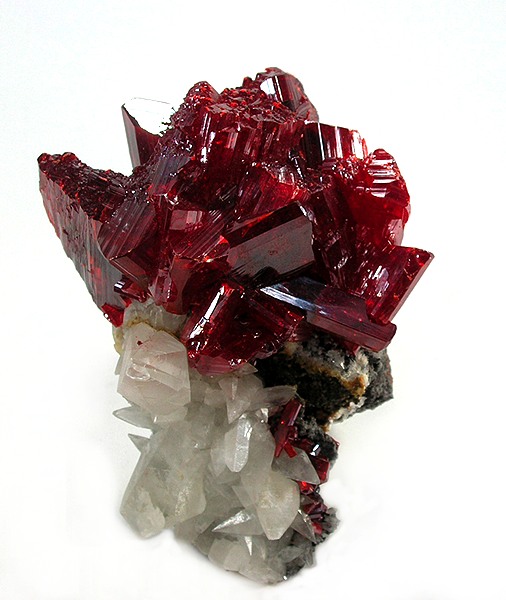
Photo: Wikimedia Commons
Search for specimens: View all specimens from Shimen Mine, China
The collector locality is the Jiepaiyu Mine, widely labeled Shimen Mine, in the Shimen deposit of Shimen County, Changde, Hunan Province, China. Labels may read Jiepaiyu Mine, Shimen Mine, Shimen As-(Au) deposit, Shimen realgar mine, or simply Shimen, Hunan. For serious collecting, the Jiepaiyu name is useful because it ties the specimen to the specific mine in the Shimen deposit rather than to the county or region in a loose sense.
The deposit is a carbonate-hosted arsenic system, commonly described as a tectonic- and karst-controlled epithermal deposit. The principal orebody is mainly hosted by Upper Cambrian dolostone and Lower Ordovician limestone. Published geological descriptions divide the mine section into siliceous rocks above, lenticular breccias, and a massive orpiment–realgar orebody below. The ore is restricted to a karst breccia pipe, grading from massive ore in the central zone to brecciated ore and then disseminated ore outward.
That geometry is central to the specimen story. A deposit mined only for compact massive realgar would have produced few collector pieces of consequence. At Shimen, brecciation, carbonate dissolution, and open-space filling allowed arsenic sulfides to line cavities and grow into voids. Realgar and orpiment could crystallize on calcite, quartz, dolomite, and carbonate matrix; calcite could form its own later or earlier crystal generations; and delicate secondary arsenates could develop in weathered, arsenic-rich environments.
Mining at Shimen has an unusually long history, extending back more than 1,500 years. Modern industrial work included large-scale mining and processing of realgar-bearing ore, while late twentieth-century specimen recovery brought Shimen to the attention of collectors outside China. The mine is reported to have produced about one million tonnes of ore, and environmental literature describes the reserves as nearly exhausted before operations ceased. Several modern environmental papers describe the mine as closed by 2011, with continuing attention to arsenic contamination in tailings, drainage, soil, and nearby water systems.
Collecting access today should not be assumed. This is a former arsenic mine with documented contamination issues, mine waste, tailings, unstable workings, and regulatory sensitivity. It is not a casual field-collecting locality. Modern Shimen specimens are normally obtained through dealers, auctions, old collections, and deaccessions rather than by visiting the mine. Labels from the 1990s and early 2000s are especially important, since much of the best collector material entered the Western market during that period.
The notable finds are the classic realgar–calcite and orpiment–calcite specimens for which the locality became famous. Realgar occurred as bright red tabular to prismatic crystals, including single crystals and floater crystals to several centimeters, and groups on white or glassy calcite. Orpiment occurred as free-standing golden-yellow to orange crystals, commonly on calcite and locally associated with realgar. Calcite alone from Shimen can also be collectible, especially when sharp, glassy, golden-tinged, or included by realgar or orpiment. In addition to the showy arsenic sulfides, the locality has become important for rare thallium sulfosalts, including shimenite, a type-locality mineral named for the Shimen area.
Shimen realgar is the locality’s signature species and ranks among the world’s finest for the mineral: bright cherry-red to orange-red, lustrous, commonly tabular to prismatic, and found as single crystals, floaters, crystal groups, and matrix pieces with calcite. Mindat records single crystals as floaters to 6 cm and bright red groups to many centimeters, while collector literature and market records emphasize the early 1990s finds of gemmy red crystals on white to gray calcite. The best pieces show sharp, translucent, saturated red crystals arranged naturally on contrasting calcite, sometimes with yellow orpiment or white picropharmacolite; ordinary pieces tend to be smaller, duller, contacted, edge-worn, or beginning to show yellow alteration. Because the species is light-sensitive, the top Shimen realgars are also judged by freshness: undulled luster, minimal pararealgar powdering, and crisp crystal edges matter as much as size.
Shimen calcite is best understood as both matrix and collectible species. It occurs as white, colorless, translucent, and pale golden crystals, commonly scalenohedral or dogtooth in habit, with some specimens showing glassy single crystals perched on drusy calcite or gray carbonate matrix. Its collector importance comes from association: calcite hosts cherry-red realgar crystals, canary-yellow to orange orpiment, realgar inclusions, and arsenic-sulfide coatings, creating the red–yellow–white combinations that define the locality. Better calcite specimens are sharp, lustrous, undamaged, and sculptural, especially where the calcite crystal form remains visible rather than being merely a broken carbonate base; pieces with included realgar or orpiment have additional interest when the inclusions are natural-looking and the crystal faces remain transparent enough to show them.
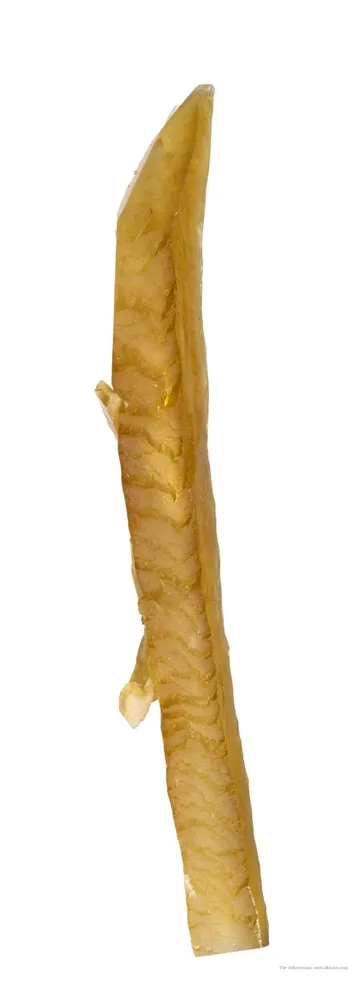
Shimen orpiment is one of the great modern occurrences for crystallized As2S3, valued because the locality produced real crystals rather than only powdery yellow crusts or foliated masses. The best examples show golden-yellow, egg-yolk yellow, orange-yellow, honey-orange, or reddish-orange prismatic to bladed crystals, commonly free-standing and associated with white to colorless calcite and red realgar. Mindat records prismatic crystals to many centimeters, and museum and dealer examples document cabinet pieces with orange-yellow crystals to several centimeters; a particularly fine public museum specimen from Shimen shows yellow-orange orpiment crystals to 4 cm interlaced with white calcite scalenohedra. Top Shimen orpiment has bright color, visible translucency, resinous to adamantine luster, sharp terminations, and minimal bruising; lesser examples are dull, cleaved, powdery, heavily contacted, or visually lost on the matrix.
Beyond realgar, calcite, and orpiment, Shimen is mineralogically important for arsenic oxides, arsenates, and rare thallium sulfosalts. Documented species include arsenolite, claudetite, native sulfur, baryte, dolomite, fluorite, gypsum, hörnesite, pharmacolite, picropharmacolite, pyrite, quartz, stibnite, weilite, christite, jankovićite, rebulite, vrbaite, and shimenite. Shimenite, Tl5Sb21-yAsyS34 with 9 ≤ y ≤ 10, is the standout rarity: it is a type-locality species from the Jiepaiyu Mine and belongs to the chabournéite group. For collectors, the most visible rare associate is often picropharmacolite, which may appear as delicate white acicular sprays or cottony growths on realgar-rich specimens; the thallium sulfosalts are generally specialist micro- or analytical species rather than display minerals.
Shimen realgar and orpiment demand disciplined storage. Realgar is famously light-sensitive and can alter toward yellow pararealgar, especially with prolonged exposure to strong light. The change may begin as dulling, yellowing, or powdery alteration at crystal edges and exposed surfaces. Display under bright lights is unwise; serious collections normally keep Shimen realgar in a dark drawer, box, or cabinet and bring it out only briefly. Orpiment is also very soft, sectile to brittle, and easily bruised, so even fine specimens may show small edge contacts if inspected closely.
Toxicity should be treated with respect but not panic. Realgar and orpiment are arsenic sulfides, and Shimen specimens should not be licked, soaked, abraded, cut, heated, or handled before eating. Wash hands after handling, avoid generating dust, and keep specimens away from children and pets. Do not clean Shimen arsenic-sulfide specimens with aggressive chemicals, ultrasonic cleaners, or heat. The most collectible surfaces are the original lustrous crystal faces; once dulled, bruised, or chemically etched, they cannot be restored.
Condition is a major value factor. Realgar crystals chip, bruise, and alter; orpiment blades cleave and scuff; calcite matrix corners break; and delicate picropharmacolite sprays are easily crushed. Many attractive pieces have minor contacts, but damage becomes serious when it affects the main display crystals or disrupts the red–yellow–white composition. Repairs and reattachments should be assumed possible on larger arsenic-sulfide specimens and should be disclosed. A well-done, disclosed repair on an important specimen may be acceptable; hidden glue, artificial-looking luster, or crystals that appear unnaturally planted on calcite should reduce confidence.
There is no widely documented Shimen-specific fake epidemic comparable to the notorious fabricated specimens from some other Chinese localities, but mislabeling and overconfident labels are common risks. “Hunan realgar,” “Chinese realgar,” and “Shimen” are not interchangeable without supporting provenance. Strong Shimen attribution is most credible when the specimen has the classic assemblage—realgar and/or orpiment with calcite from a carbonate-hosted arsenic deposit—plus old dealer, collector, or publication history. Old labels reading Jiepaiyu are especially valuable because they preserve the mine name behind the more marketable Shimen label.
Fluorescence is not a collecting reason to buy Shimen realgar or orpiment; Mindat records no fluorescence for the key arsenic sulfides from the locality. The value lies in color, crystal quality, association, and preservation. Small and moderately damaged Shimen pieces still appear on the market, but top-quality realgar groups, fresh realgar-on-calcite combinations, and sharp orpiment-on-calcite specimens are now modern classics. The best examples increasingly trade through old collections, auctions, and specialist dealers rather than as routine new mine production.
The Shimen story reads like a condensed history of modern Chinese mineral collecting. For more than a millennium and a half, the mine was an arsenic source, not a specimen locality. Realgar was useful; crystals were incidental. Then, as China’s mineral-specimen market opened in the late 1980s and early 1990s, miners and dealers began recognizing that bright red crystals on white calcite were not waste. The result was a short, vivid burst of material that changed how collectors judged realgar. Specimens that might once have been crushed or processed as ore instead moved into cabinets, museum cases, and Western dealer stocks.
One measure of that moment is the reported early appearance of exceptionally large crystals. Collector accounts describe Shimen realgar entering the market in the late 1980s, with early finds producing matrix pieces carrying 5–6 cm crystals and an extraordinary 8.5 cm single crystal exhibited in 1988. Those numbers matter because gemmy realgar of that size is not normal. Before Shimen, many collectors knew realgar as small, delicate, light-sensitive crystals from classic localities; Shimen showed that the species could be cabinet-scale, architectural, and intensely red.
The late 1990s produced some of the most memorable published Chinese arsenic-sulfide display pieces. In the Mineralogical Record’s Crystalline Treasures: The Mineral Heritage of China, Shimen is represented by an orpiment with calcite measuring 20 cm, found in the late 1990s, and a 13 cm realgar from the same mine, also found in the late 1990s and formerly in the Steve Smale collection. Those are not just large specimens; they are benchmarks for the locality’s two great visual modes—orange-yellow orpiment with pale carbonate, and concentrated red realgar in a cabinet-size mass.
There is a more sobering side to the locality. Environmental accounts describe mining and chemical plants around Shimen County continuing into the modern era, with closure by 2011 because of pollution. Scientific studies of the abandoned mine area document arsenic-bearing tailings, contaminated waters, and continuing heavy-metal concerns. For collectors, that history should not diminish the specimens; it should sharpen our sense of context. A Shimen realgar in a dark cabinet is a beautiful object, but it came from a working arsenic district where the same chemistry that made the crystals spectacular also made the landscape difficult to remediate.