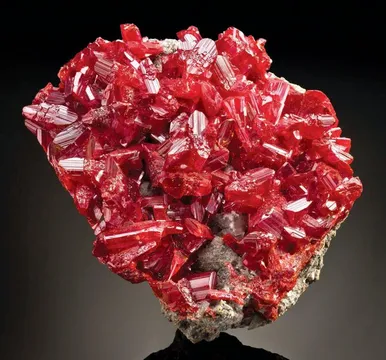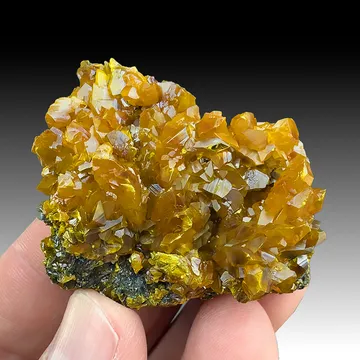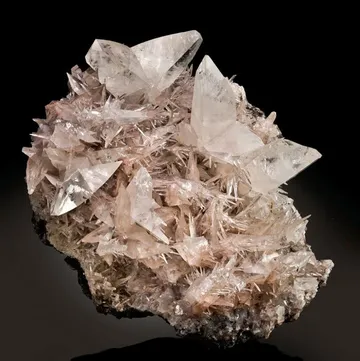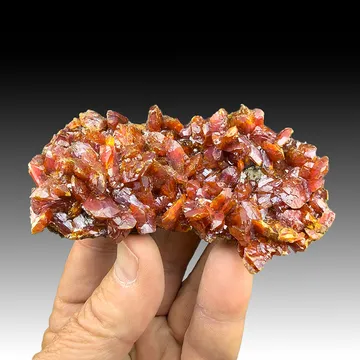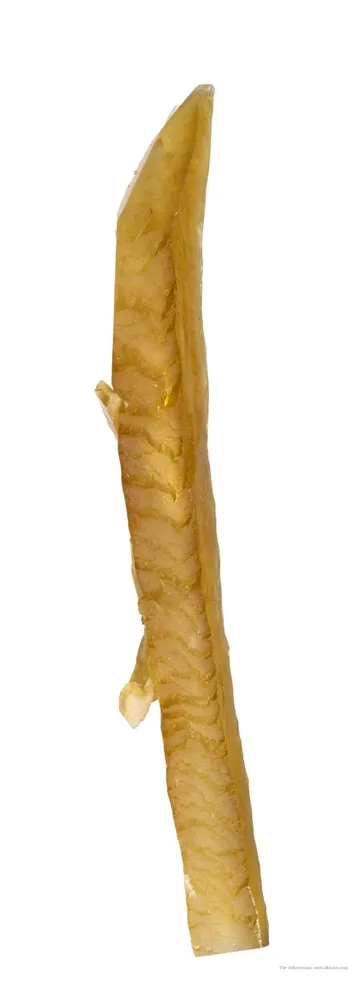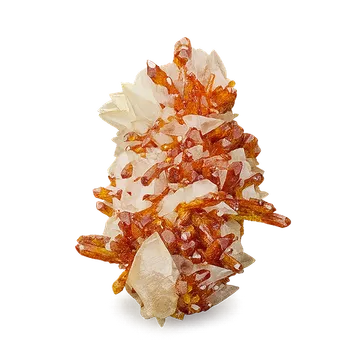
Orpiment from Shimen Mine, Hunan; bright yellow to orange prismatic crystals with calcite and realgar, rare worldwide, a notable arsenic-sulfide classic.
Key facts
Shimen orpiment is one of the great modern Chinese arsenic-sulfide classics: bright yellow to orange, locally honey-brown and reddish near terminations, with unusually well-formed free-standing crystals for a species that more often occurs as foliated masses, crusts, or earthy coatings. Fine pieces show the combination collectors want most from this locality—lustrous prismatic blades or elongated crystals rising from white to colorless calcite, often with a flash of associated red realgar. The effect can be electric: warm, translucent orpiment against a cool carbonate matrix, a color pairing that immediately separates Shimen from most ordinary arsenic-sulfide specimens.

Photo: Wikimedia Commons
The locality is the Jiepaiyu Mine, widely sold under the collector name Shimen Mine, in Shimen County, Changde, Hunan. It is not just a specimen locality but a major ore deposit: a carbonate-hosted arsenic system famous above all for realgar and orpiment. The deposit is tectonic- and karst-controlled, developed in carbonate rocks, with ore concentrated in a breccia-pipe setting. That geological architecture matters for collectors because it produced pockets and open spaces where arsenic sulfides could crystallize rather than merely replace or impregnate rock.
Although Shimen is often discussed first as a realgar locality, its orpiment deserves equal respect. Well-crystallized orpiment is rare worldwide, and Shimen pieces can show centimeter-scale, lustrous, prismatic crystals rather than only powdery yellow coatings. The best examples compete aesthetically with famous material from Peru and Nevada, but the Shimen look is its own: orange-yellow blades, sometimes darker and more amber at the tips, with white calcite and red realgar as natural counterpoints.

Photo: Wikimedia Commons
The mine’s long history also gives these specimens a weight beyond their cabinet appeal. Shimen has been worked for more than 1,500 years and produced roughly one million tonnes of arsenic ore before mining ceased under the pressure of exhausted reserves and environmental concerns. The same mineralogy that makes the specimens beautiful—arsenic sulfides in carbonate rocks—also made the district environmentally difficult. Serious collectors should understand both sides of the locality: Shimen produced superb mineral specimens, but it is also one of the studied examples of arsenic mobility from weathered orpiment-realgar tailings.
Search for specimens: View all orpiment specimens from Shimen Mine, Hunan, China
The collector locality is the Jiepaiyu Mine, commonly labeled Shimen Mine, in the Shimen deposit of Shimen County, Changde, Hunan Province, China. Mindat records it as a mine known for realgar and orpiment, with Shimen Mine as an associated historical or alternate name. In mineral-market usage, labels may read Jiepaiyu Mine, Shimen Mine, Shimen deposit, or Shimen As-(Au) deposit; all should be read carefully, but those names usually refer to the same classic arsenic-sulfide source.
Geologically, Shimen is a tectonic- and karst-controlled epithermal arsenic deposit. Published work describes the ore as hosted chiefly by Upper Cambrian dolostone and Lower Ordovician limestone. The deposit is arranged in a three-part structure: siliceous rocks above, lenticular breccias, and a massive orpiment-realgar orebody below. The orebody is restricted to a karst breccia pipe, with massive ore in the central zone, brecciated ore outward, and disseminated ore on the periphery.
That setting is an important clue to the specimen style. The carbonate host and breccia-pipe geometry created open spaces and reactive carbonate surfaces where arsenic sulfides could form in pockets and on calcite. Shimen orpiment is therefore not merely a yellow staining mineral in ore; the best pieces are crystallized specimens, often in sculptural association with calcite and realgar.
Mining history at Shimen is unusually deep. The deposit has been exploited for more than 1,500 years and is described in the literature as the largest carbonate-hosted arsenic deposit in Asia and the largest realgar mine in China. It produced about one million tonnes of ore. Modern specimen production is tied mainly to the late twentieth-century Chinese mineral boom and to finds that entered Western collections in the 1990s and early 2000s.
Mining has ceased as a result of near-exhausted reserves and environmental concerns, and separate environmental studies describe the mine as closed by 2011. Collecting access should not be assumed. This is not a casual field-collecting locality; it is a former arsenic mine with documented contamination issues, mine waste, tailings, and restricted or hazardous ground. Any visit would require permission from land and mineral-rights holders and careful attention to safety, but for practical collecting purposes Shimen orpiment is obtained through the specimen market, old collections, and deaccessions rather than by field collecting.
Notable finds include lustrous free-standing orpiment crystals with calcite, orpiment-realgar combinations, and realgar specimens for which Shimen is widely regarded as world-class. In addition to the showy arsenic sulfides, the locality has attracted mineralogical attention for rare thallium sulfosalts, including shimenite as a type-locality species, as well as christite, jankovićite, rebulite, vrbaite, and related assemblages documented from the deposit.
Shimen orpiment is most desirable when it occurs as distinct prismatic crystals or bladed crystal groups rather than as massive yellow coatings. Mindat records the locality habit as prismatic crystals to many centimeters, golden yellow in color, with centimeter-sized free-standing crystals associated with white calcite. Market examples document both miniature sprays and cabinet-size groups, including elongated crystals commonly around 1.5–2 cm and exceptional pieces with crystals reported to about 5 cm.
Color is a major quality factor. The best Shimen pieces are saturated yellow, egg-yolk yellow, orange-yellow, or butterscotch orange, with some crystals showing darker red-orange or amber tones toward the terminations. Translucency is especially prized: when the blades transmit light, the color becomes warmer and deeper, giving the crystals a resinous glow rather than a flat powdery yellow.
The classic crystal form is an elongated blade or prismatic crystal with chisel-like terminations, commonly arranged as sprays, divergent groups, or drusy-to-coarsely crystalline crusts on calcite. Some specimens consist almost entirely of orpiment crystals; others are orpiment-on-calcite combinations, with white or colorless calcite forming the architectural base. Calcite may be massive, scalenohedral, twinned, or glassy and translucent. The finest combinations use that contrast well: yellow-orange orpiment, red realgar, and white calcite in a balanced display.
Associated minerals include realgar, calcite, quartz, dolomite, baryte, gypsum, pyrite, stibnite, native sulfur, arsenolite, claudetite, pharmacolite, picropharmacolite, weilite, hörnesite, and several thallium-bearing sulfosalts. For collector purposes, the most significant associations are calcite, realgar, and picropharmacolite. Realgar provides the red counterpart to the orpiment’s yellow-orange; calcite provides contrast and structure; picropharmacolite may appear as delicate white acicular or puffball-like secondary growths on realgar-rich specimens from the deposit.
The quality hierarchy is straightforward but unforgiving. Top Shimen orpiment has sharp crystal form, high luster, strong yellow-orange color, visible translucency, minimal bruising, and an undisturbed relationship to calcite or realgar. Lesser pieces may be massive, dull, heavily contacted, powdery, or dominated by broken blade edges. Because orpiment is very soft and has excellent cleavage, even otherwise fine specimens often show contacts or bruises at exposed tips. A Shimen specimen with clean, upright, lustrous crystals and only minor edge wear is far better than its size alone might suggest.
Shimen orpiment is arsenic-bearing, soft, delicate, and light-sensitive. It should be stored like a serious sulfide specimen rather than displayed casually in a sunny cabinet. Keep it out of direct sunlight, avoid prolonged bright lighting, and store it in a covered box or drawer when not being studied. Occasional viewing under controlled light is reasonable; continuous display under strong light is not.
Handling should be minimal. Orpiment has low hardness, perfect cleavage, and fragile blade edges. Pick specimens up by the matrix or base, never by crystal groups, and do not brush, wash, or ultrasonically clean them. Avoid creating dust. Wash hands after handling, and keep specimens away from children, pets, food-preparation areas, and any setting where powder could be inhaled or ingested.
Condition is central to value. Look closely at the terminations and blade edges; pale contacts, bruised tips, and cleaved faces are common. On matrix specimens, inspect the junction between orpiment and calcite for glue lines or unnatural breaks. Repairs and stabilization are not unusual in fragile orpiment as a broader species issue, but they must be disclosed. A stable, well-disclosed repair on an important specimen may be acceptable; hidden glue, overcoating, or a suspiciously glossy consolidated surface should reduce confidence and value.
No well-documented Shimen-specific fake epidemic was found, but authenticity still requires discipline. The main concerns are mislabeling, undisclosed repairs, possible reattached crystals, and old or vague “Hunan” labels that do not prove Shimen provenance. Good Shimen material has a recognizable look: yellow to orange prismatic or bladed orpiment, commonly with calcite and sometimes realgar, from a carbonate-hosted arsenic assemblage. Specimens presented as Shimen but lacking that association, habit, or credible provenance deserve extra scrutiny.
Rarity is best understood by quality tier. Ordinary small or damaged Shimen orpiment appears periodically, but sharp, lustrous, undamaged, well-composed pieces are now much harder to obtain. Many available examples are from 1990s and early-2000s finds, old dealer stock, or collection dispersals. Recent market records show Shimen orpiment still appearing through dealers, Minfind listings, and auctions, but the best pieces are no longer plentiful. The strongest examples—large, aesthetic orpiment-on-calcite combinations with good crystal integrity—are modern classics rather than routine stock.
Rock Currier left one of the most memorable collector snapshots of Shimen orpiment. He described buying an 8 cm calcite-and-orpiment specimen from a dealer in Changsha: a somewhat transparent calcite crystal covered in micro orpiment, with a tiny bit of realgar. The dealer also had a giant specimen of the same material, more than two feet high and wide, and was asking $40,000 for it. That image—a small purchased piece beside a two-foot Chinese arsenic-sulfide monument—captures the brief moment when extraordinary Shimen material was still close to its source and some of the finest pieces had not yet vanished into permanent collections.
The later market tells the other half of the story. Dealers now describe Shimen orpiment as 1990s material, early-find material, or vintage pieces from a once-prolific mine. A 64 mm orpiment-on-calcite specimen recorded on Mindat carried a “Vintage 2004” note and the blunt observation that these specimens had “disappeared from the market.” That is the collector’s arc of Shimen in one sentence: abundant enough for a few years to define a locality style, then scarce enough that even modest, well-preserved pieces became desirable.
Another thread runs through the old labels: the names of collectors who caught the wave early. One Shimen orpiment auction specimen came from the Kurt Hefendehl collection; another Shimen realgar was tied to Dr. Stephen Smale; still another dealer listing records a realgar acquired by Neil Levett in 1996. These names matter because Shimen’s best arsenic sulfides entered the Western market during the formative years of modern Chinese specimen collecting. Provenance from that period is not just decorative paperwork—it helps anchor a specimen to the time when the mine was producing the material that made its reputation.