






A collector's guide to Sapo Mine, Brazil: its geology, mining history and notable minerals, illustrated with the 219 specimens documented from this locality on EarthWonders.
Key facts
Sapo Mine is one of the modern classic pegmatites of eastern Minas Gerais, important not because it produced a single famous look, but because it produced several. Collectors first came to know it through fine elbaite tourmaline, especially the polychrome and “blue-cap” crystals that gave the mine an identity among Brazilian tourmaline localities. Then, in the mid-2000s, Sapo astonished the specimen market with apatite-group minerals of a kind almost no one expected from a Brazilian pegmatite: flattened green hydroxylapatite dipyramids on pale K-feldspar, followed by sculptural green fluorapatite groups on albite, quartz, and muscovite. The best Sapo pieces have the strong contrast and clean architecture that define high-end pegmatite specimens: green apatite against white cleavelandite, translucent crystals perched on smoky or colorless quartz, blue-capped tourmaline crystals with sharp terminations, and cabinet plates whose minerals still look fresh from an open pocket.
The mine lies at Ferruginha, in the municipality of Conselheiro Pena, in the Doce Valley of Minas Gerais. It belongs to the great eastern Brazilian pegmatite belt, a region famous for rare-element granitic pegmatites carrying tourmaline, beryl, quartz, feldspar, mica, phosphates, Nb-Ta oxides, and related accessory minerals. Sapo’s body is a thick, gently dipping pegmatite, worked in episodes because pockets were discontinuous and the mine was repeatedly challenged by wet ground and flooding. That marshy setting is more than a footnote: the very name “Sapo” means frog, and the mine’s history is inseparable from the low, water-prone ground above the pegmatite.
Regional View
Country View
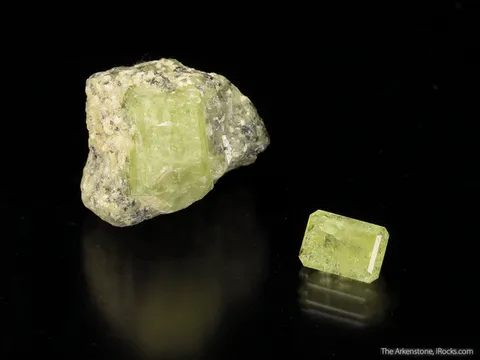
For collectors, Sapo is unusually rich in “signature” specimens. A hydroxylapatite plate from the 2005–2006 production can be recognized at a glance: flattened green dipyramids scattered over cream to tan K-feldspar, often with yellowish or paler centers and darker green edges. A fluorapatite from the 2007 production has a different personality: short, lustrous, tabular to prismatic hexagonal crystals, commonly deep green at the center and paler or nearly colorless toward the rims, set on white bladed albite or associated with muscovite and quartz. Sapo elbaite, especially from the late 1990s, is the earlier classic: slender gem crystals, green, blue-green, watermelon, multicolored, and in the coveted blue-cap style.


Photo: Wikimedia Commons
Search for specimens: View all specimens from Sapo Mine, Brazil
Sapo Mine is recorded as Sapo Mine, Ferruginha, Conselheiro Pena, Minas Gerais, Brazil. Older labels may place it at Goiabeira, Goiabera, Aimorés, or simply “Doce Valley,” because the mine lies in a part of the Conselheiro Pena municipal area affected by local boundary history and because Goiabeira is geographically close. For serious labels, the modern collector locality should be kept as Ferruginha, Conselheiro Pena, Minas Gerais.
Geologically, Sapo is a granitic pegmatite within the Eastern Brazilian Pegmatite Province, in the broader Aimorés-Conselheiro Pena pegmatite region. Regional work on the Conselheiro Pena district places these pegmatites in the Araçuaí orogenic belt along the eastern margin of the São Francisco craton, where Neoproterozoic to Cambrian granitic magmatism and related pegmatitic fluids produced bodies enriched in Li, Be, B, P, Nb, Ta, and volatile components. In the district as a whole, productive pegmatites may contain industrial feldspar and mica, gem tourmaline and beryl, quartz crystals, Li-phosphates, cleavelandite, columbite-tantalite minerals, and a suite of rare secondary phosphates.
The Sapo pegmatite itself is described as thick and subhorizontal to gently dipping. Brazilian regional summaries describe it as concordant with the enclosing schist, trending roughly north-south and dipping gently east at about 10–20 degrees; its full thickness is difficult to measure because the base and top are not exposed together, but the scale of quartz crystals found there implies a body more than 5 meters thick. The pocket assemblage is that of an evolved, phosphate-bearing pegmatite: albite, microcline, muscovite, quartz, beryl, elbaite, fluorapatite, hydroxylapatite, hydroxylherderite, columbite-tantalite series minerals, arsenopyrite, pyrite, and secondary phosphate species.
The discovery history is one of the better stories in modern pegmatite collecting. In 1985, green tourmaline signs were found outside an ant colony on a nearby property. That first occurrence became Lavra da Formiga, the “Ant Mine,” and attracted a rush of garimpeiros. When the ground became crowded, miners moved to the other side of the hill and found the pegmatite that became Sapo. Early work yielded pockets of quartz and tourmaline, but the marshy surface and nearby Horácio Creek made mining difficult during rainy seasons.
A more important mining phase began in 1992, when Clóvis Martins Coelho, widely known as Clóvis “Baiano,” leased the property and sank a shaft that intersected the pegmatite at shallow depth. This period produced large quantities of quartz, including colorless, citrine, smoky, alligator, and cathedral crystals, as well as green, blue, red-green, watermelon, and blue-cap elbaite. By the late 1990s Sapo was already a tourmaline name known to collectors.
The next major chapter was apatite. Around 2004–2006, pockets yielded flattened green hydroxylapatite crystals, chiefly on K-feldspar and more rarely on quartz. The material reached major mineral shows in 2005 and quickly became one of the locality’s defining products. Many of these crystals were originally sold under older apatite names, and later analytical work clarified that the assemblage includes hydroxylapatite, fluorapatite, and in some cases zoned crystals or composites involving both end-members. In 2007, Sapo produced another important apatite style: lustrous green fluorapatite crystals and clusters, especially on white albite with muscovite.
Collecting access today should be considered private-mine access, not open public collecting. The workings have included shafts, tunnels, water-prone ground, and sediment-filled or unstable areas after flooding. Most collectors acquire Sapo material through established dealers, old Brazilian stocks, auction resales, and collection dispersals rather than field collecting. Provenance is especially useful because the best production came in recognizable episodes: late-1990s tourmaline, 2004–2006 hydroxylapatite, and 2007 fluorapatite.
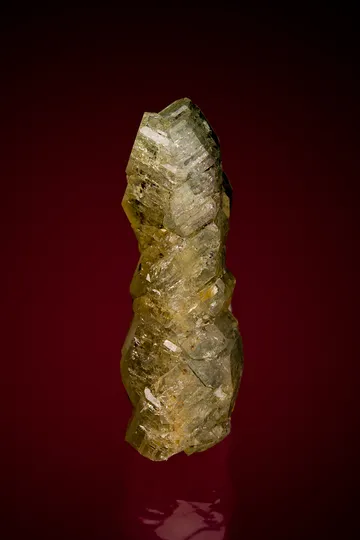
Fluorapatite from Sapo is most prized as lustrous green, tabular to short-prismatic hexagonal crystals on white albite, often with muscovite and sometimes quartz or tourmaline; the classic 2007 material shows deep mossy to forest-green centers, paler or nearly colorless outer zones, sharp pyramidal modifications, and crystal sizes commonly around 1–2 cm on miniatures to cabinet plates. Some examples form stacked, columnar, “tower-like,” or near-hollow growths, and rare pieces carry tiny tourmaline needles or quartz associations. Good Sapo fluorapatite is not merely green apatite from Brazil: it has crisp geometry, visible zoning, bright luster, clean albite contrast, and intact terminations, while ordinary examples tend to be contacted, crowded, dull, or lacking the architectural look that made the 2007 find famous.
“Apatite” on a Sapo label usually means a collector or dealer label that predates precise species naming, and it may refer to fluorapatite, hydroxylapatite, or mixed/zoned apatite-series material; this is especially true of mid-2000s specimens sold when the unusual chemistry was still being sorted out. The Sapo look ranges from flattened green dipyramids on K-feldspar to tabular green crystals on albite and quartz, with colors including yellow-green, blue-green, gray-green, deep forest green, and pale to nearly colorless zoning. Better “apatite” specimens from Sapo are those whose habit, matrix, and provenance make the locality clear even before analysis: flattened, low-angle dipyramids from the 2004–2006 hydroxylapatite pockets, or sharply zoned green fluorapatites from the 2007 albite-rich production.
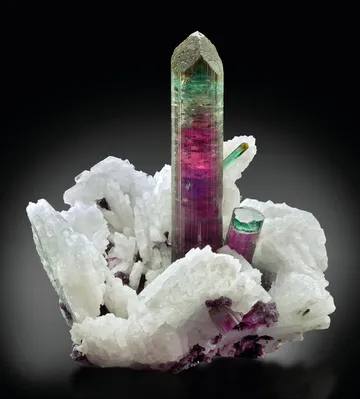
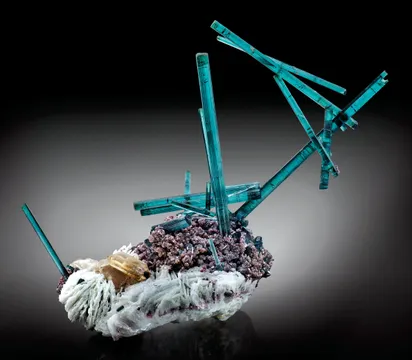
Elbaite made Sapo famous before the apatite finds did, especially through late-1990s production of gemmy green, blue, bicolored, watermelon, and blue-cap tourmalines, most commonly as loose crystals but also on albite or quartz matrix. The crystals are typically slender, lustrous, and strongly zoned, with the most coveted examples showing a contrasting blue cap over a different-colored body; fine thumbnails and miniatures can be more desirable than larger but abraded crystals because termination quality and color transition are critical here. A good Sapo elbaite has clean luster, a complete termination, attractive color separation, and enough transparency to show the internal zoning; ordinary pieces are often chipped, waterworn, overly dark, or too incomplete to carry the locality’s blue-cap reputation.
Feldspar at Sapo is both a rock-forming component and the visual stage for many of the mine’s best apatite specimens: pale cream, tan, white, or locally pinkish K-feldspar plates host the flattened green hydroxylapatites, while albite and cleavelandite provide the white bladed matrix for many fluorapatites. Older specimen descriptions often used “orthoclase” for the K-feldspar matrix, while modern locality listings emphasize microcline and albite as valid Sapo feldspars, so careful labels should distinguish K-feldspar from albite when possible. As a collectible in its own right, feldspar from Sapo is usually valued for association and aesthetics rather than isolated crystals: the best pieces have clean, sculptural feldspar surfaces that elevate the apatite or tourmaline instead of overwhelming it.
Quartz was one of Sapo’s major early products, with the mine known for large crystals in colorless, citrine, smoky, alligator, and cathedral habits before apatite became the locality’s headline mineral. For specimen collectors, quartz is most desirable when it carries the Sapo assemblage: isolated hydroxylapatite crystals on quartz are notably scarcer than apatite on feldspar, and fluorapatite on quartz can show particularly strong color and transparency. The best quartz-associated Sapo pieces balance a well-formed quartz group with green apatite or tourmaline accents; ordinary quartz-only pieces are less locality-specific unless they have exceptional size, habit, clarity, or documented provenance to the mine’s productive early quartz pockets.
Tourmaline from Sapo is chiefly represented in collections by elbaite, including green, blue-green, red-green, watermelon, and the famous blue-cap crystals, but the mine also produced black tourmaline material in the broader tourmaline suite. Sapo tourmalines are typically judged by color zoning, transparency, termination, and whether they retain pegmatite context on albite or quartz matrix; many of the most memorable examples are small, sharply terminated crystals rather than large cabinet specimens. Fine pieces are bright, gemmy, and distinctly zoned, while lesser examples may be dark, bruised, repaired, or too generically “Brazilian tourmaline” to be separable from the many other Minas Gerais pegmatites without a strong label history.
Albite, especially white bladed cleavelandite-style albite, is one of the crucial matrix minerals at Sapo, giving the 2007 fluorapatite specimens their sharpest visual contrast. It occurs as white to off-white bladed aggregates and crystalline plates, commonly with fluorapatite and muscovite and locally with quartz or tourmaline, and in the best specimens the albite is not merely background but a sculptural base that lifts green apatite crystals into open display. Collectors should look for clean, lustrous albite with minimal iron staining and little crushing around the apatite attachment points; broken or chalky albite matrix quickly reduces the aesthetic power of otherwise good Sapo fluorapatite.
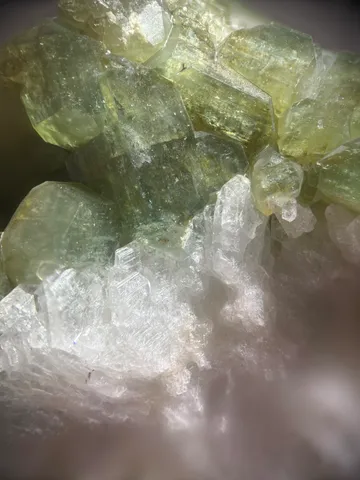
Hydroxylapatite is Sapo’s great species-level contribution to mineral collecting: green to blue-green, flattened hexagonal dipyramids, often almost lenticular or disc-like, with little to no prism development, mostly on K-feldspar and more rarely on quartz. The classic 2004–2006 material includes crystals commonly around 1–3 cm, with exceptional matrix plates carrying numerous crystals and some individual crystals reported to about 4 cm; many show yellowish or pale centers with darker green rims, and some display zoned yellow to yellow-orange fluorescence under ultraviolet light. Top examples are sharply edged, lustrous, strongly zoned, and undamaged, with the crystals placed cleanly on contrasting matrix; ordinary pieces suffer from edge chips, contacted faces, dull surfaces, or ambiguous species identity without analysis or trustworthy provenance.
Muscovite at Sapo occurs as silvery to pale mica books and aggregates in the pegmatite matrix, most often of collector interest when associated with fluorapatite, albite, quartz, and sometimes tourmaline. In fluorapatite specimens, muscovite can add sparkle and textural contrast between white albite blades and green apatite crystals; in some pieces it is a minor accent, while in others it forms part of the structural matrix. Good Sapo muscovite associations are clean, bright, and supportive rather than distracting, and the mica should not be confused with damage: natural mica books can look ragged at the edges, but crushed, bent, or freshly broken muscovite around apatite crystals may signal pocket damage or later handling.
Microcline is the principal K-feldspar host for many Sapo hydroxylapatites, forming pale cream to tan matrix plates and blocky feldspar surfaces on which the flattened green apatite crystals are scattered. Older dealer labels may call this matrix orthoclase, but careful modern descriptions usually treat Sapo’s K-feldspar as microcline unless analysis or a legacy label is being quoted. The best microcline-associated pieces have a clean, relatively flat but not lifeless feldspar plate, with green hydroxylapatite crystals well spaced across the surface; the matrix is valuable because it preserves pocket context, and trimming quality matters—too much blank feldspar weakens display, while over-trimming can remove the natural setting that makes these specimens unmistakably Sapo.
Beyond the headline species, Sapo has a phosphate-rich accessory assemblage that rewards close study. Documented minerals include beryl, arsenopyrite, pyrite, hydroxylherderite, columbite-tantalite series minerals, lithiophilite-triphylite series material, and secondary phosphates such as barbosalite, dufrénite, fairfieldite, hureaulite, leucophosphite, mitridatite, and jahnsite-group minerals. These are generally not the showpiece minerals for which Sapo is bought and sold, but they confirm the pegmatite’s evolved, phosphate-bearing character and explain why apatite-group minerals became so unusually important there.
The main authenticity issue at Sapo is not a flood of outright fakes; it is naming, treatment, and overconfident labeling. A documented problem concerns specimens marketed as “carbonate apatite” or “carbonate-rich apatite” from Sapo, which were later reported as heavily oiled fluorapatite. Oiling can darken color, improve apparent transparency, and hide surface-reaching cracks, so apatite that looks unusually wet, glossy, or unnaturally saturated deserves close inspection. The warning is especially relevant to older mid-2000s material, when Sapo apatite was new, exciting, and not always properly characterized.
Species identity matters. A label reading simply “apatite” may be honest but incomplete. Sapo material includes fluorapatite and hydroxylapatite, and published analytical work has shown that some crystals are chemically and structurally complex. For high-priced hydroxylapatite, a collector should prefer specimens with credible provenance, publication history, reputable dealer documentation, or analytical support. The flattened green dipyramidal habit is strongly suggestive, but habit alone is not a substitute for mineralogical verification on expensive pieces.
Condition is a major value factor. Apatite has Mohs hardness 5 and is vulnerable to bruising, especially on the edges and points of the flattened hydroxylapatite crystals. Check every green edge on a K-feldspar plate, not only the largest crystal. Small contacts on the underside or rear of a crystal may be acceptable; a prominent front-edge chip on the main crystal is a serious value issue. On 2007 fluorapatites, inspect for contacted terminations, broken stacked crystals, glue lines, mismatched luster across repaired breaks, and fresh pale fracture surfaces.
Fluorescence can be useful but should not be oversold. Sapo apatite specimens have been reported with yellow, creamy yellow, orange-yellow, or mustard-yellow fluorescence under shortwave and/or longwave ultraviolet light, sometimes zoned. Because response varies by species, zone, and specimen, fluorescence is best treated as an added diagnostic and aesthetic feature rather than proof of identity. If fluorescence is part of the selling claim, ask which wavelength was used and whether the response is uniform or zoned.
Mislabelling is also common in geography. “Goiabeira,” “Goiabera,” “Aimorés,” “Doce Valley,” and “Conselheiro Pena” can all appear on older Sapo labels. The most precise modern label is Sapo Mine, Ferruginha, Conselheiro Pena, Minas Gerais, Brazil. Do not confuse Sapo with Sapucaia Mine near Galiléia, another famous Minas Gerais phosphate pegmatite with a very different mineralogical and historical profile.
Market availability is episodic. Modest Sapo apatites still appear through collection resales, but top hydroxylapatite plates from the 2004–2006 production and sharp, highly aesthetic fluorapatite-albite specimens from the 2007 find are not being replaced in quantity. Fine blue-cap elbaite is likewise competitive, especially when complete and well provenanced. In today’s market, Sapo specimens are bought as modern classics: the best ones are recognizable, documented, and scarce enough that waiting for a “better one” may take years.
The Sapo story begins with an ant colony, not a prospector’s map. In 1985, a local farmer noticed signs of green tourmaline outside an ant nest on his property, across a hill from what would become the Sapo workings. The first rush was named Lavra da Formiga—“formiga” meaning ant—and the discovery brought in hundreds of garimpeiros. They dug short vertical shafts across the ground, and the reward was enough to keep the rush alive: several hundred kilograms of green, blue, and bicolored tourmaline crystals reportedly came from that first ant-inspired locality.
But too many miners on too little ground create a problem of their own. Some garimpeiros obtained permission to dig on the other side of the hill. There, they found the pegmatite later called Sapo. The name is as literal as the first one: “sapo” means frog, and the pegmatite lay beneath marshy ground where frogs were abundant. It is a perfect Minas Gerais locality name—plain, local, and tied to the ground itself.
The frogs came with water, and the water shaped the mine’s fortunes. Horácio Creek ran through or near the marsh, and the wet season repeatedly made mining difficult. Early workings found small pockets of quartz and tourmaline, but the mine did not become a major producer until 1992, when Clóvis Martins Coelho—Clóvis “Baiano,” because he was from Bahia—received a lease and sank a new shaft. At about 5 meters below surface, the shaft hit the pegmatite. From there Sapo became a serious specimen mine.
That phase produced several dozen tons of large quartz crystals, including colorless, citrine, smoky, “alligator,” and “cathedral” quartz. Then came the tourmalines: green, blue, red-green, watermelon, and the blue-cap crystals that gave Sapo a place among Brazil’s elite tourmaline names. The blue-cap material was exciting because fine examples of that color style were never common, and Sapo provided a Brazilian counterpart to earlier blue-cap tourmalines known from California.
Just before Christmas 2001, the mine’s old enemy returned. Torrential rain caused Horácio Creek to overflow, flooding the workings completely. The tunnels and access shaft were filled with hundreds of tons of sediment. For a pegmatite mine, this was not simply a pause in production. It meant that the physical path to future pockets had been buried under water-driven debris, turning a productive underground locality back into something like the marsh from which it had taken its name.
Then came the apatite surprise. In 2005, collectors at major mineral shows saw strange green and yellow-zoned “apatite” specimens from Sapo: flattened, discoidal to low-angle dipyramidal crystals on feldspar, unlike the ordinary prismatic apatite one expects from many pegmatites. Italian dealer Riccardo Prato had gone to Brazil when the pocket came to light and obtained much of the best material. The crystals were attractive, plentiful enough to make an impact, and odd enough that the correct identity took time to settle.
That uncertainty became part of the locality’s scientific interest. Some Sapo apatite was hydroxylapatite, some was fluorapatite, and some material proved compositionally zoned. For collectors, the chemistry was not an abstract laboratory matter—it could be seen in the specimens. The classic hydroxylapatites show flattened green forms, pale centers, darker edges, and zoning that can be visible in ordinary light and under ultraviolet. A Sapo hydroxylapatite plate is not just “green apatite”; it is a fossilized moment in a pegmatite pocket’s chemistry.
The 2007 fluorapatite find added a second visual language. These were not the flat green dipyramids on K-feldspar, but sharp, lustrous green hexagonal crystals, commonly on white albite with muscovite. Some were tabular, some prismatic, some stacked in odd sculptural growths, and some showed nearly colorless outer zones wrapped around deep green centers. Within a few years, Sapo had done something few localities manage: it had produced world-class specimens in more than one distinct mineral style, each recognizable in a collector’s case from several feet away.
-Orthoclase-233170.jpg)
-Quartz-197440.jpg)