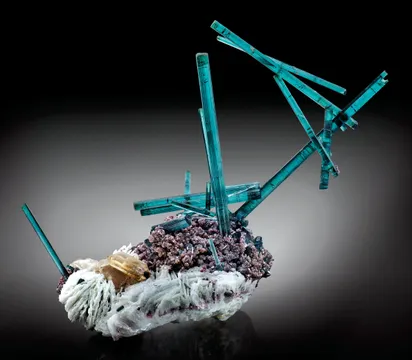
Fluorapatite from Sapo Mine, Brazil - mossy to bottle-green, glassy crystals in varied forms on pale matrix; multiple apatite phases require careful ID.
Key facts
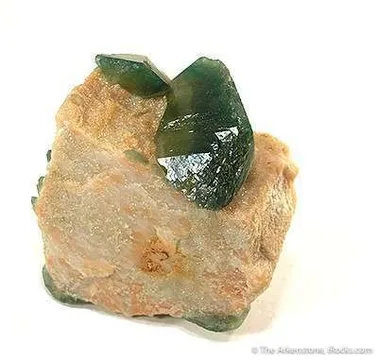
Fluorapatite from the Sapo Mine is one of the signature modern apatites of eastern Brazil: sharp, lustrous, intensely green to yellow-green crystals set against pale feldspar, bladed albite, muscovite, and quartz from a complex granitic pegmatite in the Aimorés pegmatite district of Minas Gerais. The classic Sapo look is not the common stubby hexagonal apatite prism of many pegmatites, but a suite of distinctive forms: compressed prismatic crystals with colorless margins, stacked elongated aggregates, flattened dipyramidal apatite-group crystals, and occasional sculptural “cast” or near-hollow pieces that seem to have grown around a vanished core.

Photo: Rob Lavinsky, iRocks.com / Wikimedia Commons
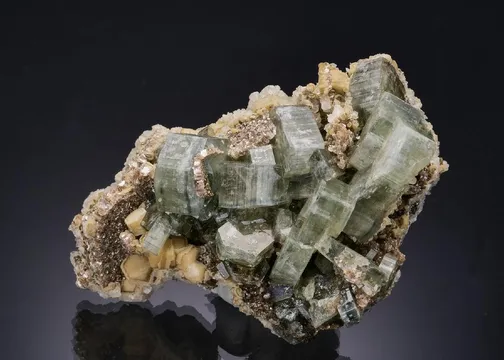
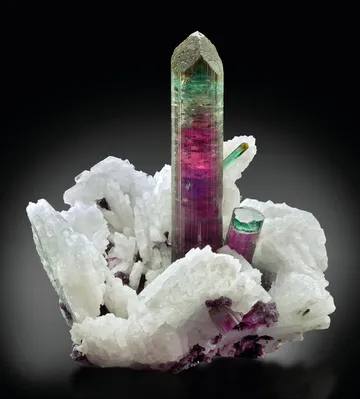
The mine belongs to the celebrated pegmatite belt of the Rio Doce region, where lithium-, beryllium-, boron-, niobium-, tantalum-, and phosphate-bearing pegmatites have supplied collectors with tourmaline, beryl, quartz, feldspar, phosphates, and rare accessory species. Sapo is especially famous for blue and blue-capped elbaite tourmalines, but its apatite finds of the 2000s gave the locality a second identity. For many collectors, the best fluorapatites from Sapo are now as recognizable as the tourmalines: mossy to bottle-green, glassy, architectural, and perched on a light matrix that gives the crystals exceptional visual contrast.

Photo: Rob Lavinsky, iRocks.com / Wikimedia Commons
Historically, the locality is important because it produced a broad and sometimes confusing apatite assemblage. Sapo specimens have appeared as fluorapatite, hydroxylapatite, apatite-(CaF), apatite-(CaOH), and, in older or dealer usage, “carbonate-apatite” or “carbonate-fluorapatite.” Serious collectors should treat those labels carefully. Genuine fluorapatite from Sapo is well documented, but visually similar Sapo apatite-group specimens may prove to be hydroxylapatite or complex intergrowths; in one published crystallographic study, a Sapo sample contained three slightly different fluorapatite phases. The result is a locality suite that rewards connoisseurship: it is not merely “green apatite from Brazil,” but a chemically and morphologically interesting pegmatite phosphate occurrence.

Collectors look for three things above all: fresh glassy luster, strong green body color with pale or colorless edge zoning, and undamaged crystals standing free on a contrasting feldspar or albite matrix. The most desirable cabinet pieces are balanced clusters with multiple complete crystals rather than flat carpets of small crystals, although rich matrix plates have their own appeal. Fine miniatures and small cabinets from the 2004–2010 production period remain especially sought after because the distinctive Sapo habits have not been continuously replenished in quantity.
Search for specimens: View all fluorapatite specimens from Sapo Mine, Brazil
The Sapo Mine is at Ferruginha, in the municipality of Conselheiro Pena, Minas Gerais, Brazil, in the Aimorés pegmatite district of the Eastern Brazilian pegmatite province. The locality has sometimes been loosely placed near Goiabeira because it is closer to Goiabeira’s town center than to the city of Conselheiro Pena, but the accepted locality assignment is Ferruginha, Conselheiro Pena.
Geologically, Sapo is a granitic pegmatite occurrence in the gemstone-bearing pegmatite terrain of the Rio Doce valley. Published locality descriptions place the mine in basement rocks of schist and gneiss overlain by lateritic soil, sand, and gravel, with the basement injected by quartzite and by granite and pegmatite lenses. The collectible minerals come from the pegmatite bodies, where late-stage volatile- and element-rich fluids produced open pockets and unusual phosphate crystallization. The mineral list is typical of a highly differentiated pegmatite: albite, microcline, muscovite, quartz, beryl, elbaite, columbite-tantalite series minerals, arsenopyrite, pyrite, fluorapatite, hydroxylapatite, hydroxylherderite, and several secondary phosphates have been reported.
Sapo had become internationally known by the late 1990s for elbaite tourmaline, particularly the blue and blue-capped material. A 1998 field description recorded roughly 250 meters of tunnels, with the deepest workings only about 15 meters below surface. Because the mine lay in a valley floor beneath unconsolidated sand and gravel, heavy rains could flood the workings and interrupt production. At that time the mine was operated in a garimpo style, with garimpeiros working the tunnels for gem and specimen pockets rather than as a large industrial operation.
The apatite chapter came later. Green fluorapatite crystals from the Sapo Mine were noted in 2004, with fine crystals reported to about two inches long. Around 2005–2006, Sapo produced unusual green apatite-group specimens later recognized in many cases as hydroxylapatite, especially flattened dipyramidal crystals on microcline or feldspar. The 2007 finds made the fluorapatite name especially visible to collectors: sharp, lustrous, hexagonal green crystals and stacked aggregates on albite and muscovite appeared prominently at the Munich show and quickly entered major dealer inventories. Smaller 2010 finds added elongated stacked olive-green pieces, but the principal collecting reputation of Sapo fluorapatite still rests on the mid-2000s discoveries.
Collecting access should be regarded as private and controlled. Sapo is a mine, not a casual public collecting site. Any field collecting requires permission from the landowner or operator, and old workings in unconsolidated tropical valley-floor material present flooding and collapse hazards. Most specimens available to collectors today are from dealer stock, auction dispersals, and older private collections rather than from reliable ongoing public production.
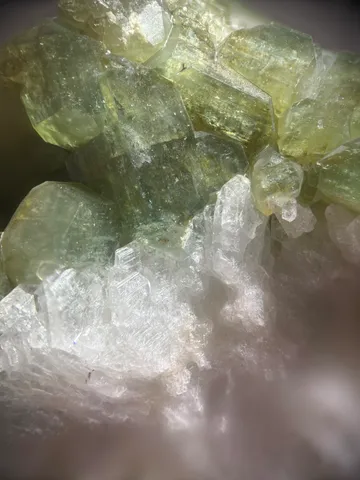
Sapo fluorapatite is typically green, yellow-green, olive-green, moss-green, or deep bottle-green, with some crystals showing nearly colorless outer zones or edges. Thin crystals and crystal margins may transmit light beautifully, giving the best pieces a green core with pale rims. Older specimen descriptions also mention soft green to colorless crystals and deep blue fluorapatite on albite; the blue material is far less common in the market than the green Sapo style.
The dominant crystal habit is hexagonal and prismatic, but Sapo’s great attraction is the way that simple apatite geometry is modified. Many crystals are compressed, tabular, or squat, with basal terminations modified by small pyramidal faces. Some are doubly terminated. Others form elongated stacked groups: a chain of overlapping apatite crystals that can look like a segmented column, “scorpion tail,” caterpillar, or growth around a central stalk. At least one marketed style has been described as a rare “Faden” habit in apatite, with a threadlike growth line running through a narrow specimen. Other Sapo apatite-group specimens, especially hydroxylapatite from the 2005 pocket, show flattened hexagonal dipyramids with little to no prism development.
Typical individual fluorapatite crystals range from a few millimeters to about 2 cm on commonly traded specimens, while better pieces show prominent crystals of 1–3.5 cm. Published and dealer-documented examples include cabinet pieces around 12 cm across with crystals to 1.8 cm, a 4.9 x 4.3 x 2.9 cm specimen carrying a 3.5 cm crystal, and a published 16 cm “Apatite H” specimen consisting of three attached elongated stacks of apatite-(CaF) crystals. Older reports of two-inch green fluorapatite crystals from Sapo confirm that crystals of roughly 5 cm existed, though complete, aesthetic matrix pieces at that scale are uncommon.
The classic matrix is white to cream feldspar, especially albite or microcline, often with muscovite and occasionally quartz. The white matrix is not incidental: it is part of the Sapo aesthetic. Green apatite on pale bladed albite has the contrast collectors want, while dark or massive matrix lowers the visual impact unless the crystals themselves are exceptional. Associated minerals documented from the locality include albite, muscovite, quartz, microcline, tourmaline, beryl, hydroxylapatite, hydroxylherderite, columbite-tantalite series minerals, arsenopyrite, pyrite, and secondary phosphates such as hureaulite, dufrénite, fairfieldite, leucophosphite, mitridatite, and vivianite.
Under ultraviolet light, some Sapo fluorapatite may fluoresce. Dealer documentation records at least one deep blue fluorapatite on albite and muscovite that faintly fluoresced creamy yellow under shortwave UV, and another analyzed Fabre Minerals specimen described as extremely fluorescent under both longwave and shortwave UV. Fluorescence should be treated as a specimen-specific bonus rather than a universal diagnostic feature.
Quality is judged by luster first. The best Sapo fluorapatites are highly lustrous, sharp, smooth-faced, and translucent to gemmy at the edges. Color should be lively rather than muddy; the most attractive pieces combine deep green centers with pale rims or thin color zoning. Form matters strongly: complete crystals standing upright on feldspar, clean stacked sprays, and sculptural near-hollow aggregates are more collectible than broken crusts. Because many Sapo crystals are perched on matrix and have delicate terminations or thin margins, a single broken face or contacted termination can strongly affect value.
The main authenticity issue for Sapo apatite is not that the locality has a notorious fake industry, but that labeling has been historically messy. Older labels may read “apatite,” “apatite-(CaF),” “fluorapatite,” “carbonate-fluorapatite,” “carbonate-rich apatite,” or “hydroxylapatite.” Mindat records a specific caution from Steffen Jahn’s 2006 Mineralien Welt note: specimens offered as “Carbonat-Apatit” or carbonate-rich apatite from the Sapo Mine at the Munich show in 2005 proved to be heavily oiled fluorapatite. That is a locality-specific warning collectors should remember. A glossy, unusually saturated Sapo apatite labeled as “carbonate apatite” deserves close inspection for oiling and for species accuracy.
Hydroxylapatite from Sapo is real and collectible, but it is a different species from fluorapatite. It commonly appears as lively green flattened dipyramids, sometimes with off-white cores, on microcline or feldspar. Some pieces that look superficially like fluorapatite may be hydroxylapatite, and some apatite-group crystals may contain complex compositional zoning or intergrowths. When the exact species matters, rely on modern analysis, documented provenance, or specimens from dealers who can explain the basis of the identification.
Condition is the other major issue. Fluorapatite has Mohs hardness 5 and is brittle; Sapo specimens often have exposed crystals, colorless thin edges, and terminations that chip easily. Look for rubbed pyramidal modifications, cleaved or nicked basal faces, broken crystal ends, repaired stacks, and contacts hidden against matrix. Dealer descriptions of otherwise fine Sapo pieces commonly mention tiny dings, contacted backs, incomplete rear faces, or sub-millimeter flaws. These are not unusual, but they should be reflected in price.
The best Sapo fluorapatite is no longer abundant. Material from the 2004, 2007, and small 2010 finds circulates through auctions and collection dispersals, and the market sees occasional cabinet and miniature pieces from old stocks. Modest thumbnails with small crystals remain obtainable, but top examples with isolated gemmy green crystals on clean albite or feldspar, large stacked aggregates, or unusual near-hollow forms are much scarcer. Fine pieces with strong provenance to Luiz Menezes, Collector’s Edge, Rob Lavinsky/iRocks, Crystal Classics, or long-established private collections carry extra appeal.
In 1998, when Sapo was already famous for tourmaline, the mine had the intimacy and vulnerability of a classic Brazilian garimpo rather than the permanence of a large engineered operation. The owner at that time was Martin Clovis Coelho of Governador Valadares, widely known by the nickname “Baiano.” The land itself belonged to a farmer, who received 20 percent of the mine revenue. Fifteen garimpeiros worked the deposit; they spent weekends in Governador Valadares and lived near the mine during the work week, receiving 15 percent of the profits.
The workings were extensive enough to matter but shallow enough to be at the mercy of the weather: about 250 meters of tunnels, with the deepest only 15 meters below surface. The mine lay in a valley floor between hills, under layers of sand and gravel. Heavy rain was not an inconvenience but a production hazard. When water came in, the ground could flood and mining had to stop.
That same setting helps explain the peculiar charm of Sapo specimens. The mine was not simply a hole in hard rock; it was a tropical valley-floor pegmatite system under lateritic soil and unconsolidated cover, with pockets pursued by hand labor for whatever the pegmatite offered. First the tourmalines built the name, then the apatites changed the conversation. By 2004, green fluorapatite crystals from Sapo were noted internationally. The 2005–2006 pockets produced strange flattened apatite-group crystals, many later understood as hydroxylapatite. Then the 2007 fluorapatites arrived at Munich: green, lustrous, sharp, and so unlike ordinary pegmatite apatite that dealers and collectors immediately recognized them as a new Sapo signature.
One of the most memorable published Sapo apatite specimens is the 16 cm “Apatite H,” described as three attached elongated stacks of apatite-(CaF) crystals. That phrase captures the locality better than any generic description could. Sapo did not merely produce single green hexagons; it produced stacks, chains, perched crystals, and odd growth forms that look as if the pegmatite was experimenting with apatite geometry at the end of its crystallization history.