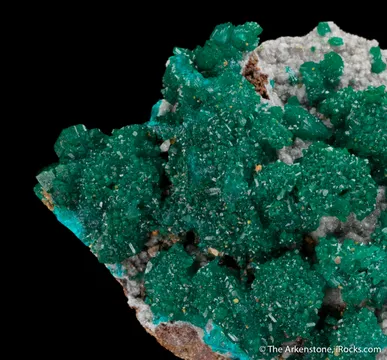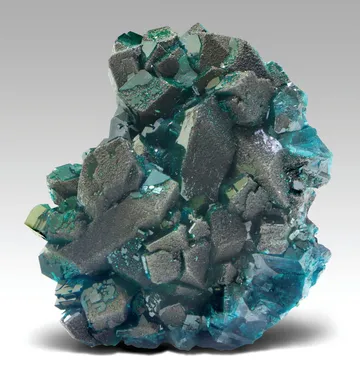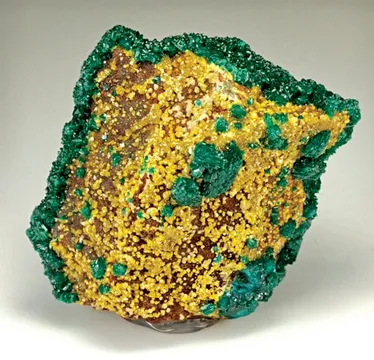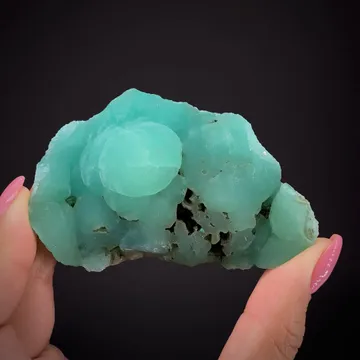
Renéville, Republic of the Congo — renowned dioptase locality with emerald crystals in dark copper-silicate matrix, often with chrysocolla and cuprite.
Key facts
Renéville is one of the great classic dioptase localities: not merely “Congo dioptase” in the broad dealer sense, but the historic Djoué Mines group near the village of Renéville in the Kindamba District of the Pool Department, Republic of the Congo. Its fame rests on a compact, complex Cu-Pb-Zn-Ag mineralization in the Niari–Djoué region, where supergene alteration of polymetallic ores produced the black, clay-rich “terres noires” that became both ore and specimen source. In collector terms, Renéville means saturated emerald-green dioptase in vugs, geodes, crusts, and sharp rhombohedral-prismatic crystals, often set against pale blue chrysocolla or plancheite, red cuprite, white to colorless quartz or calcite, and lead-vanadate/chromate rarities.
Regional View
Country View
The best Renéville specimens have a distinctive personality. They are less “white-matrix cabinet jewels” than mineralogical windows into a copper-rich oxidation zone: dark, heavy-looking matrix; open cavities lined with glassy dioptase; blue-green copper silicates wrapping the backs of plates; occasional quartz crystals carrying dioptase both on their surfaces and, in the rarest pieces, as inclusions inside the quartz. Published crystallographic work on Renéville dioptase was substantial enough by 1964 to treat the locality as a serious scientific occurrence, not simply a specimen producer, and modern collectors still recognize the mine as a benchmark against which Congo-Brazzaville dioptase is judged.

Photo: Wikimedia Commons
Renéville also has a place in species history. Fornacite, Pb2Cu(CrO4)(AsO4)(OH), was described from the Renéville/Djoué material in the early twentieth century, and the district has continued to attract scientific attention into the present day with the approval of abelloemringerite from the Renéville area. That combination—classic aesthetic dioptase, unusual copper-silicate paragenesis, and type-locality mineralogy—makes Renéville a locality where even small specimens can carry an unusually rich label.

Photo: Wikimedia Commons
Search for specimens: View all specimens from Renéville, Republic of the Congo
Renéville lies in the Pool Department of the Republic of the Congo, in the broader Niari–Djoué metallogenic province west to northwest of Brazzaville. The old mine group is commonly treated as the Renéville Mine or Djoué Mines, with the principal specimen-producing area at the Indus workings; associated workings and prospects include Amélie, Bel, Enders, Marie, Fondere/Fonders, and related sectors. The mine group was described as a set of old prospects a few kilometers north of Renéville village, with Indus the largest and the source of most significant mineral specimens.
Geologically, the deposit is hosted in the lower part of the Schisto-Calcaire sequence, particularly the SC 5 inférieur, near the southern flank of the regional “Anticlinal médian.” The sequence includes dolomitic reefal limestones, marls, argillaceous breccias, and related carbonate units, locally capped or bordered by red sandstones of the Renéville/Djoulou type and younger sandy cover. The mineralization is shallow, strongly oxidized, and discontinuous: residual “black earths” in carbonate pockets, mineralized fractures and diaclases, and carbonate blocks cut by copper-mineral veins. That combination explains both the mining disappointment and the specimen glory. The ore was too complex and too limited for major copper production, but it created exactly the cavities, geodes, and silicate-rich pockets that collectors value.
The metal suite is polymetallic. Copper dominates the specimen assemblage, but the deposit also carries lead, zinc, silver, and traces of elements such as cadmium and germanium reported in regional mineral studies. Primary and relict ore species include chalcocite, chalcopyrite, galena, pyrite, and bornite in older accounts; the collector minerals are mostly supergene products—dioptase, chrysocolla, plancheite, malachite, azurite, cuprite, cerussite, calcite, quartz, mimetite, pyromorphite, vanadinite, mottramite, descloizite, wulfenite, willemite, and fornacite. The best specimens are not random surface coatings but cavity pieces from the oxidized ore, especially from the Indus sector, where blocks of limestone and copper-rich matrix carried vugs lined with dioptase.
Mining and prospecting came in waves. The mineralization was known and worked on a small scale before systematic twentieth-century work. Between roughly 1909 and 1913, the Société des Mines du Djoué investigated the deposit and made a limited chalcocite extraction, including an open cut and a crosscut reported at about 250 m. In 1931, the Consortium minier du Congo-Niari undertook more substantial work, including over a kilometer of galleries and several drill holes, but the results did not justify continued development. BUMIFOM returned to the district in the early 1950s with regional geology, geophysical work, and drilling, again confirming that the deposit was scientifically and mineralogically interesting but of limited mining promise.
The deposit’s ore estimates emphasize that distinction. Historical summaries cite residual black-earth material on the order of tens of thousands of tonnes at only modest copper grades, and modern locality accounts suggest the old prospects probably produced less than 100,000 tonnes of ore overall. The mineralized outcrops were described as nearly continuous from Bel to Marie over a notable strike length, but the levels are irregular, variable in thickness and grade, and not securely connected into a large ore body. The mineralization also appears not to root deeply, which is why Renéville became a classic specimen locality rather than a long-lived industrial copper mine.
Collecting access today should be treated as restricted and uncertain. The old workings are historic mine sites in a rural tropical-savanna setting, and neither public collecting rights nor safe underground access should be assumed. Serious collectors should rely on documented old collections, reputable dealers, and specimens with precise labels—especially labels naming Indus Mine, Renéville Mine, Djoué Mines, Kindamba District, Pool Department, Republic of the Congo. Modern trenches and renewed small-scale searching have been reported at times, but the old classic material remains the backbone of the market, especially for large dioptase geodes, quartz-with-dioptase combinations, and pieces with uncommon associations such as plancheite or fornacite.
The most famous finds were the dioptase geodes. Published French work records that magnificent Renéville geodes were presented to the Société française de Minéralogie et de Cristallographie in January 1959, and the locality was later studied crystallographically from a large number of crystals. Some geodes were reported as reaching about 50 cm in their greatest dimension. Individual crystals on collector specimens are commonly sub-centimeter to centimeter scale, with exceptional pieces showing crystals around 2–3 cm and old accounts of larger edge measurements in museum-quality material. Renéville’s top pieces are judged by the openness and depth of the vug, the sharpness and glassiness of the dioptase, the preservation of the fragile terminations, and the contrast with blue chrysocolla/plancheite, red cuprite, white cerussite or calcite, or clear quartz.
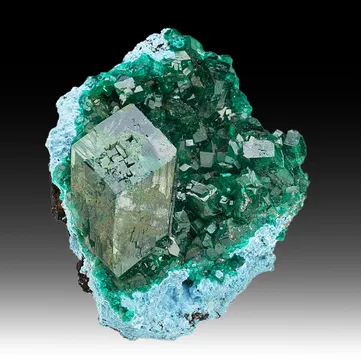
Renéville dioptase is the locality’s signature mineral, occurring in black earths, carbonate pockets, mineralized fractures, crystalline masses, and geodes—some historically reported up to about 50 cm across. The crystals are typically intense emerald to dark bluish green, glassy, and rhombohedral to short-prismatic, with many collector specimens showing drusy vug linings, crusts, or pockets in dark copper-rich matrix; better examples carry distinct crystals around 1 cm, with notable pieces reaching the 2–3 cm range. Classic associations include chrysocolla, plancheite, cuprite, cerussite, calcite, quartz, malachite, and fornacite-group rarities. The finest Renéville pieces separate themselves by depth of color, wet-looking luster, undamaged terminations, open geode architecture, and strong color contrast—especially dioptase rising from pale blue chrysocolla/plancheite or perched on quartz rather than simply forming a flat green crust.
Renéville chrysocolla is best understood as part of the copper-silicate skin of the oxidized deposit rather than as a standalone ornamental mass: it appears as light blue to greenish-blue coatings, botryoidal to earthy layers, and matrix for dioptase, often visually intergrading in dealer descriptions with plancheite where precise testing has not been done. Published and photographed specimens show gemmy green dioptase isolated on light greenish-blue chrysocolla, sometimes with crystals on both sides of a plate, implying growth on pocket surfaces rather than a simple one-sided coating. The best chrysocolla-bearing Renéville specimens are those in which the blue material is clean, continuous, and clearly contrasted with sharp dioptase; ordinary pieces are duller, powdery, massive, or visually confused with other blue copper silicates without analytical support.
Quartz at Renéville is most collectible when it participates in the dioptase story: drusy coatings on quartz crystals, clear to whitish quartz points set with emerald-green dioptase, and the much rarer quartz crystals containing dioptase inclusions. Documented specimens from old Renéville material show dioptase crystals to about 1.1 cm perched on quartz, while a Mineralogical Record-illustrated example records a 6.8 cm quartz specimen with dioptase inclusions, and another cabinet specimen shows dozens of small green dioptase crystals enclosed within quartz. This inclusion habit is one of the locality’s most coveted specialties because it preserves a paragenetic puzzle in three dimensions; the best examples have transparent enough quartz to reveal the internal green crystals clearly, plus external dioptase or a balanced overall form, while lesser pieces may be attractive but lack visible included crystals or have distracting bruising on quartz tips.
Renéville malachite is a secondary copper carbonate of the same oxidized system that produced the dioptase, occurring as light to dark green coatings, fibrous masses, vein material, and pocket associations in the Indus–Renéville workings. It is not the locality’s premier species, but it can make compelling combination specimens: one documented small-cabinet piece was a rich fibrous malachite mass hosting a 2.5 cm dioptase-lined pocket, with lustrous dioptase crystals exceeding 1 cm in the vug. For Renéville, good malachite is valued less as polished botryoidal display and more as context—fresh fibrous texture, undyed natural color, and a clear relationship to dioptase, cuprite, or chrysocolla. Ordinary malachite-rich pieces from the broader Congo trade are easily confused with DRC material, so a specific Renéville/Indus provenance matters greatly.
Other documented Renéville minerals give the locality its real mineralogical depth. Fornacite, Pb2Cu(CrO4)(AsO4)(OH), is the classic type-locality species from the Djoué/Renéville material, described as yellow to green and dark green small prismatic crystals and later studied in relation to vauquelinite. Abelloemringerite, Cu2Pb2Mn3+Mn4+3O11(OH)(H2O)2 · H2O, was approved from the Renéville area in 2025, adding a modern type-locality chapter to the district. The broader assemblage includes azurite, calcite, cerussite, chalcocite, chalcopyrite, cuprite, descloizite, galena, mimetite, mottramite, plancheite, pyrite, pyromorphite, vanadinite, willemite, and wulfenite, with several of these appearing mainly as accessory, analytical, or rare collector species rather than common cabinet specimens.
The first authenticity issue is geography. Renéville is in the Republic of the Congo, Congo-Brazzaville, not the Democratic Republic of the Congo. Many market labels casually say “Congo,” and some recent online listings have confused Renéville with DRC copper-belt localities such as Tantara or with vague “Copper Crescent” wording. For a serious collection, insist on labels that distinguish Republic of the Congo from DRC and, when possible, preserve older locality wording such as Djoué Mines, Renéville Mine, Indus Mine, Kindamba/Kindanba District, Pool Department.
The second issue is association. Blue material on Renéville dioptase is often sold as chrysocolla, plancheite, or “plancheite/chrysocolla,” and visual separation can be unreliable without testing. Plancheite tends to be the more desirable named association, but pale blue massive copper silicates should not be upgraded on appearance alone. Likewise, rare species such as fornacite, wulfenite, mottramite, mimetite, descloizite, and willemite should be treated cautiously unless the specimen has old labels, analysis, publication history, or a visually plausible and well-documented paragenesis.
No well-established industry of fabricated Renéville dioptase specimens appears to dominate the market, but restoration and misidentification are real concerns. Dioptase has perfect cleavage and is brittle; old geodes and pocket plates often show edge contacts, bruised tips, cleaved crystals, or repaired matrix. A broken quartz point or a chipped dioptase termination may not seriously diminish a major cabinet piece if disclosed, but glued crystals, recolored matrix, or unmentioned repairs should be viewed critically. Oiled or wet-looking copper silicate matrix can make color appear richer; if a specimen looks unnaturally glossy in the non-crystalline blue or green areas, ask whether any coating, oil, or consolidant has been applied.
Condition standards are strict because the species is so visual. Look for intact glassy faces, sharp rhombohedral terminations, and a lively deep green that remains attractive under different lighting. Renéville pieces commonly occur on dark matrix, so contrast can be lower than on Tsumeb calcite or white matrix specimens; the best examples overcome that with saturation and sparkle. Vug specimens should be checked deep inside the pocket, not only on the rim, because damage and dirt often hide in the cavity. Quartz-inclusion pieces need special handling: the quartz points may be bruised, and the value depends on how clearly the included dioptase can be seen.
Fluorescence is not a selling point for Renéville dioptase; locality records list dioptase, chrysocolla, malachite, cuprite, and many associated species as non-fluorescent. Willemite is documented from Renéville but locality records do not indicate fluorescence there, so do not buy Renéville material on assumptions drawn from Franklin-style willemite. Handle dioptase as a display mineral, not a gem rough: it is fragile, sensitive to knocks, and should be kept away from acids, aggressive cleaning, ultrasonic baths, and prolonged soaking of friable matrix.
Market availability is uneven. Small Renéville dioptase specimens and chips with drusy crystals appear regularly enough that the locality is attainable, while fine cabinet geodes, large undamaged crystals, dioptase-on-chrysocolla plates, and quartz with dioptase inclusions are much scarcer and command serious prices. Old provenance adds value: pieces from mid-twentieth-century collections, European collections, or published Mineralogical Record specimens carry more authority and often represent the classic production that built Renéville’s reputation. A top Renéville label should be precise, and a top Renéville specimen should show why the locality became famous even before the label is read.
Renéville’s name preserves the early mining frontier of Congo-Brazzaville. In Schubnel’s 1964 paper on the crystal forms of Renéville dioptase, the locality name is tied to René Petit-Jean, who directed the first exploitation work for the Compagnie du Djoué around 1913. That is a wonderfully human detail for a locality now remembered mostly for green crystals: the mine name is not an abstraction on a specimen label, but a fossil of the first organized push into the Djoué copper prospects.
The French mineralogical community saw Renéville at its best in January 1959, when Claude Guillemin presented “magnificent geodes” from Renéville to the Société française de Minéralogie et de Cristallographie. The locality coordinates were given with the old precision of a field notebook—about 14°48' E and 3°59' S—and the occurrence was described in the black earths as crystalline masses and geodes, some reaching 50 cm in greatest dimension. For a collector, that single meeting explains much of the Renéville legend: not scattered green crusts, but whole dioptase-lined cavities large enough to be memorable even in a room full of professional mineralogists.
The mine itself was repeatedly measured, driven, drilled, and found wanting as an ore deposit. The Société des Mines du Djoué investigated it between 1909 and 1913 and made only limited chalcocite extraction. The 1931 campaign by the Consortium minier du Congo-Niari was more ambitious: roughly 1,250 m of galleries and eight drill holes totaling 729 m. BUMIFOM came back in the 1950s with geological mapping, geophysics, and about 1,900 m of drilling. Each wave sharpened the picture without turning Renéville into a major copper mine. The economic verdict was subdued; the mineralogical verdict was the opposite. The very features that frustrated metallurgists—oxidized black-earth ore, mixed species, irregular pockets, shallow discontinuous mineralization—made Renéville one of the finest specimen localities in central Africa.
Claude Guillemin’s connection gives the locality another thread. Biographical material on Guillemin includes a photograph captioned as showing him collecting dioptase at Renéville in the Niari basin of “Congo-Brazzaville.” The image matters because it places a major French mineralogist not merely behind a microscope but in the field, at the source of the specimens that later entered museums and publications. Renéville specimens in French institutional collections are not anonymous colonial-era curiosities; they are tied to named mineralogists, named mining campaigns, and a period when central African copper deposits were being studied simultaneously as ores, crystallographic problems, and aesthetic wonders.