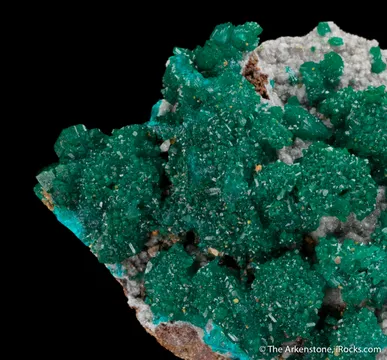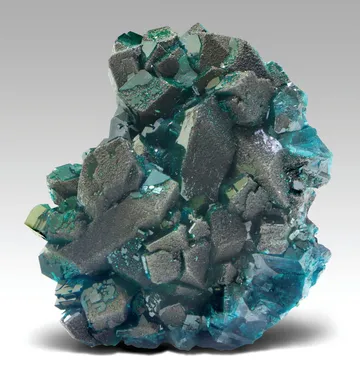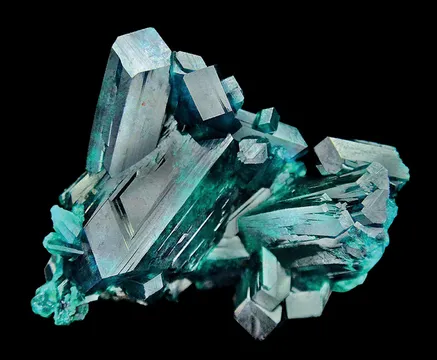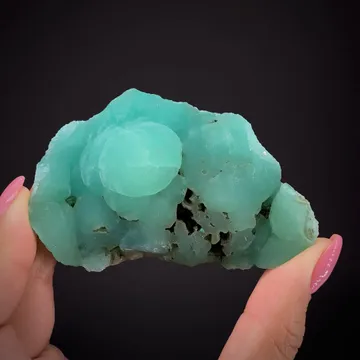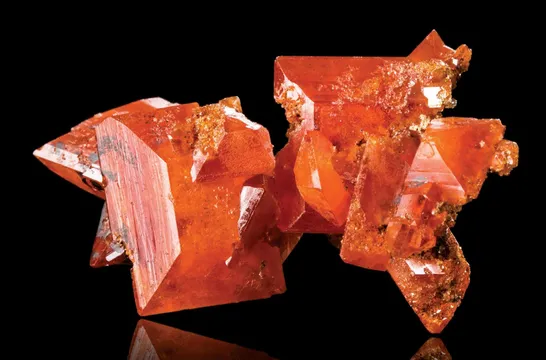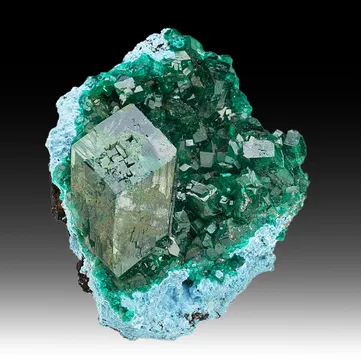
Mindouli, Republic of the Congo - type locality for plancheite; prized for emerald-green dioptase on blue plancheite and rare paragenesis with mimetite and wul…
Key facts
Mindouli is the classic collector name for a cluster of Cu-Pb-Zn occurrences in the Pool Department of the Republic of the Congo, west of Brazzaville, where Neoproterozoic carbonate and sandstone units of the Niari Basin are cut by fault-controlled mineralization. For collectors, the name has a special charge: Mindouli is the type region of plancheite, one of the great blue copper silicates, and it has produced some of Africa’s most beautiful modern dioptase specimens—emerald-green crystals on powder-blue plancheite, sparkling quartz, pale dolomite, cerussite, wulfenite, duftite, mimetite, and, in rare cases, native silver.
The best Mindouli specimens are not merely “green dioptase from Congo.” Their character is locality-specific. Sanda Hills pieces can show glossy, transparent to translucent dioptase perched on glittering quartz over blue plancheite; quartz may enclose blue plancheite spherules or wisps, giving otherwise colorless crystals a floating internal haze. N’tola specimens, by contrast, are famous for dark green dioptase crusts and casts: semi-concave, cup-like epimorphs after an earlier botryoidal or kidney-shaped mineral, probably a copper silicate such as plancheite, shattuckite, or chrysocolla. Add yellow-orange mimetite or green duftite to that palette and Mindouli becomes one of those rare localities where the paragenesis is as memorable as the individual species.
Regional View
Country View
Historically, Mindouli matters on several levels. It was part of an old copper-producing landscape in the Niari Basin, where malachite-bearing ores were smelted long before modern mineral collecting; it became a colonial mining district tied to the Brazzaville–Mindouli rail connection and the Compagnie Minière du Congo Français; and in 1908 Alfred Lacroix described plancheite from Sanda material brought from the French Congo. In the twenty-first-century specimen market, new work at Sanda, Kimbedi, Mpita, Pimbi/M’bumba, and N’tola renewed the locality’s reputation, putting Mindouli dioptase beside the better-known classics of Tsumeb and Kazakhstan—but with a distinctly Congolese look.

Photo: Wikimedia Commons
Search for specimens: View all specimens from Mindouli, Republic of the Congo
Mindouli lies in the Niari Basin, within the West Congo Belt, where the important mineralized ground follows a faulted contact between karstified carbonate rocks and sandstone. The regional rocks are Neoproterozoic, and the collector mineralization is concentrated in oxidized, near-surface zones developed above older Cu-Pb-Zn sulphide bodies. Modern geological work interprets the deposits as complex, multiphase systems: first, hydrothermal fluids circulated through permeable faults, fractures, karst cavities, and breccias, depositing sulphides; later, supergene alteration remobilized copper, lead, zinc, arsenic, vanadium, and silica into the brilliant secondary assemblages prized by collectors.
The primary ore minerals documented in the wider Mindouli district include chalcocite, chalcopyrite, galena, sphalerite, and pyrite, with chalcocite especially important in the copper-rich parts of the system. Koud’s petrological study of the Mindouli copper silicates emphasized that dioptase, chrysocolla, and plancheite form the major supergene copper-silicate phases, and that among the copper sulphides observed—bornite, digenite, chalcocite, and covellite—chalcocite is the sulphide that shows direct alteration into copper silicates. This relationship helps explain why massive dark sulphide ore, blue-green copper silicate crusts, sparkling quartz linings, and isolated gemmy dioptase crystals can occur in close association.
Mindouli is not a single mine in the way that Tsumeb or Milpillas is a single name. Collectors use “Mindouli” for a districtal suite of workings and prospects around the town and nearby mining localities, including Sanda Hills, Kimbedi, N’tola, Mpita, Pimbi/M’bumba, and associated small quarries and adits. Sanda Hills is especially important because it is the type locality for plancheite and has produced the famous dioptase-quartz-plancheite plates. N’tola is famous for dioptase with mimetite, duftite, and dolomite, and for its unusual dioptase epimorphs. Kimbedi and Mpita have supplied additional dioptase and plancheite-bearing material, while M’Passa, farther west-southwest in the district, is better known as a Cu-Pb-Zn mine with spectacular chalcocite.
Mining history reaches far deeper than the European period. Archaeological work in the Niari Basin has shown that copper production around Mindouli was active by the fourteenth century, with malachite-rich oxidized ore smelted locally to produce copper objects for exchange. Later, during the colonial period, the Compagnie Minière du Congo Français worked the Mindouli copper deposits after the first decade of the twentieth century. Historical accounts record shipments of ore to Brazzaville before the First World War, subsequent periods of irregular production, and repeated attempts to restart or modernize mining after the Second World War. In the twenty-first century, Chinese-linked Société Lulu de Mine held polymetallic permits for Mindouli and M’Passa-Moubiri, and reports from 2014 describe formalization of its exploitation convention for polymetals in Pool Department.
For specimen collectors, the productive period of greatest interest is much more recent. The modern collector market saw important Mindouli-area dioptase material circulate from the 2010s onward. At N’tola, unusual dioptase epimorphs were produced in quantity from roughly 2016 to 2018 and first appeared widely on the U.S. market in 2019; several sources record that the mine had closed by spring 2019. At Sanda, field accounts describe old exploration tunnels, hard silicified limestone, vein systems with dioptase and plancheite in cracks, and pockets containing quartz, plancheite, cerussite, wulfenite, and dioptase. Especially memorable are pockets recorded at Sanda with plancheite, cerussite, and quartz perimorphs after hemimorphite, and a larger pocket around a meter across with dioptase, quartz, and plancheite.
Collecting access today should be treated as controlled rather than casual. These are mined or formerly mined prospects in a district with changing mineral rights, underground workings, recent industrial interest, and local land use. Some specimens have come from organized collecting, exploration, or local miners working old openings and silicified veins; a visiting collector should not assume legal or safe access to adits, quarries, dumps, or road cuts without permission from landholders, local authorities, and mineral-rights holders. The geology is generous, but the ground is not a tourist collecting site.
Mindouli dioptase ranges from small, glittering crusts to prominent crystals over 2 cm and, in exceptional reported cases, crystals approaching 3 cm; the color is typically deep emerald to forest green, often with glassy luster and enough transparency to glow under strong light. At Sanda Hills, the finest crystals sit on drusy quartz over plancheite, sometimes with blue inclusions visible inside quartz; associations include plancheite, cerussite, wulfenite, quartz, duftite, and locally coronadite-like dark coatings. At N’tola, the characteristic form is different: tiny lustrous crystals can coat semi-concave casts and cup-like epimorphs after an earlier botryoidal copper silicate, commonly with yellow mimetite along the edges and white to pale dolomite as a contrasting matrix. Good Mindouli dioptase is judged by sharpness, luster, transparency, saturated green color, undamaged terminations, and locality-specific contrast—green on blue plancheite, green on sparkling quartz, or green casts with mimetite—not merely by crystal size.
Quartz from Mindouli is important less as an isolated species than as the optical stage on which the copper minerals perform. In Sanda material, quartz forms clear to milky druses, small terminated crystals, and glittering crusts over plancheite and dioptase; some crystals contain blue plancheite inclusions as spherules, wisps, or acicular sprays, producing a distinctive blue-in-clear effect. Quartz also overgrows plancheite, chrysocolla-like copper silicate, wulfenite, and dioptase, so specimens may appear as sparkling pale crusts with color glowing from below. The best quartz-bearing pieces show a clean, lustrous druse with visible green dioptase and blue plancheite rather than a dead, sugary coating; on top Sanda plates, quartz adds both contrast and depth, while in silver specimens a single plancheite-included quartz crystal perched on native silver can turn a small thumbnail into a highly unusual association piece.
Plancheite is the signature blue mineral of Mindouli and the species for which Sanda Hills is the type locality. Alfred Lacroix’s original material included dark blue mammillated concretions with tight fibrous structure, pale blue spherules made of needles, and light blue asbestos-like fibers or veinlets in sandstone, reported up to about 4 cm long. Modern Sanda specimens commonly show plancheite as powder-blue to deep blue botryoidal or fibrous masses beneath dioptase and quartz, as rounded inclusions in quartz, and as blue vein material in copper-rich silicified matrix; associated minerals include dioptase, quartz, cerussite, duftite, calcite, cuprite, chalcocite, native silver, malachite, and chrysocolla-like copper silicates. A fine Mindouli plancheite specimen should have a strong blue color, visible fibrous or botryoidal texture, and convincing contrast with emerald dioptase or clear quartz; ordinary pieces are massive blue-green copper silicate with uncertain identity, while better ones preserve the texture and paragenetic relationships that make the type locality meaningful.
Native silver is one of Mindouli’s more surprising collector minerals, known from historical references to silver with dioptase and willemite in limestone and from modern specimens where silver occurs with quartz, plancheite, calcite, malachite, and other secondary copper minerals. The most distinctive recent pieces are thumbnails: crystallized silver or silver-rich nuggets carrying clear quartz crystals with blue acicular plancheite inclusions, plus small green malachite or copper-phosphate-looking growths that may require Raman confirmation. Silver from Mindouli should not be expected as abundant wire masses; it is a rarity in a copper-silicate district, valuable because of the association. The best specimens show recognizable metallic silver, not merely gray matrix, with well-placed quartz and visible blue plancheite inclusions; careful analytical labeling matters because tiny green associates on silver have been confused visually with libethenite, dioptase, or malachite.
Mindouli mimetite is especially associated with the N’tola Mine, where it occurs with dioptase, dolomite, duftite, and locally wulfenite-like yellow-orange habits. On collector specimens it may appear as tiny yellow to orange crystals or aggregates lining the edges of dioptase casts, sprinkled on dolomite, or accompanying dark green dioptase on pale matrix; it is generally an accent mineral rather than the main visual mass. Its importance is in contrast and locality character: mimetite gives the N’tola dioptase epimorphs a warm edge-color that immediately separates them from many Sanda dioptase-plancheite plates. Fine examples show clearly crystallized yellow-orange mimetite in direct association with lustrous dioptase and, ideally, on undamaged cast forms; ordinary examples have only sparse, hard-to-see specks that can be mistaken for wulfenite or iron staining unless the habit and context are carefully checked.
Other documented Mindouli and Mindouli District minerals include aurichalcite, azurite, calcite, cerussite, chalcocite, chalcopyrite, chrysocolla, cuprite, dolomite, duftite, fornacite, galena, germanite, goethite, hematite, hemimorphite, libethenite, malachite, mottramite, native copper, plattnerite, pseudomalachite, pyrite, pyromorphite, sphalerite, willemite, and wulfenite. Plancheite is the standout type-locality mineral. Among rarities and unusual associations, Mindouli is notable for native silver with copper silicates, wulfenite and cerussite on Sanda quartz, N’tola dioptase with mimetite and duftite, and old references to willemite in association with dioptase and silver.
The main authenticity problem with Mindouli specimens is not a famous fake industry; it is locality and species precision. Labels are often too broad—“Mindouli,” “Pool,” “Congo,” “Congo Brazzaville,” or simply “Republic of Congo”—and the different sublocalities have different specimen styles. Sanda, Kimbedi, Mpita, Pimbi/M’bumba, and N’tola should not be collapsed automatically into one label when the original source is known. Conversely, older labels may use French Congo, Congo-Brazzaville, Congo Republic, or Pool Region. A recurring modern error is confusing the Republic of the Congo with the Democratic Republic of the Congo; a Mindouli label belongs to the Republic of the Congo, not Katanga or the DRC Copperbelt.
The second concern is the identity of blue copper silicates. Plancheite, shattuckite, chrysocolla, and other blue copper-silicate material can be visually similar, especially in massive, fibrous, or cryptocrystalline crusts. Sanda type-locality plancheite is well documented, but not every blue coating on a Mindouli specimen should be assumed to be plancheite without context or analysis. Dealers have sometimes described blue matrix cautiously as “plancheite(?)” or “copper silicate,” and analyzed plancheite carries a premium. The same caution applies to small yellow-orange associates on N’tola specimens: mimetite, wulfenite, and duftite can all be present in the district, and tiny crystals may require magnification or analytical work.
Condition is a serious factor. Mindouli dioptase can be highly lustrous and gemmy but is brittle and unforgiving; exposed crystals chip, cleave, and bruise easily. The Sanda material is commonly extracted from hard silicified limestone, so sawn bases, contact marks, and trimming scars are not unusual. Quartz overgrowth can protect some surfaces while also hiding broken or etched mineral below. Plancheite’s fibrous and botryoidal surfaces can be rubbed smooth or dulled, and powder-blue coatings show dirt, abrasion, and old handling quickly. N’tola epimorphs should be checked around the rims of the cups, where the sparkling dioptase crust is most exposed.
Mindouli pieces remain available in the market, but quality varies sharply. Small N’tola dioptase epimorphs and Sanda dioptase-plancheite thumbnails are obtainable; large, aesthetic plates with gemmy green crystals on sparkling quartz over saturated blue plancheite are much less common and can command strong prices. Specimens with reliable sublocality data, analyzed plancheite, native silver, well-developed mimetite, or exceptional quartz inclusions are especially desirable. Associated willemite, where present, may fluoresce, but most Mindouli dioptase-plancheite display specimens are bought for color, texture, and paragenesis rather than fluorescence.
The oldest Mindouli story is not a specimen story at all, but a metallurgy story. The Niari copper district was a working landscape centuries before European mining companies put adits into the hills. Archaeological work around Mindouli has documented copper production sites dating to the fourteenth and fifteenth centuries, with dark patches of reddened earth, charcoal fragments, slag, and tuyère remains marking the actual work areas. The ore was not the gemmy green dioptase collectors prize today, but malachite-bearing oxidized copper material that could be sorted, crushed, and smelted. In the Mindouli region, small copper bars—barrettes made for exchange—were part of a long-distance trade system that linked the Niari Basin to broader western Central African political worlds.
By the fifteenth to seventeenth centuries, the metallurgists around Mindouli were doing something wonderfully particular: they were smelting copper in reused decorated domestic pottery. At Kingoyi near Mindouli, researchers studied Moubiri-type pottery, crucibles, slag, ore, and tuyère fragments, comparing them with Kindangakanzi material from the Boko-Songho area. The laboratory program was unusually concrete: roughly 10.5 kg of metallurgical debris from the two sites was screened, 85 samples were selected, and 17 were prepared as polished blocks for optical microscopy and SEM–EDS. The Kingoyi crucibles were not anonymous industrial ceramics; they were domestic vessels pressed into metallurgical service, with alumina-rich, quartz-based fabrics that proved refractory enough for copper smelting.
The tuyères add another vivid detail. At Mindouli-area sites including Kingoyi, their internal diameters were about 3.5 cm—too broad for blowpipes, too narrow for natural-draught systems, and consistent with bellows-driven air supply. They were formed around reeds, leaving organic impressions on the interior surfaces, and they were not pre-fired; they became ceramic in the heat of use. That small technical choice pulls the reader close to the furnace mouth: reeds, clay, decorated pots, bellows, malachite ore, charcoal, and a heat strong enough to transform domestic pottery into copper-smelting crucibles.
Centuries later, another named figure entered the mineral story. François Gilbert Planche, an engineer, industrialist, railway promoter, and French politician, was connected with the Compagnie Minière du Congo Français and the construction of the Brazzaville–Mindouli line. The new blue copper silicate from the French Congo was named plancheite by Alfred Lacroix in 1908 in his honor. It is a mineralogical naming story with real industrial scenery behind it: rail lines, copper concessions, colonial mining capital, and blue fibrous mineral specimens carried from the Sanda area to Parisian scientific attention.
The modern collecting stories are more intimate and underground. Field accounts from the Spirifer Minerals team describe the practical obstacles of working in the Republic of the Congo: bad roads, wet-season weather, equipment scarcity, negotiations with local people, and the need to bring essential tools into the country piece by piece. Their work around N’tola was partly detective work, tracing specimens that had been sold only as coming from an “unknown location in the Mindouli area” back to the actual mine. The underground photographs and descriptions place dioptase on the walls, in cracks in limestone, and in pockets in partly flooded tunnels; one flooded part of the mine had dioptase visible on the ceiling.
At N’tola, the collector prize was a strange morphology: dioptase perimorphs and epimorphs after an unknown kidney-shaped mineral, probably chrysocolla or plancheite. These casts, sometimes several centimeters across, are known for semi-concave, cup-like forms built from tiny sparkling green crystals. Some carry yellow mimetite around the edges, turning the specimen into a green-and-gold fossil of an earlier mineral’s shape. The source mineral is gone or transformed, but the form remains, which is exactly the kind of geological afterimage collectors remember.
Sanda tells a different kind of field story. The same field accounts describe an old exploration tunnel in the upper Sanda area, probably from the French period, with dioptase and calcite mineralization in the walls. Outside the tunnel, dioptase and plancheite occur in cracks in Neoproterozoic limestone, and the mineralized veins can be so hard and silicified that fragile specimens had to be sawed out with equipment brought from Poland. The field photographs record a 40 cm pocket with plancheite, cerussite, and quartz perimorphoses after hemimorphite, and another pocket about 1 m across with dioptase, quartz, and plancheite. Those dimensions matter: they explain why Sanda has produced both small tight miniatures and large, dramatic plates.
One small anecdote says much about the practical ethics of modern specimen mining at Sanda. A working in a mineralized vein partly cut into a road; after digging, the team repaired the road. It is a tiny detail, but it belongs in the locality’s collecting history because Mindouli specimens do not come from sterile laboratory drawers. They come from villages, roads, old adits, silicified limestone, seasonal weather, and negotiations on the ground.
Alfred Lacroix, “Sur une nouvelle espèce minérale, provenant du Congo français,” Comptes rendus de l’Académie des Sciences, 146, 1908, pp. 722–725. Original description of plancheite from the French Congo, tied to the Mindouli/Sanda material. URL: https://www.mindat.org/min-3233.html
Alfred Lacroix, “Les minéraux accompagnant la dioptase de Mindouli (Congo français),” Bulletin de la Société Française de Minéralogie, 31, 1908, pp. 247–259. Classic early account of the Mindouli dioptase assemblage and associated minerals. URL: https://www.mindat.org/min-3233.html
Jean-Mathias Koud, “Genèse et évolution des silicates de cuivre dans le gisement de Mindouli au Congo / Genesis and evolution of copper silicates in the ore deposit of Mindouli, Congo,” Sciences Géologiques, Bulletin, 41(3–4), 1988, pp. 279–288. Petrological study of supergene copper silicates at Mindouli, especially dioptase, chrysocolla, and plancheite. URL: https://www.persee.fr/doc/sgeol_0302-2692_1988_num_41_3_1799
Howard T. Evans and Mary E. Mrose, “The crystal chemistry of the hydrous copper silicates, shattuckite and plancheite,” American Mineralogist, 62(5–6), 1977, pp. 491–502. Structural and crystal-chemical study relevant to plancheite and its distinction from related blue copper silicates. URL: https://pubs.geoscienceworld.org/msa/ammin/article-abstract/62/5-6/491/104943/The-crystal-chemistry-of-the-hydrous-copper
Thierry De Putter and Nicolas Nikis, “The Mindouli (Republic of the Congo) mining district revisited (1): geological context and preliminary results on the formation of complex, multiphase, Cu-Pb-Zn deposits,” 5th International Geologica Belgica Meeting, Mons, 2016. Important modern geological model for the faulted karst-limestone/sandstone setting and supergene Cu-Pb-Zn mineralization. URL: https://www.researchgate.net/publication/283461334_The_Mindouli_Republic_of_the_Congo_mining_district_revisited_1_geological_context_and_preliminary_results_on_the_formation_of_complex_multiphase_Cu-Pb-Zn_deposits
Nicolas Nikis and Thierry De Putter, “Le cuivre du Niari, une ressource ancienne et prisée. Études géologique et archéologique des mines de cuivre-plomb-zinc du Bassin du Niari (République du Congo),” Science Connection, 50, 2016. Concise geological and archaeological synthesis of Niari copper, including Mindouli’s ancient copper production. URL: https://www.researchgate.net/publication/303783538_Le_cuivre_du_Niari_une_ressource_ancienne_et_prisee_Etudes_geologique_et_archeologique_des_mines_de_cuivre-plomb-zinc_du_Bassin_du_Niari_Republique_du_Congo
Braden W. Cordivari, Nicolas Nikis, and Marcos Martinón-Torres, “Smelting copper in decorated pottery: communities of practice in the Niari Basin, Republic of the Congo, fifteenth–seventeenth centuries CE,” Archaeological and Anthropological Sciences, 14, article 210, 2022. Archaeometric study of Kingoyi near Mindouli and Kindangakanzi near Boko-Songho, with pXRF, microscopy, SEM–EDS, and FTIR data on crucibles, slags, tuyères, and pottery. URL: https://doi.org/10.1007/s12520-022-01653-9
Vandall T. King and George W. Robinson, “What’s New in Minerals? Annual World Summary of Mineral Discoveries, April 1992 through April 1993,” The Mineralogical Record, 24(5), 1993, pp. 381–394. Includes reported Sanda Hills cerussite and dioptase-plancheite material in the modern collector literature. URL: https://www.mindat.org/loc-4308.html
L. J. Spencer, “South African occurrences of willemite. Fluorescence of willemite and some other zinc minerals in ultra-violet rays,” Mineralogical Magazine, 21, 1927, pp. 388–396. Notes a similar occurrence of native silver with dioptase and willemite in limestone at Mindouli, citing Lacroix. URL: https://www.cambridge.org/core/journals/mineralogical-magazine-and-journal-of-the-mineralogical-society/article/abs/south-african-occurrences-of-willemite-fluorescence-of-willemite-and-some-other-zinc-minerals-in-ultraviolet-rays/6CB122DB6085220CF3A5884330B22642
L. Cuisinier, “Les gisements de Mindouli (ex-Congo français) et environs en 1931 / The deposits of Mindouli (ex-French Congo) and surrounding areas in 1931,” Cahiers Géologiques, 128, 1996, pp. 1603–1609. Historical geological reference for the Mindouli deposits and their early twentieth-century context. URL: https://eurekamag.com/research/075/597/075597108.php
“Dioptase from Mindouli, Mindouli District, Republic of the Congo,” Fabre Minerals. Short specimen video of a lustrous Mindouli dioptase with a dominant prismatic crystal and acute rhombohedral terminations. URL: https://vimeo.com/828971283
“TUC1729 Dioptase Mindouli District Congo,” Fabre Minerals. Specimen video focused on Mindouli dioptase display character. URL: https://vimeo.com/843022454
Mindat: Mindouli, Mindouli District, Pool Department, Republic of the Congo — Core locality page for the collector-level Mindouli mineral list and sublocalities.
Mindat: Sanda Hills occurrences, Mindouli — Essential page for the plancheite type locality and Sanda dioptase-quartz-plancheite assemblage.
Mindat: N’tola Mine, Mindouli — Locality page for N’tola dioptase, including the mimetite-duftite-dolomite association.
Mindat: Mindouli District, Pool Department — District-level mineral list, useful for separating Mindouli-area species from individual mine occurrences.
Mindat: Plancheite mineral data — Mineral data page documenting plancheite’s type locality, formula, name origin, and references.
Koud, 1988, on copper silicates at Mindouli — The key geological paper on the genesis and evolution of dioptase, chrysocolla, and plancheite at Mindouli.
De Putter & Nikis, 2016, Mindouli mining district revisited — Modern interpretation of the faulted, karstic Cu-Pb-Zn system and supergene overprint.
Nikis & De Putter, 2016, “Le cuivre du Niari” — Accessible geological and archaeological overview of Niari copper production, including Mindouli.
Cordivari, Nikis & Martinón-Torres, 2022, decorated-pottery copper smelting — Peer-reviewed archaeometric study of Kingoyi near Mindouli and related Niari copper-smelting practices.
Spirifer Minerals: Veszelyites and other minerals from Congo — Field-rich account of Niari Basin mineral localities, including N’tola and Sanda, with valuable in-situ context.
Wikimedia Commons: Dioptase-Plancheite-273383.jpg — Open-licensed photo of dioptase on plancheite from Kimbedi, Mindouli District.
Republic of Congo mining convention report: Lulu de Mine — News account of the 2014 polymetallic exploitation convention covering Mpassa-Moubiri and Mindouli.