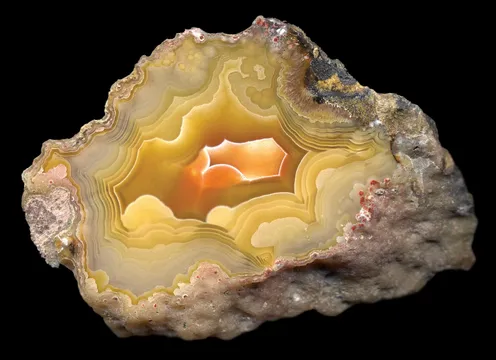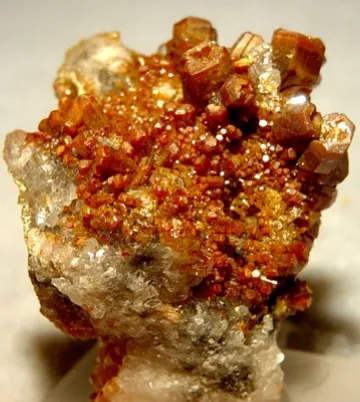
San Pedro Corralitos, Mexico — famed for luminous mimetite crusts and botryoids on rusty gossan, a classic carbonate-replacement locality prized by collectors.
Key facts
San Pedro Corralitos is one of the great Mexican collector localities because a workaday lead-silver-zinc mining district produced one of the most recognizable mimetite styles in the world: lustrous yellow to orange botryoidal crusts, often on thin, hollow, rusty gossan matrix. The district lies in northern Chihuahua near the Casas Grandes–Nuevo Casas Grandes region, where carbonate rocks of the Chihuahua Platform were intruded, fractured, altered, and mineralized as a classic carbonate-replacement and vein system carrying lead, zinc, silver, copper and locally gold. To the economic geologist it belongs in the same broad northern Mexican family as Naica, Santa Eulalia, Bismark and Los Lamentos; to the collector, it is simply “San Pedro” — shorthand for glowing, rounded mimetite that looks almost poured onto the matrix.
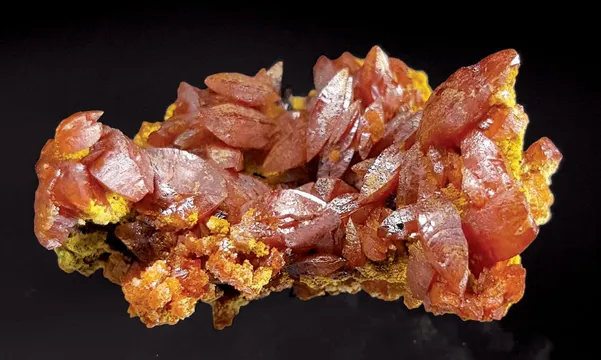
The locality’s specimen fame rests overwhelmingly on the late-1960s discovery in the Congreso-León workings. Those pieces are not typical prismatic mimetite in the Tsumeb or Ojuela sense; they are satiny, sparkling hemispheres and clustered botryoids, from lemon yellow through golden yellow to deeper orange-yellow, coating arched plates and cellular crusts. The best examples combine saturated color, a wet-looking or silky luster, strong three-dimensional form, and very little bruising on the delicate rounded surfaces. Good pieces still have a magnetic presence in a case: the color reads from across the room, while close viewing reveals a field of tiny compound botryoids and subtle chatoyancy.
Regional View
Country View
The great pocket material was mined from old, deep, deteriorated workings rather than from a modern specimen operation, which is part of the reason San Pedro Corralitos specimens have the aura of a closed chapter. The mine’s industrial story began long before the collector boom: Candelaria Mining Company and its successors worked a suite of claims and mines in the San Pedro district, with the León and Congreso workings eventually becoming the collector-important heart of the locality. Production estimates vary by source, but all agree that the district was a substantial oxidized base-metal producer, with ore carrying important lead and zinc values, significant silver, and accessory copper and gold. Germanium in the ores also influenced later economic interest.

Photo: Rob Lavinsky, iRocks.com via Wikimedia Commons
Search for specimens: View all specimens from San Pedro Corralitos, Mexico
San Pedro Corralitos is a mining district in northern Chihuahua, listed mineralogically under Casas Grandes Municipality, Mexico. The collector locality is usually represented by the Congreso-León Mine of the León Group, although the broader district includes the Candelaria group, San Pedro Mine, San Nicholas group, San Benigno group, Porvenir, Plomo, Isabelitas, La Purita and other workings. The mine area sits in low hills dominated by San Pedro Peak, with an arid to semi-arid climate and an elevation around 5,200 feet cited for the district in the Mineralogical Record treatment.
Geologically, the district is a carbonate-replacement and vein system developed in Cretaceous thin-bedded limestones and shales cut by intrusive rocks. A granodiorite laccolith forms San Pedro Peak, and later diorite, hornblende andesite porphyry and related dikes exploited the district’s fracture architecture. The important ore bodies formed where mineralizing fluids moved along dikes, hanging-wall contacts, flexures and cross-fractures, replacing carbonate rocks and feeding chimney-and-manto style mineralization. Around the ore zones the limestones were recrystallized and marbleized; altered dikes near the ore bodies show chalky sericitic alteration. Fluorite-bearing fissures are recorded in the district, though their relationship to the main ore system is not straightforward.
The mines can be thought of in two principal mineralized zones: the San Pedro Corralitos proper area on the southeast side of San Pedro Peak, dominated by the Congreso-León workings, and the Candelaria zone northwest of the peak. The Congreso-León mine contained most of the known ore chimneys, concentrated in a relatively compact area. Published descriptions cite extensive underground workings with fourteen levels spaced about 40 feet apart, large stopes, two main vertical shafts and an inclined shaft. The lower levels were historically affected by water, and levels below the twelfth were reported flooded in an early-1970s account.
Mining history is unusually well documented for a specimen locality. The first “modern” production at Congreso is generally tied to 1885, when E. D. Morgan and associates of New York acquired the mine and formed the Candelaria Mining Company, though older workings predated that corporate phase. Early attention centered on the Candelaria end of the property, with the Congreso-León end becoming increasingly important after the mid-1890s. By 1907 the Candelaria Mining Company controlled hundreds of claims in the San Pedro Mining District, and by 1909 the Congreso mine was shipping large quantities of carbonate ore, especially from the Bonanza and 49 chimneys. The important named ore bodies included Bonanza, Morgan, Dwight, Reeves, Pilota, Ávalos, Espinoza, García and García Extension; some joined at depth into larger chimneys.
The Mexican Revolution and its aftermath interrupted the camp severely. Operations in the area largely ceased by about 1913, apart from small lessees and later exploratory campaigns. Water was a persistent mining problem: development was historically limited below the deeper levels despite pumping plans, and accounts note large steam pumps that were about to be installed when operations shut down but were abandoned unused. In 1926 the Peñoles Mining Company of Mexico leased and bonded the Candelaria properties and restarted work, describing the mines as lying about 110 to 112 miles southwest of Juárez and El Paso and connected by the Mexico Northwestern railroad. Later corporate history includes Candelaria Mining Company’s merger with San Luis Mining Company in 1961 as Minas San Luis S.A., the 1962 emergence of Luismin, continued Luismin control into the early 1990s, and acquisition of Minas Luismin by Wheaton River Minerals in 2002.
Production figures are not perfectly consistent among modern summaries, but the scale was significant. The Mineralogical Record article cites roughly one million tons of oxide ore during the productive years, grading around 7% lead, 7% zinc, 1.5% copper, 219 grams of silver per tonne and 1 to 6 grams of gold per tonne. A Rock & Gem summary drawing on Peter Megaw’s work gives about three million tons at comparable base-metal and precious-metal grades, and emphasizes that germanium in the ores helped determine periods of renewed interest.
For collectors, the pivotal event was the late-1960s mimetite discovery in the old Congreso-León mine. The best-known accounts place the famous find in 1968 or 1968–1969, with Benny Fenn of Las Cruces, New Mexico responsible for the production that entered the market. Some references describe the pocket as part of the old San Pedro section of the interconnected Congreso-León mine, and one mineralogical listing cites bright yellow to orange botryoidal masses associated with goethite from pockets on the nineteenth level. Auction and collection records consistently treat the great San Pedro material as a one-time find: a large, spectacular occurrence that has never been repeated in comparable quality or quantity.
Collecting access today should be regarded as non-casual. These are old underground mine workings, historically deep, partly flooded, and long abandoned or inactive for specimen mining. Land and mineral rights must be respected, and no collector should attempt entry without current permission and professional mine-safety knowledge. The San Pedro Corralitos specimens available to collectors now are overwhelmingly recycled old material from the 1968–1969 production and subsequent collection dispersals, not new finds from an open collecting site.
San Pedro Corralitos mimetite is prized for rounded botryoidal aggregates rather than sharp individual prisms: translucent to semi-translucent yellow, golden-yellow, orange-yellow and occasionally deeper orange masses coating gossan, limonite and thin cellular crusts, commonly with calcite or iron oxides and derived from the oxidized lead-rich zones of the Congreso-León workings. Individual botryoids on collector specimens are often in the millimeter to centimeter range, with whole pieces from thumbnails to cabinet plates; the celebrated late-1960s production included large showy masses, and later market records include 10 cm and larger display specimens. Top examples show saturated but natural color, bright sparkling or silky luster, rolling three-dimensional surfaces, and a pleasing arched or hollow-crust form; ordinary pieces tend to be flatter, browner, less lustrous, more heavily scuffed, or broken from the fragile crusts. The classic association is yellow-orange mimetite on rusty gossan, and the very best pieces have a distinctive “bubbly” vitality that separates San Pedro from the sharper mimetite habits of Tsumeb, Ojuela or Santa Eulalia.
Other minerals documented from San Pedro Corralitos reflect its oxidized lead-zinc-copper-silver system. The broader locality and especially the León Group/Congreso-León Mine have recorded acanthite, adamite, aragonite, arsenopyrite, austinite, baryte, beudantite, calcite, cerussite, chalcopyrite, chlorargyrite, chrysocolla, conichalcite, fluorite, galena, goethite, hemimorphite, malachite, native gold, plumbojarosite, pyrite, rosasite, smithsonite, sphalerite, tetrahedrite-group minerals, willemite and wulfenite. Herrerite, historically reported from the León Mine as an apple-green to bluish-green copper-bearing variety of smithsonite, is a locality-linked rarity that adds mineralogical interest beyond the famous mimetite. Wulfenite is much less celebrated here than at Los Lamentos, but it is a legitimate San Pedro species, recorded from the San Pedro Mine, Congreso-León and an unnamed prospect. The zinc arsenates and carbonates — adamite, austinite, conichalcite, rosasite, smithsonite and willemite — are the collector’s clue to how chemically lively the oxidation zone was, even though most are rarely seen in attractive specimens compared with the mimetite.
The chief authenticity issue is not synthetic or treated San Pedro mimetite — no well-documented, widespread treatment problem is associated with the classic material — but attribution. Good San Pedro Corralitos pieces have a recognizable habit: yellow to orange botryoidal mimetite, usually on rusty gossan or limonitic matrix, with rounded, satiny to sparkling surfaces. However, botryoidal mimetite from other localities can be visually close enough to confuse the market. Iranian mimetite from the Anarak district, particularly material attributed in different reports to Chah Milah or Nakhlak, has been noted for resembling the old San Pedro material, though it tends to be more orange and brighter in some examples. Santa Eulalia and Ojuela mimetite labels can also become confused in collections, especially when older labels simply say “Chihuahua, Mexico” or omit the mine.
Spelling and locality precision matter. Labels may read San Pedro Corralitos, San Pedro de Corralitos, Congreso-León, Congreso-Leon, Leon-Congreso, or even the misspelled “Congresso-Leon.” Those variants are common in the specimen trade, but a strong label should place the piece in the Congreso-León Mine or León Group where possible, not merely “Mexico.” Conversely, older or careless labels giving the state as Durango should be treated with caution; San Pedro Corralitos is a Chihuahua locality.
Condition is a major grading factor. The botryoidal surfaces are rounded but not indestructible, and many classic pieces have tiny scuffs, flat spots, bruises or edge wear from decades of handling. Because the mimetite commonly coats thin hollow crusts, backs and edges may be naturally broken or trimmed; what matters most is whether the display face remains undamaged and whether the form looks complete rather than sawed or snapped away. The most desirable specimens show clean, uninterrupted botryoidal fields, strong color, and sculptural relief. Large cabinet examples in excellent condition are markedly rarer than small miniatures, because the original crusts were fragile and the find was finite.
Handle San Pedro mimetite as a lead arsenate mineral. It is safe as a display specimen under normal collecting practice, but it should not be abraded, cleaned aggressively, soaked in acids, used in jewelry, or handled by children. Wash hands after handling and avoid generating dust. The matrix may be friable limonitic gossan, so dry brushing should be light, and ultrasonic cleaning is inappropriate. Fluorescence is not a major selling point for the classic mimetite itself, though associated calcite on some pieces may respond variably; evaluate these specimens in white light, where color, luster and form carry the value.
Market availability is steady but limited because the famous pocket material dispersed widely from the late 1960s into collections and has been recycled ever since. Small, representative specimens appear regularly, but fine miniatures and cabinet plates with saturated yellow-orange color, glossy botryoids and minimal damage are increasingly expensive. The market still rewards old labels, named collections, 1968–1969 provenance, and publication history. A premium San Pedro Corralitos mimetite is not just a “Mexican mimetite”; it is a classic from a single legendary production run, and the price structure reflects that closed-source status.
The San Pedro Corralitos story that collectors retell begins with Benny Fenn going underground in 1968, not into a clean operating mine but into an old, dangerous system that had been idle and deteriorating for years. One exhibition account says he descended 900 feet on ropes into the Congreso-León mine, then began digging into a wall, following mimetite until the narrow lead opened into a chamber 40 feet long and 30 feet tall. The walls were lined with yellow botryoidal mimetite. It is the kind of detail that explains why the specimens seem unreal: not a handful of vugs or a pocket the size of a suitcase, but a room.
Other accounts add a miner’s sequence to the moment. Fenn had been pursuing silver ore and encountered a wide seam packed with granular, silver-rich cerussite. After removing the cerussite “sand” and reportedly recovering about seven tons of silver ore, he saw that the opened walls on both sides were coated with brilliant yellow mimetite. The transformation is pure Mexican mineral lore: ore first, specimens second, and then the specimens outliving the ore in collector memory.
The quantity was large enough to change the market for a few years. Fenn is remembered as selling the material cheaply, even by the pound or kilo, and Rock & Gem recounts that he sold specimens “by the dynamite box.” Another collector reminiscence gives the unforgettable price of $5.75 per pound for flats of choice pieces bought through Tucson wholesaler Suzie Davis. From today’s perspective, when fine cabinet pieces can bring four- and five-figure prices, that early pricing feels almost impossible. But it matches the way great one-time finds often enter the hobby: first as abundance, then as classic material, then as history.
The Tucson Show of 1969 became the public debut in many retellings. Specimens from the find spread through dealers and rock shops, and for several years, roughly from 1969 into the mid-1970s, collectors of modest means could still buy attractive San Pedro pieces. That brief window is why so many old American collections contain one miniature or small cabinet example with a faded label, while truly exceptional plates remain far scarcer than the fame of the locality might suggest. The paradox of San Pedro Corralitos is that the find was once abundant enough to be sold casually, yet it was never repeated; every fine specimen today is competing against a fixed historical supply.
Wilson, Wendell E. (2004). “Famous Mineral Localities: San Pedro Corralitos, Chihuahua, Mexico.” The Mineralogical Record, 35(6), 5–17, 65. The principal modern collector-locality article, covering history, geology, workings and the famous mimetite find.
Mexico IV, The Mineralogical Record, Vol. 35, No. 6, November–December 2004. The special Mexico issue containing Wilson’s San Pedro Corralitos article along with articles on Guerrero amethyst and the San Francisco Mine.
Mindat reference record for Mexico IV, The Mineralogical Record, Vol. 35, No. 6. Useful for the mineral-occurrence indexing tied to the León Group, Congreso-León Mine, Porvenir and unnamed San Pedro Corralitos prospects.
Panczner, William D. (1987). Minerals of Mexico. Van Nostrand Reinhold, New York. Frequently cited for San Pedro Corralitos mineral occurrences, including mimetite, galena, pyrite, arsenopyrite and wulfenite in the old San Pedro/Congreso-León system.
Bideaux, Richard A. (1990). “Featured Mineral at the 1990 Tucson Show: The Desert Mineral Wulfenite.” Rocks & Minerals, 65(1), 11–30. Includes San Pedro Mine wulfenite in the broader treatment of wulfenite localities.
Del Río (1830), American Journal of Science, 18, 193, cited in Mindat’s herrerite entry. Historical reference for herrerite, the copper-bearing smithsonite variety originally reported from the León Mine at San Pedro Corralitos.
Villaseñor, L. (1951). “Problema de bombeo de las minas León y Congreso de San Pedro Corralitos, Chihuahua, México…” Memorias de la Primera Convención Interamericana de Recursos Minerales, México, D.F., 278–287. Engineering paper on the pumping problems of the León and Congreso mines during the Minas de Durango/Eagle-Picher period.
Rogers, A. H. (1907). Report on the property of the Candelaria Mining Company. Unpublished company report cited by Wilson for early San Pedro district history and mine ownership.
Wisser, E. (1944–1948). Series of unpublished reports on the León-Congreso lead-gold mine and Congreso exploration program. Important historical company-report series cited in the Mineralogical Record bibliography.
Poggi, Luisa; Pratesi, Giovanni; Bindi, Luca. Piccolomini-Pratesi mineral collection publication. Documents a San Pedro Corralitos mimetite specimen in the Piccolomini-Pratesi collection, specimen G47755, measuring 9 x 8 x 3 cm.
“Mimetite - Congreso-Leon Mine, San Pedro Corralitos, Casas Grandes Mun., Chihuahua, Mexico” — The Arkenstone / iRocks on Vimeo A specimen video of an intense yellow-orange miniature from the classic 1969 find, ex. Jack Halpern.
“IRB1965 MIMETITE, San Pedro Corralitos, Mexico” — Crystal Classics on Vimeo Dealer specimen video showing the lustrous botryoidal San Pedro style in motion.
“IRB1798 Mimetite, San Pedro Corralitos, Mexico” — Crystal Classics on Vimeo Another short specimen video useful for judging luster, color and relief on a classic mimetite.
San Pedro Corralitos locality page on Mindat — Best starting point for the district-level mineral list, sublocalities and coordinates.
Congreso-León Mine locality page on Mindat — The key collector mine page for the famous mimetite and the León Group assemblage.
San Pedro Mine locality page on Mindat — Useful for the old San Pedro section now treated as part of the interconnected Congreso-León system.
León Group locality page on Mindat — Mineral list for the group of mines that includes Congreso-León and the main specimen-producing area.
Candelaria group locality page on Mindat — Context for the northern mine group and its sulfide assemblage.
Wilson, Wendell E. (2004), Mindat reference record — Bibliographic record for the definitive Mineralogical Record article.
Mineralogical Record Mexico IV back issue — Publisher page for the special issue containing the San Pedro Corralitos article.
Rock & Gem: “De Colores: San Pedro Corralitos” — Short collector-friendly summary by Peter Megaw’s “De Colores” series, emphasizing the late-1960s mimetite find and ore grades.
University of Delaware exhibition: “In The Beginning” — Includes a San Pedro Corralitos mimetite specimen and a vivid account of Benny Fenn’s underground discovery.
Wikimedia Commons: Mimetite-199592.jpg — Openly licensed image of a 5.7 x 3.8 x 2.5 cm San Pedro Corralitos mimetite, ex. Dave Stoudt Collection, photographed by Rob Lavinsky.
SGM geological-mining map: San Pedro Corralitos H13-A62 — Servicio Geológico Mexicano geologic map for the San Pedro Corralitos quadrangle.
Mineral Auctions: classic 1968 San Pedro Corralitos mimetite, ex. Hauck — Market record documenting the late-1968/early-1969 find, Benny Fenn attribution, and botryoid size.
Mineral Auctions: 1969 pocket cabinet mimetite — Useful market example for the high end of the locality, including a major cabinet specimen and auction result.
Mineral Auctions: 2024 San Pedro Corralitos mimetite — Recent market record showing continued demand and typical grading language for color, luster, damage and provenance.
Weinrich Minerals: Congreso-León Mine mimetite — Dealer archive describing classic old San Pedro mimetite in the oxidized zone of a lead-rich hydrothermal vein system.