A collector's guide to San Antonio Mine, Mexico: its geology, mining history and notable minerals, illustrated with the 188 specimens documented from this locality on EarthWonders.
Key facts
San Antonio Mine is the East Camp anchor of the Santa Eulalia mining district in Chihuahua, a locality whose specimen reputation is inseparable from its ore geology. The mine sits on the eastern side of the Sierra Santa Eulalia, east of Chihuahua City, in one of Mexico’s classic carbonate-replacement systems: a lead-zinc-silver-copper-iron deposit developed in Cretaceous carbonate rocks and driven by Tertiary felsite intrusions. In the East Camp, mineralization is not simply a set of veins; it is a vertically extensive, intrusion-cored skarn and sulfide system around the San Antonio graben, with zinc-rich calc-silicate chimneys, lead-rich massive sulfide mantos, tin-bearing upper bodies, and a sharply expressed oxidation profile.
Collectors know San Antonio best for the strange richness created where that ore system met groundwater. The mine’s high, nearly horizontal water table lies at about the 8th Level, and the oxidized zone above it produced superb supergene zinc minerals: smithsonite in yellow, green, blue-green, and blue habits; colorless to white and blue hemimorphite; aurichalcite; cerussite; anglesite; and related oxide-zone species. That is why a good San Antonio label often carries level data. “8th Level” is not decoration—it points to the mine horizon where zinc, lead, carbonate, sulfate, and silica chemistry repeatedly remade earlier ore and gangue into collector specimens.
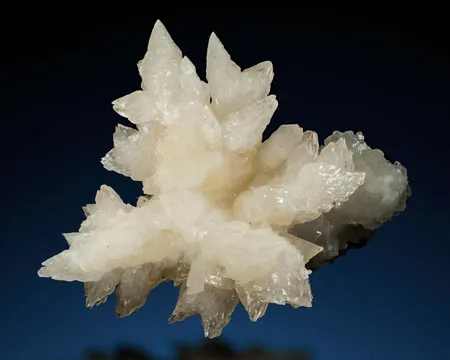
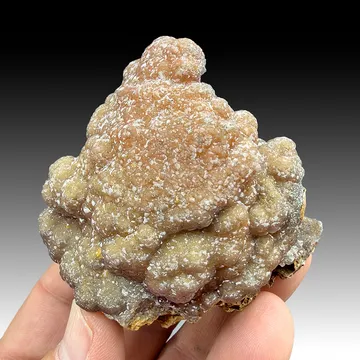
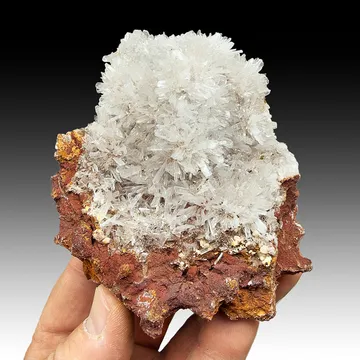
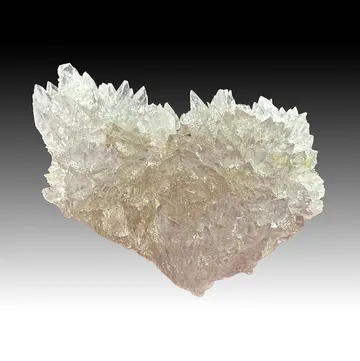
The best San Antonio specimens have a look that is both Mexican and unmistakably local. Smithsonite may appear as translucent botryoids, stalactitic masses, rice-grain crystals, turkey-fat yellow crusts, or scalenohedral calcite pseudomorphs. Hemimorphite ranges from pearly blades on gossan to large snowy-white sprays and blue botryoidal crusts. Calcite commonly forms honey, peach, or iron-stained dogtooth scalenohedra, and quartz may rise as water-clear crystals from sphalerite, pyrite, calcite, or rhodochrosite. The mine is also one of the world’s essential ludlamite localities, with rich green, lustrous, bladed sprays from old finds that are now far scarcer than the modern smithsonites.
Regional View
Country View
San Antonio’s historical significance goes beyond specimens. The mine has produced silver, lead, zinc, copper, vanadium, tin, and associated skarn ore, and it is widely noted in mineral literature for its unusual tin-bearing bodies. Published summaries describe the mine as the first economic tin mine in North America, with cassiterite associated with specular hematite, quartz, topaz, fluorite, magnetite, tourmaline, and wolframite in a chimney developed beside the San Antonio dike. That skarn-and-sulfide backbone explains the otherwise surprising breadth of the collector suite: primary ore minerals below the water table, dramatic oxidized lead-zinc minerals at the 8th Level, and rarer phosphate, tin, manganese, vanadium, and iron species in the altered upper system.

Photo: Wikimedia Commons

Photo: Wikimedia Commons

Photo: Wikimedia Commons
Search for specimens: View all specimens from San Antonio Mine, Mexico
San Antonio Mine, also known as San Antonio el Grande, is in the East Camp of the Santa Eulalia mining district, Aquiles Serdán Municipality, Chihuahua. The district lies roughly 23–26 km east of Chihuahua City in the rugged Sierra Santa Eulalia. Older and modern mining references divide Santa Eulalia into the West Camp, dominated by the Buena Tierra and Potosí mines, and the East Camp, centered on the San Antonio mine area. Between them lies the less productive Middle Camp. This geographic division matters to collectors because “Santa Eulalia” alone is not a precise locality label: Potosí rhodochrosite, Buena Tierra wulfenite, Inglaterra legrandite, and San Antonio smithsonite or ludlamite are different collecting stories.
Geologically, San Antonio is part of a district-scale carbonate replacement deposit, but the East Camp has its own personality. Santa Eulalia mineralization is hosted principally by Cretaceous limestone and dolomite of the Sierra Santa Eulalia, affected by folding, normal faulting, and Tertiary felsite intrusions. In the East Camp, ore is focused around the San Antonio graben, a north-northeast-trending structural zone with more than 250 m of displacement. The graben was intruded repeatedly by felsite dikes before and during mineralization, and these intrusions acted as guides and heat engines for the skarn and sulfide system.
The San Antonio ore bodies are described as tabular, calc-silicate-dominated, zinc-rich chimneys zoned outward from the felsite. Closest to the intrusions are epidote-chlorite endoskarn zones in the felsite itself; outward lie garnet-hedenbergite and hedenbergite-rich exoskarn, and beyond or intergrown with those are massive sulfide bodies. The sulfide suite is comparatively simple for a district of this complexity: sphalerite, galena, pyrite, pyrrhotite, with lesser arsenopyrite and chalcopyrite. Smaller lead-rich massive sulfide mantos cut the skarn chimney at several levels, and unusual tin-bearing carrot-shaped chimneys occur high in the system. For the collector, that architecture explains why one mine can yield sphalerite-pyrite-quartz-calcite combination pieces, manganese-carbonate material, oxidized lead minerals, tin species, vanadinite, fluorite, and secondary zinc minerals.
The oxidized zone is the critical specimen environment. In the San Antonio Mine, oxidation extends down to a comparatively high, flat water table at the 8th Level, around 400 m below surface. Above that level, groundwater penetrated the ore system freely enough to oxidize much of the ore; below it, unoxidized sulfides continue downward. At the water table itself, zinc leached from sphalerite and related primary ore was redeposited as smithsonite, hemimorphite, and related minerals. This is why the 8th Level appears so often on labels for modern San Antonio smithsonite, hemimorphite, aurichalcite, cerussite, and anglesite combinations.
Mining in the broader Santa Eulalia district has a long history. Published summaries describe near-continuous production from 1703 onward, with the district ultimately ranking among Mexico’s great silver and base-metal producers. Early mining followed rich oxidized bodies containing cerussite and anglesite with silver halides downward from the surface until miners reached water or sulfide ore. In the twentieth century, selective flotation allowed the deeper sulfide ore—galena, sphalerite, pyrrhotite, and pyrite—to become the production backbone. San Antonio’s industrial identity continued under major Mexican operators, including IMMSA/Grupo México, and the mine area has remained a focus of exploration around the San Antonio graben and San Antonio Sur.
Collector production has come in waves. Older San Antonio cabinets include calcite, quartz, sphalerite, pyrite, pyrrhotite, fluorite, hemimorphite, and especially the prized green ludlamites of the 1970s and early 1980s. The modern fame of the mine rests heavily on the Level 8 zinc-oxide finds of the late 1990s through the 2010s. Late November 1999 brought the celebrated electric-blue smithsonite pocket: botryoidal and stalactitic masses from thumbnail size to very large pieces, commonly with hemimorphite, and locally with anglesite, cerussite, hydrozincite, aurichalcite, or barite. Another important period around 2012–2013 produced lime-green smithsonite pseudomorphs after calcite scalenohedra from Level 8, many with layered replacement shells that reveal the sequence of calcite growth, partial replacement, dissolution, and final smithsonite overgrowth.
Access today should be understood as mine access, not recreational field collecting. San Antonio is an industrial mining locality in an active or intermittently maintained district, with underground workings, flood-control issues, private or corporate mineral rights, and surface ownership considerations. Specimens available to collectors generally come through miners, dealers, older collections, and historic finds rather than casual collecting. A precise label—San Antonio Mine, East Camp, Santa Eulalia District, Aquiles Serdán Municipality, Chihuahua, Mexico, ideally with a level, pocket, date, or former collection—is worth preserving.
Smithsonite is the signature modern San Antonio mineral, especially from the 8th Level water-table zone, where oxidized zinc ore redeposited as botryoidal, stalactitic, rice-grain, and pseudomorphic forms. The palette is unusually broad: yellow to orange “turkey-fat” material, gray-green and yellow-green botryoids, mint to sea-foam green masses on gossan, robin’s-egg to electric blue crusts, and lime-green pseudomorphs after calcite. The late-1999 blue finds produced botryoidal and stalactitic specimens from thumbnails to very large pieces, many with colorless hemimorphite, and rarer examples carrying anglesite, cerussite, aurichalcite, hydrozincite, or small orange barite accents. The 2012–2013 Level 8 material added lustrous smithsonite pseudomorphs after calcite scalenohedra, with the best replacements reaching several centimeters and showing crisp scalenohedral architecture. The finest pieces here are not merely colorful: they combine saturated blue, green, or yellow color; undamaged rounded or rice-grain texture; three-dimensional limonitic matrix; strong contrast with hemimorphite or lead minerals; and, for pseudomorphs, clear calcite form with layered replacement shells rather than shapeless crust.
Calcite from San Antonio is both a primary gangue mineral and a specimen mineral in its own right, appearing as sharp scalenohedral “dogtooth” crystals, rhombohedral later-stage crystals, peach to golden-yellow groups, and iron-oxide-included brownish material with the pineapple-like texture collectors often associate with Santa Eulalia. San Antonio calcites commonly occur with quartz, sphalerite, pyrite, fluorite, marcasite, hematite, and smithsonite; some are the original forms later replaced by smithsonite, especially the Level 8 scalenohedral pseudomorphs. Good calcite specimens from this mine are judged by clean scalenohedral form, freedom from bruised tips, attractive iron-oxide zoning or inclusions, and strong matrix contrast—particularly pieces where translucent golden calcite rises above darker sulfide matrix or where later white calcite selectively decorates quartz and sphalerite.
Hemimorphite is one of the great San Antonio secondary zinc minerals and is closely tied to the same oxidized 8th Level environment that produced the mine’s best smithsonite. It occurs as colorless, glassy blades and sprays perched on green to blue smithsonite, as pearly white radial and fan-like aggregates on limonitic gossan, as snowy-white prismatic groups, and as silky light-blue botryoidal crusts known from older collections. Documented large cabinet pieces show lustrous, gemmy to translucent individual crystals in aesthetic “pinwheel” or radiating groups, and dealer descriptions of Level 8 material emphasize 5–10 mm blades associated with 3–8 mm blue rice-grain smithsonite. The best San Antonio hemimorphites have sharp terminations, airy radial structure, high luster, and contrast—either white on brown gossan, colorless on blue-green smithsonite, or blue botryoidal material with a silky surface; ordinary pieces tend to be massive, contacted, or too uniformly crusted to show the mine’s distinctive open-space growth.
San Antonio ludlamite is old, scarce, and disproportionately important: fine specimens from the mine, especially those attributed to 1970s, early-1980s, and small 1992 finds, rank among the world’s finest examples of the species. The classic habit is rich green to deep apple-green, lustrous, translucent to gemmy bladed crystals in fans and sprays, commonly in vugs in siderite-rich matrix and locally associated with calcite, sphalerite, or oxidized material. Many specimens are thumbnails or small miniatures with crystals around 6–10 mm, though exceptional pieces show larger crystal groups and unusually saturated color. The best San Antonio ludlamites are crisp, glassy, undamaged sprays with intense green color and aesthetic separation on tan siderite or dark matrix; because so few high-quality examples reached the market and most were absorbed into major collections, any well-labeled old specimen with sharp green blades deserves attention.
Quartz at San Antonio is chiefly a combination-specimen mineral, and its value comes from placement and association rather than rarity. It occurs as water-clear to white, lustrous points and drusy coatings with calcite, sphalerite, pyrite, marcasite, fluorite, gypsum, and rhodochrosite. Good examples include clear quartz crystals to several centimeters on black sphalerite and brassy pyrite, sometimes preferentially coated on one side by small white dogtooth calcites, and quartz-on-rhodochrosite pieces where transparent crystals are visually warmed by pink carbonate beneath. The strongest specimens show undamaged terminations, good transparency, and sculptural contrast—clear quartz standing against dark sulfide matrix, white calcite, or pink rhodochrosite—while ordinary quartz-only pieces from the mine are commoner-looking and far less locality-specific.
Fluorite from San Antonio belongs to both the primary gangue and later open-space assemblages of the East Camp. Published and collector sources record fluorite with quartz, calcite, pyrite, sphalerite, chalcopyrite, pyrrhotite, and other sulfides; San Antonio is also noted in Mexican fluorite surveys for purple cubes, reportedly reaching very large size, and for crusts or epimorphic coatings related to quartz and calcite. Dealer-documented Level 13 combination pieces show colorless cubic fluorite with quartz, sphalerite, and chalcopyrite, while broader Santa Eulalia material includes lilac octahedral fluorite with calcite. The best San Antonio fluorites are cleanly crystallized and firmly tied to the mine by matrix and association—cubes or modified crystals with quartz, calcite, pyrite, and sphalerite—whereas isolated purple fluorites with weak labels require caution because similar-looking Mexican fluorites from other districts are common.
Rhodochrosite from San Antonio is much less common on the market than smithsonite, calcite, or hemimorphite, but documented specimens show pink botryoidal and rhombohedral carbonate associated with quartz, gypsum, and goethite-rich or sulfide matrix. The most attractive San Antonio examples are not large rhodochrosite crystals in the Sweet Home sense; they are vug and combination pieces, with drusy or water-clear quartz scattered over pink rhodochrosite rhombs, or quartz and selenite perched above botryoidal rhodochrosite. Good pieces have vivid pink color visible through or between the quartz, fresh luster, and a well-placed vug; lesser pieces can be visually muted by iron staining, drusy overgrowth, or poor exposure of the rhodochrosite beneath its later coatings.
Beyond those collector staples, San Antonio has a deep mineral list reflecting skarn, sulfide, oxidation, tin, and manganese-oxide environments. Documented species and associations include sphalerite, galena, pyrite, pyrrhotite, arsenopyrite, chalcopyrite, magnetite, hematite, ilmenite, garnet, epidote, hedenbergite, actinolite, tremolite, scapolite, topaz, tourmaline, orthoclase, muscovite, fluorite, cassiterite, wolframite, vanadinite, mimetite, cerussite, anglesite, aurichalcite, rosasite, goethite, plattnerite, franklinite, hetaerolite, ramsdellite, siderite, gypsum, dolomite, marcasite, and rarer tin- and iron-bearing phases reported in specialist references. Natanite is an important Santa Eulalia species, but current locality records caution that San Antonio attributions for natanite have been misloaded or misassigned, with the reliable occurrence tied to West Camp mines rather than San Antonio.
The first collecting rule for San Antonio is label precision. Many older specimens are labeled simply “Santa Eulalia, Chihuahua,” which may be accurate but incomplete; the district contains multiple classic mines with overlapping species but different parageneses and market histories. A label reading “San Antonio Mine, East Camp” is stronger than a district-only label, and “8th Level,” “Level 13,” “chimenea Cox, Level 4,” a date, or a former collection can materially improve both scientific and market value.
San Antonio smithsonite is widely copied in appearance by other zinc localities, but its best material has a recognizable combination of gossan matrix, hemimorphite, Level 8 provenance, and distinctive habits. For blue and blue-green smithsonite, look for natural transitions into limonite or hemimorphite rather than unnaturally uniform color. For the 2012–2013 smithsonite-after-calcite pseudomorphs, crisp scalenohedral shape and layered replacement shells are important; several dealer records note analytical confirmation accompanying examples from that find, and a high-value pseudomorph should ideally have comparable provenance or analytical confidence.
Hemimorphite is fragile. The San Antonio blades and radial sprays often have excellent luster but are vulnerable at their terminations, and even “good condition” pieces may show small contacts where sprays met pocket walls. Blue botryoidal hemimorphite can be more durable visually but may hide bruising on high points. Clean with air or a soft brush only; avoid soaking friable gossan or iron-oxide matrix.
Ludlamite demands special care and skepticism. Fine San Antonio examples are scarce, old, and valuable; many have passed through major collections and should have believable provenance. The crystals are softer and more delicate than their glassy luster suggests, and hydrated iron phosphates should be kept away from heat, harsh light, desiccating display conditions, acids, and ultrasonic cleaning. Expect many real pieces to be thumbnails or miniatures with millimeter-scale blades; a large, saturated, undamaged cabinet ludlamite from San Antonio is a major specimen, not a casual purchase.
Calcite and quartz combinations commonly show small bruises at terminations. On dogtooth calcite, check the tips and edges under magnification; iron-oxide inclusions and brown coloration are normal for some San Antonio calcites, but glued repairs on scalenohedral tips can be difficult to spot without close inspection. Some San Antonio smithsonite fluoresces weakly under longwave ultraviolet light, but fluorescence is not a dependable authentication test for the locality. Fluorite should be bought with particular attention to provenance, because San Antonio, Naica, Ojuela, and other Mexican localities can produce superficially similar fluorite-calcite-quartz-sulfide combinations.
Market availability is uneven. Smithsonite and hemimorphite from the Level 8 zinc-oxide zone appear regularly enough that collectors can be selective about color, luster, damage, and association. Good calcite, quartz, and sulfide combinations are available but often not premium unless especially aesthetic. Fine ludlamite is genuinely difficult, and attractive San Antonio rhodochrosite combinations are far less common than district-wide Santa Eulalia rhodochrosite from the West Camp. The best buys are specimens with exact mine and level data, old collection labels, and matrix/mineral associations that make sense for San Antonio.
In late November 1999, the San Antonio Mine produced the find that permanently changed its place in modern specimen collecting. Before that moment, Level 8 zinc-oxide collecting had already yielded gray-green to yellow-green smithsonite balls and heart-shaped distorted rhombs. Then miners broke into electric-blue material: botryoidal and stalactitic smithsonite from thumbnails to boulder-size masses. Many pieces carried hemimorphite, and a few were mineralogical stage sets—sharp doubly terminated anglesite crystals to 1 cm, 7 mm cerussite crystals, white hydrozincite patches, and 1 cm aurichalcite balls with hemimorphite. The numbers give the episode its bite: only about 25 very good pieces came from the key pocket, and just six were considered truly excellent. Yet hundreds of attractive blue, green, and yellow botryoidal smithsonites followed, enough to seed collections around the world while leaving the true pocket greats famous and elusive.
One of the most memorable styles from that period looks almost too delicate for a mine better known for gossan and massive ore: isolated blue rice-grain-shaped smithsonite crystals, only about 3–8 mm across, perched on colorless hemimorphite blades 5–10 mm long. Some pieces had tiny sharp orange barite crystals as accents. In a district of broad mantos and skarn chimneys, these are intimate specimens—small architectures built at the water table from zinc-bearing solutions, open space, and just enough time for the crystals to separate cleanly instead of merging into crust.
The 2012–2013 episode was different. It was tied to flooding and the mine’s stubborn relationship with water—the same water table that had created the supergene blanket. The prize this time was not botryoidal blue smithsonite but lime-green smithsonite replacing calcite. These were scalenohedral pseudomorphs, the best reaching about 7 cm long, and many showed the layered anatomy of replacement: calcite partially replaced, parts dissolved, and later smithsonite shells preserving or rebuilding the form. When specimens from the find appeared on the European market in 2013, dealers described them as one of the great finds of that year. For collectors, they bridged two San Antonio worlds: the old calcite cave environment and the later zinc-rich water-table chemistry that rewrote it.
San Antonio ludlamite has its own quieter legend. Unlike the later smithsonite, the great ludlamites did not arrive in endless modern flats. They emerged mainly from older finds—especially material attributed to the 1970s, early 1980s, and a small 1992 discovery—and were quickly absorbed into collections. One famous 5.2 x 4.1 x 4 cm specimen, long in the Steve Smale Collection, became a touchstone for the Mexican find: deep green bladed groups with unusually saturated color, a published pedigree, and a reputation among collectors as one of the aspirational examples of the species. That is the reason even a thumbnail San Antonio ludlamite can stop an advanced collector cold; the mine’s best examples compete not merely within Mexico, but among the finest ludlamites known.