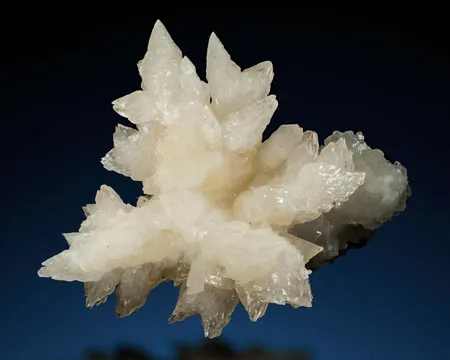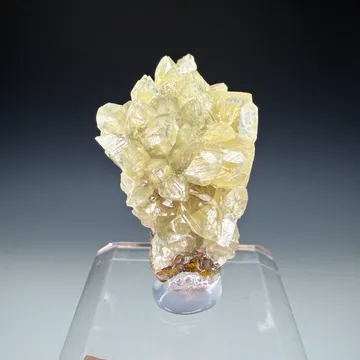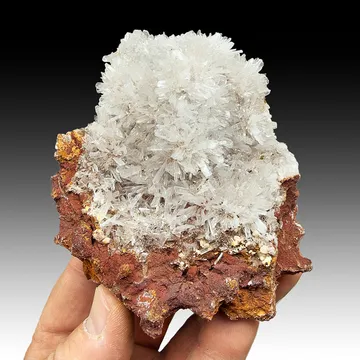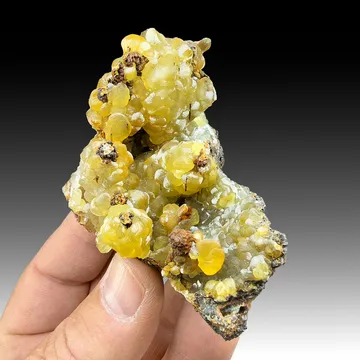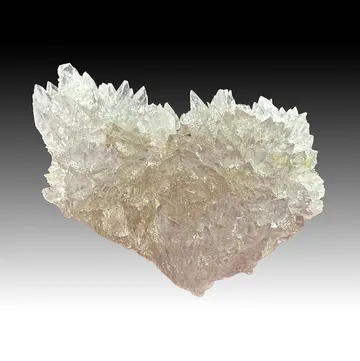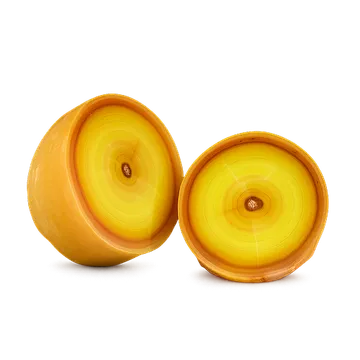
Smithsonite - Santa Eulalia, Mexico: mint-green to blue-green botryoidal and rice-grain forms; renowned CRD district material tied to the San Antonio Mine.
Key facts
Santa Eulalia smithsonite belongs to that select class of Mexican zinc minerals whose appeal is inseparable from the mine architecture that made them. The best-known material comes from the San Antonio Mine in the East Camp of the district, where oxidizing waters stripped zinc from primary sulfide ore and redeposited it at the water table as smithsonite, hemimorphite, and related secondary zinc minerals. Collectors value these specimens not merely as attractive smithsonite, but as products of one of the great carbonate-replacement districts of northern Mexico.

Photo: Wikimedia Commons
Visually, Santa Eulalia smithsonite is surprisingly varied. The locality is most famous for mint-green to blue-green botryoidal and “rice-grain” smithsonite on white or colorless hemimorphite, but it also produced yellow, orange, yellow-green, gray-green, bone-white, and robin’s-egg-blue material. Fine pieces may show satiny, silky, wet, or vitreous luster; translucent rounded masses; stalactitic growth; or smithsonite pseudomorphs after calcite. The San Antonio Mine’s Level 8 material is especially collectible because it ties the mineral directly to the mine’s well-defined supergene zinc blanket at the modern water table.
The district itself is a classic Mexican carbonate replacement deposit, or CRD: an intrusion-related silver-lead-zinc system hosted largely by Cretaceous limestone and dolomite. Santa Eulalia is divided into the West Camp and East Camp, with the San Antonio Mine representing the East Camp. The larger district has produced for more than three centuries and ranks among Mexico’s major silver and base-metal districts, with production measured in hundreds of millions of ounces of silver and millions of tonnes of lead and zinc. In mineral-collecting terms, that long mining life matters: specimen recovery came not from a single showy pocket, but from repeated encounters with oxidized cavities, water-table caverns, and by-passed zinc-rich zones over many decades.

Photo: Wikimedia Commons
For collectors, the prize is a specimen with confident San Antonio attribution, undamaged rounded smithsonite, strong color, good translucency, and a harmonious association with hemimorphite. The best green and blue examples stand comfortably in comparison with famous smithsonite localities such as the Kelly Mine in New Mexico, while retaining a distinct Mexican CRD character: gossan matrix, hemimorphite blades, occasional anglesite or cerussite, and the complex overprinting typical of Santa Eulalia’s oxidized zones.
Search for specimens: View all smithsonite specimens from Santa Eulalia Mining District, Mexico
The Santa Eulalia Mining District lies in central Chihuahua, about 23 km east of Chihuahua City, in the rugged Sierra Santa Eulalia. The district occupies a north-northwest-trending, fault-bounded range of limestone and volcanic rocks; its elevations exceed 2400 m, and deep canyons cut the carbonate and volcanic sequence. The mineralized district covers roughly 250 km2 and includes the West Camp, East Camp, and the comparatively less productive Middle Camp.
Geologically, Santa Eulalia is one of the great northern Mexican carbonate-replacement systems. Cretaceous carbonate and evaporite strata were folded into a broad, doubly plunging anticline, then buried and intruded during Tertiary igneous activity. Felsite intrusions, dikes, and sills are important ore controls. The district’s Oligocene mineralization is closely tied to these intrusive events, and its ore bodies formed as mantos, chimneys, skarns, and replacement bodies in limestone and dolomite. That combination of soluble host rocks, multiple mineralizing pulses, and deep oxidation created abundant open space for later specimen growth.
The West Camp, historically the main mineral zone, produced massive sulfide manto and chimney ores, with local high-level iron-calcic skarn. The East Camp is represented chiefly by the San Antonio Mine area and is characterized by intrusion-cored skarn zoning with peripheral massive sulfide manto bodies. For smithsonite collectors, the East Camp is the crucial one. At San Antonio, oxidation extends down to a high, relatively flat water table at the 8th Level, about 400 m below the surface. There the leached zinc from sulfide ores was redeposited as a smithsonite-dominated supergene blanket, accompanied by hemimorphite and other secondary zinc species.
Mining began in the district in the early 1700s and continued, with interruptions and changing emphasis, into the modern era. Early miners pursued near-surface oxidized ore rich in cerussite, anglesite, and silver halides, following it downward until water or sulfides intervened. Later, the development of selective flotation allowed the exploitation of deeper sulfide ores of galena, sphalerite, and pyrrhotite. The long life of the district explains why Santa Eulalia specimens occur in so many old collections: for much of the twentieth century, miners and dealers handled a steady flow of calcite, creedite, gypsum, hemimorphite, mimetite, rhodochrosite, smithsonite, and other species from the labyrinthine underground workings.
Collecting access should be regarded as mining-controlled, not recreational. Santa Eulalia is an active and historic industrial district with deep underground workings, water hazards, unstable oxidized ground, and company-controlled areas. Important smithsonite specimens reached the market through mining operations, mine personnel, dealers, and older collections rather than casual surface collecting. Provenance therefore matters: “Santa Eulalia” is acceptable for older material, but the most desirable labels specify San Antonio Mine, East Camp, and, when known, the 8th Level.
Notable finds are strongly tied to mine flooding and shifts in production. When the lower sulfide levels flooded, mining attention moved upward to the mixed oxide-sulfide ores at the water table, and smithsonite specimens appeared in quantity. Important episodes include post-1982 yellow, orange, and lime-green botryoidal smithsonites; late-1990s mint-green and blue smithsonite with hemimorphite; late-November 1999 electric-blue botryoidal and stalactitic masses; and 2012–2013 lime-green smithsonite pseudomorphs after calcite.
Santa Eulalia smithsonite is primarily a supergene zinc carbonate, ZnCO3, formed in the oxidized zone of a silver-lead-zinc CRD. In collector specimens it is most often seen as botryoidal crusts, rounded knobs, stalactitic masses, ropy coatings, rice-grain-shaped crystals, distorted rhombs, and pseudomorphs after calcite. The San Antonio Mine is particularly noted for smithsonite perched on hemimorphite: blue-green or mint-green rounded smithsonite set against colorless to white, sparkling hemimorphite blades.
The color range is broader than casual labels suggest. Green and blue-green are the signature colors of the finest San Antonio specimens, but documented material also includes bone-white, gray, gray-green, yellow, orange, lime-green, yellow-green, robin’s-egg blue, and brown-stained pseudomorphs. Some yellow-orange to yellow-green material has been described with greenockite inclusions, and many pseudomorphs show iron-oxide staining. The most attractive specimens combine color saturation with translucency; the surface should look alive, not chalky.
Habits fall into several recognizable collector types. One is the “rice-grain” style: small isolated, rounded to elongate smithsonite crystals, commonly a few millimeters across, perched on hemimorphite blades. Another is the botryoidal cabinet specimen, with rounded blue, green, or yellow masses covering matrix. A third is stalactitic or ropy smithsonite lining water-table caverns. A fourth is the calcite pseudomorph: smithsonite shells or replacements after scalenohedral, flattened rhombohedral, or platy calcite crystals. The best pseudomorphs preserve the calcite form while adding the color and texture of smithsonite.
Size varies from thumbnails to large cabinets. Common market specimens are miniatures and small cabinets in the 3–8 cm range; good San Antonio smithsonite with hemimorphite commonly appears around 5–8 cm. Larger cabinet specimens are known, including substantial botryoidal plates and masses more than 20 cm across. The 1999 electric-blue find reportedly included material from thumbnails to boulder-size, although only a small number of the very best specimens were retained as major display pieces.
Associated minerals are a key part of the locality’s look. Hemimorphite is the classic companion, often as white or colorless blades and sprays. Goethite and limonite provide dark or rusty gossan matrix. Hydrozincite may appear as white patches. Aurichalcite occurs locally, and some notable smithsonites carried anglesite, cerussite, barite, or creedite. The broader San Antonio oxidized assemblage includes many secondary lead, zinc, copper, arsenic, and vanadium minerals, but smithsonite-hemimorphite combinations are the central collectible association.
Quality is judged by color, luster, translucency, form, association, and condition. A top Santa Eulalia smithsonite should have a clear mine attribution, preferably San Antonio Mine, East Camp; saturated blue-green, mint-green, yellow, or robin’s-egg-blue color; silky to wet luster; visible translucency in the botryoids or knobs; little or no bruising on exposed rounded surfaces; and an aesthetic contrast with hemimorphite or gossan. Pseudomorphs are judged by completeness of the replaced calcite form, sharpness of the inherited crystal habit, and freedom from broken tips or crushed edges.
Santa Eulalia smithsonite is available on the collector market, but the best examples are not common. Ordinary gray-green, white, or modest botryoidal pieces appear periodically, while fine blue-green smithsonite on hemimorphite, large translucent botryoidal cabinets, and sharp lime-green pseudomorphs after calcite are much more competitive. Older labels can add value, especially when they specify San Antonio Mine or Level 8. Vague “Santa Eulalia, Mexico” labels are common on older material and are not automatically suspect, but they should be weighed against the specimen’s style and associations.
Authenticity issues are usually about identification, locality, and enhancement rather than a famous Santa Eulalia-specific fake. Blue and green botryoidal minerals are often confused in the market: smithsonite, hemimorphite, aragonite, aurichalcite-rich material, and dyed carbonate masses can be mislabeled. True smithsonite is notably heavy for its size, with a measured density around 4.4 g/cm3, and it effervesces in acid more sluggishly than calcite. Its hardness of 4 to 4.5 means it is softer than quartz but harder than calcite. These are not tests to perform casually on a valuable specimen, but they are useful context when considering questionable material.
The most convincing San Antonio smithsonites show the expected locality associations: hemimorphite blades, gossanous or iron-oxide matrix, ropy or botryoidal smithsonite, and colors consistent with documented finds. Be cautious with unnaturally uniform neon color, color concentrated in cracks, porous-looking dyed matrix, or pieces lacking any plausible zinc-oxide-zone context. A specimen sold as “blue smithsonite” with no credible locality, no weight in the hand, and no supporting mineral association deserves skepticism.
Condition is a serious issue. Botryoidal smithsonite bruises easily, and even small contact marks show as dull white or flattened patches on otherwise lustrous surfaces. Rice-grain crystals can be knocked off hemimorphite blades, leaving tiny pits or interrupted growths. Hemimorphite sprays are brittle and commonly chipped; check them under magnification. Stalactitic pieces may have natural terminations or old breaks, so distinguish mining damage from natural pocket contacts. Pseudomorphs after calcite can be hollow or shell-like and may have fragile edges, internal boxwork, or repaired projections.
From a market standpoint, Santa Eulalia remains one of the more attractive values among important smithsonite localities. Excellent pieces can be expensive, but they often trade below the most famous Kelly Mine or Tsumeb smithsonites of comparable visual impact. Recent market examples include small-cabinet yellow botryoidal smithsonite from San Antonio in the low four figures, 5–8 cm smithsonite-hemimorphite specimens in the mid-hundreds to low thousands depending on quality, and large blue botryoidal cabinet pieces selling for several thousand dollars. The finest material, especially with strong color and old provenance, is increasingly absorbed into advanced collections.
The San Antonio Mine’s smithsonite story is inseparable from water. At the East Camp, the crucial zone lies at the mine’s 8th Level, where the water table formed a remarkably flat floor to the supergene zinc blanket. Descending acidic waters dissolved laterally extensive caverns at that horizon, some described as tens of meters high, wide, and long. Their walls were decorated with ropy gray, greenish-gray, and green smithsonite; in places the surfaces were studded with smithsonite pseudomorphs after calcite crystals as long as 10 cm.
Those pseudomorphs are among the most revealing objects from the mine. Many are brown-stained by iron oxides, but some emerged in bright yellow-orange or yellow-green. The best examples are not merely coatings. They are thick hollow shells, and their interiors preserve ribbed smithsonite boxworks that follow calcite cleavage patterns. In the upper part of the supergene zone, such pseudomorphs sit on gossanous matrix; deeper down, they can rest directly on fresh arsenopyrite or sphalerite, a beautiful visual boundary between oxidation and untouched sulfide ore.
Flooding repeatedly changed what collectors saw. At depth, miners periodically intersected water-filled fractures that could gush as much as 90,000 gallons per minute, rapidly flooding lower levels. When that happened, production shifted upward to the mixed oxide-sulfide ores at the water table while the lower workings were pumped out. Almost every such shift produced smithsonite. In a district where many finds can be frustratingly hard to date, these flood cycles created recognizable specimen generations.
After a major flood in 1953, the mine remained dry until 1982. During that interval, miners intermittently recovered white, gray, gray-green, and rusty stalactitic smithsonite masses. They were not especially successful commercially, but they established the San Antonio smithsonite zone as real. Then the 1982 flood changed the picture. Bright yellow, orange, and lime-green smithsonite appeared, with botryoids reaching 8 cm and crude crystals to 2 cm. Some of the vivid yellow-green material owed its color to inclusions of greenockite.
The next great episode began quietly in early 1998. An access drift for an expanded underground repair shop cut into the smithsonite zone. At first, only small numbers of bright-blue smithsonite appeared: rice-grain-sized and rice-grain-shaped crystals perched on transparent, colorless hemimorphite. They were pretty but small, more tantalizing than impressive. Their importance was psychological. They proved that the zone could make blue smithsonite on hemimorphite, and they made collectors wonder what might lie just beyond the drift.
The answer came in spring 1999, when the mine flooded again and production shifted upward. A small number of superb miniature to cabinet-size translucent green smithsonite knobs and stalactites emerged, some reaching 15 cm and studded with hemimorphite. The flood was quickly brought under control, and mining returned to deeper levels, but the prices realized for those stalactites had already changed the incentives. With the cooperation of mine staff, specimen work continued in the zone.
For a time the results were mostly gray-green to yellow-green balls and heart-shaped distorted rhombs. Then, in late November 1999, miners hit the find that made modern San Antonio smithsonite famous: electric-blue botryoidal and stalactitic masses ranging from thumbnails to boulder-size. Many specimens carried hemimorphite. Some had sharp doubly terminated anglesite crystals to 1 cm. A few had 7 mm cerussite crystals perched on the smithsonite. Others showed white hydrozincite patches, and a few carried 1 cm aurichalcite balls with hemimorphite. The pocket produced only 25 very good pieces, of which just six were considered truly excellent, but hundreds of good bluish, green, and yellow botryoidal smithsonites followed.
One particularly memorable style from that period consisted of isolated blue rice-grain-shaped smithsonite crystals, 3–8 mm across, perched on colorless 5–10 mm hemimorphite blades. Some carried tiny sharp orange barite crystals as accents. A few blue heart-shaped distorted rhombs also appeared, including excellent thumbnails and small miniatures. This is the material that many collectors now picture when they hear “San Antonio Mine smithsonite.”
The 2012–2013 flooding produced a different prize: lustrous lime-green smithsonite pseudomorphs after calcite scalenohedra, with the best reaching 7 cm long. Many lesser examples came out as well, along with good replacements of platy and rhombohedral calcite. These later pseudomorphs linked the modern market back to the mine’s older water-table cave story: calcite forms built in open space, later overprinted by zinc-bearing solutions, then brought to light only when mining and water again forced attention to the oxidized horizon.