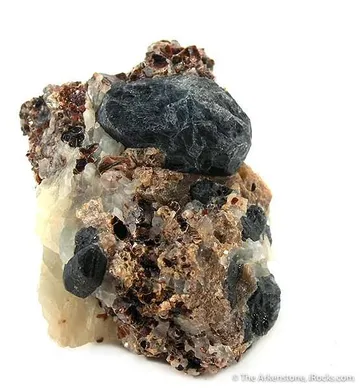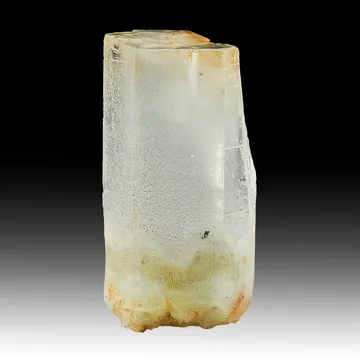
Sambava District, Madagascar - Ambariomiambana basalt quarry yields amber calcite twins on basalt with quartz and white zeolites; a modern classic.
Key facts
Sambava District is a small but memorable name in the modern cabinet-mineral canon because of one road-metal basalt quarry at Ambariomiambana, in Ambohimalaza Commune, west of Sambava on the road toward Andapa. The quarry is not a gem pegmatite and not an ore mine; its specimens are products of open cavities in basalt, where late fluids deposited calcite, quartz and a compact zeolite suite. What made the locality famous was the sudden appearance, in the early 2000s and especially in the 2004 market influx, of honey-yellow to champagne, highly lustrous, unusually twinned calcites on basalt and quartz matrix, commonly accompanied by white stilbite-Ca and laumontite. In a country better known to collectors for pegmatite gems, titanite, demantoid and sapphire, Sambava’s contribution is a sharply defined volcanic-pocket assemblage with a look closer to fine Deccan-Trap zeolite specimens than to the familiar Malagasy pegmatite world.
Regional View
Country View
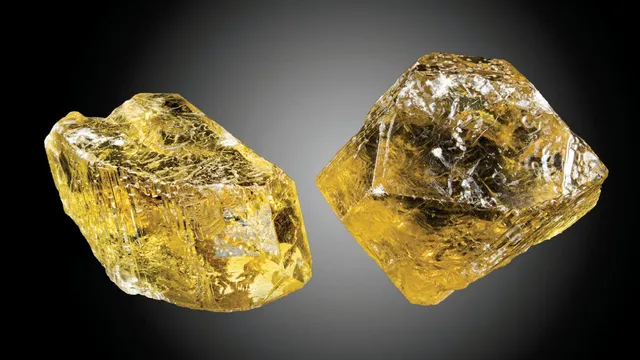
The best Sambava pieces are instantly recognizable: complex, interpenetrant rhombohedral calcite twins in warm amber-yellow tones, often glassy enough to show internal reflections, standing on drusy quartz or dark basalt with white zeolite accents. Fine examples can be small but visually forceful; larger cabinet specimens are much scarcer and are the pieces that put the locality into the “modern classic” category. The district also has an older mineralogical footprint through Alfred Lacroix’s record of analcime from basalt outcrops around Sambava, but the collector locality that matters most today is Ambariomiambana.
Search for specimens: View all specimens from Sambava District, Madagascar
The collecting locality is the Basalt Quarry at Ambariomiambana, recorded at about 14° 16' 34" S, 50° 3' 56" E, roughly 8 km from Sambava in the direction of Andapa and about 2.5 km west of Ambariomiambana village. It is a quarry locality in basic volcanic rock, worked for construction aggregate rather than for metallic ore. The mineralization is best understood as a low-temperature cavity assemblage in basalt: vesicles, fractures and irregular pockets became lined with quartz, zeolites and calcite after the lava had cooled and been opened to late hydrothermal or meteoric fluids.
Geologically, the setting belongs to the broad volcanic inheritance of northeastern Madagascar, a region affected by Cretaceous and younger volcanic rocks along the island’s eastern margin. Sambava-area collector specimens come from basalt, not from the Precambrian crystalline basement or the coastal sedimentary plain. That distinction matters for labels: “Sambava, Madagascar” on a calcite-zeolite specimen should point to a basalt-pocket occurrence at Ambariomiambana, while “Madagascar” labels on quartz, tourmaline, beryl or pegmatite minerals usually refer to entirely different geological provinces.
There are no ore bodies in the usual mining sense. The specimen-producing “bodies” are pockets and seams in the quarry rock. Pocket walls may carry dark basalt, drusy quartz, laumontite, stilbite-Ca, heulandite-Ca, fluorapophyllite-(K), mordenite and chlorite-group material, with calcite forming the dominant show crystals in the famous pieces. The most desirable calcites are not massive vein calcite but discrete crystals or clusters: yellow to honey, transparent to translucent, lustrous, and twinned in uncommon rhombohedral forms.
The collecting history is short and distinctive. Mindat and dealer records point to discovery around 2000, with specimens reaching the European market by 2004. Several notable dealer descriptions specifically identify August 2004 material, and some later records mention 2005–2006 pockets or a 2011 zeolite-rich find. Because the quarry’s purpose was basalt aggregate, collecting appears to have depended on temporary exposure of cavities during road-metal quarrying rather than on systematic mineral-specimen mining. Published public sources do not consistently name a corporate quarry operator; most accounts speak instead of workers, miners, local diggers and dealers who recognized that the shiny pocket crystals had specimen value.
Access today should be treated as uncertain and locality-dependent. The quarry is a working or former construction-material site rather than a formal collecting preserve, and the best-known calcite pockets are widely regarded as exhausted or at least no longer producing comparable material in quantity. Collectors should not expect casual field access without local permission, and modern acquisitions are far more likely to come from old dealer stock, collections formed after the 2004 discovery, or secondary-market pieces.
Sambava calcite is the locality’s signature mineral: honey-yellow, champagne, pale tan to nearly colorless crystals in highly distinctive twinned rhombohedral groups, typically on dark basalt or drusy quartz and commonly with laumontite or stilbite-Ca. The classic pieces were recovered from the Ambariomiambana basalt quarry in the early 2000s, with the August 2004 find especially well represented in dealer and museum-style records. Sizes range from thumbnails and miniatures to strong small-cabinet and cabinet specimens; documented examples include crystals around 1.5 cm, 4.1 cm, 4.5 × 3 cm, and elite collector pieces with calcite individuals up to about 74 mm across. What separates a good Sambava calcite from an ordinary one is the combination of sharp twinning, transparency, glassy luster, warm color, minimal bruising on the exposed edges, and an undisturbed matrix context; pieces with drusy quartz under the calcite and white zeolite accents show the pocket environment best.
Quartz at Sambava is chiefly a matrix and pocket-lining mineral rather than the main attraction, but it is important because many of the best calcites are perched on carpets of tiny quartz crystals. Dealer descriptions of the 2004 material repeatedly mention “little Quartz crystals,” drusy quartz, or thin quartz matrix beneath twinned calcite, and Mindat records quartz from the Ambariomiambana basalt quarry as part of the calcite-zeolite assemblage. The crystals are generally colorless, small, and sparkling rather than large stand-alone points; fine quartz-bearing pieces are those where the druse provides clean contrast and scale without distracting from the calcite twins or being obscured by later zeolites. As a locality species, Sambava quartz is collectible primarily when it documents the paragenesis of the basalt cavities: quartz first as a glittering lining, followed by laumontite, stilbite-Ca and the sculptural calcite groups that made the quarry famous.
The Sambava stilbite is recorded specifically as stilbite-Ca from the Ambariomiambana basalt quarry, occurring as white to pearly sheaflike clusters, blades and occasional distinct crystals with calcite, laumontite and quartz. Mindat photo records include sheaflike stilbite-Ca on basalt with laumontite and millimetric quartz, and a documented biterminated stilbite crystal 65 mm long from a Spirifer Minerals specimen in the Volker Betz zeolite collection. Later dealer material includes lustrous, pearlescent stilbite-Ca crystals to about 3 cm with snow-white laumontite from a 2011 find, while some market descriptions note pinkish stilbite with white calcite. Fine stilbite specimens from Sambava are judged less by rarity of the species and more by freshness, luster, crisp sheaf form, attractive contrast against basalt, and honest association with the calcite-quartz-laumontite pocket assemblage.
Other documented minerals from Sambava District and its Ambariomiambana basalt quarry include fluorapophyllite-(K), heulandite-Ca, laumontite, mordenite and chlorite-group material; analcime is also recorded from basalt outcrops in Sambava Commune in older literature. Fluorapophyllite-(K) is a notable accessory, with crystals reported to 3 cm in small cavities in the main quarry wall. Laumontite is especially important as a white prismatic associate on calcite-quartz specimens and as rosettes or aggregates with stilbite-Ca. The published mineral record for Sambava is not built around valid type-locality mineral species; its importance is instead morphological and paragenetic, centered on unusually twinned calcite and a compact basalt-zeolite assemblage.
Sambava calcites are sufficiently distinctive that good examples are often recognizable, but labels require care. Older and dealer labels may read “Sambava,” “Sambava District,” “Antsiranana Province,” “Sava Region,” “Ambariomiambana,” or simply “Northern Madagascar.” The most precise label for the classic material is Basalt Quarry, Ambariomiambana, Ambohimalaza Commune, Sambava District, Sava, Madagascar. Specimens labeled only “Madagascar calcite” should not automatically be assumed to be Sambava unless the crystal habit, basalt/quartz/zeolite matrix, and provenance support it.
The most common authenticity issue is not outright fabrication but imprecise or incomplete locality information. Some high-end dealer records explicitly mention incorrect locality information on custom bases, which is a reminder that an attractive old base is not proof of accuracy. Another potential confusion is visual comparison with Indian Deccan-Trap zeolite specimens: Sambava calcite-stilbite pieces can look superficially Indian, but the calcite habit, documented Malagasy basalt quarry provenance, and associated labels separate the locality. No well-documented, locality-specific industry of dyed, irradiated, repaired or artificially twinned Sambava calcite is evident in the sources reviewed, but normal specimen-preparation concerns apply, especially on larger matrix pieces.
Condition matters greatly. The calcite twins tend to present exposed corners, terminations and stepped edges, so bruising on high points is common and should be disclosed. Transparent yellow crystals may show internal veils or rainbow reflections naturally, while lower or more massive crystals may be more opaque. White zeolites, especially laumontite, require careful handling: laumontite can be prone to dehydration and surface degradation in dry environments, so avoid heat, direct sun, repeated washing, and aggressive cleaning. Store important pieces in stable humidity and dust them gently rather than soaking them.
Fluorescence is a genuine selling point for some Sambava calcites. Multiple dealer records describe strong yellow fluorescence, including responses under both long-wave and short-wave ultraviolet light, and one large M&W Minerals specimen was described as showing strong yellow fluorescence in the yellow crystals. Fluorescence should be treated as an added diagnostic and aesthetic feature, not as proof by itself; test gently, and remember that associated zeolites may not respond in the same way.
Market availability is uneven. Small and modest pieces appear periodically, but the best 2001–2004 calcite specimens are finite and increasingly collection-bound. Published dealer records range from inexpensive small examples to high-end collection pieces; a 2026 Collector’s Edge listing from the Spann collection offered a 10.7 × 8.1 × 5.2 cm small-cabinet specimen with golden-yellow twinned rhombohedral calcite to 74 mm at $7,250, while a 2025 MineralAuctions cabinet calcite-on-quartz example sold for $110. That spread reflects condition, size, crystal quality, provenance, aesthetics and whether the piece represents the classic twinned-calcite look.
In the mid-2000s, Sambava entered the collector conversation the way some of the best locality stories do: through quarry workers breaking ordinary construction stone and finding something wholly unsuited to road metal. Heritage Auctions later described the basalt quarry as presumably worked for crushed gravel, the “road metal” used for road base. Then cavities opened, shiny crystals appeared, and the workers’ familiarity with Madagascar’s specimen trade turned a construction-rock exposure into a collector locality. One honey-colored calcite specimen from that episode was reportedly held back by the miners from 2004 until it surfaced in a 2010 Beverly Hills natural history auction; it measured a substantial 7 × 7 × 5 inches and carried glassy luster, transparent color, unusual twinning, and colorless stilbite laths.
The show-floor debut had the energy of a surprise. At the 2004 mineral-show circuit, French dealer Laurent Thomas was reported with remarkable new Sambava calcites from Madagascar. The observer’s reaction was not lukewarm: “I can not overstate the exceptional rarity of twinned calcite like these.” That sentence captures why the locality matters. Calcite itself is abundant everywhere; Sambava mattered because the twinning was not ordinary, and because the crystals arrived as lustrous, gemmy, sculptural groups rather than as dull cavity fillings.
A different thread of the story runs through Spirifer Minerals and the Polish collecting world. Mindat photo records describe perfect, transparent, very lustrous, multiply twinned calcites on quartz matrix, 4.5 to 5.5 cm high, collected during a Spirifer expedition in Madagascar in 2001 and photographed by Jeffrey Scovil. Those early 2001 pieces, followed by the better-known 2004 material, are the backbone of the locality’s collector reputation. Spirifer later offered a yellow, gemmy calcite with stilbite from a “famous 2005-6” find, noting that only a very small number of specimens were collected from that pocket and emphasizing its multiply twinned calcite crystal.
The zeolite side of the quarry had its own quieter afterlife. A Volker Betz collection record preserves a biterminated Sambava stilbite-Ca crystal 65 mm long from a Spirifer Minerals specimen, and later dealer listings from a 2011 find show lustrous pearly stilbite-Ca to 3 cm with snow-white laumontite. Those are not the trophy headlines that the amber calcite twins earned, but they show that Ambariomiambana was more than a one-mineral curiosity: it was a compact basalt-pocket locality whose cavities recorded a full late-stage sequence of quartz, zeolites and calcite.