Betroka District, Madagascar — renowned for gem-quality sanidine feldspar from Itrongay and rare pegmatite minerals, prized by collectors, transparency and col…
Key facts
Betroka District is one of southern Madagascar’s great collector names because it ties together two very different mineral stories: the old Itrongay yellow feldspar country and the newer Beravina laurentthomasite pegmatite. For most specimen collectors the classic image is a loose, glassy, honey-yellow to yellow-green feldspar crystal from the Itrongay–Benono–Andangovato area—blocky, prismatic, gemmy under a skin of etched or pitted faces, and historically labeled “orthoclase.” Modern X-ray and structural work has shown that the celebrated gem feldspar is sanidine, specifically Fe-bearing low sanidine, making Betroka one of the few localities where sanidine occurs as truly collectible, gem-quality hand specimens rather than as small volcanic phenocrysts.
The geological setting is the deeply metamorphosed basement of southern Madagascar: granulite- to amphibolite-facies gneisses, marbles, pyroxenites, migmatites, and associated pegmatitic bodies and feldspar-rich veins. This is not a simple granitic-pocket locality. The feldspars, diopside, zircon, scapolite, phlogopite, corundum, sapphirine, and related rarities reflect a terrain repeatedly cooked, sheared, metasomatized, and locally remobilized by fluids during and after Pan-African high-grade metamorphism. That complexity is precisely why Betroka labels can be both desirable and treacherous: “Itrongay” has long been used in commerce for a broad area, while the district also contains several distinct phlogopite, corundum, and rare-element pegmatite occurrences.
Regional View
Country View
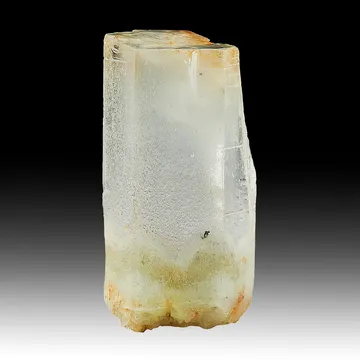
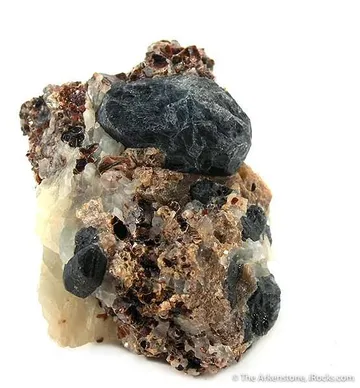
The most sought-after Betroka feldspars have the unmistakable look of weathered gem crystals: transparent interiors, yellow to yellow-green color from ferric iron, sharp enough terminations to read as crystals rather than tumbled gems, and enough surface texture to show they are natural pieces liberated from pegmatitic or feldspathic host rather than cut material. The best small cabinet and thumbnail specimens are not merely bright; they have internal fire, clean crystal form, and minimal cleavage damage. Larger feldspar crystals exist, but clean, complete, well-colored examples are far scarcer than the number of old “orthoclase Madagascar” labels might suggest.

Photo: Wikimedia Commons
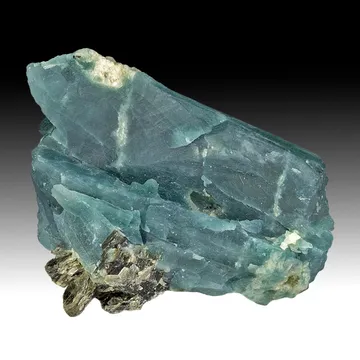
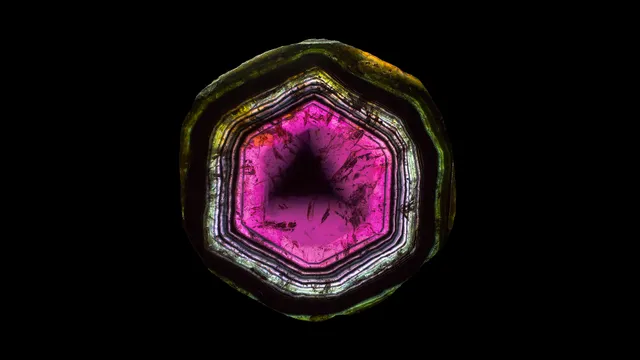
Beravina, east of Betroka near Ambaro, adds a modern chapter. There, a deeply weathered Sc-bearing pegmatite produced laurentthomasite, a blue to green-yellow, strongly dichroic milarite-group mineral approved as a new species in 2019 and published in 2020. Its finest crystals are tiny by feldspar standards but spectacular under light: cobalt-blue down the c-axis and yellow-green from the side, transparent enough to cross the boundary between systematic mineral rarity and gem mineral.

Photo: Wikimedia Commons
Search for specimens: View all specimens from Betroka District, Madagascar
Betroka District lies in the Anosy Region of southern Madagascar and includes a number of mineral localities that have been grouped, re-grouped, and sometimes loosely named in the specimen trade. The most famous collector locality is Itrongay, also seen historically as Itrongahy, in Mahasoa Est. Older literature placed the ancient village of Itrongay on the route between Betroka and Benenitra; today the name is not generally found on ordinary maps, but it survives in geological and mineralogical usage. In specimen commerce, “Itrongay” often refers not to a single pit but to a mineralized area around the former village, including material from nearby places such as Benono and Andangovato.
The classic feldspar occurrence is a pegmatitic to quartzofeldspathic system within high-grade metamorphic country rock. Lacroix described the yellow feldspar and associated diopside as pegmatitic, and later work reported yellow gemmy sanidine in feldspar veins derived from pegmatite and cutting marbles. Recent studies of Itrongay K-feldspar samples describe crystals collected from the ground near pits and from tailings at abandoned workings in an area of predominantly quartzofeldspathic pegmatites. The host region records very high-grade metamorphism, with southern Madagascar’s crystalline basement having reached granulite-facies to ultrahigh-temperature conditions during Gondwana assembly and later cooling through the temperature interval in which the pegmatitic and fluid-related events are interpreted to have taken place.
The “ore bodies” of interest to specimen collectors are not ore bodies in the metallic-mining sense. At Itrongay they are feldspar-rich pegmatitic veins, quartz-feldspar pegmatites, and weathered eluvial concentrations that released tough, loose K-feldspar crystals to the ground. Their collectible mineralization includes yellow sanidine, gem diopside, zircon, scapolite, phlogopite, quartz, smoky quartz, chalcedony, opal, rutile, titanite, spinel, sapphirine, apatite, and REE-bearing accessory minerals such as chevkinite-group minerals and bastnäsite-group entries in the district records. Some old references and labels use orthoclase for the yellow feldspar; the modern collector should read that label critically, because the famous gem-yellow Itrongay feldspar tested in modern studies is sanidine.
Betroka is also an important phlogopite district. Phlogopite occurs in pyroxenites and in pegmatoid mica veins and pockets, with long-known mines and deposits at Benato Toby, Ambatomivary, Bekorobo, Iaborotra, Beapombo II, Jangany, and other district localities. Savornin’s 1934 work on Betroka phlogopite described phlogopite both as a normal constituent of pyroxenite and as a vein or pegmatoid mineral; he interpreted the pyroxenites as metamorphosed marls and marly limestones modified by a magma rich in mineralizing agents. Broader summaries of Madagascar phlogopite note that these deposits, including Betroka-zone deposits, have been worked since the early twentieth century and that Madagascar’s mica production remains largely phlogopite from southern regions.
Corundum adds another layer. Iankaroka, near Ianabinda about 35 km south of Betroka, is described as a polychromatic corundum-bearing cordieritite lens first discovered in 1984–1985. Its corundum occurs as small elongated to tabular hexagonal prisms and bipyramids, generally millimetric. Ambatomena, northeast of Isoanala, is a ruby deposit exploited from 2000 to 2001 by a private company. It occurs in cordieritite and sapphirinite assemblages that include cordierite, rutile, K-feldspar, sapphirine, phlogopite, and pyroxene. These corundum localities are of real geological importance, but they should not be confused with the classic loose yellow feldspars of Itrongay.
The rare-element story is centered at Beravina, near Ambaro in the Tsaraitso commune, about 40 km east of Betroka. The laurentthomasite locality is a strongly weathered pegmatite hosted in high-grade metamorphic rocks such as amphibolite and migmatite. The associated assemblage reported for the pegmatite includes K-feldspar up to several centimeters, quartz, rare green apatite, phenakite, beryl, albite, magnetite, thortveitite, cheralite, grossular, and rare grey-tan tabular corundum. Only limited zones of the pegmatite yielded laurentthomasite, which helps explain why even small thumbnail crystals have commanded strong attention in the systematic and gem-mineral market.
Mining and collecting in Betroka District have been a mixture of small pits, artisanal work, phlogopite mining, gem and specimen recovery, and short-lived private operations. There is no meaningful public-collecting culture comparable to an organized North American fee-dig locality. Access today should be treated as private, local, and permit-sensitive; serious collectors normally encounter Betroka specimens through Malagasy dealers, European and American dealers, old collections, and occasional new parcels rather than through direct field collecting. Provenance is unusually important here because names such as “Itrongay,” “Betroka,” “Toliara,” “Fianarantsoa,” and “Madagascar orthoclase” have been used at different levels of precision over more than a century of trade.
Betroka District’s sanidine is the classic yellow to yellow-green gem feldspar of the Itrongay area, including material attributed to nearby Benono and Andangovato; it occurs as prismatic to blocky K-feldspar crystals, commonly loose, transparent, and etched or pitted on the surface, with ferric iron responsible for the warm yellow color. Documented crystals in museum and dealer records range from small thumbnails around 1–3 cm to larger cabinet pieces exceeding 5 cm, but the value curve is steep: the best examples are bright, internally clean, naturally terminated, and visually crystal-like rather than broken gem rough. Associated minerals in the Itrongay field include quartz, smoky quartz, chalcedony, diopside, zircon, scapolite, phlogopite, apatite, rutile, titanite, spinel, and sapphirine, though matrix combinations are much less common than isolated feldspar crystals. What separates fine Betroka sanidine from ordinary material is the combination of body color, transparency, coherent form, and limited cleavage damage; many otherwise attractive pieces have bruised edges, etched faces, or old labels calling them orthoclase, but the important modern identity of the famous gem-yellow material is sanidine.
Orthoclase from Betroka District is a label that must be handled with unusual care: the historic “orthoclase” of Itrongay—the yellow, facetable, prismatic feldspar that made the district famous—has been shown by modern X-ray and structural studies to be sanidine, and Mindat treats the Itrongay orthoclase occurrence as an erroneous literature entry. That does not make old orthoclase-labeled specimens uninteresting; quite the opposite, because they are often classic sanidines with labels preserving the nineteenth- and twentieth-century nomenclature. True orthoclase is nevertheless documented in the district at Beravina in the laurentthomasite-bearing pegmatite, where K-feldspar crystals up to about 5 cm occur with quartz and rare green apatite in the limited zones that produced laurentthomasite. For collectors, the finest “orthoclase” pieces carrying Betroka or Itrongay labels are generally judged as sanidine specimens unless independently tested; a good piece under the old name should be transparent yellow to yellow-green, sharp enough to show crystal habit, and accompanied by a label history that makes the nomenclature clear rather than ambiguous.
Other documented Betroka minerals give the district far more depth than the feldspar trade name suggests. Beravina is the type locality and, so far, the defining locality for laurentthomasite, Mg2K(Be2Al)Si12O30, a transparent hexagonal milarite-group mineral notable for cobalt-blue to green-yellow dichroism and appreciable scandium content. The same pegmatite assemblage includes albite, apatite, beryl, cheralite, grossular, magnetite, phenakite, quartz, thortveitite, and orthoclase. Itrongay and related Mahasoa Est localities add gem diopside, zircon, scapolite, phlogopite, smoky quartz, chalcedony, opal, rutile, titanite, spinel, and sapphirine. The wider district includes numerous phlogopite mines and deposits, corundum localities such as Iankaroka and Ambatomena, ruby and sapphire occurrences, prehnite, pyrite, chalcopyrite, celestine, pyrophyllite, and a suite of metamorphic minerals tied to pyroxenites, cordieritites, marbles, gneisses, and granulites.
The central authenticity issue for Betroka District is naming, not treatment. The classic yellow Itrongay “orthoclase” is now understood as sanidine; old labels are historically valuable but mineralogically outdated. A specimen labeled “orthoclase, Itrongay” should not be dismissed, but it should be catalogued with a note such as “old label orthoclase; modern identification sanidine unless tested.” Conversely, a seller offering “rare Betroka orthoclase” should be asked whether the piece is a tested orthoclase from Beravina or an old-name Itrongay sanidine.
Locality precision is the second major concern. “Itrongay” has been used for a broad mineralized area, and some gem feldspar from other Betroka localities has entered the trade under the more famous name. Betroka District, Itrongay area, Benono, Andangovato, Mahasoa Est, Beravina, Iankaroka, Ambatomena, and Benato Toby are not interchangeable labels. For high-value pieces, original dealer labels, old collection labels, and any analytical notes matter. The same caution applies to “Madagascar orthoclase” cut stones and gem rough; without documentation, they may represent general Malagasy feldspar rather than the classic Betroka material.
Condition is a real grading factor. Sanidine has good cleavage, and many Itrongay crystals show cleaved ends, edge bruises, chips, healed-looking cracks, or naturally etched surfaces. Surface corrosion is not automatically damage; it is part of the appearance of many genuine crystals. However, the best specimens balance natural etching with readable morphology and transparent interiors. A heavily pitted but gemmy thumbnail can be excellent; a shattered or cleaved piece with only yellow color is ordinary. Avoid over-cleaning: strong acids and aggressive mechanical cleaning can worsen etched surfaces or expose cleavage weaknesses.
Treatments are not a major documented issue for mineral specimens from Betroka feldspar pockets, but cut gems and rough deserve ordinary feldspar caution. Color, clarity, and identity should not be assumed from appearance alone, and gemological reports may still use trade or historical names inconsistently. Transparent yellow K-feldspar is especially vulnerable to casual mislabeling because “orthoclase,” “sanidine,” and “feldspar” have all been used in the market.
Laurentthomasite requires a different set of collector habits. The crystals are small, rare, brittle, and valuable because of their type-locality status, gem transparency, dichroism, and limited production. Handle them as systematic specimens: protect from abrasion, avoid unnecessary recleaning, retain labels, and record whether the piece is from the April 2019 Beravina find or a later parcel if such information is documented. Because laurentthomasite is a beryllium-bearing mineral and associated species at Beravina include thorium-bearing cheralite and scandium-bearing thortveitite, specimen handling should follow normal mineral practice: do not grind, cut, or create dust, and wash hands after handling friable matrix.
Market availability is uneven. Small and mid-grade Itrongay sanidines appear periodically, including old-stock specimens and dealer parcels; top-quality transparent, well-formed yellow crystals remain genuinely scarce. Old “orthoclase” labels are common enough that they should be expected, not feared. Laurentthomasite is far rarer and appears mainly as thumbnails and micro-to-small miniatures, often at prices more typical of new species and gem rarities than of ordinary pegmatite minerals. Betroka phlogopite is available from time to time but is usually collected as large mica, industrial material, or regional representation rather than as elite display specimens.
The old Itrongay story begins with a place name that has almost outlived the place. Early mineralogists used Itrongay for a village on the path between Betroka and Benenitra, in the mineral-rich interior of southern Madagascar. The name persists on labels and geological maps, but modern travelers should not expect to find it easily on ordinary maps. One explanation preserves a local Bara-language origin from “mitrongay,” meaning “to walk with a limp”—a small human remnant attached to one of the world’s most recognizable feldspar localities.
Itrongay then became a name larger than a village. Over time it came to cover a roughly 40 km mineralized area around the old settlement, and dealers used it still more loosely for yellow feldspar coming from nearby ground. That looseness is part of the charm and part of the problem. A fine crystal may carry an old “Itrongay” label even if it came from Benono or another nearby occurrence; another may say only “Betroka” or “Madagascar orthoclase.” Serious collectors learn to read those labels as historical documents, not GPS coordinates.
The most dramatic modern twist is that the famous “orthoclase” was not orthoclase after all. For generations, the yellow Itrongay feldspars circulated under that name and were prized as some of the world’s best gem orthoclase crystals. Then modern X-ray work on bright yellow to colorless material collected in 2001, followed by more detailed structural study, established the material as high- to low-sanidine, with the Itrongay feldspar further characterized as monoclinic low sanidine. The result is one of those rare mineralogical reversals where a correction did not diminish a classic locality; it made it stranger and better. The specimens remained the same glowing yellow crystals, but their significance shifted from “fine orthoclase” to “world-class gem sanidine.”
Beravina produced a different kind of revelation. In 2019, laurentthomasite was approved as a new mineral species, and the important April 2019 find introduced collectors to small hexagonal crystals with a startling optical personality: cobalt blue in one direction, green-yellow in another. The species was named for Laurent Thomas, the geologist, prospector, and mineral dealer associated with the discovery and promotion of the material. At Tucson 2020 the mineral attracted exactly the kind of attention a new, beautiful, type-locality gem species tends to attract—part systematic rarity, part gemstone, part Madagascar surprise.
Alfred Lacroix, Minéralogie de Madagascar, Tome I, 1922 — The foundational descriptive work for many Malagasy mineral localities, including the old literature context for Itrongay feldspar and associated minerals.
Henri Ungemach, “Contribution à la Minéralogie de Madagascar,” Bulletin de Minéralogie 39, 1916, pp. 5–38 — Early twentieth-century mineralogical treatment cited in later records for the historic Itrongay feldspar nomenclature.
André Savornin, “Sur la présence de la phlogopite dans les pyroxénites de la région de Betroka,” Bulletin de Minéralogie 57, 1934, pp. 130–139 — A focused paper on Betroka-region phlogopite in pyroxenites and pegmatoid mica veins.
William B. Simmons and Alexander U. Falster, “Yellow Orthoclase (sanidine) from South Betroka, Madagascar,” The Mineralogical Record 33(1), 2002, pp. 79–80 — The key modern collector reference for the reidentification of the classic yellow Betroka “orthoclase” as sanidine.
Sonia Ackermann, Martin Kunz, Thomas Armbruster, Jürg Schefer, and Henry Hänni, “Cation distribution in a Fe-bearing K-feldspar from Itrongay, Madagascar,” 2005 — A combined neutron- and X-ray single-crystal diffraction study characterizing the Itrongay K-feldspar as Fe-bearing monoclinic low sanidine.
Richard A. Wartho et al., “Direct measurement of Ar diffusion profiles in a gem-quality Madagascar K-feldspar using the ultra-violet laser ablation microprobe,” Earth and Planetary Science Letters 170, 1999 — A geochronology and diffusion study using gem-quality yellow ferriferous low-sanidine from a pegmatite body near Itrongay.
Daniil V. Popov et al., “Diffusion and fluid interaction in Itrongay pegmatite (Madagascar): Evidence from in situ 40Ar/39Ar dating of gem-quality alkali feldspar and U-Pb dating of protogenetic apatite inclusions,” Chemical Geology 556, 2020 — A modern study of Itrongay feldspar zoning, fluid interaction, and dating constraints.
Daniil V. Popov, Richard A. Spikings, and coauthors, “Inclusions of Amorphous and Crystalline SiO2 in Minerals from Itrongay (Madagascar) and Other Evidence for the Natural Occurrence of Hydrosilicate Fluids,” Geosciences 12, 2022 — Open-access work on Itrongay K-feldspar, quartz/chalcedony relationships, and hydrosilicate-fluid interpretations.
Cristiano Ferraris, Isabella Pignatelli, Fernando Cámara, Giancarlo Parodi, Sylvain Pont, Martin Schreyer, and Fengxia Wei, “Laurentthomasite, Mg2K(Be2Al)Si12O30: a new milarite-group-type member from the Ihorombe region, Fianarantsoa Province, Madagascar,” European Journal of Mineralogy 32, 2020, pp. 355–365 — The type description of laurentthomasite from Beravina, including chemistry, structure, optical properties, and geological setting.
Ritsuro Miyawaki, Frédéric Hatert, Marco Pasero, and Stuart J. Mills, “New minerals and nomenclature modifications approved in 2019,” Mineralogical Magazine 83, 2019, pp. 479–483 — CNMNC newsletter entry recording the approval of laurentthomasite.
Gaston Giuliani et al., “Oxygen isotope systematics of gem corundum deposits in Madagascar: relevance for their geological origin,” Mineralium Deposita 42, 2007, pp. 251–270 — Includes Madagascar corundum deposits such as Ambatomena in Betroka District in a broader isotope study.
Amos Fety Michel Rakotondrazafy et al., “Gem corundum deposits of Madagascar: A review,” Ore Geology Reviews 34, 2008, pp. 134–154 — A review covering Betroka-district corundum localities including Ambatomena and Iankaroka.
N. O. T. Rakotonandrasana, M. Arima, R. Miyawaki, and R. A. Rambeloson, “Widespread Occurrences of Högbomite-2N2S in UHT Metapelites from the Betroka Belt, Southern Madagascar,” Journal of Petrology 51, 2010, pp. 869–895 — Important regional petrology documenting ultrahigh-temperature metamorphism and hydrous melt/fluid activity in the Betroka Belt.
Gaston Giuliani et al., “Ruby Deposits: A Review and Geological Classification,” Minerals 10, 2020 — Includes geological classification and imagery for Ambatomena-type ruby mineralization in the Betroka region.
Mindat: Betroka District, Anosy, Madagascar — Best single locality index for the district’s minerals, sublocalities, references, and photo galleries.
Mindat: Itrongay (Itrongahy), Mahasoa Est, Betroka District — Essential locality page for the classic yellow sanidine field and its historical naming issues.
Mindat: Sanidine from Itrongay — Occurrence page documenting the Itrongay sanidine identity and specimen significance.
Mindat: Orthoclase from Itrongay — Useful specifically because it records the old orthoclase attribution as erroneous for the classic gem-yellow feldspar.
Mindat: Beravina, Ambaro, Tsaraitso, Betroka District — Type-locality page for the laurentthomasite-bearing pegmatite and its associated mineral list.
Mindat: Laurentthomasite — Species page summarizing formula, properties, type locality, and current locality status.
European Journal of Mineralogy: Laurentthomasite type description — Open-access primary paper for laurentthomasite chemistry, structure, dichroism, and Beravina geological context.
Wikimedia Commons: Sanidine-227686.jpg — Freely licensed photograph of a classic yellow-green Itrongay sanidine crystal.
Wikimedia Commons: Feldspar 3.jpg — Freely licensed photograph of a larger Itrongay feldspar-variety sanidine specimen.
Wikimedia Commons: Ejm-32-355-2020-f02.jpg — Freely licensed figure showing laurentthomasite’s strong dichroism.
USGS: Madagascar mineral industry profile — Current context for Madagascar’s mica, gemstone, and broader mineral production.
Persée: Savornin 1934 Betroka phlogopite paper — Historical primary source on phlogopite in Betroka pyroxenites.