A collector's guide to Mandrosonoro, Madagascar: its geology, mining history and notable minerals, illustrated with the 20 specimens documented from this locality on EarthWonders.
Key facts
Mandrosonoro sits in the mineralogical heart of Madagascar’s central highlands, at the northern end of the Ampandramaika-Malakialina pegmatite field—a broad rare-element pegmatite district long known to Malagasy miners, colonial-era prospectors, gem dealers, and pegmatite specialists. For collectors, the name carries two rather different meanings. In a strict geological sense it anchors a cluster of lithium-cesium-tantalum granitic pegmatites, including the Sakavalana pegmatite near Ambatovita, famous as the type locality of pezzottaite-(Cs), the raspberry-pink Cs-Li beryl-group mineral first recognized from the extraordinary 2002 pocket. In the specimen trade, “Mandrosonoro” also appears on labels for the large green cubic fluorites that began circulating internationally around 2018–2019, usually as groups of translucent to edge-translucent cubes on pale quartz-rich matrix.
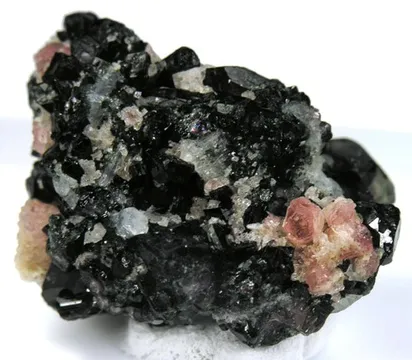
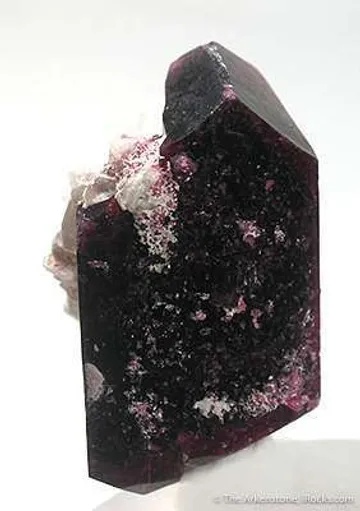
The pegmatites around Mandrosonoro are not casual roadside cavities; they are remote, weather-dependent, hand-worked deposits in highland terrain, hosted in Precambrian metamorphic rocks and surrounded by an old beryllium-gemstone mining culture. The best Sakavalana specimens are unmistakable: raspberry to purplish-pink pezzottaite crystals in compact tabular forms, commonly with albite, smoky quartz, amazonite, tourmaline, spodumene, and locally the remarkable brownish-red Be-zeolite chiavennite. Good fluorite specimens from the broader Mandrosonoro-labelled production have a different visual language entirely—green cubes, sometimes with frosty pale cores and darker green rims, set as hefty clusters or perched on pale drusy quartz.
Regional View
Country View
The locality’s historical importance rests above all on the Sakavalana discovery. Pezzottaite was not simply another attractive gem beryl variety; the high cesium and lithium contents, distinctive structure, and anomalous gemological properties made it a new mineral species. That scientific story unfolded almost in real time on the gem market: material reached Antananarivo in late 2002, caused excitement at the 2003 Tucson shows, was briefly sold under names such as “red beryl,” “raspberyl,” and “hot pink-red beryl,” and then was formally studied as a new beryl-group mineral. The deposit appears to have been rapidly depleted, which is why specimen-quality Sakavalana pezzottaite remains far scarcer than the publicity surrounding the discovery might suggest.

Photo: Wikimedia Commons
Search for specimens: View all specimens from Mandrosonoro, Madagascar
Mandrosonoro is a commune in the Ambatofinandrahana District of Madagascar’s Amoron’i Mania Region. Mineralogically, the name is most useful when treated as a district-level collecting label rather than a single hole in the ground. The most important pegmatite locality tied to the name is the Sakavalana mine near Ambatovita, about 22–25 km south of Mandrosonoro. The wider Ampandramaika-Malakialina pegmatite field extends across the central highlands; Mandrosonoro marks its northern border, while the confluence of the Masiatra and Mantsahala rivers forms its southern limit.
The district’s classic ore and gem deposits are rare-element granitic pegmatites. The larger field was Madagascar’s most important industrial beryl area during the mid-20th century, with commercial beryllium minerals and columbite-tantalite among the recorded commodities. At Sakavalana, the pegmatite is a subvertical dike at least 4–6 meters wide and more than 200 meters long. It is hosted by impure marbles assigned in the geological literature to the Vohimena Group, on the limb of a synform dominated by quartzitic gneisses, with amphibolite-grade metasedimentary rocks and deformed granites forming the broader setting.
Sakavalana is especially interesting because it does not fit neatly into a simple pegmatite category. It has been described as a “mixed feature” rare-element granitic pegmatite, showing both LCT character—lithium, cesium, tantalum enrichment—and NYF character—niobium, yttrium, fluorine enrichment. In the outer portions, the pegmatite consists mainly of K-feldspar, quartz, plagioclase, and black mica. The core zone is richer and more collectable: amazonite microcline, smoky quartz, zoned mica, cleavelandite, danburite, zircon, Nb-Ta oxides, black tourmaline, minor beryl, spessartine, and spodumene. The important specimen minerals came from miarolitic cavities in this core zone.
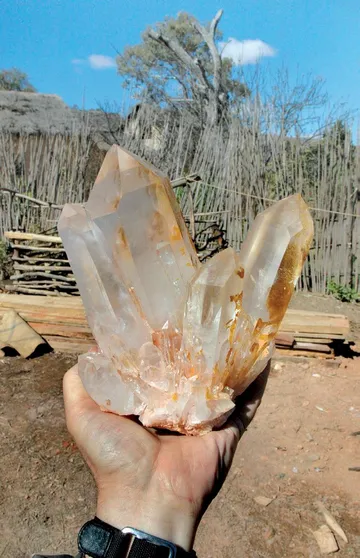
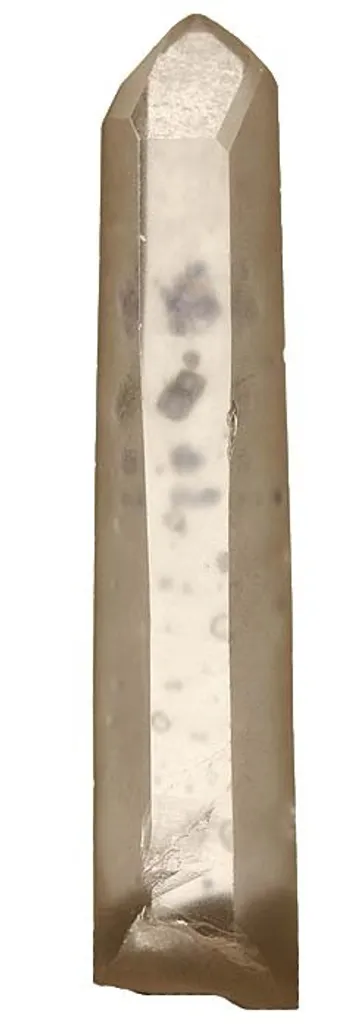
Mining at Sakavalana began in the 1940s under French colonial prospectors working primarily for tourmaline. Later, local miners continued intermittent hand-tool digging for tourmaline and other pegmatite minerals. The defining event came in mid-November 2002, when miners opened a large crystal-bearing cavity roughly 6 meters below the surface. That pocket contained smoky to citrine quartz, multicolored tourmaline, pink to yellow-green spodumene, amazonite, cleavelandite, lepidolite, danburite, and the deep purplish-pink Cs-Li mineral soon recognized as pezzottaite-(Cs).
The main pezzottaite cavity may have reached about 3.0 × 3.0 × 1.2 meters. Beneath it was a zone of smaller vugs that also yielded pezzottaite, but all recorded early production came from a limited area in the pegmatite. The pocket was unusually productive by gem-mineral standards: approximately 700 kg of smoky quartz, 280 kg of multicolored tourmaline, more than 40 kg of pezzottaite, and about 25 kg of transparent spodumene were reported from the main pocket. The largest tourmaline crystals were said to weigh 15, 25, and 50 kg. By contrast, the good pezzottaite was much more restricted: most pieces were only grams in weight, gem-quality portions were usually less than 1–2 grams, and fine crystals on matrix were rare from the start.
The workings were rudimentary. Early reports describe pits, shafts, small open cuts, short tunnels, candlelight underground, log scaffolding, and instability caused by clay-coated fractures and backfilling. A deeper shaft, about 30 meters, produced tourmaline but suffered from flooding. After the 2002 discovery, a rush brought roughly 120 people to the deposit, including about 60 miners and their families. By April 2003 most had left because production had fallen off, and by July 2003 only about 20 people were actively working the pegmatite. Later that year the underground workings were already described as poor and dangerous, with little if any additional pezzottaite being recovered.
Collecting access should be regarded as difficult and not comparable to recreational collecting in North America or Europe. The Sakavalana area is remote, reached historically by long dirt-track travel beyond Ambatofinandrahana and Mandrosonoro, and field parties needed local guides for both navigation and safety. The old pezzottaite zone was substantially exhausted shortly after discovery, and surviving specimens are now mainly in collections, museums, and dealer inventories. Any modern field access would require permission, local arrangements, realistic seasonal planning, and avoidance of unstable underground workings.
The green fluorites sold under the Mandrosonoro label appear to be from a separate commercial occurrence rather than the documented Sakavalana pezzottaite pocket. The best-publicized labels have used wording such as “Fluorite occurrence, Mandrosonoro, Ambatofinandrahana, Amoron’i Mania,” or the broader “Mandrosonoro-Ambatofinandrahana.” Collectors should understand that this label may cover an area rather than a precisely documented named mine. The specimens themselves are distinctive enough to have become recognizable in the trade: green cubic fluorite, commonly on pale quartz-rich matrix, in groups ranging from miniatures to large cabinet specimens.
Beryl from the Mandrosonoro area belongs to the same rare-element pegmatite system that made the district a major industrial beryl producer in Madagascar, but the collector-grade material is best understood through specific sublocalities such as Sakavalana, Ankiperatra, Marivolanitra, and Maroanaka. At Sakavalana, ordinary beryl is recorded alongside aquamarine and morganite, but it is overshadowed by the associated beryl-group rarity pezzottaite-(Cs). The better Mandrosonoro beryls are pegmatite specimens rather than isolated gem crystals: pale blue aquamarine or pink morganite-type material associated with feldspar, quartz, mica, tourmaline, and the LCT accessory suite. Pieces that rise above the ordinary have intact crystal form, natural matrix association, and clean locality data separating true beryl from pezzottaite, which was itself initially misidentified in the trade as pink or red beryl.
Mandrosonoro-labelled fluorite is a comparatively recent collector-market phenomenon, known for medium-green cubic crystals in chunky groups, commonly with pale or frosty interiors, darker green zoning, and in some specimens a subtle bluish outer zone that gives the cubes a blue-green cast. Documented examples range from hand-sized clusters to large cabinet specimens, with individual cubes reported to about 3.5 cm and groups exceeding 25 cm. Most are not glassy in the English or Chinese fluorite sense; the appeal is instead in the size, geometry, soft green color, and pale quartz-rich contrast. Damage to corners and edges is common, especially where cubes project from matrix, and fluorescence reports vary from weak to strong under long-wave ultraviolet, making a 365 nm test worthwhile rather than assumed.
Other documented minerals from the Mandrosonoro area make the locality far more than a two-species stop. Sakavalana is the type locality for pezzottaite-(Cs), Cs(Be2Li)Al2(Si6O18), and also produced notable chiavennite, hambergite, liddicoatite, elbaite, spodumene varieties including kunzite and hiddenite, amazonite, danburite, cassiterite, zircon, monazite-(Ce), allanite-(Ce), bavenite, analcime, schorl, smoky quartz, citrine, and chalcedony. The broader Ampandramaika-Malakialina field adds phosphate and rare-element interest at places such as Marivolanitra, with graftonite, triplite, lithiophilite, phosphosiderite, vivianite, hureaulite, rockbridgeite, stewartite, tavorite, autunite, uranophane, and other alteration products. Ankiperatra is important for lithium phosphates and for the montebrasite question: material historically labelled amblygonite from Ankiperatra was later investigated by Raman spectroscopy and found to be montebrasite with significant fluorine content.
The principal authenticity issue at Mandrosonoro is not synthetic material but naming and locality discipline. Pezzottaite from Sakavalana entered the market before its identity was settled and was sold under several names, including “red beryl,” “raspberyl,” “hot pink-red beryl,” and even, in some cases, as tourmaline. For serious collectors, true Sakavalana pezzottaite should be separated from ordinary morganite, red beryl, and pink tourmaline by reliable provenance and, where value warrants it, analytical confirmation. Its refractive indices and specific gravity are higher than beryl, and Raman, infrared, and X-ray diffraction data provide more secure separation when gemological observations are not enough.
Oiling is a documented concern for early pezzottaite rough. Local dealers in Madagascar reportedly oiled purplish-pink rough to see into it more easily through etched surfaces; this was described as manually applied mineral oil rather than pressure-injected clarity enhancement. Collectors buying crystals or polished material should inspect fractures under magnification, especially where low-relief fractures or bubbles might indicate filling. Heated color stability is also relevant: experimental work showed that heating to 450°C for two hours caused near-total loss of color in one pezzottaite fragment, though lower experimental temperatures did not produce the same result. Pezzottaite should therefore be kept out of any repair, cleaning, or mounting procedure involving significant heat.
Condition is a major value separator. Sakavalana pezzottaite crystals are commonly corroded, etched, fractured, included, or present only as fragments. Matrix specimens with sharp, bright raspberry-pink crystals are genuinely rare. Small size should not be held against a specimen if the crystal is sharp, lustrous, and well positioned on albite, quartz, tourmaline, or chiavennite-bearing matrix. By contrast, larger etched masses or cleavage fragments may be scientifically interesting but are less desirable unless the color is strong and the form is legible.
For Mandrosonoro fluorite, condition and label precision dominate. Edgewear, corner bruising, cleaved cubes, and broken crystals near the base are common in the large green clusters. The best examples show a coherent arrangement of cubes, minimal corner damage, attractive green zoning, and contrast with pale quartz matrix. Fluorescence can be a selling point, but reports are inconsistent enough that it should be demonstrated rather than assumed. Collectors should also watch for overly broad labels: “Mandrosonoro,” “Mandrosonoro-Ambatofinandrahana,” and “Amoron’i Mania” may not all indicate the same level of locality precision.
Market availability divides sharply by species. Green Mandrosonoro fluorite has appeared regularly enough in recent years that good cabinet pieces can still be found, though the better, cleaner, larger clusters are less common. Beryl from the broader district appears intermittently. Sakavalana pezzottaite, especially matrix-quality crystals, is scarce and commands a premium because the original pocket was short-lived, famous, and essentially exhausted soon after discovery.
The Sakavalana story begins not with a laboratory but with a hand-dug pegmatite pocket in a remote part of central-western Madagascar. In mid-November 2002, local miners opened a large cavity in an almost vertical dike that had been known since the 1940s for tourmaline. What emerged must have looked, at first, like a very good gem pocket: smoky quartz, multicolored tourmaline prisms suitable for carving or slabbing, and transparent spodumene in green, blue, purple, pink, and yellow-green hues. Then came the odd deep-pink crystals—too tabular for tourmaline, too high in refractive index for ordinary morganite, too saturated to ignore.
By early December 2002 the material had reached Antananarivo. Laurent Thomas saw the deep pink crystals and recognized the contradiction immediately: the color resembled tourmaline, but the form resembled tabular morganite. On a shiny pinacoidal face he measured an index of 1.619, a number that did not sit comfortably inside the normal beryl box. Samples went to Federico Pezzotta in Italy, where Alessandro Guastoni’s preliminary EDS work revealed very high cesium and Franco Demartin’s unit-cell calculations pointed toward a beryl-like mineral with extreme cesium enrichment. The trade was already moving faster than the science. Some material had been sold as tourmaline; soon, rumors of a new “red beryl” sent local names toward “bixbite,” “raspberyl,” and other excited inventions.
The 2003 Tucson gem shows turned the discovery into a sensation. Three principal suppliers—Polychrome, Le Minéral Brut, and MJ3 Inc.—had roughly 5 kg of rough, with only a small number of faceted stones and cabochons. Laurent Thomas reportedly had about 0.5 kg suitable for faceting or cat’s-eye cabochons, about 2 kg of carving quality, and about 1 kg of crystal specimens. The excitement had consequences: after Tucson, Madagascar’s customs department temporarily froze exports because of confusion over the material’s identity and the possibility that it might be a new mineral. That rumor proved true.
The road to the mine was an ordeal even in the dry season. From Antsirabe, travel to Ambatofinandrahana covered about 160 km of paved road and took roughly six hours. Then came about 140 km of rough dirt track to Mandrosonoro, and another 25 km toward the mine near Ambatovita. In July 2003, a field party guided by Federico Pezzotta needed local guides for navigation and safety. The final drive usually took around 14 hours, and mechanical breakdowns were common because of the rough terrain. The rainy season, from December to April, could make the road hazardous to impassable.
One episode from the first rush has become part of the locality’s hard-edged lore. Laurent Thomas visited the mine soon after the pocket was discovered, but the visit ended abruptly when he had to flee after drawing gunfire. The early literature did not romanticize the area: foreigners were described as unwelcome, and Mandrosonoro was considered among the more dangerous areas in Madagascar at the time.
Underground, the mine was as improvised as the road was brutal. Reports from 2003 describe pits, shafts, open cuts, short tunnels, candlelight, crude log scaffolding, clay-coated fractures, and unstable ceilings. The pezzottaite-bearing workings consisted of two small rooms reached by tunnels only several meters long. Another deeper shaft, about 30 meters, produced tourmaline but suffered from flooding. At the height of the rush, about 120 people lived at the deposit, including roughly 60 miners and their families. By April 2003, most had gone. By July, only about 20 people were actively working the pegmatite.
The main pocket’s numbers are astonishing because they show how much mineral came out—and how little of it became fine pezzottaite. The cavity yielded about 700 kg of smoky quartz, with crystals up to 50 kg; about 280 kg of multicolored tourmaline coated in a black skin; more than 40 kg of pezzottaite crystals, fragments, and masses; and about 25 kg of transparent spodumene. The three largest tourmaline crystals weighed 15, 25, and 50 kg and were reportedly bought by a Korean dealer for carving. Against that bulk, attractive pezzottaite crystals were almost vanishingly few. Most pezzottaite pieces weighed only a few grams; gem-quality portions were usually under 1–2 grams.
The pocket also held a second surprise after the pezzottaite news had already broken. In February 2003, Hervé Forner examined a 5 cm specimen from Ambatovita containing brownish-red radial aggregates cementing fragments of quartz and pezzottaite. In July 2003, Federico Pezzotta obtained from a local miner a specimen weighing more than 7 kg, with pezzottaite, liddicoatite, green amazonite, quartz, manganese oxides, and large masses of the same brownish-red mineral. When the mass was broken, cavities up to about 5 cm across appeared, lined with globules and tabular crystals. By October 2003, EDS and X-ray powder diffraction work in Milan identified the brownish-red mineral as chiavennite and the white flat prisms as hambergite. In most localities chiavennite is a tiny late-stage curiosity; at Ambatovita it was abundant, fresh, and intimately associated with one of the great gem-mineral discoveries of the decade.
Brendan M. Laurs, William B. Simmons, George R. Rossman, Elizabeth P. Quinn, Shane F. McClure, Adi Peretti, Thomas Armbruster, Frank C. Hawthorne, Alexander U. Falster, Detlef Günther, Mark A. Cooper, and Bernard Grobéty, “Pezzottaite from Ambatovita, Madagascar: A New Gem Mineral,” Gems & Gemology, Vol. 39, No. 4, 2003, pp. 284–301. The key gemological and geological account of the Sakavalana discovery, including access, mining, production, associations, and diagnostic properties.
George R. Rossman, William B. Simmons, Frank C. Hawthorne, Mark A. Cooper, Brendan M. Laurs, Thomas Armbruster, Adolf Peretti, Detlef Günther, Bernard Grobéty, and Alexander U. Falster, “Pezzottaite, Cs(Be2Li)Al2Si6O18, a Spectacular New Beryl-Group Mineral from the Sakavalana Pegmatite, Fianarantsoa Province, Madagascar,” The Mineralogical Record, Vol. 35, No. 5, 2004, pp. 369–378. The formal mineralogical record establishing pezzottaite as a new beryl-group mineral from Sakavalana.
Federico Pezzotta, Alessandro Guastoni, Hervé Forner, Francesco Demartin, and Roy Kristiansen, “Exceptional Chiavennite Associated with Pezzottaite from the Sakavalana Pegmatite, Ambatovita, Madagascar,” Mineralogical Society of America Pegmatite Interest Group article, 2004. Detailed account of the exceptional chiavennite occurrence associated with pezzottaite, hambergite, chalcedony, and late-stage manganese oxides.
Mark Mauthner, “Connoisseur’s Choice: Pezzottaite, Sakavalana Mine, Ambatovita, Mandrosonoro Commune, Ambatofinandrahana District, Fianarantsoa Province, Madagascar,” Rocks & Minerals, Vol. 92, No. 2, 2017, pp. 138–143. Collector-focused treatment of top pezzottaite specimens from Sakavalana, including fine matrix examples photographed by Jeff Scovil and Matteo Chinellato.
Diego Gatta, Ilaria Adamo, Martin Meven, and Erica Lambruschi, “A single-crystal neutron and X-ray diffraction study of pezzottaite, Cs(Be2Li)Al2Si6O18,” Physics and Chemistry of Minerals, Vol. 39, 2012, pp. 829–840. Structural study refining the crystal chemistry of pezzottaite from the Sakavalana type locality.
Barbara Rondeau, Emmanuel Fritsch, Philippe Lefevre, Michel Guiraud, André-Mathieu Fransolet, and Yves Lulzac, “A Raman Investigation of the Amblygonite–Montebrasite Series,” The Canadian Mineralogist, Vol. 44, No. 5, 2006, pp. 1109–1117. Includes the important reevaluation of an Ankiperatra specimen historically labelled amblygonite, found by Raman work to be montebrasite-rich.
Jean Behier, “Les minéraux phosphates de la pegmatite de Marivolanitra, Madagascar,” in C.C.T.A. Géologie, Comités régionaux Centre, Est et Sud, Vol. 1, Service Géologique de Madagascar, Tananarive, 1957, pp. 237–242. A key early source for the phosphate assemblage of the Marivolanitra pegmatite in the Mandrosonoro area.
Jean Behier, “Contribution à la minéralogie de Madagascar,” Annales géologiques de Madagascar, Vol. 29, République Malgache, 1960. Foundational reference for many Mandrosonoro-area phosphate and pegmatite minerals, including Marivolanitra species.
Henri Besaire, “Gîtes minéraux de Madagascar,” Annales géologiques de Madagascar, Vol. 34, République Malgache, 1966. Classic survey of Madagascar mineral deposits, cited for several Mandrosonoro-area pegmatite minerals and sublocalities.
Mandrosonoro locality page on Mindat — The central index for mineral localities grouped under Mandrosonoro, including Marivolanitra and other sublocalities.
Sakavalana mine on Mindat — The most important locality page for the pezzottaite type locality and its associated pegmatite species.
Ampandramaika-Malakialina pegmatite field on Mindat — Useful regional context for Mandrosonoro’s place within Madagascar’s major industrial beryl pegmatite field.
GIA: “Pezzottaite from Ambatovita, Madagascar: A New Gem Mineral” — Essential reading for the history, geology, gemology, and production of the Sakavalana discovery.
MSA Pegmatite Interest Group: “Exceptional Chiavennite Associated with Pezzottaite from the Sakavalana Pegmatite” — Best accessible source on the chiavennite-hambergite-pezzottaite late-stage assemblage.
Rocks & Minerals: “Connoisseur’s Choice: Pezzottaite, Sakavalana Mine…” — A collector-oriented article focused on fine Sakavalana pezzottaite specimens.
Mineralogical Record, Tom Moore’s Online Report 52 — Includes useful market commentary on the green Mandrosonoro-labelled fluorite groups.
Wikimedia Commons: Pezzottaite, quartz, albite from Sakavalana — Freely licensed specimen photograph with detailed locality metadata.